
Wither the GCC? Saudi-UAE Rivalry Spells More Trouble for Bloc’s Effectiveness
- Damien Tan
- -
On 28 April 2026, the United Arab Emirates (UAE) announced its departure from the Organization of the Petroleum Exporting Countries (Opec) after 59 years of membership. While the UAE’s energy minister justified the decision to leave the de facto Saudi-led organisation as a strictly strategic financial policy decision, the move was made during a severe downturn in ties between the Emirates and Saudi Arabia. Once key allies on regional issues, the growing rivalry between the two Gulf states creates significant ramifications for the geopolitical landscape, and clouds the outlook for multilateral initiatives in the region — which have a spotty record, in any case — and the relevance of the Gulf Cooperation Council (GCC) altogether.
Roots of the Saudi-UAE Divergence
Disagreements between the two Gulf monarchies in recent years mainly stem from the UAE’s long-term desire to chart a more independent strategic policy, moving away from a period of close cooperation and alignment with Saudi-led regional frameworks, especially on economic and security affairs. This marks a departure from the unusually close cooperation in the 2010s, which saw the two sides aligning on critical issues such as the Arab Spring, the Yemeni civil war, and the Qatar diplomatic crisis. The Emirates has since shifted its focus, concerned with regional threats to its long-term stability, including political Islam, Iran, and economic competition with Saudi Arabia, which requires a grand strategy approach that is more pre-emptive and active in managing geopolitical issues than its GCC neighbours. The UAE’s ultimate goal is to position itself as a decisive middle power, rather than a junior partner in a Saudi-centric coalition, thereby securing greater autonomy and direct influence over regional developments.
This dynamic encapsulates the tensions between Riyadh and Abu Dhabi. Both sides have backed opposing factions in various regional conflicts. A major arena for influence is Sudan, where the UAE is reportedly backing the Rapid Support Forces (RSF) against the Saudi-backed Sudanese Armed Forces (SAF). The UAE hopes to establish a secular counterweight to the Islamist-aligned “old guard” within the Sudanese military, while simultaneously providing the Emirates with a strategic partner to manage lucrative gold-mining networks. Meanwhile, Saudi Arabia is backing the SAF in an attempt to hold the Sudanese state together and prevent a chaotic collapse. The UAE also supported the Southern Transitional Council (STC) in Yemen against the Saudi-backed Presidential Leadership Council (PLC). Saudi Arabia views this support as a grave threat to its security and its goals of leading and consolidating resistance movements in Yemen against the Houthis, as the STC is represented as an alternative, third party to both the PLC and the Houthis in the Yemeni Civil War. The UAE, meanwhile, has reflected its desire to break away from the Kingdom’s conservative approach to foreign policy, as well as Riyadh’s preference for preserving failing state institutions in regional states, as an acceptable geopolitical outcome. Abu Dhabi calculates that this is a highly risky approach that fails to address the root causes of regional threats, especially political Islam. To address this, it is working to diversify cooperation with a wider range of partners, such as Israel and India, to counter Islamist factions in the immediate region. With Israel, the UAE has found a partner that is willing to create a new and more active strategy in East Africa, building up alternative actors such as the RSF and Somaliland. The UAE is also increasing defence and trade ties with India. These geopolitical moves not only grant the Emirates an alternative nexus of foreign support, but are also a direct response to Saudi Arabia’s own regional moves. Solidifying ties with India, in particular, provides Abu Dhabi with a riposte to the recent Saudi-Pakistan defence pact.
Economic motivations are also a fundamental point of contention for both sides, as they urgently attempt to diversify their economies for a post-oil world. Saudi Arabia’s Vision 2030 echoes strategies long employed by the UAE, such as mega infrastructure projects aimed at attracting international tourism. Part of Vision 2030 includes the regional headquarters programme, which essentially requires foreign firms to establish their regional headquarters in Riyadh to bid on government contracts. This move threatens the position of the Emirates — where many of the firms targeted by Saudi Arabia are based — as the heart of the region’s economic engine. Saudi Arabia’s larger size and resources could potentially overshadow the UAE’s economic model, and it has already begun to compete directly with Abu Dhabi in certain sectors. A key example is the formation of Riyadh Air, a new aspirant set up directly via the Kingdom’s sovereign wealth fund. As a more modern alternative to the current flag-carrier, Saudia, which traditionally focused more on point-to-point and haj services, rather than a high-volume hub and spoke model, Saudi Arabia’s move to create a premium global hub in Riyadh directly threatens the UAE carriers Emirates and Etihad Airways and their respective hubs’ status as a dominant connector for international air travel. Abu Dhabi’s decision to leave Opec reinforced the intensity of the economic rivalry. After years of failed lobbying with the Saudi-led organisation over output quotas, the Emirates formally exited the cartel to finally operationalise the higher production capacity it has secured through long-term heavy investment. The ceiling of 3.4 million barrels per day imposed by Opec left nearly 30 per cent of the UAE’s 4.85 million barrels per day capacity stranded, and the economic shock from the war against Iran compounded an already challenging economic dilemma. The decision to leave Opec exemplified the UAE’s urgency in reasserting control over its economic future.
As Saudi Arabia leverages its massive scale to maintain a dominant role in the Gulf, it clashes with the UAE’s pivot towards an increasingly independent path that focuses on preemptively and aggressively weeding out perceived threats. The Iran war further validates Abu Dhabi’s push for an independent grand strategy, and its status as the conflict’s most targeted state underscores its acute geopolitical vulnerability. The relentless barrage of Iranian missiles and drones directed at Emirati infrastructure has also exposed the limits of collective GCC deterrence, a founding — but as yet unrealised — goal of the grouping when it was established in 1981. Given the high stakes of their respective post-oil geopolitical strategies, further divergence, rather than a return to the era of close coordination in the past decade, is the expected trajectory for the relationship between Riyadh and Abu Dhabi.
Gulf Multilateralism on the Decline
As the friction is mainly driven by incompatible future visions — along with longstanding territorial and parity issues — rather than a temporary dispute over any single item, the Saudi-UAE rivalry is best characterised as a long-term structural divergence, with a notable risk of open proxy intervention, as seen in the Mukallah port strikes by the Saudis in December 2025. A protracted period of a cold peace, reminiscent of the tension of the 2000s, is hence expected between the two sides. While current frictions are significant, both sides will likely attempt to maintain a facade of diplomatic harmony.
Riyadh needs to demonstrate its capacity to lead and maintain order within the GCC, while Abu Dhabi seeks to avoid alienating its larger neighbour completely, as its ultimate goal is to achieve self-sufficiency, rather than dominance in the Gulf. The current rift, therefore, will be unlikely to resemble the complete diplomatic breakdown of the 2017-2021 Qatar blockade. Similarly, the GCC has shown a preference to exert pressure on the UAE behind the scenes, preserving at least a facade of unity against Iran. However, as in the case of Qatar, which was able to endure the Saudi-led blockade for years, the Emirates currently senses no incentive to compromise on its ambitions.
In the immediate future, the UAE’s moves have strengthened its autonomy. Abu Dhabi has already strengthened its ties with Israel and India, forming an emerging third pillar in Gulf politics. While Riyadh is unlikely to impose maximalist measures such as a diplomatic rupture, it could accelerate moderate measures that directly challenge the UAE’s value proposition by diminishing its position as the economic gateway to the Gulf. Saudi Arabia has revamped customs tariffsto remove exemptions for goods produced in the UAE free zones, and is building new Red Sea port facilities aimed at bypassing Emirati infrastructure entirely. Whether these measures will be successful in bringing the Emiratis back under the GCC’s geopolitical umbrella remains to be determined.
The anticipated protracted period of cold peace will limit the GCC’s effectiveness as a multilateral institution – particularly in the area of defence, a much-broached topic in the wake of Iran’s strikes — and will impact smaller states like Bahrain, Kuwait, and Qatar, for whom remaining neutral is increasingly difficult. Riyadh may utilise its market size to demand loyalty from them through trade regulations, especially as the comparative negotiating power of the smaller states vis-à-vis-a-vis Saudi Arabia will be reduced without the Emirates’ willingness to counter this. A weaker alliance may also further exacerbate the insecurity of its members, especially in the wake of the Iran war. With the GCC offering no deterrence from Iranian attacks in March, decaying Gulf Arab unity can further embolden Tehran to exploit this rift strategically, such as offering bilateral non-aggression or de-escalation deals to junior states in exchange for diplomatic leverage and other concessions. With the GCC’s centrality to Gulf Arab affairs diminishing, bilateral networks are now the openly preferred alternative. The UAE-European Union free trade agreement shows how the long-term contingency for each Gulf state to engage with external partners individually, rather than as a bloc, can be activated quickly amid deteriorating multilateral unity.
Additionally, the UAE’s push for strategic independence is forming a nascent third pillar in Gulf politics: Its closer alignment with Israel puts it at odds with both Iran, as well as the emerging “Step” — Saudi-Turkey-Egypt-Pakistan — axis. This strategic reordering of the Gulf also has other implications: With GCC states pursuing independent paths forward with Iran, American influence in the region will become more fragmented and harder to maintain. Washington will remain the indispensable power in the region, but other external players will have more wiggle room. India, for example, naturally functions as a major external partner to the Israeli-Emirati axis, while China may seek to complement its economic weight with strategic pull. The competing powers will mean that conciliation between both sides will become less and less likely — unless another major shock occurs, much in the same way the Arab Spring drove their accommodation in the 2010s.
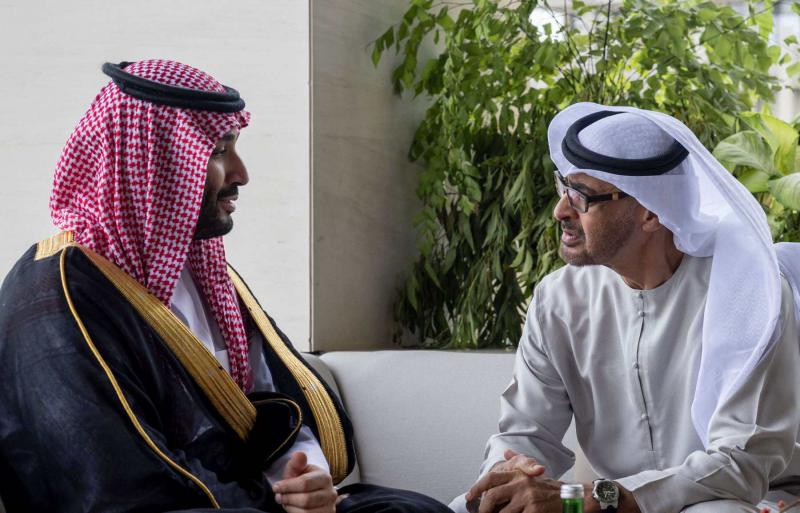
Image Caption: UAE’s President Sheikh Mohamed bin Zayed al-Nahyan meeting with Saudi Crown Prince Mohammed bin Salman on the sidelines of the G20 summit in the Apurva Kempinski hotel on 15 November 2022. Photo: AFP
About the Author
Damien Tan was a Research Assistant at the Middle East Institute, National University of Singapore, with experience in policy research in government and academia. His research focused on international security and Middle East foreign policy.


More in This Series

- Mohammad Eslami and Zeynab Malakouti
- -
- Alfred Schipke, Michelle Teo, Yu Hong, Fang Guo, and Lin Jing
- -