Iran’s Plastic Propaganda Coup
- Sima Aghazadeh
- -
During the United States-Israel war against Iran, the Islamic Republic waged a robust and highly visible information campaign alongside its kinetic one, relying on a cluster of cheap, fast, and highly shareable digital tools. Iran-linked creators and state‑adjacent channels flooded social platforms with short, AI-generated animations, satirical clips, remixed battle footage, and coordinated embassy posts. These were cheap to produce, easy to circulate, and effective at shaping the online mood.
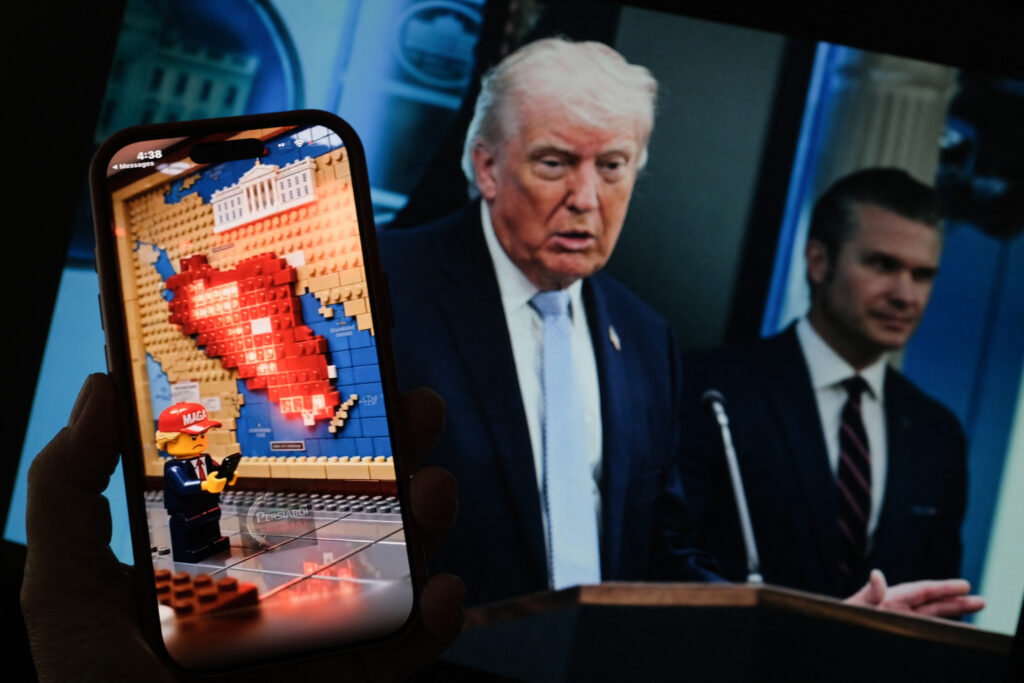
Within this wider “meme war”, one facet was an unqualified success for the attention it gained from around the world: The Lego-styled animations produced by small studios such as Explosive Media. The clips combined recognisably familiar representations of the toy, punchy English slogans, and AI-generated rap to tell tightly-scripted stories of American and Israeli aggression, and Iranian “vengeance for all”. In one widely shared clip, a plastic Donald Trump fidgets in a war room as missiles labelled “For Hiroshima” and “For Flight 655” — a reference to the Iranian airliner shot down by the USS Vincennes in 1988, killing all 290 people on board — roar towards their targets. The soundtrack is an AI-generated diss track, while the visuals echo video games and social media trends. Viewers who might never read a policy brief or even the news could instantly grasp the moral script: Decades of Western violence were finally being repaid.
The work of a small team (fewer than 10 Gen‑Z Iranians), the clips have been widely-circulated, won praise even from Westerners, and have been co-opted by other movements – proof of how cheap and easily-produced visuals can capture global attention and shape how a conflict is perceived in the age of social media.
Besides the Lego clips, Iranian embassies and consulates also turned their official accounts into meme factories, using humour and pop‑culture references to target Western audiences. The Embassy in South Africa, for instance, responded to Mr Trump’s talk of “joint control” of the Strait of Hormuz with a photo of a car dashboard fitted with two steering wheels. Embassies in Zimbabwe and Ghana chimed in with lines like “we lost the keys” and “say hello to the new world superpower”, turning control over a strategic chokepoint into a stream of cheap, tailored jokes that travelled widely across English‑language feeds. Some of the most effective posts barely mentioned Iran at all: One viral example featured a brown dog with a blank stare, captioned “those who were waiting last night for Iranian civilisation to be destroyed”, mocking a threat made by Mr Trump. Another consulate shared an AI‑generated Inside Out‑style video of creatures in the president’s brain slamming a “lie” button. The clip ends with the tagline: “Inside Out: Epstein’s Client.” Another reshared a Tom and Jerry meme to ridicule America’s inability to force open the Strait of Hormuz.
These posts, along with the Lego clips, helped bolster Iran’s asymmetric influence campaign. All shared the same logic: They are inexpensive, relied on simple, off‑the‑shelf AI models and consumer apps, and use humour, nostalgia, and mock outrage, rather than formal persuasion, to make Iran’s case. Their impact lay in volume and resonance. The central lesson is that in the current media environment, the skilled deployment of imaginative, yet cheap, content by a conventionally weaker adversary can go a long way in the battle for hearts and minds. The Lego clips crystallise this dynamic. They show how a relatively resource-constrained state can win the propaganda war by using AI tools and widely-accessible media platforms to punch above its weight, speak fluently to Western audiences, and brush its own record of repression out of view by turning the spotlight on its foe.
Asymmetric Warfare, Rendered in Plastic
For Iran, this is a deliberate information strategy. Militarily, it cannot match American or Israeli power; diplomatically, it is frequently isolated. Using information technologies to produce and target AI‑generated Lego videos at Western audiences is a deliberate effort to fight ideologically and psychologically. The tools that were used make the work fast and inexpensive, creating an affective package using instantly-recognisable visual codes to send a message about revenge, while claiming the moral high ground. Given Iran’s success, it is not hard to imagine other actors, state or non‑state, adopting similar tactics to wage their own information wars.
Cultural Fluency as a Strategic Weapon
The meme campaign also exposes a considerable asymmetry in cultural literacy. The clips and posts are a reminder that whoever understands the other side’s culture has a decisive edge in information warfare. Iranian creators moved fluently inside Western meme vocabularies, while much American engagement with Iran still rests on stereotypes and thin knowledge of how Iranians actually live and think. Beyond Lego, the Iranian producers used rap music, gaming aesthetics, and English witticisms to project an image of Iran that is whip-smart, agile, and technologically savvy — a counter to its worldwide image as a joyless or backward theocracy. Their intended targets are global consumers who live by algorithmic feeds and may have only the faintest knowledge of Iran’s political history. This cultural literacy helps explain why the clips travel so far.
By contrast, much Western depictions of Iran still rely on well-worn, if not inaccurate, tropes: The angry cleric, the dour and monolithic regime, and massed popular anger against the leadership. This reflects a shallow cultural literacy which makes it difficult to grasp the complexity of Iran’s system of government — its overlapping institutions, rival centres of power and informal networks — and to recognise the plurality of the Iranian public sphere. In such a view, the fractures inside that public sphere are almost invisible: The same Lego clips can be read as a source of pride by regime supporters, as bitter irony by disillusioned youth, or as a cynical glossing over of domestic suffering by those who have endured repression. Without that nuance, Western observers remain ill‑equipped to engage seriously with Iranian culture beyond moments of crisis, and in turn misread both the impact of Iran’s meme war and the limits of their own campaigns for “regime change”.
In this sense, Iran’s information campaign illustrates that cultural fluency is not a luxury, but a strategic asset. This cultural and digital fluency works alongside more traditional asymmetric advantages — Iran’s geography, particularly the advantage the Strait of Hormuz affords it, and religious narratives of endurance. Geography, culture, and religion thus become the raw material of accessible, repeatable content: Visualisations of the Strait of Hormuz, pious invocations of sacrifice and endurance, and everyday scenes of resilience that can be endlessly remixed into short clips and memes. In this way, Iranian endurance is framed as both plausible and emotionally compelling, rather than as an abstract slogan.
Editing History, Displacing Culpability
The moral force of the Lego clips comes from their framing of history — a timeline of Western violence, from the use of atomic bombs in World War II to repeated invasions — and weaving it into a single story of a predatory enemy and a perpetually injured Iran. Retaliation is cast as a form of ethical bookkeeping, a way of closing the account on decades of impunity, all while whitewashing the Islamic Republic’s own ledger of violence, from the repression, torture, and murder of its own citizens, to the downing of Ukrainian Flight 752, and acts of terrorism.
That is perhaps the most troubling facet of the social media age. Audiences are invited to look, laugh, and share, but not reflect on who is missing from the frame. Over time, repeated exposure to such selective narratives can normalise a world in which some forms of suffering are vividly imprinted on the public consciousness, while others are quietly forgotten.
Conclusion
Iran’s Lego videos are not an isolated production at the margins of its confrontation with the US. They are the most visible edge of a multi-front information campaign that ran through embassies, consulates and unofficial channels. They are a preview of where information warfare is headed. They show how a country that is militarily inferior — by conventional metric — to the United States can nevertheless weaponise low-cost technologies and algorithmic storytelling to exert asymmetric influence beyond the front lines. Iran has opened an ideological and psychological battlefield where perception itself becomes the terrain of asymmetric warfare.
The lessons for analysts and observers are straightforward. First, seemingly playful formats should no longer be mistaken for politically trivial ones; they are now central vehicles of asymmetric information warfare. Second, the most effective response to such content is not always moral panic or blunt censorship, but a more demanding form of strategic literacy. We need to ask whose suffering is foregrounded, whose is erased, and how selective histories are turned into emotionally satisfying truths. Many viewers probably did not treat the Lego shorts as serious, but still forwarded them widely, and joked about them, reflecting the fact that asymmetric information warfare thrives in the gap between what audiences perceive as entertainment and what, in practice, shapes their political intuition about who is justified and who is to blame. That kind of literacy cannot be improvised in a crisis; it requires cultivating a new generation of technologically-savvy analysts, journalists, and citizens who can move fluently across platforms, recognise how algorithms shape what they see, and read other cultures critically. Third, and perhaps the most important, cultural intelligence matters: Anyone seeking to understand contemporary conflict must learn to read cultural and sub-cultural codes of memes, sounds, and platform aesthetics as carefully as political and military speeches. This is not only an academic concern, but a practical security skill, especially for small states that live by trade, reputation, and information flows. In places where citizens experience distant wars primarily through their phones, the ability to decode how a Lego clip or a trending hashtag frames minds and history is highly important. Cultural literacy, in this sense, is a skill necessary for societies to protect themselves from easily accessible narratives that might arrive, riding on humour, nostalgia, or outrage.
In such a world, the most important security tools may look less like weapons than mindsets: The capacity to pause before sharing, to sense when a story is too neat, and to ask after the lives left off-screen.
Image Caption: This illustration photo created in Los Angeles on 9 April 2026 shows a Lego-style AI-generated war-themed video playing on a smartphone screen in front of a photo of US President Donald Trump and US Secretary of Defence Pete Hegseth.
About the Author
More in This Series

- Mohammad Eslami and Zeynab Malakouti
- -