*The writer was a speaker at MEI’s Annual Conference this year – this article expands on his perspectives.
The war between Israel, the United States, and Iran did not merely add a new crisis to the region’s long list of shocks. It exposed how much the underlying architecture of the Gulf has already shifted in ways that force external powers, China chief among them, to reevaluate their approaches to the region. The Gulf that external actors were operating in could be characterised as a reasonably unified region, held together by shared threat perception and a dependable American security umbrella. This has changed. In China’s case, its approach to the region, built almost entirely around economics rather than security, was never designed to survive a moment like this one, and the war has exposed that gap clearly.
A Region Already Fracturing Before the War
The Gulf Cooperation Council (GCC) was already cracking before the war began. Tensions between Saudi Arabia and the United Arab Emirates, which predate the current crisis, sharpened noticeably last winter.[1] When the war broke out, early optimism that a shared existential threat would pull the six GCC states back into alignment proved short-lived. If anything, the war has sharpened the divergence between Gulf states rather than resolved it.
The clearest evidence is the UAE’s steady drift toward an independent, bilateral foreign policy at the expense of collective GCC action. China has been negotiating a GCC-wide free trade agreement since 2004, and the effort increasingly looks anachronistic, as appetite for genuine multilateral initiatives has largely evaporated, particularly in Abu Dhabi. In its place, the UAE has been signing a growing list of bilateral Comprehensive Economic Partnership Agreements with individual countries.[2] This marks a different orientation towards regional affairs than most of its GCC partners still hold, and the war has made that difference impossible to ignore.
Nothing has crystallised this shift more than the UAE’s decision to leave Opec+ early in the conflict.[3] In the lead-up to the announcement, speculation in Abu Dhabi centered on what big news might be forthcoming — whether the UAE was leaving the Arab League, or the GCC itself. The logic that ultimately prevailed reflects a broader pattern: Leaving the Arab League would change little, since the body delivers limited practical value to the UAE either way; the GCC continues to deliver real value through social, educational, cultural, and economic programmes, though not much politically or diplomatically; and leaving Opec, whatever the cost to other members, was simply advantageous for the Emirates. That logic — evaluating each institution purely on what it delivers, rather than treating regional solidarity as valuable in itself — captures where Gulf foreign policy is heading.
Out of this fragmentation, two loose groupings are emerging, neither especially formalised, both with real internal tensions, but each reflecting a genuinely different theory of regional order. One is an increasingly visible alignment between the UAE, Israel, the United States, and, to a lesser extent, India — activist rather than regionally rooted, more interested in practical exits from cycles of conflict than in traditional pan-Arab or pan-Islamic solidarity. The other is a looser, more traditional bloc of Saudi Arabia, Egypt, Pakistan, and Turkey, still working through older frameworks of Arab and Islamic cooperation. Neither grouping’s coherence or durability should be overstated. But these nascent camps represent two different beliefs about what actually produces stability in the region — one is betting on deepening ties with external guarantors and treating multilateralism as largely symbolic, while the other is still running, however strained, through the existing regional architecture.
For external powers operating in the Gulf, this matters. The region that external actors grew comfortable with over the past 30 years was built on the post-Gulf War arrival of US bases and the security architecture that followed. which offered a relatively unified logic to work with. That logic is no longer available. Navigating the Gulf today increasingly means navigating two divergent regional projects at once, not one coherent bloc.
Why the UAE Is Doubling Down on Washington and Jerusalem — and Why the Rest of the Gulf Isn’t
One of the more counterintuitive dynamics of this war has been the UAE’s continued doubling down on its relationship with the United States and Israel. From outside the region, this looks paradoxical: The war was, after all, imposed on the region by reckless administrations in Jerusalem and Washington. Why deepen ties with the powers whose recklessness triggered the crisis in the first place? The answer has less to do with the Gulf as a whole than with the UAE’s specific position within it. As an Abraham Accords signatory, the UAE has spent the past several years building a security and diplomatic architecture that assumes deepening integration with Washington and Jerusalem. The war has reinforced that architecture, rather than called it into question, because the alternative of distancing the Emirates from the US-Israeli relationship at the moment it is most tested would undercut the entire logic of normalisation Abu Dhabi has invested in since 2020.
The deeper and more visceral frustration in the UAE is directed towards Iran, not the United States or Israel. The UAE spent the better part of seven years deliberately trying to lower the temperature with Tehran, investing real diplomatic effort into recalibrating that relationship. When Iran nonetheless struck quickly and aggressively once the war began, the attacks were read locally less as retaliation against the war’s instigators, and more as confirmation that Iran remained willing to escalate against neighbours actively trying to de-escalate with it. That reinforced, rather than undermined, the logic of leaning further into the security relationships that actually deliver protection. For the UAE, those relationships run through Washington and Jerusalem.
That does not apply to the Gulf as a whole. Saudi Arabia, Qatar, Kuwait, Oman, and Bahrain continue to maintain robust relationships with Washington. Defence cooperation, basing arrangements, and arms purchases have not meaningfully lapsed, but these relationships have not deepened in the same direction, or with the same enthusiasm, as the UAE’s. They coexist with serious political tensions, open frustration with decisions made in Washington during the war, and, in private if not always in public, real questions about the judgment of the Trump administration as a security partner.[4] These states are not distancing themselves from the United States; they still depend on the American security relationship, and have no near-term alternative to it. But their posture is one of continued, wary reliance, rather than the deliberate deepening of integration the UAE has pursued. The war has sharpened this distinction rather than erased it: It has not produced a unified Gulf response to Washington, but rather two different relationships to it — one increasingly bound up in the logic of normalisation with Israel, the other more transactional and considerably more guarded.
This points to a broader principle for external actors: Gulf leaders are keeping a fairly explicit ledger of who helped and who did not during this crisis, whatever the private frustrations of their own publics. South Korea’s provision of air defence support, Ukrainian drone assistance, France’s deployment of fighter jets to help intercept Iranian missiles, and the US-Israeli security role are the kind of contributions that shift elite-level perceptions in ways likely to outlast the war itself. Countries that tried to stay neutral — cultivating relationships with both Iran and the GCC without picking a clear side — will emerge considerably weaker. This has direct implications for China.
China’s Model Wasn’t Built for This
A narrative began circulating in American think-tanks almost as soon as the war began — that the conflict was, at bottom, about containing China’s growing footprint in the Middle East.[5] Taken together with the January 2026 US kidnapping of Venezuelan President Maduro, an idea was circulating that Washington was weakening Beijing by targeting its partners. That framing is unpersuasive. China’s most meaningful relationships in the Gulf are with the GCC. China’s relationship with Iran receives outsized attention, but in material terms — investment, trade, contracting, and especially expatriate population — China’s stake in the Gulf Arab states dwarfs its stake in Iran. The UAE alone, a country of roughly 10 million people, hosts an estimated 370,000 Chinese nationals, the largest Chinese population anywhere in the Middle East.[6] By contrast, when China evacuated its citizens from Iran during last year’s 12-Day War, the number involved was just over 3,000 people.[7] China’s actual, on-the-ground interests in the Gulf are overwhelmingly concentrated among US allies and partners on the Arab side, not Iran — which makes the “containing China” narrative considerably less convincing.
Given this, the war was bad for China’s interests, not an opportunity for it. It disrupted the low-cost, low-risk model China has relied on for two decades: Entering the Gulf economically without needing to build the kind of military or naval presence required to protect its own citizens and assets directly, effectively free-riding on the security guarantees — real or merely assumed — that the United States provided.[8] That framework depended on the region being predictable. It no longer is, and the implication extends beyond China to any external actor whose Gulf strategy assumed an underlying American security umbrella.
China’s actual response to the war has satisfied almost no one. It offered material support to Iran, including industrial goods that helped keep Iranian factories running, alongside diplomatic engagement, while trying simultaneously to maintain warm relations with Gulf Arab states. Diplomatic outreach on its own is generally viewed favourably in the region, since it keeps channels of communication open. But material support to Iran is something else, especially when China is relying on Gulf Arab states to keep hundreds of thousands of its own citizens safe. Being simultaneously a guest asking for protection and a supplier providing assistance to the other side — even indirectly, through information that could aid Iranian targeting[9] — is a difficult position to sustain.
China’s approach to the Middle East has been fundamentally economics-first, which is well suited to periods of stability, where money and energy flow can substitute for a costly security commitment. But it is poorly suited to genuine turbulence. That is less a failure than a reflection of priorities: The Middle East is not where China’s core strategic attention lies; that is reserved for the South China Sea, South-east Asia, North Korea, and the broader relationships with Russia and the United States. The Gulf, by comparison, is where China goes to make money and secure energy — both of which could be sourced elsewhere, even if less conveniently.
This leads to the most important structural point: China’s current dependence on the Gulf for 40 to 50 per cent of its energy imports is a historical anomaly. Traditionally, China pursued a more genuinely diversified energy strategy. The convenience of the current arrangement was real: When Iranian sanctions cut into Chinese oil imports, Saudi Arabia could simply increase output to cover the shortfall, with no diplomatic complications required. But if the Gulf stops being the easy, stable option, China should be expected to recalibrate toward diversification again rather than double down on a region that now carries meaningfully higher risk.
What This Means Going Forward
Taken together, these two arguments point to a Gulf entering genuinely uncharted territory — not because any single external power’s strategy has triumphed or failed, but because the underlying architecture that made the region predictable and low-risk for outsiders is eroding. GCC cohesion, long assumed as a baseline by external actors, can no longer be taken for granted; the region now contains at least two distinct and diverging visions of regional order, and outside powers need to reckon with both, rather than treating the Gulf as a single bloc. At the same time, Gulf states are drawing sharper distinctions than ever between the partners who showed up during the crisis and those who tried to stay above the fray, and that ledger will shape relationships for years to come.
China is the clearest test case of what happens when an external actor’s model is not built for this kind of moment. Its entire approach to the Gulf was constructed for a version of the region that assumed the United States would remain a reliable security provider, leaving China free to focus on trade, investment, and energy. That assumption no longer holds. Donald Trump’s decision to go to war has destabilised the region. As a result, the gap between China’s stated interests and its actual capacity to protect them has proven impossible to paper over. How China, and every other external actor accustomed to the old Gulf, adjusts to that fact may be the real story of what comes next.
End Notes
[1] Vivian Nereim, “How a Call from Trump Ignited a Bitter Feud between Two U.S. Allies,” The New York Times, February 28, 2026, https://www.nytimes.com/2026/02/27/world/middleeast/saudi-arabia-united-arab-emirates-feud-trump-call.html
[2] United Arab Emirates Ministry of Economy and Tourism, “Comprehensive Economic Partnership Agreements,” https://www.moet.gov.ae/en/cepa
[3] Summer Said, Jared Malsin and Dov Lieber, “The U.A.E.’s OPEC Bombshell Signals a New Middle East Order,” The Wall Street Journal,April 30, 2026, https://www.wsj.com/world/middle-east/u-a-e-opec-new-middle-east-32ceda56?mod=Searchresults&pos=3&page=1
[4] Edward Wong, “How the Iran War Ignited a Clash between Trump and the Saudi Crown Prince,” The New York Times, July 1, 2026, https://www.nytimes.com/2026/07/01/us/politics/trump-saudi-crown-prince-iran.html?searchResultPosition=1 ; Shelby Holliday, Summer Said, and Robbie Gramer, “Opening Hormuz Drives a Wedge into U.S.-Saudi Relations,” The Wall Street Journal, July 1, 2026, https://www.wsj.com/world/middle-east/saudi-arabia-us-relationship-iran-war-ca0f31a0?mod=Searchresults&pos=1&page=1
[5] Zineb Riboua, “The Iran Strike Is All about China,” The Hudson Institute, March 1, 2026, https://www.hudson.org/national-security-defense/iran-strike-all-about-china-zineb-riboua
[6] “World Chinese Entrepreneurs Convention to Make Mideast Debut in UAE in 2027,” Xinhua, November 12, 2025, https://english.news.cn/20251112/9b9a30faee454d76a1ffbdd2c88e5831/c.html
[7] Ministry of Foreign Affairs of the People’s Republic of China, “Foreign Ministry Spokesperson Guo Jiakun’s Regular Press Conference on June 23, 2025,” https://www.fmprc.gov.cn/eng/xw/fyrbt/202506/t20250623_11655211.html
[8] Jonathan Fulton, “China in the Persian Gulf: Hedging under the US Umbrella,” in Routledge Handbook of Persian Gulf Politics, ed. Mehran Kamrava (Abingdon: Routledge, 2020), 492–505.
[9] Miles Johnson, Peter Andringa, Alison Killing, Charls Clover, and Dmitri Sevastopulo, “Iran Used Chinese Spy Satellite to Target US Bases,” Financial Times, April 15, 2026, https://www.ft.com/content/1fddd2cd-1294-4e9c-a17d-5ea06b399355
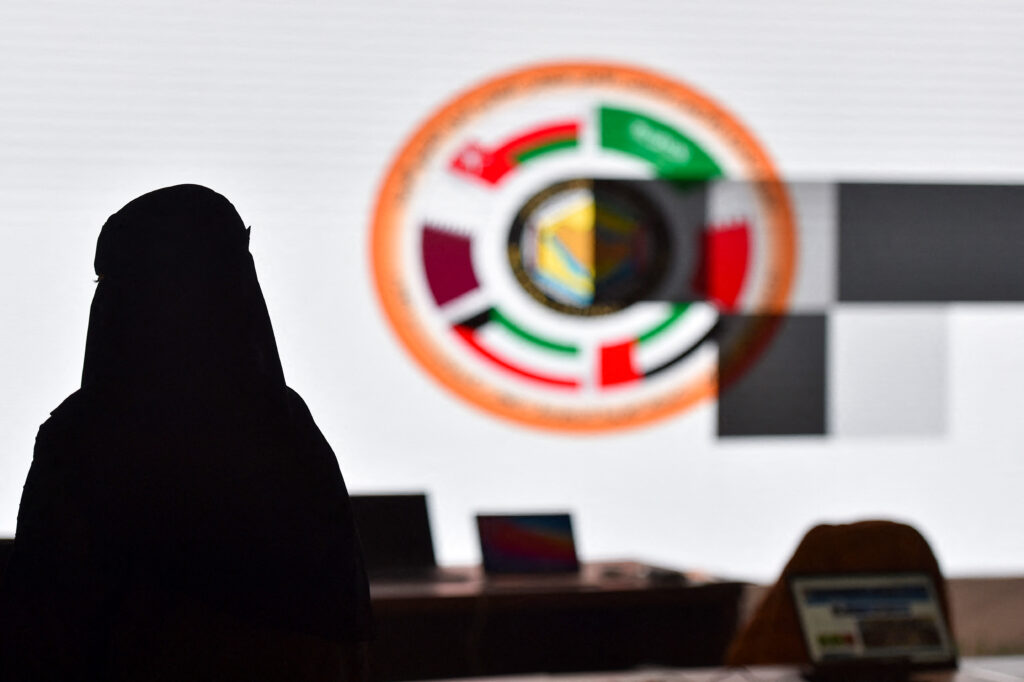
Image Caption: A Saudi journalist is pictured in front of the logo of the Gulf Cooperation Council (GCC) at the media centre ahead of the 41st summit in the city of al-Ula in northwestern Saudi Arabia on 5 January 2021. Photo: AFP
About the Author
Jonathan Fulton is Associate Professor at Zayed University in the United Arab Emirates