*The writer was a speaker at MEI’s Annual Conference this year – this article expands on her perspectives.
The Middle East is entering a new phase. The war on Iran showed that the old regional security order is no longer enough. Today’s threats are interconnected: Nuclear risks, missiles, drones, militias, maritime security, energy markets, and violations of state sovereignty.
From an Emirati perspective, the key question is not only how to end this war, but how to prevent another one. The region needs a more stable and disciplined security architecture. The preliminary agreement between Tehran and Washington is an important step. It may help de-escalate tensions, protect navigation, and prevent a wider conflict. But it is not enough if it focuses only on the nuclear file. Any sustainable agreement must also address missiles, drones, proxy militias, threats to maritime routes, cyber risks, and interference in the affairs of states.
For the United Arab Emirates, sovereignty must be the foundation of the next regional order. No state can feel secure if its ports, airports, energy facilities, ships, or civilian infrastructure are exposed to attack or used as tools of pressure. Respect for sovereignty is not only a legal principle; it is essential for preventing wars.
The UAE also believes that deterrence and diplomacy must work together. Deterrence is needed to protect states, but it cannot alone create stability. Diplomacy is necessary to reduce escalation, but it must be supported by clear rules and credible strength.
The future Middle East should be governed by basic rules: no attacks on civilians, no targeting of infrastructure, no disruption of navigation, no use of militias as tools of pressure, and no use of negotiations for blackmail. Gulf security is also global security. The Strait of Hormuz is not just a regional waterway; it is a global artery for energy and trade. Protecting freedom of navigation is therefore an international priority, not only a Gulf concern.
Iran must be addressed as a comprehensive strategic file. The challenge is not only its nuclear programme, but also missiles, drones, proxies, maritime pressure, cyber activity, and threats to energy security. Dialogue with Iran is necessary, but it must be linked to sovereignty, non-interference, and regional stability. At the same time, the Palestinian question remains central. A new Middle East cannot be built on security and economic arrangements while ignoring the need for a just political solution and a two-state framework.
Finally, power in the region is changing. It is no longer measured only by armies and weapons, but by resilient economies, secure infrastructure, technology, trade corridors, and the ability to create stability. The UAE’s vision is clear: No stability without sovereignty, no sovereignty without deterrence, no deterrence without diplomacy, and no diplomacy without rules.
The goal is not to return to the old order, but to build a new regional architecture based on sovereignty, discipline, connectivity, development, and a Middle East better able to manage competition without falling into war.
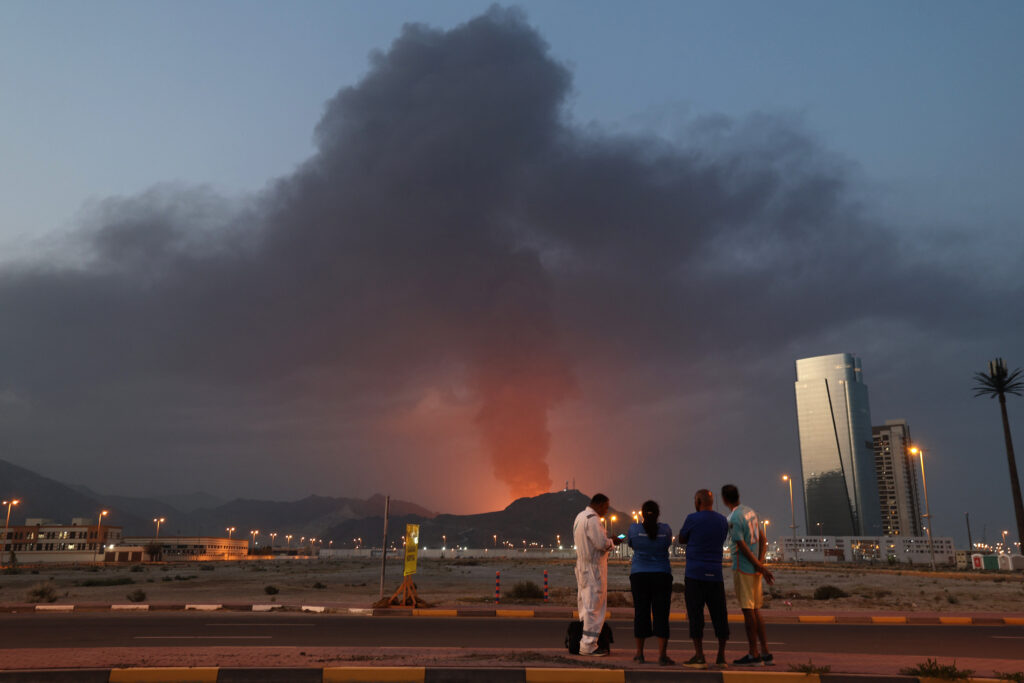
Image Caption: A tall plume of black smoke ascends following an explosion in the Fujairah industrial zone on 3 March 2026. Iran’s strikes on Gulf neighbours since 28 February, following the US-Israeli attack, forced the UAE to shut its airspace, blindsiding travellers who thought they were headed to one of the region’s safest holiday destinations. Photo: AFP