As the build-up towards Israel’s 2026 elections grows, one group remains underestimated in its potential parliamentary weight, and ability to impact the final results. This is likely to continue until the bitter end, when votes are counted and the leading party is invited by the president to form a coalition to govern the country. This group, which throughout Israeli history has consistently been undervalued and discounted, comprises the Palestinian citizens of Israel.
Despite making up around 20 per cent of Israel’s electorate, Israeli Arabs are overlooked and marginalised not only by the country’s Jewish majority, but also by the wider Arab world.[1] Palestinian citizens of Israel, also called Israeli Arabs, Israel’s Arab citizens, or Palestinian-Israelis, became a defined group in the aftermath the 1948 war. When the dust settled and with armistice lines drawn, some 156,000 Arab Palestinians remained within Israel, and received citizenship as well as voting rights, participating in the first parliamentary elections held in 1949.[2] To quell concerns about this potential fifth column, who had so recently fought against the state in the war of its creation, Arab villages and cities were placed under strict martial law, and closely monitored by the Israeli security apparatus, severely limiting their freedoms of movement, speech, and press. The Palestinian citizens of Israel also faced electoral restrictions: Arab political parties were required to run under the umbrella of a Jewish party, functionally creating a proxy system when it came to minority participation in the fledgling state’s parliamentary politics.
In the almost 80 years since, much has changed. Martial law over these citizens was slowly diluted, and formally cancelled in 1966. Today, Palestinian citizens of Israel benefit from the country’s welfare, education, and health systems, its geographically exceptional freedoms of speech and press, and its regionally anomalous parliamentary participation. Yet, they are still largely seen as a potential threat to Israel’s security, and are begrudgingly included in the country’s politics. One major way this suspicion is expressed is discounting their electoral weight, and their ability to impact real political shifts, as well as leveraging threats to exclude them to win political points. In early May, a far-right minister in the Israeli government, Bezalel Smotrich, went as far as to say that forming a coalition with the Arab parties is “worse than October 7”.[3]
The upcoming Israeli elections will undeniably be historic. This will be the first time Israelis head to the polls after the Hamas attacks of 7 October, 2023, following two years of war in Gaza, and two bouts of fighting with Iran. Israeli society is increasingly fragmented, with infighting over military conscription, as well as Prime Minister Benjamin Netanyahu’s corruption trail. Over the last decade, election campaigns have been presented as binary both within and outside of Israel, aligning parties and voters within two distinct blocs: Either with or against Mr Netanyahu. This paradigm of division is largely maintained in the press and in public opinion polls ahead of the election, as various parties and leaders vie for a chance to dethrone the Prime Minister.[4]
Could the Bibi-Binary be Over?
Yet, presenting this election as a “Bibi-binary” misses one of the changes ongoing within Israel. Since 2025, a significant uptick in political engagement by Israel’s Palestinian citizens has occurred. This group’s potential 18 per cent of national voters,[5] and, accordingly, its proportionate number of seats in the Knesset, could offer Israelis of all religions, races, and creeds an alternative to the iron grip Mr Netanyahu has held on the country’s politics. They could help form an alternative bloc with which to form a governing coalition, displacing the Ultra-Orthodox parties, which oppose universal conscription to the military (a deal-breaker for most Israelis), or the far-right, which is bent on annexing the West Bank and resettling the Gaza Strip. Considering that Israel’s youngest voters do not remember a time without Mr Netanyahu as a contender for prime minister, the opportunity presented by the Palestinian Israelis as partners in opening a new chapter of Israeli political history should not be overlooked by the opposition. However, it still is.
Many pundits and political analysts (as well as Israeli politicians themselves) continue to underestimate the potential political power of the Palestinian citizens of Israel, pointing to their past pledges to remain in the opposition, not to collaborate with Zionist parties, and decreasing voter participation rates. The most serious contenders to unseat Mr Netanyahu at the moment, a new combined list led by former Prime Ministers Naftali Bennett and Yair Lapid, have already pledged not to partner with Arab parties. “The Arab parties are not Zionist, and therefore we will not rely on them,” said Mr Bennett, even though the first polls since the announcement of the Bennett-Lapid conglomeration still show them falling short of defeating Mr Netanyahu if they do not join forces with the Arab parties to bolster their Knesset seat count.[6]
But Israel’s opposition could instead look to bolster the Arab vote towards swinging Israel’s election results, ending Mr Netanyahu’s tenure, and ensuring that the far-right government that drove Israel’s Gaza war to drastic proportions becomes but a page in the history books. In fact, since Mr Bennett made exactly this move during his previous tenure as prime minister — when he partnered with Mansur Abbas and his United Arab List in 2021 — such a project would not have to start from scratch. Without the Arab vote, it appears electorally impossible to dethrone Mr Netanyahu; each of the opposition leaders know this. However, they continue to grandstand their refusal to engage with the Arab parties. One reason for this is the general, underlying distrust of Palestinian Israelis over concern about where their loyalties truly lie. This is clearly expressed in recent polling by the Israel Democracy Institute, which found that over 70 per cent of Jewish Israelis oppose the inclusion of Arab parties in the government.[7] It must be noted, however, that running an election campaign on refusing to sit with another party in government does not mean that the very same party will at the end of the day invite them into the government — as happens regularly in Israeli politics.
Indeed, three critical shifts signalling growing involvement by Israel’s Palestinian citizens over the last few months could bode well for the anti-Netanyahu camp — if properly harnessed. The first change within Israel’s Palestinian population took place in early January, when the United Arab List Party (also called Ra’am, the acronym for that party’s name in Hebrew) announced it would open its slate to include Jewish candidates.[8]Considering that Ra’am represents the Islamic movement[9] in the Jewish state, this is far from a trivial statement.
Second, in late January, the leaders of Israel’s four national-level Arab political parties, Ra’am, Hadash (the communist Democratic Front for Peace and Equality), Ta’al (the Arab Movement for Renewal, a moderate, Arab nationalist party), and Balad (the National Democratic Alliance, a less moderate, pan-Arab and Palestinian nationalist party) signed an early-stage agreement to run together on a joint list in October.[10]Polls showed that a huge majority — 82 per cent — of Arab voters supported this move, which would ensure that none of the Palestinian parties falls below the threshold of votes required to enter the Knesset, thereby bolstering overall Arab representation in parliament, representation which could strengthen the opposition.[11]Such widespread support for a joint list may also foreshadow high turnout by Arabs on election day, a rate that regularly surpassed that of Jewish Israelis, and once hit almost 80 per cent.
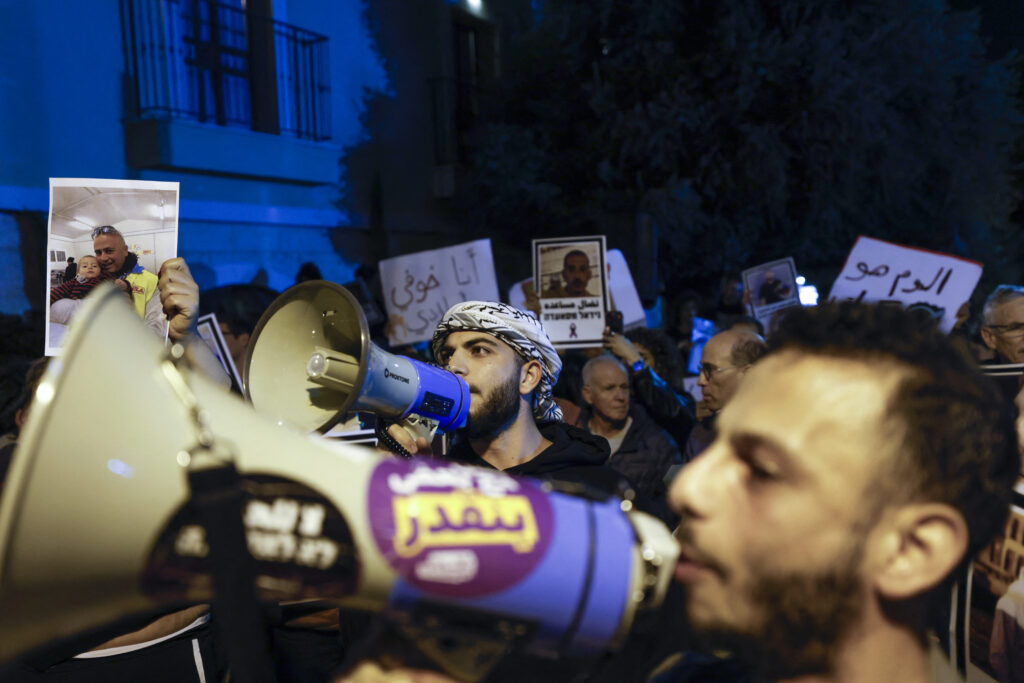
Third, over the last few months, Israel’s Palestinian community has turned out en masse for protests in Tel Aviv. The demonstrations centre on spiking homicide rates within Arab society, which since the beginning of this year have claimed the lives of nearly 100 citizens of Israel.[12] The protests have built upon the foundations of what has become a modern Israeli tradition of protesting on Saturday nights — a weekly ritual which began in opposition to proposed judicial reforms in 2023 aimed at limiting the Supreme Court’s powers, among others, before evolving into calls demanding a hostage deal after 7 Oct, and later against the Gaza war more generally.
Could these three aspects be an indicator of real change?
The reality is that, for the most part, mainstream Jewish Israelis still look at the Palestinian citizens of Israel with wariness, a factor which has largely left the Arab parties outside the sphere of influence in the government.[13] Still, when one looks into Israeli history, even outside of the governing coalitions, the Arab minority has in fact succeeded in helping shape Israeli political history in several ways — both from within the governing coalition and from outside of it, leveraging the power of their small but substantial electoral weight — and will almost definitely do so again in one direction or another. It is up to the opposition to decide whether the Arab parties and their voters will tip the scales to their benefit, or whether their exclusion will perpetuate Israel’s current far-right, ultra-Orthodox domination.
Looking Back to Look Forward
When considering the Israeli Arabs’ past parliamentary impact, three election outcomes show the potential influence Israeli Palestinians could have: 1977, 1992, and 2021.
In the 2021 elections, the impact of one Arab party was abundantly clear. In a polling cycle similarly defined by the pro-Netanyahu/anti-Netanyahu binary, Ra’am saved the day for the Israeli opposition, becoming the first Arab party to ever join a governing coalition. The move, spearheaded by the then and current Ra’am chairman, Mansour Abbas, allowed the anti-Netanyahu bloc, led by Mr Bennett (Yamina Party) and Mr Lapid (Yesh Atid Party), to take the reins. This was the only time the prime ministerial position had been held by anyone other than Mr Netanyahu since 2009.
By looking only at the 2021 election, it is clear that the small number of seats held by Israel’s Palestinian parties can make or break an election, a governing coalition, and a prime minister. Ra’am’s offering at the time of just four seats gave the opposition, composed of unlikely parties ranging from the right, centre, and left, their chance to unseat Mr Netanyahu, even if that government lasted only until June 2022.
Naysayers may point — correctly — to the fact that Ra’am is unique in its willingness to join an Israeli government. But according to the same poll conducted by the Israel Democracy Institute, 77 per cent of Arab Israelis support joining a governing coalition.[14] And yet, Balad, for example, has consistently asserted that it will not partake in a Zionist coalition, opting to remain in the opposition as a firm, ideological red line.
One can turn to the 1992 elections for a counterfactual, however. Within scholarly discourse, the 1992 polls are considered a “critical election” based on the results, which shifted the locus of power from right to left on a national scale.[15] In 1992, the Arab parties played a critical role in this shift, this time from outside the government.
In order to compose his coalition then, Yitzhak Rabin of the Labor Party wove together an eclectic group of parties ranging from the left to the Ultra-Orthodox Shas Party. In order to impede the Likud Party from stepping up to form a government, the Arab parties created an obstructive bloc from outside of the coalition, vowing to oppose the right-wing parties from establishing the coalition government. The two Arab parties’ collective five seats made it impossible for the right to take control, thus clearing the way for Rabin. (At the time, there were only two Arab parties, Hadash and the Arab Democratic Party.) This example shows exactly how powerful the Arab parties can be, even if excluded from forming the government. The 2026 elections could indeed follow a parallel path. Should the Palestinian parties choose to remain outside of the coalition, or should the election winners choose to exclude them, the Arab parties could still have a substantial impact on the outcome.
The long-term impact of the 1992 election results was historically significant. Rabin’s government proceeded to sign the Oslo Accords the following year, the first agreement between Israel and the Palestine Liberation Organization. Another first for Israeli history, although tragic, was Rabin’s assassination two years later by a member of the religious right who opposed the deal with the Palestinians.
Finally, to assess and identify the implications of the protests ongoing within Palestinian society in Israel, the best case study to consider is the 1977 elections. The results from that parliamentary contest are most commonly associated with what was lauded as “a revolution”, or “an upheaval”: It was the first time in Israeli history that the right ousted the left.
In most of the research and analysis of the 1977 election results, the right-wing victory, led by then-Prime Minister Menachem Begin, was attributed to discontent among Mizrahi Jews — Jews from Arab and Muslim countries who faced discrimination by the leftist, European, bourgeoisie ever since the founding of the state. The left’s dysfunction came to the fore amid the 1973 Yom Kippur War, and while leaders from this bloc were ensnared in corruption scandals, voters looked for an alternative and found Begin, coming out in droves to vote for him and his party, successfully shifting the locus of power.
The consequences of the 1977 election results are just as historic as those from 1992. Begin’s tenure brought with it a visit to Jerusalem and the Knesset by then-Egyptian President Anwar Sadat, followed by the peace deal with that country in 1979. Sadat’s 1981 assassination by a member of Egypt’s religious right, which opposed the peace deal, followed closely behind.
However, what this recitation of history is missing is the role the Palestinian citizens of Israel played in the election results. It is true that “the revolution” in Mizrahi Jewish Israeli society was the primary factor which drove the election results; yet “an upheaval” also occurred concomitantly within Arab Israeli society, which also affected the election results.
The 1977 elections were held in May. Less than a year prior, on March 30, 1976, one of Palestinian Israelis’ most salient historical days took place: Land Day. Responding to government expropriation of land in Israel’s north from its Arab citizens to clear the way for new towns and cities (which would be populated by Jewish Israelis), Arab leaders called for protests and a general strike. When Israeli security forces looked to subdue the protests blocking main traffic arteries, the clashes turned violent, and police killed six Palestinian citizens, wounding more than 100 civilians as well.
Just over a year later, when Israelis went to the polls, the outcome of Land Day was decisive. First, disenchantment with the Labor government led the Arab participation rate in the election to drop to 74 per cent — the first time in Israeli history it fell below the Jewish participation rate, which was just shy of 80 per cent.[16] Second, in prior elections, many Palestinian citizens of Israel voted for the left’s proxy parties, which were established at the founding of the state — meaning that they essentially voted for the ruling Labor Party, even if indirectly. This trend shifted following Land Day, and instead, Arab Israelis cast their vote for Arab parties, such as Hadash and the United Arab List, which were independent and unaffiliated with the left. These two parties together garnered six seats in the Knesset, half of which had, in the previous elections, gone to and buoyed the electoral weight of the Labor Party.[17]
Indeed, the 1977 elections show that protest is one major form of political participation among the Palestinian citizens of Israel. This must be kept in mind when considering the current trajectory of Israeli politics. The question at hand is not whether this will affect election outcomes, but rather how successful the Palestinian Israeli political parties and their leaders will be in harnessing political participation from the streets and translating it in the voting booth.
Why These Elections Could be Different When it Comes to Arab Israelis
One more critical shift must be considered when looking to the political history of the Israeli Arabs and analysing their potential impact today. The last three years have been brutal for all Israelis. Israel’s Palestinian as well as Jewish citizens have weathered war with Iran (with Palestinian Israelis disproportionately left exposed, lacking proper shelter and coverage by the Iron Dome system), members of their communities were taken hostage by Hamas and killed on 7 Oct (even if they garnered far less media attention), the rising cost of living affects Israelis of all stripes, and unrelenting frustration with Mr Netanyahu and his far-right allies is not limited to one group or another. Using this lens, there is much that could unite Israel’s Arab and Jewish citizens.
The protests ongoing at the moment are a perfect example of this. In the past, Arab citizens’ discontent was around land rights — a zero-sum issue. So often in Israeli history, Arab citizens’ disgruntlement was centred around issues such as land allocation and expropriation, which threatened Jewish Israelis and stood in contradiction to the Zionist idea. These tensions highlighted issues that pitted Jewish citizens against Arab citizens.
Today’s Palestinian protesters do not stand in opposition to Jewish Israeli society. Quite the opposite. Jewish Israelis are also horrified by the rising rates of violence, even if they disproportionately affect Palestinian communities. This is an issue that is not controversial for mainstream Jewish society, whereas land allocation was. The brutal reality of homicide rates, which on Independence Day also took the life of a young Jewish Israeli,[18] can be a consensus issue, one of zero tolerance from all sub-groups of society. Whereas with Land Day, when the allocation of Israel’s limited land was a hot-button issue dividing Arabs and Jews, this time, both sides can make common cause.
The reality is that according to polls, the Israeli opposition will not be able to unseat Mr Netanyahu alone. Even if Mr Bennett and Mr Lapid pledge not to partner with non-Zionists, at the end of the day, they are likely to find themselves between a rock and a hard place: Between accepting an unending Netanyahu-led hegemony, and partnering with a population that, while historically polarising, is today increasingly in agreement with much of Jewish Israeli society — one that could tip it over the edge.
Image Caption: Arab-Israeli protesters hold portraits and chant slogans during a demonstration in Haifa city on 10 February 2026, to protest what they said was the police’s inaction on curbing soaring violent crime in Arab-Israeli communities. Photo: AFP
About the Author
Dr Molly Bernstein is the opinion editor at Haaretz English Edition and an adjunct researcher at Tel Aviv University. She holds a PhD in History from Tel Aviv University, focusing on the intersection between media and narrative in the Middle East. Her other research interests include intellectual history and cultural history, specifically focusing on literature as political protest.
End Notes
[1] Molly Bernstein, “Poetry, Protest, and Parliamentary Politics: Egypt Press Responses to Milestones in the History of the Arab-Palestinian Citizens of Israel, 1949-2000,” PhD Diss, Tel Aviv University, 2024.
[2] Hillel Cohen, Good Arabs: The Israeli Security Agencies and the Israeli Arabs, 1948-1967 (Berkley: University of California Press, 2011), 1.
[3] https://www.haaretz.com/israel-news/israel-politics/2026-05-05/ty-article/.premium/far-right-minister-says-forming-govt-with-arab-party-more-grave-than-oct-7/0000019d-f6dc-df01-a3dd-f7fd7d4a0000
[4] https://www.nytimes.com/2026/02/04/magazine/yair-golan-israel-palestine-gaza-war.html; https://www.haaretz.com/opinion/2026-02-16/ty-article-opinion/.premium/a-bennett-led-party-wont-end-the-occupation-but-at-least-it-could-end-bibi-ism/0000019c-629c-d618-a19d-73ff3a270000
[5] https://dayan.org/content/comments-electoral-strength-joint-arab-list
[6] https://www.haaretz.com/israel-news/israel-politics/2026-04-28/ty-article/.premium/first-polls-after-lapid-bennett-merger-show-no-majority-for-anti-netanyahu-bloc/0000019d-d02e-d942-a5bf-f76e475b0000
[7] https://en.idi.org.il/publications/62338
[8] https://www.timesofisrael.com/abbas-says-raam-party-will-be-open-to-jewish-candidates-in-major-shift/
[9] There are two branches of the Islamic Movement in Israel, called the Northern and the Southern. Ra’am represents the southern branch, which is far less radical. The northern branch does not participate in national elections.
[10] https://israelpolicyforum.org/2026/01/26/the-return-of-the-joint-list/
[11] https://www.jpost.com/israel-news/politics-and-diplomacy/article-885823
[12] https://www.haaretz.com/israel-news/israel-politics/2026-04-21/ty-article/four-killed-in-arab-communities-as-israels-2026-homicide-toll-nears-100/0000019d-b08d-dc1b-a5bf-f9ad4ab20000
[13] https://www.haaretz.com/opinion/editorial/2026-04-27/ty-article-opinion/israeli-opposition-must-remember-there-is-no-democracy-without-arabs/0000019d-d077-d0b7-abdf-f6779bee0000
[14] https://en.idi.org.il/publications/62338
[15] Sammy Smooha and Don Peretz, “Israel’s 1992 Knesset Elections: Are They Critical?” Middle East Journal 27, no. 3 (Summer 1993): 456.
[16] Landau, The Arab Minority in Israel, 138; Tamar Karin Schafferman, “Participation, Abstention and Boycott: Trends in Arab Voter Turnout in Israeli Elections,” (The Israel Democracy Institute, April 21, 2009) https://en.idi.org.il/articles/7116
[17] Yechiel Harari “HaBhirot BaMigzar HaAravi 1977: Kneset, Histadrut,” Mekorot Araviim VeAfro-Asianim, (Givat Haviva: HaMerkaz LeLimudim Araviim, 1978).
[18] https://www.haaretz.com/israel-news/haaretz-today/2026-04-26/ty-article/.highlight/israeli-arabs-warned-about-violent-crime-then-came-the-independence-day-murder/0000019d-c9b5-d1f9-addd-edb776ce0000