Strategic observers are now beginning to recognise that something unprecedented is unfolding in the Strait of Hormuz — one that is fundamentally different from anything that has come before in the long history of United States-Iran confrontations.
Iran and the US — and, in a broader sense, Iran and America’s Western allies — have long grown accustomed to building a sustainable “co-existence” in the face of repeated crises. They have learned to endure, to absorb pressure, and to wait, all while simultaneously probing for diplomatic openings and waging asymmetric battles. But this time, the familiar rhythm of passivity and patience may no longer apply: The crisis possesses characteristics that render the old logic obsolete.
What distinguishes it from previous confrontations is a simple yet profound concept, which is deeply rooted in geography, the multiplicity of stakeholders, and the intricate interconnections between the security and economic dimensions of the Strait of Hormuz: The “crisis tolerance threshold.”
To understand this, we must first review the crises of previous decades, define the “crisis tolerance threshold”, and then re-examine the current standoff over the Strait of Hormuz through the lens of these two preceding analyses.
Coexistence with Crisis: The Pattern of Iran-West Relations
Over the past century, the dynamic between the West and Iran has been defined by “co-existence with crisis” — prolonged adversarial relations, spanning decades, with little effort to resolve underlying disputes.
During the Second World War, British forces invaded southern Iran from their bases in Iraq, while Soviet forces entered the country from the north. Despite Iran’s declared neutrality, the two Allied powers occupied the country and effectively divided it into zones of influence for much of the remainder of the war. Britain’s 1951 “boycott” of Iranian oil, orchestrated in opposition to the-then Prime Minister, Dr Mohammad Mosaddegh, came nearly two decades after the oil crisis with the United Kingdom first erupted in 1933. That crisis culminated in 1953 with a coup orchestrated by the US and Britain that overthrew Mosaddegh’s legitimate government.
The 1979 student takeover of the American embassy, amid fears of another coup, and the ensuing hostage crisis, was the founding trauma of the fraught relationship between the US and the Islamic Republic. It upturned an American effort to reach out to the leaders of the revolution, and has poisoned relations between both sides since the revolution.
Similarly, the revelation of secret Iranian nuclear facilities in 2002, and Tehran’s support for non-state militant actors in the region, remain unresolved to this day. Meanwhile, tensions between Iran and the Arab states of the Persian Gulf, ignited by their backing of Saddam Hussein during the 1980 war, continue to bedevil ties between both sides of the waterway.
Numerous other examples could be added to the list. In response to these crises, Iran’s adversaries have resorted to isolating the country, first through the British embargo, then continued and refined through a Western policy of boycotts, embargoes, and sanctions.
Iran is today among the most sanctioned countries by the US, occasionally accounting for approximately 50 per cent of all such actions. The European Union has largely aligned with American sanctions, making trans-Atlantic isolation a cornerstone of Western strategy towards Iran, even though Europe’s strategy has been one of containment, rather than confrontation. Its neighbours, meanwhile, have sought to keep it arm’s length, careening between outright hostility and feeble attempts at reconciliation.
Through nearly five decades of economic sanctions and three decades of nuclear crisis, one American policy has remained constant: Isolate Iran, bleed its economy, and wait. Iran’s response has been equally consistent: Resist, build resilience, and outlast. Both sides are skilled at prolonging crises. Neither has been skilled at ending them. What has remained unchanged is “coexistence with crisis”.
The “Crisis Tolerance Threshold”
What all these crises share is a set of common features that have rendered “coexistence with crisis” feasible for both Iran and its adversaries. This coexistence was possible because these crises generally involved a limited number of stakeholders, produced relatively contained economic and security repercussions, and did not escalate to the level of an immediate threat to international peace and security.
However, in none of these cases did the situation reach the “crisis tolerance threshold”. Instead, the actors involved have been able to sustain these conflicts for years on end, all while displaying no genuine will to address the underlying disputes and contradictions in a fundamental manner. If we are to offer an implicit definition of the “crisis tolerance threshold”, we can consider the following dimensions:
a) The Number of Stakeholders
Previous crises, in terms of state and non-state actor involvement, were generally not of a nature that would prompt escalation to a full-blown international crisis. The oil disputes between Iran and Britain, spanning nearly two decades, effectively involved no more than those two countries. Iran’s nuclear programme, in reality, posed no threat to any nation, and for over two decades, only the five permanent members of the United Nations Security Council and Israel viewed it as a concern. Even the Iran-Iraq war, in practice, remained confined to Iran and Iraq until its very end, even though outside powers exploited it, and it briefly erupted as an international concern during the “tanker war” as the conflict lurched towards its end.
b) Economic and Security Pervasiveness
Previous crises were predominantly either purely security-related, or purely economic in nature. In the case of the former, they carried no significant economic consequences, as was the case with the nuclear file. If they were economic in nature, they did not escalate into international security crises.
c) Creation of an Imminent International Threat
None of the earlier crises generated an immediate international threat. The Iran-Iraq war lasted eight years, yet for many neighbouring countries, it did not rise beyond the level of media headlines.
The 9/11 attacks, followed by President George W. Bush’s designation of Iran as part of an “axis of evil” in 2002, significantly heightened international tensions and security concerns surrounding Iran. Instead, the Bush administration turned its attention to Iraq, which the United States invaded in 2003. In the years that followed, Iran expanded its regional influence through its support for a network of allied armed groups and proxies. Nevertheless, this was largely treated as a manageable regional challenge, with an uneasy form of coexistence prevailing between Iran and its regional and international adversaries. Until 7 October 2023, this network remained a significant source of Iranian regional influence and deterrence. Since then, however, several of these groups have been substantially weakened, eroding a key pillar of Iran’s regional strategy.
Iran’s nuclear programme likewise never approached the threshold of an immediate security threat, except in the rhetoric of hardliners in the US Congress and Israeli politicians. But while the nuclear programme generated proliferation concerns, Iran had not developed nuclear weapons, and a distinction should be made between political rhetoric and actual military capability. The regional picture was further complicated by Israel’s own (undeclared) possession of nuclear weapons and its status outside the Nuclear Non-Proliferation Treaty (NPT).
A crisis remains within the “tolerance threshold” as long as it involves a limited number of stakeholders, does not simultaneously trigger both security and economic fallout, and does not impose an urgent time constraint on decision-makers. Once any or all of these three indicators escalates beyond a certain point, the crisis crosses the threshold and demands immediate and fundamental resolution.
The Strait of Hormuz: Beyond the Tolerance Threshold
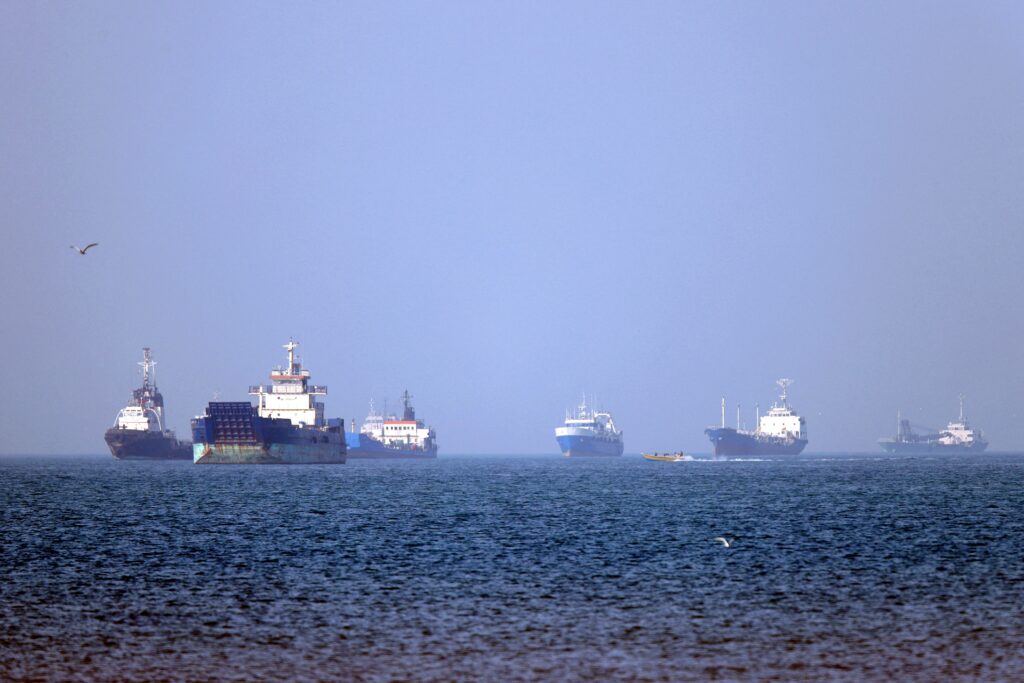
That is the case with the current crisis over the Strait of Hormuz, which involves nearly every major global economy. The closure of the Strait of Hormuz directly impacts China, Japan, India, South Korea, and the European Union, all of whom depend on the free flow of oil and liquefied natural gas through the waterway. The US and its allies are not the only stakeholders — the global economy itself is one. According to the US Energy Information Administration, approximately 20 per cent of globally-traded oil and 25 per cent of LNG passed through the Strait of Hormuz daily before the war. No other chokepoint rivals its strategic significance.
The blockade has already disrupted global energy markets, spiked insurance premiums, and slowed tanker traffic to a crawl. At the same time, the presence of US naval forces, Iranian Revolutionary Guard Corps vessels, and the constant threat of military escalation have transformed the waterway into a battlefield. The economic costs are immediate. The security risks are existential. The two cannot be separated.
Unlike the Iran-Iraq war (1980-88), which remained a regional conflict, or the Iranian nuclear programme, which was a protracted diplomatic issue, a sustained closure of the Strait of Hormuz could trigger a global recession.
Iran’s Position: Leverage
The Strait of Hormuz cannot be isolated. It is a geographic feature, not a political body. The US cannot sanction a waterway. Nor can it close the Strait in order to reopen it. Iran, for its part, cannot simply “resist” a blockade that is strangling its already-dire economy. This time, neither side can coexist with a crisis.
From Tehran’s perspective, the Strait of Hormuz is not a card to be overplayed. As Mohammad Bagher Galibaf, the Speaker of the Iranian Parliament and erstwhile chief negotiator, stated in a televised interview, Iran understands the strait’s strategic importance, and is not seeking to weaponise it recklessly. The goal is not permanent disruption, but a new framework for maritime governance — one that better reflects Iran’s interests as a coastal state. From a legal perspective, the Strait of Hormuz is used for international navigation, yet its waters fall within the territorial seas of Iran and Oman, and are therefore subject to their sovereignty. Under the United Nations Convention on the Law of the Sea (Unclos), the regime of transit passage applies to such straits. The legal position, however, is not entirely straightforward. Iran has not ratified UNCLOS, does not accept that the right of transit passage has acquired the status of customary international law, and has consistently maintained its position as a persistent objector to the convention. Instead, it maintains that the applicable regime is that of innocent passage, which affords coastal states greater control over navigation through their territorial seas.
Iran’s limited ability to benefit fully from its ports and strategic geographical position, particularly in comparison with other Persian Gulf littoral states and in the context of longstanding sanctions, has further fuelled these tensions. Combined with what Iran regards as unlawful US and Israeli attacks in violation of Article 2(4) of the UN Charter, these factors help explain why Tehran is unlikely to relinquish the strategic leverage it derives from the Strait. For Tehran, The strait is an “adjustment screw”, allowing to fine-tune both the pace of negotiations, and the calibration of reciprocal actions.
For direct and indirect players, there is no longer a question of whether they can “coexist” with the crisis. They must resolve it. The challenge is not whether to engage — it is how. A new framework is needed, one that acknowledges Iran’s interests, ensures the free flow of energy, and prevents the crisis from spiraling out of control. For Iran itself, the crisis may remain manageable in the short term. After years of sanctions and economic pressure, the Islamic Republic has developed a considerable capacity for resilience. But this is no longer simply a question of economic survival. What is clear is that remaining in limbo, trapped in a prolonged state of uncertainty, is not a sustainable option for Iran.
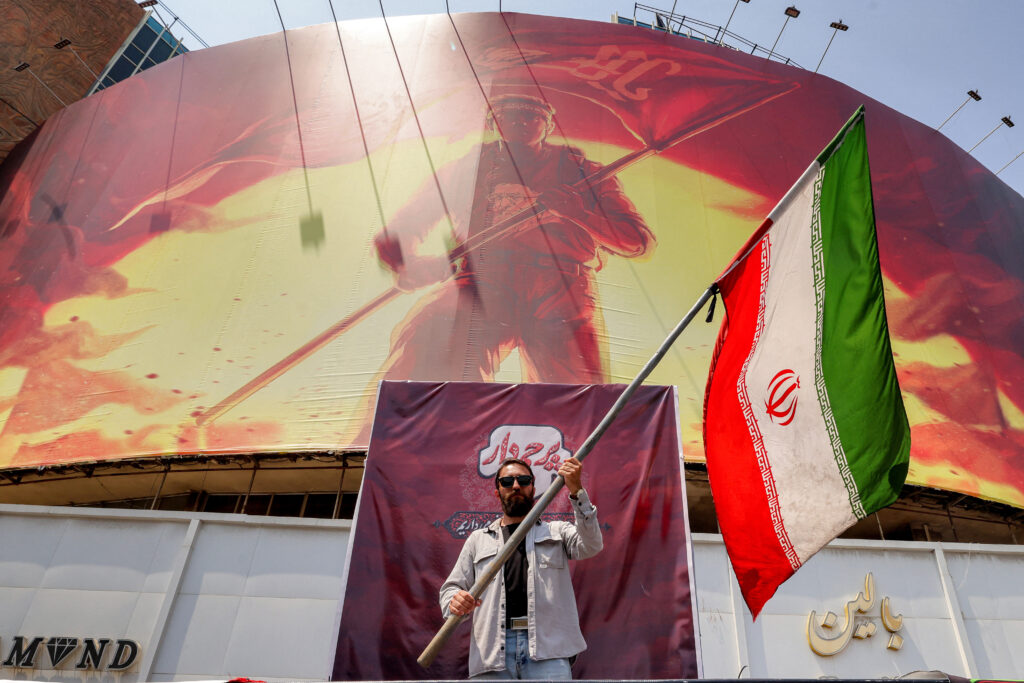
Image Caption: A man waves an Iranian flag before a political billboard at Valiasr Square in central Tehran on 8 August 2026. Photo: AFP
About the Author
Mohammad Eslami is a Research Fellow at the University of Tehran. He is a co-author of “The Second Europe”, a study of Iranian-European nuclear negotiations, and was formerly editor-in-chief of Khorasan Diplomatic Magazine.
Dr Zeynab Malakouti is a Research Affiliate at the Middle East Institute-NUS. She holds a PhD in International Law from the University of Leeds, UK and an LLM in Human Rights from the University of Reading, UK.