Introduction
Saudi Arabia has faced numerous intellectual, political, social and economic challenges at various junctures in its history. Amidst these, the emergence of the Arab Spring in 2011 was a profound shock that sounded serious alarm, exposing the country’s internal problems and challenges. These included a growing youth population with rising expectations, a youthunemployment crisis, a new class of educated women, diverse intellectual currents with specific demands for change, radical Wahhabi preachers, oppressed minorities, and widespread criticism of the shortcomings, deficiencies, and performance of governance through social media networks. These challenges have been extensively examined in the works of Madawi Al-Rasheed, a leading scholar of Saudi affairs.[1] Similarly, David Rundell, a prominent scholar of Saudi studies and a former American diplomat in Arab countries, including Saudi Arabia for 30 years, wrote in his book Vision or Mirage: Saudi Arabia at the Crossroads: “The same forces that have historically driven change in other kingdoms have emerged in Saudi Arabia: The end of social subservience, the decline of Wahhabi Islam, and the rise of individualism. Travel and satellites have allowed Saudis to experience the outside world, and returning Saudi graduates have experienced societies different from their own; hence, the surrender to the acceptance of hierarchical and patrimonial structures is gradually fading.”[2] The accumulation of these challenges and a consequent legitimacy deficit have compelled Saudi rulers to recognise the criticality of implementing modern reforms in the country. Regional military conflicts did little to positively influence Saudi youths’ perception of governance, as their primary desire was a transformation of the country’s conservative culture.[3] Consequently, Saudi Crown Prince Mohammed bin Salman embarked on liberal social and economic reforms within the framework of Vision 2030[4] and the National Transformation Program[5] to achieve these objectives: Securing the support of Saudi youth (given that the population structure is predominantly young, with 73 per cent falling within the 15-64 age group in 2023),[6] addressing youth unemployment, shaping his own political future, and that of the country, projecting a modern image of Saudi Arabia in line with global standards, attracting foreign investment to foster economic diversification, and preventing domestic unrest.
The Various Challenges and Modernist Reforms in Saudi Arabia
The various political, social, and economic challenges in Saudi Arabia ultimately compelled the country’s decision-makers to adopt a strategy of socio-economic reforms. The challenges arose not only from economic needs — such as strengthening the private sector, addressing youth unemployment, and diversifying the economy — but also from rising social demands, the need to prevent the growth of social discontent, and potential political upheavals. In this context, scholars argue that social, cultural, and religious reforms are crucial in achieving economic goals, such as attracting Foreign Direct Investment (FDI) and global talent, as well as bolstering the tourism sector, all contributing to the broader goal of economic transformation.[7]
By the time the wave of pro-democracy protests and uprisings which became known as the Arab Spring erupted in 2010-2011, the emergence of intellectual currents and various political, social, and economic challenges, coupled with largely static social and political institutions that failed to respond to these new demands, meant the Saudi authorities had to grapple with a legitimacy deficit. The image of the Kingdom around much of the world following the 9/11 attacks on the United States added to the problem: Since then, Saudi Arabia had become synonymous with radical religious teachings, gender inequality, and unmet youth demands.8 In this context, the adoption of a modernist reform approach — such as the implementation of significant changes concerning women and the judiciary — contributed significantly to reducing the legitimacy deficit, changing the mindset of Saudi youth towards the government.9
It is worth noting that Vision 2030 represents the crystallisation of Saudi Arabia’s reform strategy in both the domestic and foreign arenas. The plan emphasises opening the economy to foreign investment, economic diversification, and privatisation.10 The three pillars guiding the transformation are the fact that Saudi Arabia is located at the heart of the Arab and Islamic worlds, as it is the Land of the Two Holy Mosques; it has strong investment capabilities, and aims to use this to power a diversified and sustainable economy; and that its unique strategic location is ideal for the establishment of a global hub connecting Asia, Europe, and Africa. Based on this, Vision 2030 has been structured around three overarching themes: A “vibrant society, thriving economy, and ambitious nation”.11
The Impact of Domestic Dynamics: Vision 2030 and Beyond
Vision 2030 constitutes not only the primary structural foundation of Saudi Arabia’s domestic transformation, but has also prompted a profound revision of its foreign policy principles that are aimed both at realising its economic goals and improving its global image.12 It should be noted that it is not the sole factor shaping this shift. Events such as the 2019 Abqaiq attacks also markedly impacted the re-assessment of the Kingdom’s regional and international posture.13 While Vision 2030 introduced a development-oriented logic that redefined foreign policy from within, the Abqaiq attacks exposed the country’s vulnerabilities, intensified doubts regarding US security guarantees, and underscored the high costs of regional conflicts. Consistent with the key goals of Vision 2030 mentioned above, Riyadh has redesigned its foreign policy framework to prioritise economic interests, national security, diplomacy, and regional stability.13 This new Saudi diplomacy has been characterised as rational, pragmatic, based on immediate national interests, and is mediation-oriented, flexible, and economic-investment-driven.14 Furthermore, Riyadh has adopted a hedging strategy[8] (reinforced by the 2019 Abqaiq attacks) to maximise its national interests, and has distanced itself as much as possible from ideological conservative foreign policy and military adventurism.[9] [10] As achieving the main goals of Vision 2030 requires financial resources, technology, economic security, and the attraction of foreign investment,[11] Saudi rulers have focused on national interests and economic-investment diplomacy, rather than relying on traditional pan-Islamic or pan-Arab ideals.[12] Taken together, these developments not only represent a redesign of the guiding principles of Saudi foreign policy based on national interests, economic diplomacy, and regional stability, but also mark a departure from the persistent logic of geopolitical and identity-based rivalries in the Middle East.
Building on the domestic transformation driven by Vision 2030, MBS plays a pivotal role in guiding and implementing this initiative. As Karen Elliott House argues in her book, The Man Who Would Be King: Mohammed bin Salman and the Transformation of Saudi Arabia, the Crown Prince’s ambition, impetuosity, decisiveness, and extreme risk-taking have had a significant impact on the transformation of Saudi society and the economy. His ambition and determination have led him to break with long-standing conservative traditions of Saudi society — rooted in Wahhabi ideology and tribalism — and to implement bold social changes. This stems from his desire to make Saudi Arabia one of the main poles of global investment, and winning the support of the young generation. However, his extreme risk-taking raises the dangers of massive strategic and financial failures. If Vision 2030 achieves its main goals, it would be a major achievement for him, but economic failure could have serious consequences for the Saudi monarchy.[13] This explains recent moves to scale back on some of its more ambitious projects, highlighted by the decision to end funding for the LIV Golf competition.[14]
On the whole, domestic dynamics not only affect the behaviour and style of a country’s foreign and regional policies, but can even shape its regional strategy. In this regard, Saudi Arabia’s focus on modernist reforms, particularly its economic development programmes from 2019 onwards, has gradually led to a shift in the country’s Middle East strategy. If the period from 2015 to 2023 is considered, the share of military expenditure in Saudi Arabia’s GDP decreased after 2019, from 7.8 per cent in 2019 to 7.3 per cent in 2024. Defence spending during this period was highest in 2015 (13 per cent), which coincided with the beginning of the war in Yemen.[15] The lowering of this figure as a percentage of GDP from 2019 onwards reflects the gradual shift in Saudi Arabia’s Middle East strategy. It should be noted that Saudi Arabia’s military expenditure has increased in absolute terms between 2019 and 2024, even as its share of GDP has declined. This indicates a reduction in the relative share of military spending and suggests a shift in Saudi Arabia’s regional policy priorities. In fact, the Saudis’ focus on economic reforms and investment has contributed to a decline in military spending as a percentage of GDP, although this trend may shift under war conditions, such as in 2015 (the Yemen war), when military expenditure increased significantly, and in the wake of the United States-Israel war against the Islamic Republic of Iran, which has seen the Kingdom targeted. The effects of these economic reforms were particularly evident in the diversification of the budget towards non-oil revenue sources in subsequent years: In 2025, roughly 45.5 per cent of total revenue came from non-oil revenue,[16] compared to almost 8 per cent in 2012.[17] In fact, from 2019 onwards, Riyadh’s focus on the reform strategy, specifically economic development programmes, and the move from traditional to modern legitimacy (redesigning the social contract based on increasing social and economic freedoms while maintaining the monarchy, in contrast to the previous patron-client arrangement between the state and society),[18] represents a marked transformation in its approach to regional geopolitical rivalries, and a sharp reduction in its incentives to enter into regional conflicts or escalate such conflicts has been observable.
The clearest manifestation of Saudi Arabia’s post-2019 foreign policy approach came in March 2023, when the agreement between it and Iran to resume diplomatic relations following more than seven years of severed ties was reached. One of Riyadh’s primary motivations for signing the agreement was to avoid conflicts and reduce regional tensions with Iran — an essential component of Vision 2030, since any escalation would threaten the financing of economic projects, pose a serious deterrent to foreign investment, and jeopardise Saudi Arabia’s ambition to become a regional and global hub for logistics, trade, and industry.[19] It should be noted here that despite Saudi Arabia’s focus on de-escalation and economic-diplomatic engagement, regional pressures such as the current US-Israeli war with the Islamic Republic cannot be ignored. As such, these factors continue to influence Saudi Arabia’s calculations, and its approach to maintaining stability and securing its economic interests. Other examples of this diplomatic push include ending the nearly four-year blockade of Qatar in January 2021— despite the crisis having been largely driven by the United Arab Emirates — as well as expanding economic interactions with Iraq, and establishing the Council of Arab and African States bordering the Red Sea and the Gulf of Aden in 2020. Beyond the Middle East, Riyadh has also hosted important summits with the Gulf Cooperation Council, the United States, China, and Central Asian countries, as well as negotiations related to the wars in Sudan and Ukraine (active diplomacy).[20] This new approach to Saudi Arabia’s foreign policy towards the Middle East region in the post-2019 period marks a clear departure from its earlier foreign policy approaches between 2003 and 2018. Following the US invasion of Iraq in 2003, Saudi foreign policy in the region shifted from a conservative stance to an assertive one between 2003 and 2011, including security-driven policies and indirect hard-power interventions in Iraq to contain Iran’s influence. With the onset of the Arab Spring, this stance shifted into a more aggressive regional posture between 2011 and 2018,[21] including military involvement in Syria and Bahrain, the Yemen war, and the diplomatic crisis with Qatar. In sum, Saudi Arabia’s new Middle East strategy in the post-2019 period reflects a recalibration towards de-escalation, diplomatic engagement, and economic cooperation, prioritising investment-driven and negotiation-oriented diplomacy, rather than direct or proxy military confrontation.
Conclusion
Considering the type of governance and domestic politics is essential for understanding states’ foreign and regional policies. There is an interplay between domestic and foreign policy: On the one hand, domestic dynamics and drivers shape foreign policy behaviour and regional strategy, while on the other, the style and actions of foreign policy have domestic consequences. From 2019 onwards, Saudi Arabia’s focus on socio-economic reforms under various initiatives, particularly Vision 2030, has gradually led to a significant transformation in the country’s foreign policy, most notably a gradual shift in its Middle Eastern strategy and geopolitical rivalry with Iran.
Vision 2030 introduced a development-oriented logic that has redefined foreign policy from within. In line with Vision 2030’s key goals of diversifying the economy and improving Saudi Arabia’s global image, the country’s foreign policy framework has also been redesigned to prioritise economic interests, national security, diplomacy, and regional stability. Indeed, given that achieving the main goals of Vision 2030 require financial resources, technology, economic security, and the attraction of foreign investment, Saudi rulers have focused their foreign and regional policies on national interests, economic diplomacy, and regional stability, rather than relying on traditional pan-Islamic or pan-Arab ideals. Such a transformation in Saudi foreign policy highlights the growing importance of development-oriented governance in shaping foreign policy behaviour, and suggests that domestic reform agendas can play a crucial role in shaping foreign policy priorities and defining national interests.
In addition, Riyadh’s strategy — through positive diplomatic engagement at the regional and international levels, and the resolution of disputes with regional actors — not only attracts more foreign investment, but also strengthens domestic legitimacy. Finally, taking steps towards “good governance”, for example, through domestic reforms, represents a sustainable solution for reducing and resolving regional disputes, which ultimately helps to create and deepen regional peace and stability. This is particularly critical for the Middle East — a region that continues to face challenges stemming from a lack of democracy and is prone to conflict.
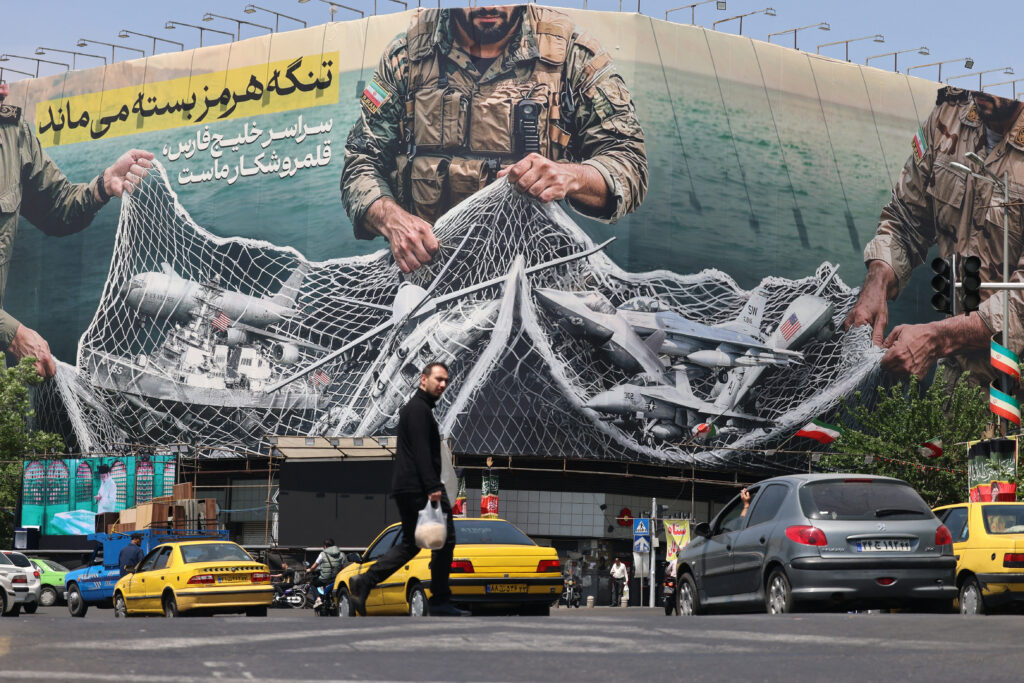
Image Caption: Vehicles drive past a giant billboard reading ‘The Strait of Hormuz remains closed’ at the Revolution Square in Tehran on 28 April 2026. Photo: AFP
About the Author
End Notes
[1]. Madawi Al-Rasheed, Salman’s Legacy: The Dilemmas of a New Era in Saudi Arabia (Oxford: Oxford University Press, 2020), 1-3.
[2]. David Rundell, Vision or Mirage: Saudi Arabia at the Crossroads (London: I.B. Tauris, 2020), 330.
[3]. Cyril Widdershoven, “Saudi Crown Prince’s Power Consolidation Puts Vision 2030 Back on Track,” Atlantic Council, January 19, 2018, https://www.atlanticcouncil.org/blogs/new-atlanticist/saudi-crown-prince-s-power-consolidation-puts-vision-2030-back-on-track/#:~:text=The%20most%20significant%20demand%20of%20the%20youth,and%20allowing%20cinemas%20back%20into%20the%20country.
[4]. Vision 2030, “Saudi Vision 2030; Overview,” accessed December 12, 2025. https://www.vision2030.gov.sa/en/overview.
[5]. Vision 2030, “National Transformation Program,” accessed December 12, 2025. https://www.vision2030.gov.sa/en/explore/programs/national-transformation-program.
[6]. World Bank Group, “Population ages 15-64 (% of total population) – Saudi Arabia,” World Bank Open Data, accessed December 12, 2025. https://data.worldbank.org/indicator/SP.POP.1564.TO.ZS?locations=SA.
[7]. Hassan al-Mustafa, “The Impact of Vision 2030 on Saudi Arabia’s Foreign Policy, Arab News, May 4, 2025, https://www.arabnews.com/node/2599540.
- 8. Madawi Al-Rasheed, The Son King: Reform and Repression in Saudi Arabia (Oxford: Oxford University Press, 2021), 64-65.
- Mark C. Thompson, “The Impact of Vision 2030 on Saudi Youth Mindsets,” Asian Affairs 52, no. 4 (2021): 819, https://doi.org/10.1080/03068374.2021.1992202.
- 10. Vision 2030, “Vision 2030: Overview,” 51, 83, accessed December 12, 2025, https://www.vision2030.gov.sa/media/quudi5wq/vision-2030-overview.pdf.
- Vision 2030, “Vision 2030: Overview,” 6, accessed December 12, 2025, https://www.vision2030.gov.sa/media/quudi5wq/vision-2030-overview.pdf.
- Cinzia Bianco, “Global Saudi: How Europeans Can Work with an Evolving Kingdom,” European Council on Foreign Relations, May 8, 2024, https://ecfr.eu/publication/global-saudi-how-europeans-can-work-with-an-evolving-kingdom/; Layla Ali, “Unpacking the Drivers of Saudi Arabia’s Foreign Policy,” Gulf Research Center, February 2025, 3, https://www.grc.net/documents/67d18702f416cUnpackingDriversSaudiArabiaForeignPolicy3.pdf.
- 13. Michael Safi and Graeme Wearden, “Everything You Need to Know about the Saudi Arabia Oil Attacks,” The Guardian, September 16, 2019, https://www.theguardian.com/world/2019/sep/16/saudi-arabia-oil-attacks-everything-you-need-to-know.
- 13. Mordechai Chaziza and Carmela Lutmar, “Saudi Arabia’s Niche Diplomacy: A Middle Power’s Strategy for Global Influence,” World 6, no. 2 (2025): 1, https://doi.org/10.3390/world6020065.
- 14. Cinzia Bianco, “Global Saudi: How Europeans Can Work with an Evolving Kingdom,” European Council on Foreign Relations, 8 May 2024, https://ecfr.eu/publication/global-saudi-how-europeans-can-work-with-an-evolving-kingdom/; Majid Rafizadeh, “Saudi Arabia’s Rise as a Global Mediator and Regional Stabilizer,” Al-Arabiya English, 12 June, 2025, https://english.alarabiya.net/views/2025/06/12/saudi-arabia-s-rise-as-a-global-mediator-and-regional-stabilizer.
[8]. Saudi Arabia’s hedging strategy aims to leverage relationships with major global powers, such as the United States, China, Russia, and India in order to maximize its national interests and reduce dependence on any single actor. It is worth noting that Riyadh has intensified its strategy of diversifying foreign relations following the 2019 Abqaiq attacks in order to mitigate its security vulnerabilities.
[9]. Following the US invasion of Iraq in 2003, Saudi foreign policy in the Middle East shifted from a conservative approach to an assertive one (2003–2011, such as security-driven and indirect hard-power interventions in Iraq to contain Iran’s growing influence) and with the onset of the Arab Spring, from an assertive stance to an aggressive regional posture (2011-2018, military interventions in Syria and Bahrain, the Yemen war, and the diplomatic crisis with Qatar, which was largely driven by the UAE.
[10]. Mordechai Chaziza and Carmela Lutmar, “Saudi Arabia’s Niche Diplomacy: A Middle Power’s Strategy for Global Influence,” World 6, no. 2 (2025): 3-4, https://doi.org/10.3390/world6020065.
[11]. al-Mustafa, “The Impact of Vision 2030 on Saudi Arabia’s Foreign Policy.”
[12]. Fatiha Dazi-Héni, “The New Saudi Leadership and Its Impact on Regional Policy,” The International Spectator 56, no. 4 (November 2021): 61, https://doi.org/10.1080/03932729.2021.1987033.
[13]. Karen Elliott House, The Man Who Would Be King: Mohammed bin Salman and the Transformation of Saudi Arabia(Harper, 2025), 18–21, 50, 133-182.
[14] https://www.nytimes.com/2026/05/01/world/middleeast/saudi-arabia-spending-sports-liv-golf.html?searchResultPosition=4
[15]. World Bank Group, “Military Expenditure (% of GDP) – Saudi Arabia,” World Bank Open Data, accessed December 12, 2025, https://data.worldbank.org/indicator/MS.MIL.XPND.GD.ZS?locations=SA.
[16]. “Saudi Arabia’s 2025 Budget: Record Non-Oil Revenues, Sustained Investment in Well-Being,” Asharq Al Awsat, February 2026, https://english.aawsat.com/business/5244194-saudi-arabia%E2%80%99s-2025-budget-record-non-oil-revenues-sustained-investment-well-being.
[17]. PricewaterhouseCoopers (PwC), Saudi Economy Watch (2023), accessed December 12, 2025, https://www.pwc.com/m1/en/publications/saudi-arabia-economy-watch/documant/saudi-economy-watch-english.pdf.
[18]. Mokhtar Zibaee, Farhad Daneshnia, and Godrat Ahmadian, “Globalization and Transformation of the Government Function in Saudi Arabia (2015-2022),” Scientific Journal Quarterly of Middle East Studies 30, no. 114 (2024): 33-57.
[19]. Yasmine Farouk, “Riyadh’s Motivations behind the Saudi-Iran Deal,” The Carnegie Endowment for International Peace, March 30, 2023, https://carnegieendowment.org/posts/2023/03/riyadhs-motivations-behind-the-saudi-iran-deal?lang=en.
[20]. Anna Jacobs, “Understanding Saudi Arabia’s Recalibrated Foreign Policy,” International Crisis Group, September 14, 2023, https://www.crisisgroup.org/middle-east-north-africa/gulf-and-arabian-peninsula/saudi-arabia/understanding-saudi-arabias.
[21]. Masoud Hamyani, “A Shift in Saudi Arabia’s Foreign Policy: From the Strategy of Balancing to Coalition Leadership,” Foreign Policy Quarterly 29, no. 1 (2015): 55