
US-Saudi Nuclear Deal: Implications of Strategic Exceptions
- Cauvery Ganapathy
- -
History casts long shadows. A largely-forgotten chapter of United States-Iranian relations is steeped in remarkable irony: Tehran’s first nuclear reactor resulted from American technical cooperation under President Dwight Eisenhower’s Atoms for Peace programme, complete with US-supplied fuel. The reactor continues operating to this day on the Tehran University campus. The cooperation marked the beginning of Iran’s nuclear programme, which eventually led to the war launched by the US and Israel on 28 February, and which continues to roil the globe. That irony looms over the civilian nuclear cooperation deal the US signed with Saudi Arabia recently, though it would be far too reductive to conclude that the two American-led events will travel the same proliferation path. This commentary seeks to touch on the nuances of the Saudi deal, the precedents it sets, and its potential implications.
The US-Saudi Nuclear Deal: the Devilled Details
The US-Saudi deal induces understandable anxieties in the region and beyond. In its present form, the deal allows Saudi Arabia a viable pathway to uranium enrichment, should Riyadh so choose. Minus any commitment to the non-proliferation “Gold Standard” of a 123 Agreement, the deal forgoes any demands on Riyadh to commit to this, and the International Atomic Energy Agency’s additional protocols. Bypassing such basic safeguards could impact proliferation and nuclear safety concerns in a region replete with geopolitical volatility, undercurrents of distrust born of internecine conflicts, and the potential of kinetic warfare which increasingly – and illegally — considers civilian energy infrastructure as a legitimate target. When combined with signals from the Kingdom regarding keeping their options for enrichment open, this compounds an already tenuous strategic regional environment.
There are some caveats, however. The deal must still be ratified by the US Congress, President Donald Trump has linked it to Saudi normalisation of ties with Israel, and political changes in Washington may impact the agreement in its current form. As of this writing, the proposed deal is before Congress. Without an active effort by the Congress to change or sink the deal via a two-thirds majority, it will automatically enter into law in December 2026. Despite the increasing concerns raised about the precedent the deal sets and the lack of safeguards, the US-Saudi deal is thus highly likely to pass through Congress. The sheer prerogatives that the Trump Administration has arbitrarily exercised to allow for a pathway to uranium enrichment without any adherence to proliferation safeguards thus makes the impact of the Saudi deal on the global nuclear landscape more immediate.
Bypassed Protocols: Hypocrisy or Strategic Exception?
While internationally accepted norms and safeguards that Washington itself has been safeguarding over the decades have been bypassed, it may be pertinent to consider the motivations that may have led the US to grant these exceptions to the Saudis.
Despite it being evident that the US does not apply the same standards to every country on the question of nuclear proliferation, it is equally important to ask if and how any degree of equanimity can be expected from nations in the conduct of their strategic affairs — the US’ ties with Riyadh are on a different plane to those with Tehran. Arguably, in Washington’s assessment, the strategic threat that a nuclear-armed Iran poses to the region, and US interests, is not something that it expects to be reflected in Riyadh’s conduct of geopolitics. Despite the recent irritants in the bilateral, the US still sees Saudi Arabia as an important and, crucially, a dependable partner. While the oil for security calculus that formed the bedrock of the relationship has been upended by the shale-gas revolution in the US, Riyadh, like some of the other Gulf states, continues to be a reliable strategic partner to Washington. Given this, the potential that the Saudis may have been courted by China to explore a civilian nuclear partnership may have raised the stakes for the US to act more expediently and exceptionally in reaching a deal with the Kingdom.
Nuclear energy cooperation carries strategic relevance like few other partnerships do. Binding countries into multi-decade partnerships, agreements on nuclear energy – civilian or otherwise – tend to create shared strategic stakes in bilateral relations. President Eisenhower’s Atoms for Peace programme was part of the US’ Cold War strategy to forge impactful partnerships with developing countries to keep them out of the Soviet ambit. It was an approach that largely proved successful. It is through this lens that the US-Saudi deal may today be considered too. Despite the dangerous precedent it sets by triggering proliferation risks, it is likely that agreement may also have been judged to be a point of leverage to keep the Saudis within Washington’s ambit.
Muddying the Muddied Middle East Waters
The timing of the announcement itself could also be considered to have been strategically motivated. Discussions regarding a civilian nuclear deal between the US and Saudi Arabia have been ongoing for more than a decade now, and have gone through three different US Presidents. Through every previous discussion, Washington made the deal contingent on a variety of factors, not least among them diplomatic recognition of Israel. Given Saudi outright reluctance to do this in the wake of the war in Gaza, this arguably makes the timing of this announcement an important indicator of what the deal signifies, more than what it may eventually deliver.
Even if the agreement passes and work begins on it today, project delivery — whether civilian or strategic — would take a bare minimum of more than seven years. The deal is thus not meant as a deterrent to Iran. At any rate, the Saudis have previously indicated a willingness to acquire — or purchase — nuclear weapons should Iran ever get the bomb, which their strategic defence agreement with Pakistan provides a pathway for.
Given this, the lens through which the agreement should be viewed is that of leverage — for both sides. In the case of the US, it serves to keep Saudi strategic and commercial pathways aligned with Washington’s own interests and offerings. In time, the agreement could also be used to cajole the Saudis into normalising ties with Israel, should political changes in the country give rise to a revival of discussions over a future Palestinian state. For the Saudis, the deal improves the Kingdom’s strategic standing in the US calculus, and provides the basis for future deterrence if Iran goes nuclear.
The US-Saudi strategic calculus must be acknowledged to fully appreciate the trajectory the nuclear agreement may take. In addition to this, a more immediate and significant impact of it may be seen in how its precedent is assessed by other countries, particularly within the region. The United Arab Emirates (UAE), as the first country in the Arabian-peninsula with an official civilian nuclear programme, is an important actor to consider in this regard, given its strategic rivalry with Riyadh, which has sharpened recently.
Implications of the US-Saudi Deal on UAE’s Non-Proliferation Commitments
The UAE was well aware of the strategic geography it inhabits when it began building its nuclear programme, and made regulatory pledges that reinforced its commitment to non-proliferation. The Emirati programme was accordingly founded, and continues to be based, on this clear commitment towards of a robust set of international protocols focused on safety standards and non-proliferation.
Table.2: UAE’s Adherence to International Treaties and Agreements Relating to Nuclear Safety and Non-Proliferation
|
International Protocols/Agreement |
UAE’s Signing/Joining/Accension
|
| IAEA Convention on Early Notification of a Nuclear Accident |
1987 |
| IAEA Treaty on Non-Proliferation of Nuclear
Weapons
|
1995 |
| UN Comprehensive Test Ban Treaty
|
2000 |
| IAEA Comprehensive Safeguards Agreement
|
2003 |
| IAEA Convention on the Physical Protection of
Nuclear Material
|
2003 |
| UN Security Council Resolution 1540
|
2004 |
| UN International Convention for the Suppression
of Acts of Nuclear Terrorism
|
2005 |
| IAEA Additional Protocol to Safeguards
Agreement
|
2009 |
| IAEA Amendment to the Convention on the
Physical Protection
|
2009 |
| IAEA Joint Convention on the Safety of Spent Fuel Management and on the Safety of Radioactive Waste Management
|
2009 (Accession) |
| NSG Export Guidelines
|
2022 |
Source: Author’s own based on ENEC Policy Document; UAE Embassy in Washington data on the UAE’s non-proliferation commitments
Compliance with these protocols has led to a systemic integration of the following principles into the UAE’s nuclear trajectory:
| No enrichment of Uranium
|
| The spent fuel will not be reprocessed in the country and would be moved out under international supervision
|
| Fuel (Uranium) would be sourced from responsible producers through transparent supply chains |
|
The Barakah Nuclear Plant will remain open to international scrutiny to check compliance with non-proliferation agreements
|
|
Nuclear Waste Management will be done in accordance with international safety standards where it is first stored in cooling pools for 20 years and then in dry solid caskets
|
Source: Based on ENEC and WNA
If the Saudis exploit the loopholes to enrichment afforded by the deal with the US, it can be expected that the UAE, and other regional actors such as Turkey, will react given the increasingly complex security environment. While this does not mean that Abu Dhabi would re-negotiate the terms of its 123 Agreement immediately, it is worth considering how the acquisition of nuclear weapons or pathways to enrichment by other regional actors may inform Abu Dhabi’s future strategic calculus given changing regional dynamics. Under Section 123 of the US’ Atomic Energy Act of 1954, the UAE is eligible to renegotiate the terms of the treaty if the US signs a similar nuclear cooperation agreement with any other country that does not conform to the “Gold Standard”. Indeed, the Emirates raised this very issue after the Joint Comprehensive Plan Of Action (JCPOA), which accorded Iran greater leverage to continue with its enrichment programme, was signed.
The Emirati decision to forgo the right to enrichment and commit to internationally-recognised principles of non-proliferation is a demonstration in principle to not just the Iranians — who are engaged in a decades-long struggle to be allowed the right to enrichment despite their insistence that their nuclear programme is a peaceful, civilian electricity-oriented one — but the region as a whole that the power of the atom can be harnessed without it necessarily devolving into nuclear proliferation. Should the US’ arbitrary and unequal implementations of civil nuclear cooperation agreements lead to potential reversal of the Gold Standard by the UAE, a country long committed to the ethos of non-proliferation, it would qualify as an abject failure on the part of the global nuclear regime to have safeguarded its fundamental principles.
In Conclusion
The willingness of the US to selectively circumvent the non-proliferation architecture that it previously guarded qualifies as an arbitrary implementation of the global nuclear regime, despite the strategic motivations that may have informed the trade-off. The irony that Washington was a progenitor of the Iranian nuclear programme it now wages a war against reflects a throughline of paradoxes in international affairs. In the easing of its proliferation standards the US — and the international community — would do well to remember the old international affairs adage: In this realm, there are no permanent friends or foes, only permanent interests. It is a dictum that may resonate more in the future should patterns of friendship change. It is then that the arbitrary easing of non-proliferation protocols without the institution of adequate guardrails will exact its true cost.
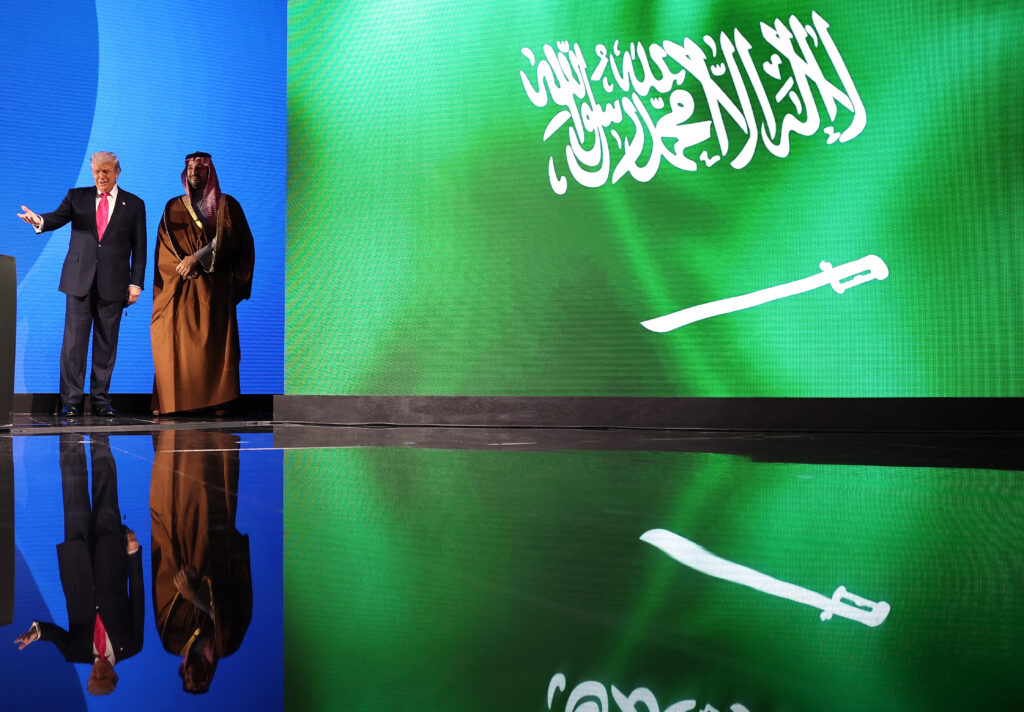
Image Caption: U.S. President Donald Trump and Crown Prince and Prime Minister Mohammed bin Salman of Saudi Arabia arrive at the U.S.-Saudi Investment Forum at the Kennedy Center on 19 November 2025 in Washington, DC.
About the Author
Cauvery Ganapathyis a Fellow at the Observer Research Foundation in the Middle East, where she specialises in climate and energy affairs.


More in This Series
- Mohammad Eslami and Zeynab Malakouti
- -
- Alfred Schipke, Michelle Teo, Yu Hong, Fang Guo, and Lin Jing
- -