Salah, the Super Lig, and the Reckoning to Come
- V Shakthii Vel
- -
Unlike past European football transfer seasons, when teams in England and Spain usually make the most waves, there was an interloper this year: The Turkish Super Lig. Two of Istanbul’s “Big Three” clubs — Fenerbahce, which signed Belgian striker Romelu Lukaku, and Besiktas, which added Premier League champion Leandro Trossard from Arsenal — made waves. But it was a club outside of the big names that landed the biggest fish: Former Liverpool superstar Mohamed Salah took his scoring boots to the Anatolian coast, and donned Trabzonspor’s claret and sky blue colours.
Just two years removed from a Premier League title, the talk prior to the Egyptian’s signing was that he would gun for a bigger European team in a bid to chase more major honours and cement his legend. When it emerged that Besiktas was a front-runner for his signature, that raised eyebrows. Trabzonspor? It appeared to be another of those transfer season rumours that seemed so far-fetched as to be laughable. But was it?
Why Salah to Trabzonspor Fits the Script
Broken down by player motivation and club identity, however, the transaction reveals a calculated convergence of interests.
For Salah, the move offered financial and personal incentives that Western European clubs have been increasingly reluctant to grant ageing forwards, even ones with his pedigree. Turkish clubs routinely structure contracts around guaranteed net-salary packages, mitigating the high tax burdens (often 45 per cent to 50 per cent) found in the Premier League or Serie A. Official financial filings show Trabzonspor signed Salah to a two-year contract guaranteeing US$19.6 million per season (in base salary and signing bonuses), plus a 20 per cent cut of all sales from his personalised merchandise. Beyond the economics, relocating to a predominantly Muslim country provides significant lifestyle and cultural alignment, guaranteeing him undisputed icon status both on and off the pitch.
For Trabzonspor, landing Salah is an assertion of Anatolian identity. Located in the Black Sea port city of Trabzon, the club historically stands as the primary disruptor to Istanbul’s football hegemony. As the first team outside Istanbul to break the Big Three’s title monopoly in the 1970s, Trabzonspor carries the fiercely regionalist pride of Anatolia. Its fanbase is unique in Turkey — exclusively local, and deeply hostile to metropolitan dominance. The flipside to this is that fans drive the club’s decisions: Management is constantly under pressure to deliver the kind of players that will excite supporters, and Salah fits that category, as the frenzied reactions to his arrival showed. In sum, Trabzonspor needs to match the Big Three in Istanbul both on the pitch and off. To further understand the Salah signing, one must first look at what the Big Four teams represent.
Galatasaray — The European Elite Mandate: Rooted on the European side of Istanbul, Galatasaray has historically tied its identity to international prestige and institutional elite status. Tracing its roots back to the prestigious French-language Galatasaray High School, established during the late Ottoman era, the club was founded with an explicit directive: To compete with European teams on an equal footing. This founding ethos instils a mandate to pursue global prominence. For Galatasaray’s board, spending heavily on internationally-recognised stars is not simply a short-term title strategy; it is seen as fulfilling a core historical mandate to project power abroad and maintain its self-proclaimed role as Turkey’s window to the West.
Fenerbahce — The Populist Counterweight: Across the Bosphorus, on the Asian side of the city, Fenerbahce’s identity was forged in direct opposition to Galatasaray’s high-society roots. Established in the district of Kadikoy, Fenerbahçe built its tradition as the club of the heartland merchants, the middle class, and fierce national pride – framing itself as the “people’s club” of Turkey. Strongly aligned with modern secular republican values and claiming a widespread supporter base, the club operates under constant pressure to assert dominance. When its crosstown rival brings in world-class names, Fenerbahce’s leadership faces an immediate populist requirement to match that spending to satisfy a fanbase that demands absolute equality — or total superiority — over the European side.
Besiktas — The Counter-Culture Team: Based in its historic neighborhood along the European shoreline, Besiktaş represents the third leg of Istanbul’s traditional football power structure, carrying a distinct community-driven and counter-culture identity. Though founded near the Ottoman court, the club evolved into a symbol for local artisans, working-class supporters, and famously anti-establishment fan groups like Çarşı, and commands a fiercely loyal local following. Hence, when Galatasaray and Fenerbahce embark on multi-million-Euro transfer windows, Besiktaş has to keep up. To keep pace in the title race, the club often finds itself forced into high-risk wage commitments to recruit established European talent.
Trabzonspor — Anatolian Pride: Trabzonspor is the primary disruptor of Istanbul’s hold over Turkish football, and represents the fiercely regionalist pride of the Black Sea coast. As the first club outside Istanbul to break the Big Three’s title dominance, Trabzonspor’s identity is defined by Anatolian resistance against metropolitan dominance. Its supporter base is singularly local, and intensely demanding. When Istanbul clubs spend lavishly, Trabzonspor’s executive leadership comes under immense local pressure to respond with high-stakes recruitments of their own. For Trabzonspor, making high-profile transfers is treated not just as a sporting venture, but as a vital defence of regional identity.
Driven by these deep-seated historical rivalries and intense supporter demands, Turkish executive boards operate in an environment where passivity is not an option. Falling behind in the transfer market carries immediate political and cultural consequences for club leadership.
Why the Economics Don’t Add Up
The result of this acute rivalry between the clubs, and management’s pandering to fans’ demands, is that the Super Lig is mired in eye-watering debt, leading it to be called “one of the most unstable football ecosystems in Europe”. Despite being weighed down by a combined debt exceeding €1.6 billion (85 billion lira) across the Big Four, the clubs continue to indulge in structural overspending. But despite their financial outlay, Turkey’s biggest names have historically sat well outside Europe’s elite financial — or, indeed, competitive — tier, with only Galatasaray recently managing to crack Europe’s top 25 most valuable clubs again after a long time in the wilderness.
This persistent overspending has left these clubs facing a deep financial crisis rooted in a severe currency mismatch. While clubs pull in most of their income — from domestic broadcasting rights, ticket sales, local sponsorships, and kit purchases — in Turkish lira, foreign stars demand contracts denominated in Euros or US dollars. As the lira faces persistent inflation and devaluation, these foreign currency wage obligations expand exponentially on domestic balance sheets. Consequently, squad cost ratios at top Turkish clubs routinely swallow over 80 per cent to 90 per cent of total revenue, far eclipsing the sustainable thresholds enforced by European governing bodies. But rather than fully adhering to these caps, Turkish clubs often absorb UEFA penalties, operate under multi-year settlement agreements, and rely on domestic debt restructuring. For many, the financial reward of qualifying for European competitions — and earning Euro-denominated prize money — outweighs the immediate cost of regulatory sanctions.
Despite this, this high-stakes spending rarely yields the financial returns required to support it. In the top-five European leagues, heavy wage bills are comfortably offset by lucrative UEFA Champions League purses — totalling as much as €150 million for winning the competition. For Turkish clubs, however, this avenue is closed: Despite their inflated wage bills, no Turkish club has come close to winning football’s most glamourous club competition. The last time a team won a European tournament was in 2000, and even that was the lower level UEFA Cup, now known as the Europa League.
Beyond broadcasting and prize money lies a profound disparity in fanbase scale and global commercial appeal. While elite European powerhouses command massive, worldwide audiences that drive lucrative international merchandising and sponsorships, Turkish clubs remain heavily reliant on a passionate yet geographically constrained domestic market. This ceiling is further reflected in physical infrastructure: Whereas clubs like Trabzonspor play in venues holding roughly 41,000 spectators, Europe’s top-tier giants routinely fill stadiums accommodating 60,000 to over 80,000 fans, generating vastly superior gate receipts and matchday hospitality revenue. Lacking the cushion of these sprawling global commercial streams, Turkish teams face a rigid revenue limit — leaving them structurally unequipped to shoulder the compounding weight of Euro-denominated player salaries.
To keep the system solvent, the big teams have repeatedly relied on external interventions. Combined club liabilities have routinely forced state-influenced banking consortiums (such as Ziraat Bank and DenizBank, under the Turkish Banks Association framework) to step in with massive debt restructuring agreements. While clubs like Galatasaray and Trabzonspor have recently cleared specific Bank Association restructuring loans through major real estate monetisation projects, the overarching culture of overspending remains intact. Executive leadership operates under a clear hazard: The belief that state safety nets and political backing will always prevent historic football institutions from outright collapse.
How the Super Lig Bankrolls Its Purchases
Even while swimming in debt, these clubs somehow keep pulling off headline-grabbing transfers. How do they keep defying economic gravity? The secret lies in a mix of state-backed rescue nets and tax loopholes.
First, there is collective debt restructuring. Instead of facing bankruptcy over mountains of lira liabilities, clubs like Galatasaray, Fenerbahce, and Besiktas have repeatedly turned to state-aligned banking unions — specifically through programmes orchestrated by the Banks Association of Turkey (TBB) and public lenders like Ziraat Bank. By stretching out repayment timelines over a decade or more, these programmes take the immediate pressure off club executives, giving them the artificial breathing room they need to borrow more cash and sign new superstars.
At the same time, football in Turkey is far more than just a sport — it is a massive pillar of national pride and cultural life. Knowing that absolute structural collapse is politically unviable, decision-makers continually prioritise short-term domestic sporting success — delighting fans with marquee foreign acquisitions — over long-term financial prudence.
To top it all off, clubs exploit a massive tax advantage to lure foreign talent. While elite players in Western Europe watch nearly half their paychecks vanish to taxes (around 45 per cent to 50 per cent), foreign stars in the Super Lig usually sign net-salary deals. The club covers a localised withholding tax that sits at a much friendlier 15 per cent to 20 per cent. This tax gap lets Turkish teams match Western take-home pay without the same immediate financial sting — though it creates a stark divide in the locker room, where foreign players enjoy net guarantees while local players bear the full weight of domestic inflation and standard tax brackets.
Commercial momentum has somewhat kept pace with their rising ambitions. This is driven by stadium naming rights, major corporate sponsorships, and instant shirt sellouts whenever a new star arrives — as seen in Galatasaray’s example, with its enterprise valuation surging past US$800 million. Yet, rather than curing their deep-rooted structural vulnerabilities, this revenue stream frequently serves as fuel for another cycle of spending, leaving the Turkish giants to rely on state refinancing lifelines and preferential tax codes just to fund the present, even though every short-term fix further clouds their long-term financial survival.
Conclusion
Mohamed Salah’s arrival at Trabzonspor and the arms race in Istanbul represent the pure, unvarnished romance of Turkish football culture — where century-old rivalries and local pride push clubs to achieve the impossible and outdo each other. Flashing the cash has brought immediate dividends for the club: As of this writing, Trabzonspor lie in 4th place in the 18-team league, three points off leaders Galatasaray. Salah, meanwhile, is the competition’s top-scorer, on eight goals. Both club and player, then, are on course for success. Yet, the very system that has bedeviled the Super Lig is also what enabled Trabzonspor to orchestrate such a landmark signing, which in turn feeds directly into an inevitable financial reckoning. As commercial revenue, state-backed rescue nets, and tax loopholes collide with compounding debts and unsustainable overspending, a definitive question remains: How long will the delusion of the Turkish Super Lig last?
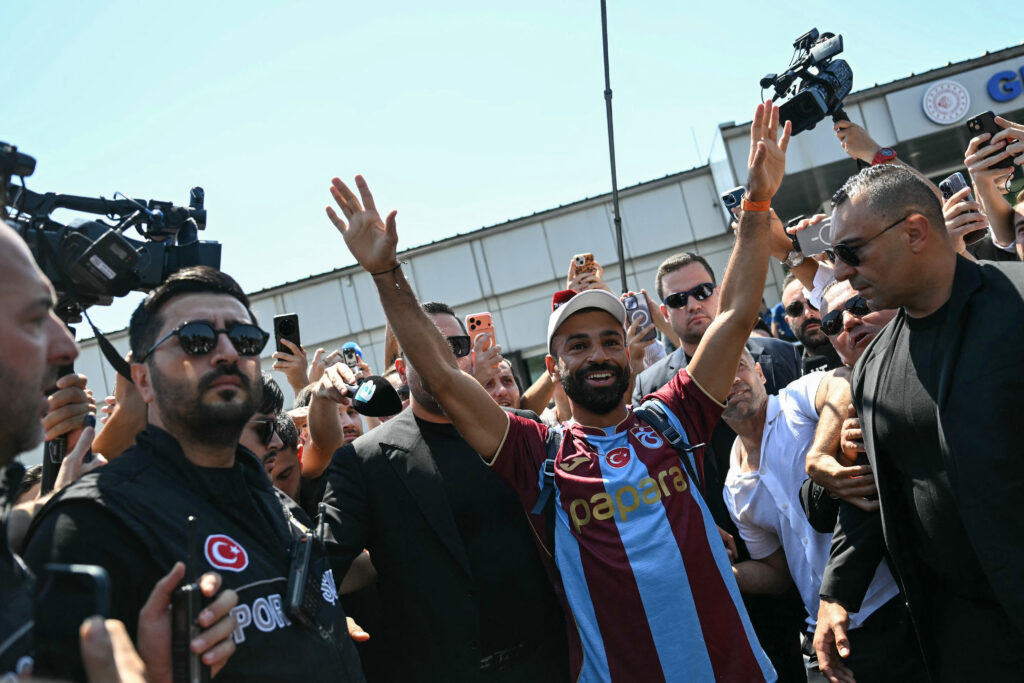
Image Caption: Egyptian forward Mohamed Salah gestures as he arrives at Istanbul Ataturk Airport to complete his transfer to Turkish football club Trabzonspor in Istanbul on 5 August 2026. Photo: AFP
About the Author
V Shakthii Vel is a communications specialist at the Middle East Institute-National University of Singapore, with several years of experience in the field. He holds a bachelor’s degree in Mass Communications with Public Relations from the University of Northumbria.
More in This Series
- By Reza Asadian and Hamid Bahrami
- -