
The Fallout from the Failure of Israeli and Iranian Deterrence
- Reza Asadian
- -
States devote enormous resources to preventing threats before they materialise. They build armies, fortify borders, deploy missile defences, form alliances, and threaten retaliation. Yet military power does not automatically produce deterrence. A state can possess overwhelming capabilities and still fail to prevent an attack.
Deterrence is ultimately an attempt to shape an adversary’s decision. It works when the intended target believes that a particular action will either fail, or produce costs greater than its expected gains. The decisive calculation, therefore, takes place not in the arsenal of the defender, but in the mind of its opponent.
There are two principal ways of shaping that calculation. Deterrence by denial seeks to convince an adversary that it cannot achieve its objective. Air and missile defences, fortified borders, surveillance systems, and forces capable of blocking an attack all contribute to denial. Deterrence by punishment, by contrast, accepts that an adversary may be able to strike, but threatens consequences severe enough to make doing so unattractive.
Israel and Iran illustrate the strengths and vulnerabilities of these two approaches. Before 7 October 2023, Israel increasingly trusted its ability to deny its adversaries the capacity to produce a strategic shock. The Hamas attack shattered that confidence, and pushed Israel towards a far more visible reliance on punishment. Iran developed from almost the opposite starting point. Unable to prevent the United States or Israel from striking it, Tehran sought to convince them that any attack would trigger intolerable retaliation and regional escalation. As that threat lost credibility, Iran began searching for another source of leverage.
Israel: When Denial Failed
Israel’s pre-7 Oct posture combined punishment with an increasingly sophisticated system of deterrence by denial. Repeated operations against Hamas degraded military infrastructure and eliminated commanders, while the strategy often described as “mowing the grass” sought to periodically renew the costs associated with confrontation without eliminating the organisation.
Israel also constructed one of the region’s most sophisticated defensive systems. Iron Dome, David’s Sling, and Arrowprotected against different categories of rockets and missiles. Around Gaza, an extensive barrier incorporated cameras, sensors, radar, surveillance towers, and underground defences. Israel’s intelligence capabilities added another layer.
The underlying assumption was not that Hamas could cause no harm. It was that Hamas could not penetrate these systems long enough to produce a strategic shock.
7 Oct demonstrated otherwise. Hamas fighters breached the border, bypassed or disabled surveillance systems, overran military positions, killed approximately 1,200 people and took around 250 hostages. The attack was an intelligence and operational failure, but also a deterrence failure. Hamas had concluded that Israel’s defences could be overcome, and that the expected benefits of the operation justified the anticipated response.
Once denial failed so publicly, Israel faced pressure to restore deterrence through punishment. A limited response risked signalling not only that Israel’s defensive system had failed, but that its willingness to retaliate had weakened as well.
The audience extended beyond Hamas. Hezbollah, Iran, the Houthis and other armed groups were watching Israel’s response. Prime Minister Benjamin Netanyahu made this broader signalling explicit when he warned Hezbollah leader Hassan Nasrallah against entering the war, threatening consequences he “cannot even imagine”.
The subsequent campaign in Gaza, and later Israeli operations against Hezbollah and Iran, demonstrated both the capability and willingness to impose extraordinary costs. Yet the distinction between demonstrating punishment and establishing durable deterrence remains important. Military operations can convince an adversary that aggression will be costly without necessarily eliminating the political or strategic motivations that make it willing to accept those costs.
Israel’s experience therefore exposes the vulnerability of denial. Defensive technology contributes to deterrence only for as long as the adversary believes that it cannot circumvent it. Punishment can restore fear after denial fails, but fear alone does not necessarily produce a stable security order.
Iran: When Punishment Lost Credibility
Iran’s deterrence architecture developed around a different vulnerability. Tehran could not match the conventional air power, intelligence reach, or alliances of the US and Israel. Instead, it built a system designed to make attacking Iran prohibitively expensive.
Ballistic missiles and drones threatened military bases, cities, ports, and energy infrastructure. The “Axis of Resistance”provided geographic depth through Hezbollah, Iraqi and Syrian militias, the Houthis, and Palestinian armed groups. The message was straightforward: An adversary might successfully strike Iran, but it could not control what happened next.
For years, this threat of escalation was central to Iranian deterrence. A limited attack could theoretically trigger missile strikes against Israel, attacks on US forces, pressure on Gulf infrastructure, or disruption of international shipping.
The problem was that successive confrontations gradually made these consequences appear more manageable.
After the US withdrew from the Iran nuclear agreement in 2018 and restored sanctions, Tehran initially pursued what it called “strategic patience”. In January 2020, the US assassination of Qassem Soleimani produced a direct Iranian missile response against American bases in Iraq. The attack demonstrated capability and resolve, but its careful calibration also limited its deterrent effect. Advance warning helped prevent American deaths, and allowed both sides to avoid a larger war.
That tension between crisis management and deterrence became even clearer in 2024. After an Israeli strike on Iran’s diplomatic compound in Damascus killed senior Iranian commanders, Tehran launched its first direct attack from Iranian territory against Israel. More than 200 missiles and drones were fired, but Israeli and allied defences intercepted most of them.
This operation crossed an important threshold, but the strategic damage was limited. Israel subsequently escalated further, including through the assassination of Ismail Haniyeh in Tehran and, later, Hassan Nasrallah. Iran’s October 2024 missile attack again demonstrated its ability to reach Israel, but did not convince it that further escalation would impose an unacceptable price.
Meanwhile, the regional architecture supporting Iranian deterrence was weakening. Hezbollah suffered major leadership and personnel losses, while the fall of Bashar al-Assad in December 2024 severed an important corridor connecting Iran to Lebanon. When Israel launched extensive strikes on Iran in June 2025, Tehran’s regional partners were largely unable or unwilling to intervene on the scale once anticipated.
The ultimate failure came on 28 February 2026, when the US and Israel launched a major joint operation that killed Supreme Leader Ali Khamenei and other senior political and military officials. The architecture Tehran had spent decades constructing had failed to prevent direct attacks on both Iranian territory and the leadership of the Islamic Republic.
The problem was not an absence of retaliation. Iran repeatedly demonstrated missile capability and political willingness to respond. Rather, its adversaries increasingly appeared to believe that Iranian punishment could be intercepted, calibrated, delayed, or contained. Once that perception took hold, the threat of retaliation became less effective at preventing further escalation.
Hormuz: Iran’s Search for a New Deterrent
The 2026 war consequently forced Tehran to reconsider where its strongest punitive leverage remained. The answer increasingly became the Strait of Hormuz.
The logic is different from Iran’s previous deterrent architecture. Approximately 23.2 million barrels of oil and refined petroleum products passed through the Strait each day in the first half of 2025, alongside roughly one-fifth of the global liquefied natural gas trade. Iran does not need to close the waterway completely to impose significant costs. Mines, missiles, drones, tanker seizures, or even the persistent threat of naval clashes can increase insurance costs, discourage commercial traffic, and place pressure on global energy prices.
By the summer of 2026, Hormuz had become what the Reuters news agency described as Iran’s “golden weapon”. Tehran also proposed a new arrangement for shipping through the strait that would give Iran greater control over inbound and some outbound traffic, arguing that the previous system no longer met its security requirements.
This represents an attempt to construct a new form of deterrence by punishment. Instead of threatening only military retaliation against the state responsible for an attack, Iran can distribute the costs of conflict across the international economy. An adversary contemplating another strike must therefore consider not only Iranian missiles, but also the possibility of an energy shock affecting allies, markets, and trading partners.
Hormuz also blurs the line between deterrence and “compellence” . Deterrence seeks to prevent a future action; “compellence” seeks to force an adversary to stop or reverse an action already underway. Restricting shipping to change American or Israeli behaviour amounts to “compellence”; establishing a lasting capacity to threaten the waterway in response to future attacks is deterrence.
Yet, the strategy contains its own contradiction. Iran’s trade and energy exports depend on the same waterway. Persistent disruption gives Gulf states stronger incentives to develop alternative pipelines and transport routes, while encouraging external powers to weaken Iran’s coastal defences, missile batteries, and naval capabilities.
This is the central dilemma of Iran’s strategy. Hormuz has imposed economic costs on a scale that the Islamic Republic’s missiles and weakened regional network have struggled to achieve. But a deterrent that must repeatedly be activated risks consuming the very leverage that makes it credible.
Israel and Iran have arrived at opposite ends of the same problem. Israel learned that sophisticated defences cannot deter an adversary which believes they can be breached. Iran learned that the capacity to retaliate is insufficient once an adversary believes the retaliation can be absorbed.
Deterrence ultimately depends less on what a state possesses than on what its opponent believes it is prepared and able to do. In the Middle East’s current security environment, rebuilding that belief may prove far more difficult than acquiring the weapons designed to sustain it.
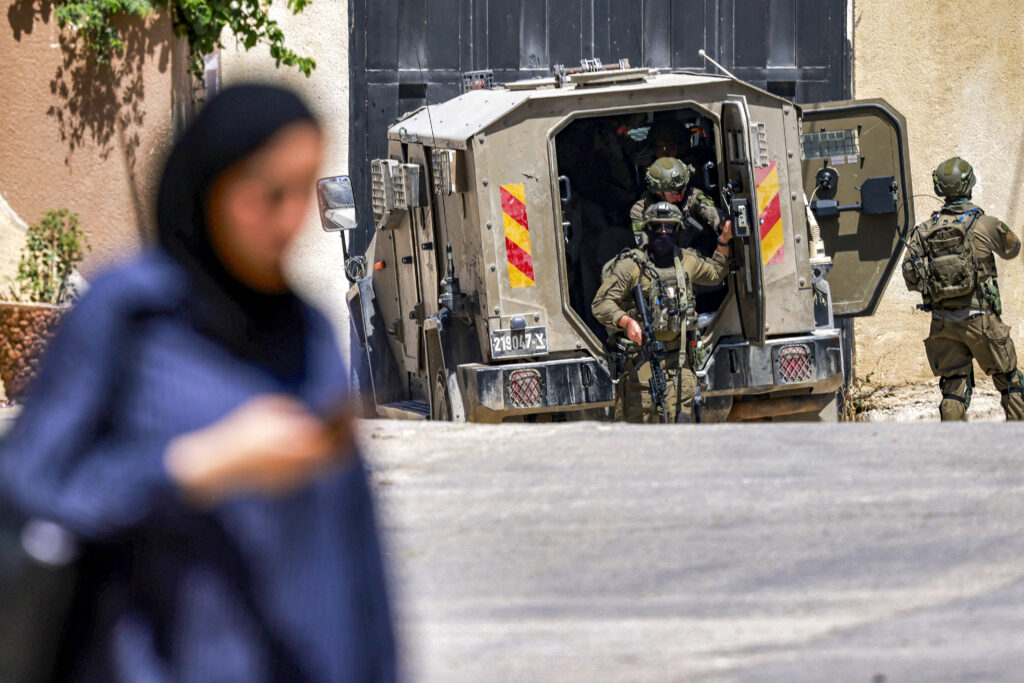
Image Caption: A Palestinian woman walks near Israeli army soldiers disembarking from a military vehicle during a military operation in the village of Salem, east of Nablus in the occupied West Bank, on 2 August 2026. Photo: AFP
About the Author
Reza Asadian is Senior Researcher at the Keio University SFC Institute in Japan focusing on Middle Eastern geopolitics, Iranian nationalism, and US foreign policy.

More in This Series
- Mohammad Eslami and Zeynab Malakouti
- -
- Alfred Schipke, Michelle Teo, Yu Hong, Fang Guo, and Lin Jing
- -