Iran’s Leaders Preach Resilience and Resistance. Its People Pay the Price
- Sima Aghazadeh
- -
The killing of Supreme Leader Ayatollah Ali Khamenei at the start of the United States-Israel war against Iran was presented as a significant military achievement and, optimistically, an opportunity to weaken or dismantle the Islamic Republic. Both the US and Israel aim to reshape the region into one without a long‑time ideological enemy. However, this narrative has overlooked or underestimated the institutional depth of the Islamic Republic, the centrality of endurance in Shia political doctrine, and the entrenched power of the Islamic Revolutionary Guard Corps (IRGC).
The appointment of Mojtaba Khamenei, the slain Supreme Leader’s son, as his heir partly reinforces this point. But despite the title, the Islamic Republic is not built around a single leader – as evidenced by the fact that even after the killing of top officials, including Ali Larijani just this week, Iran has continued to hold out under sustained bombardment. Instead, Iran’s governing system is structured around a complex network of clerical authorities, institutionalised revolutionaries, and security organisations designed to ensure its survival, and the system is based on dual governance.
The Supreme Leader, at the apex, is selected by the Assembly of Experts, an elected clerical body. The constitution places both religious and political power in the hands of the Supreme Leader, a system based on Shia theology, or velayat‑e faqih (guardianship of the jurist). This doctrine provides an ideological framework for the continuity of supreme leadership and the maintenance of state authority, even during crises. Beneath the Supreme Leader lie several layers of clerical and bureaucratic hierarchy — the Supreme Leader’s office, the Guardian Council, the judiciary, the security ministries, and semi‑state religious foundations. Alongside this authority lie the republic’s institutions (the President and Parliament), which are elected by popular vote, and operate in parallel with the clerical and bureaucratic bodies. Taken together, these entities’ overriding purpose is to preserve the regime by structuring power and resources in overlapping ways that make it difficult for the whole system to collapse, or for any one body to have supersede the others in authority. Having revolutionary courts beside regular courts, or the revolutionary guards alongside the national army, are examples of parallel jurisdictions and institutions that converge, particularly when regime survival is at stake.
At the centre of this underlying principle of ensuring loyalty to the regime’s core ideals is the Islamic Revolutionary Guard Corps (IRGC). Its extensive influence over the regular military, intelligence, economy, and media enables it to play a decisive role in managing leadership succession, suppressing challengers, controlling the streets, and reframing public narratives to ensure the regime’s survival. The IRGC also controls the Basij, a paramilitary network of cooperatives that links ordinary people to the structures of the security state.
With the appointment of Mojtaba Khamenei — a choice widely understood as engineered by the IRGC, and more as a strategic than a theological one[1] — the Corps signalled both its power and the intent to elevate a successor committed to the former leader’s vision, as well as his Asl-e Moghavemat (the “principle of resistance”). As importantly, the IRGC’s pivotal role in selection of the former Supreme Leader’s son — reportedly over the protests of some segments of the leadership — allows it to protect its own institutional interests. The Corps is more than a military body charged with protecting the regime. Over four decades, it has built its own economic empire. It has moved from the barracks to a business network, including oil and gas, petrochemicals, construction, transport, telecoms, banking, agriculture, medicine, real estate, and airports.[2]
As mentioned above, resistance — to the “last drop of blood”, a common declaration of resistance from officials and troops in the country — is the other key component of the system. This is an ideological position that frames compromise as a betrayal of the ideals of the Islamic Republic. At the same time, this concept of resistance draws from Shia Islam, particularly its narratives of suffering and steadfastness. The Karbala narrative — centring on Imam Hussain’s refusal to surrender to an unjust caliph, and his eventual martyrdom — is retold in sermons, mourning rituals, passion plays, and poetry, embedding it into the cultural memory. After 1979, the new regime systematically capitalised on these religious beliefs to boost its own legitimacy as part of its anti-imperialist brand. It recast Imam Hussain’s last stand as a model for revolutionary resistance against injustice, even when defeat is certain, while using the Shia ethos of martyrdom, defending faith, and homeland to build a security-heavy system tuned towards constant confrontation. In this frame, the deaths of Ayatollah Khamenei and other senior leaders have been narrated not as a defeat, but a voluntary sacrifice that elevated them to the status of a martyr — resilient and steadfast leaders who chose to face the enemy rather than flee, inviting citizens to read the current war as the latest chapter in the history of resistance.
This resistance to any form of compromise is not limited to external threats — it is also deployed to stymie internal challenges from reformists and popular protest movements. The hostility of the leadership and the IRGC to internal pressures is rooted as much in self‑preservation as in ideology. Reform would mean opening up politics, media, and the economy, potentially exposing the regime’s web of networks, which benefit those classified as insiders. In particular, the IRGC’s sprawling empire could be subject to scrutiny, and potential rollback. Decades of investment in sanctions‑proof networks and monopolies mean that its authority and material survival are tied to a hard-line Iran. A more open Iran with meaningful political reform would erode the IRGC’s dominance and privileged role in elections, policing, and foreign policy. Ideologically, the IRGC sees itself as the guardian of the revolution against internal and external plots; in this vein, it can — and has — recast reformists and protesters as instruments of a covert war, making compromise look like a betrayal of the revolution, rather than adaptation. This explains the frequent casting of reformists and protesters alike as “agents of foreign enemies”.
The Islamic Republic’s survival is thus tied to a lattice of authorities around the IRGC and related security entities. Over time, this hard core has been unchallenged, owing to a weak reformist camp that has been broken up and intimidated, both within official politics and beyond it. The internal opposition has thus been fragmented and easily repressed. Meanwhile, the overseas-based opponents of the regime, most notably Reza Pahlavi, the son of the former Shah, are easily painted as being directed by forces outside Iran.
There is a flip side to this, however. Ordinary Iranians have also tapped the qualities of resilience and resistance to adapt to, improvise, and survive under severe economic, bureaucratic, and political constraints. They deal with shortages, censorship, imprisonment, and rigid rules by bending and subverting them through informal networks, grey markets, humour, satire, metaphor, and creative reinterpretations. The pride of an ancient civilisation with a long history of foreign intrusion has animated nationalism and the spirit of defiance amongst Iranians. Modern episodes like the Constitutional Revolution (1905), the 1953 United States-led coup that overthrew Prime Minister Mohammed Mossadegh, and the Iran-Iraq war, are all remembered as examples of external interference and the resistance of a nation that was besieged, but endured. This imperative has been aided by the themes of endurance and quiet defiance that have a long-standing presence across classical and modern Persian literature. Poets like Hafiz and Rumi employ mystical, libertine language to subtly contest dominant power while advocating patience and inner resilience to transform hardship into spiritual growth. This tradition continues in contemporary writing by authors such as Dowlatabadi, Parsipour, and Daneshvar; for example, Shahrnush Parsipur’s Women Without Men (1989) uses allegory and magical realism to portray women’s quiet resistance as a form of survival and solidarity under patriarchal repression[3]. After decades of repressive rule, economic mismanagement and crippling sanctions, resistance and endurance have become normalised features of life. Perhaps more potently, they are a daily reminder that much of the cost of the leadership’s policies is ultimately paid by ordinary Iranians. This explains the deep anger and hatred that many Iranians feel towards the regime. Decades of corruption and mismanagement, aggravated by sanctions and wars, have caused constant inflation, unemployment, blackouts, and a scarcity of everyday items. The leadership has replied only with increasing repression and humiliation. Repeated waves of protests and uprisings, from the 2009 Green Movement, to the 2022 “Women, Life, Freedom” protests, and the unrest in January 2026, have been silenced by brutal crackdowns. The killing of protesters in the demonstrations earlier this year has only deepened the sense of anger and disappointment. The current war has made things worse, forcing Iranians to tap even deeper into their reserves of endurance, trapped between the regime and external forces that encouraged them to rise up, but which have only added new layers of danger and uncertainty to their lives and livelihoods.
If, as expected, the Islamic Republic survives this war, it will be because of the resilience that has been built into the system, making it less vulnerable to the decapitation campaign waged by the US and Israel. However, Mojtaba Khamenei and his leaders will be left with a shattered economy, limited deterrence capability, and the enmity of neighbours. Iranians will be an angry and helpless people that have once again been presented with the bill from the path its leaders have chosen. With what is likely to be a regime that will be even more hardline than the one it replaced, Iranians will (again) be called upon to display the resilience and endurance that their leaders have deployed effectively in service of their own survival.
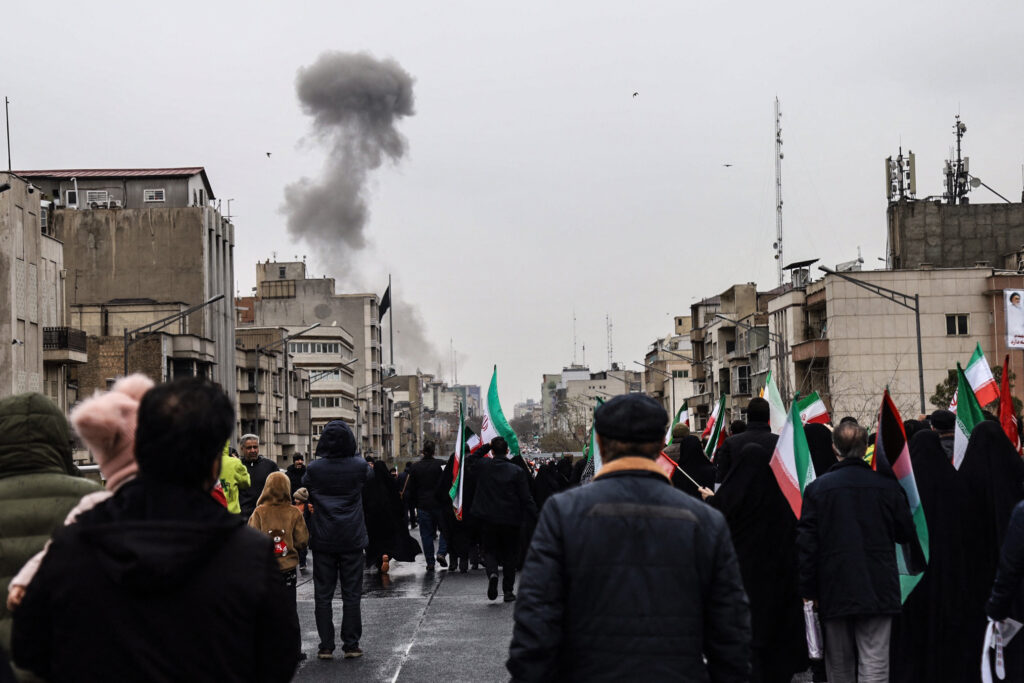
Image Caption: Black smoke rises following an airstrike, as Iranians take part in the Al-Quds (Jerusalem) Day rally, a commemoration in support of the Palestinian people on the last Friday of the Islamic holy month of Ramadan, in Tehran on 13 March 2026. Photo: AFP
About the Author
End Notes
[1] https://www.nytimes.com/2026/03/16/world/middleeast/iran-mojtaba-khamenei-election-supreme-leader.html?searchResultPosition=1
[2] For further background on the IRGC’s economic role, see “Economic activities of the Iranian Revolutionary Guard Corps,” Wikipedia, last modified 27 November 2024, accessed 17 March 2026, https://en.wikipedia.org/wiki/Economic_activities_of_the_Iranian_Revolutionary_Guard_Corps.
[3] Mukherjee, Reshmi. (2020). “Gender and Imagination: A Feminist Analysis of Shahrnush Parsipur’s Women Without Men”. In K. Moser, and A.C. Sukla (Eds.), Imagination and Art: Explorations in Contemporary Theory (Value Inquiry Book Series, Volume 351, pp. 111-136). Brill Academic Publishers. https://doi.org/10.1163/9789004436350_007