
Syria’s Economy Remains on Life Support – a Recovery is Not in Sight
- Samriddhi Vij
- -
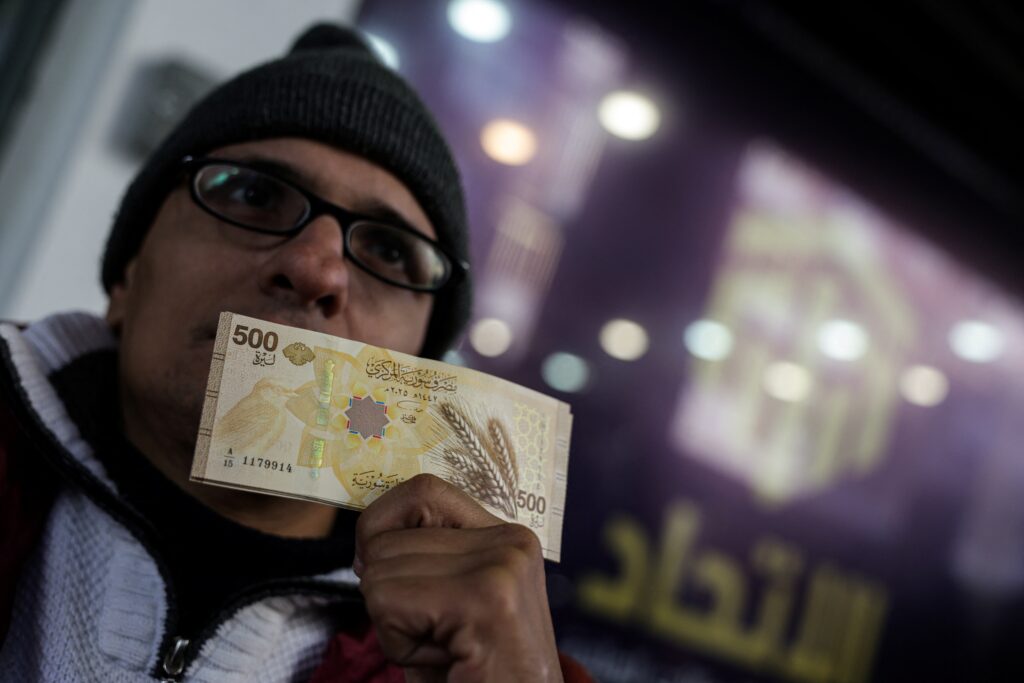
An assessment of Syria’s trajectory 14 months after the fall of the Assad regime requires a shift in direction, from the cessation of conflict to state-building. The current discourse has focused heavily on narratives of global support for President Ahmed al-Sharaa and large investment pledges by the Gulf countries to stabilise the country. However, there is a dissonance between international diplomatic signalling and empirical macro-economic constraints on the ground. Understanding the granular mechanics of this transition is essential to identifying the structural blockages that might be preventing a genuine recovery in Syria.
Negative Stabilisation and Bootstrapped Recovery
The current environment in Syria is best understood as a state of “negative stabilisation”. This is a fragile equilibrium where the absolute collapse of the state has been averted, yet the foundational institutional prerequisites for sustainable renewal are missing. There have, however, been crucial localised developments. The removal of rent-extracting Assad-era security checkpoints and the unification of previously fragmentedinternal tariffs have eased domestic trade. By eliminating the toll mechanisms, the logistical friction historically imposed on internal supply chains has drastically reduced. This direct reduction in transportation costs prevents the artificial inflation of the prices of basic commodities, enabling basic goods to reach urban markets at fairer prices, which actively stimulates latent domestic demand. This has provided some localised economic stimulus, allowing basic commerce to circulate across the country.
However, over one million refugees and an estimated two million internally displaced persons (IDPs) are returning to their communities in Syria, which is increasing the demographic pressure on the country. These pressures can manifest as severe strains on already weak municipal infrastructure and a demand-side shock for basic provisions. Consequently, the localised economic stimulus generated by the easing of internal trade can be rapidly absorbed and largely offset by this population surge, leading to marginal supply-side improvements being swallowed by consumptive needs. This dynamic further thrusts the Syrian economy into a weak equilibrium, making it inherently unstable.
Magnifying these challenges is the fact that there is no centralised external guarantor willing to completely underwrite Syria’s reconstruction. The most plausible candidate would not be a singular global superpower, but rather a regional coalition spearheaded by Gulf sovereign wealth — specifically Saudi Arabia, which facilitated the initial conversation between US President Donald Trump and Mr al-Sharaa. This absence of a guaranteed financial backstop has given rise to what can — optimistically — be termed a “bootstrap model” of endogenous recovery.
An important engine of Syria’s decentralised stabilisation has been diaspora remittances, which the Syrian Central Bank has described as a “lifeline” for the economy. Estimates suggest remittance inflows stoodat US$4 billion annually in 2025, accounting for 15-20 per cent of the unofficial GDP. In the immediate post-conflict period, these transfers primarily financed basic consumption like food, fuel, and rent. However, recent local reporting indicates that Syria’s micro-, small- and medium-sized enterprises are witnessing a revival, especially after sanctions were rolled back. While systematic data on this structural shift remains limited, qualitative evidence suggests that diaspora capital is playing a growing role in localised economic reactivation in the absence of formal credit markets.
Despite these small wins, an estimated 90 per cent of the Syrian population remains mired in poverty, and the formal financial system is effectively crippled by a severe liquidity crisis. These issues were laid bare in February 2025, when the Central Bank had to fly in reserve banknotes from Russia to maintain circulation. According to World Bank reporting, this liquidity crunch has resulted in weekly bank withdrawal limits of approximately US$38 for ordinary Syrians, which dampens economic activity.
This financial triage has successfully secured a baseline of societal survival, but, at best, has led to negative stabilisation — the macro-economic reality still presents a severe challenge. The World Bank estimates that Syria’s physical reconstruction will require a staggering US$216 billion in capital expenditure. This is 10 times Syria’s GDP, which is an estimated US$21.4 billion. While the endogenous bootstrap model has established a fragile economic floor and shielded the population from immediate crisis, Syria is structurally and institutionally incapable of scaling. Addressing a US$216 billion reconstruction bill requires a fundamental shift in international de-risking mechanisms and domestic governance, a shift that current geopolitical trends do not yet support. Therefore, this “bootstrap” dynamic does not necessarily lead to a genuine macroeconomic recovery, but can be understood as a survival mechanism born of necessity. Endogenous, localised capital will find it difficult to bridge the country’s infrastructural deficit and therefore, without significant external institutional funding, Syria might remain trapped in a low-level equilibrium of mere subsistence.
Low-Level Economic Equilibrium
The core challenge facing the Syrian political economy is its inability to transition from informal survival to formalised macro-economic recovery, leading to a low-level economic equilibrium — stagnation. This stagnation is driven by three main issues.
First, there is a vast gap between geopolitical pledges and actual capital deployment. The narrative of Syrian reconstruction is currently driven by headlines about mega-investments. President al-Sharaa has claimed that the transitional state has attracted US$28 billion in foreign investments over a 10-month period. This includes a US$14 billion package announced in August 2025, and a subsequent US$5.3 billion framework of bilateral agreements signed with Saudi Arabia in February 2026 covering aviation, telecommunications, and water infrastructure. However, the deployment gap tells a different story. These deals are often criticised as taking the form of non-binding Memoranda of Understanding (MoUs) that lack enforceable legal frameworks. The reality is that the actual disbursement of institutional foreign direct investment remains unclear in public reporting, and highly limited relative to headline pledges. Capital is being pledged for regional stability, but translating this into bankable, executed projects remains uneven.
Second, Syria suffers from a profound sovereignty deficit. National economic integration has proven difficult because of territorial fragmentation. The interim government does not exercise control over the entire country, with pockets of the north-east still under the control of ethnic Kurdish-led Syrian Democratic Forces (SDF), while areas south of Damascus are controlled by members of the Druze religious minority. In the north-east, while a framework was reached to integrate SDF structures into the national institutions, the agreement has proven hard to implement. The interim government has reportedly taken over of Syria’s largest oilfields, but continued inter-communal violence underscores how fragile the transition remains. This fragmentation leads to uncertainty over resource collateral and the fiscal insolvency of the central government.
Third, the residual architecture of international sanctions maintains a legal quarantine around the formal economy. While the US terminated broad sanctions and also repealed the Caesar Act (an American law imposing severe sanctions on members of the Syrian regime), Syria remains on the Financial Action Task Force’s (FATF) “grey-list”, a designation highlighting systemic vulnerabilities regarding money laundering and terrorist financing. As a result, global banks and investors remain sceptical about the safety of their assets in Syria, leaving the country disconnected from normal global banking and investment channels.
Evaluating this “bootstrap” model yields a bifurcated verdict. As a survival mechanism, it has worked. It has functioned as a resilient system, preventing famine, absorbing over three million returning refugees and IDPs, and establishing a certain degree of localised commercial stability. However, as an engine for macro-reconstruction, it has failed. An informal cash economy cannot bootstrap a US$216 billion infrastructural deficit.
Ultimately, Syria’s economic paralysis is also a direct symptom of its political fracture. A foundational axiom of political economy is that sustainable macro-economic developments are inevitably tethered to political stability. Large-scale capital investment demands the certainty of a consolidated state and the rule of law. Until this foundational political stability is achieved, the prospect of transitioning Syria from a fragile survival economy more akin to a failed state to a developing nation will remain in limbo.
Image Caption: A Syrian citizen shows off a new banknote released and distributed by the Central Bank, in the capital Damascus on 3 January 2026. People have begun exchanging the old currency — which lasted for more than five decades — at banks and private exchange offices, and started using the new notes on the first day of their release into the Syrian market. Photo: AFP
About the Author

More in This Series
- Mohammad Eslami and Zeynab Malakouti
- -
- Alfred Schipke, Michelle Teo, Yu Hong, Fang Guo, and Lin Jing
- -