
A New Alliance in the Middle East? Evaluating the Mecca Agreement
- Huzeir Ezekiel Dzulhisham
- -
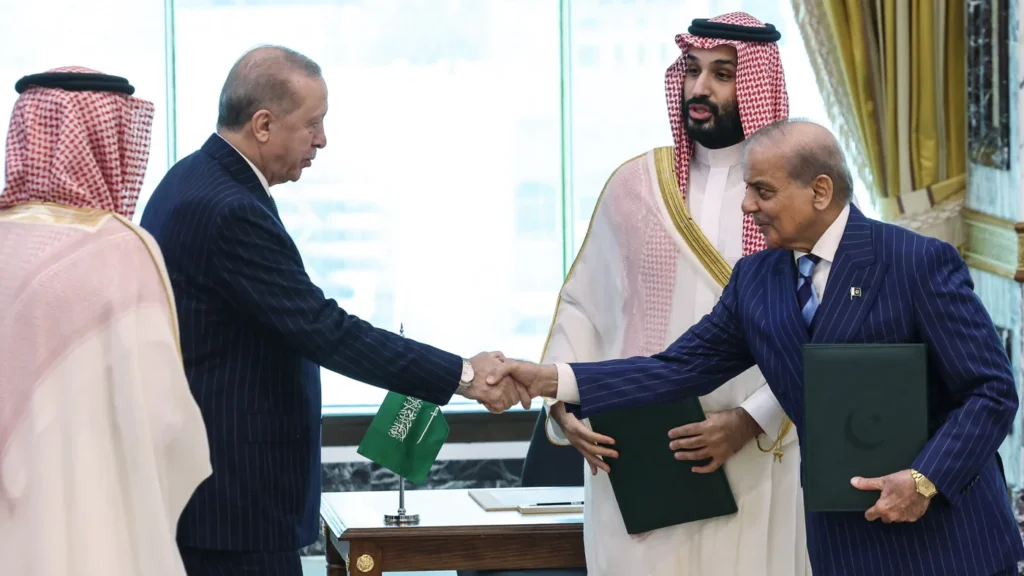
The signing of the Mecca Joint Defence Agreement on 7 August by Turkey, Pakistan, and Saudi Arabia has spurred intense debate over the future of the Middle East’s regional security architecture. Of particular interest in the Mecca Agreement is the reported mutual defence clause, which states that an attack on one is an attack on all, similar to the North Atlantic Treaty Organisation’s (Nato’s) Article 5. The agreement’s timing is certainly opportune, as the ongoing US-Iran War has forced Persian Gulf states to reconsider their reliance on American security guarantees, and to recognise the possibility of being repeatedly and unwillingly impacted by the consequences of policies made in Washington. Two critical questions ought to be considered in the wake of the signing of the agreement: Will it replace US security guarantees, and grant greater strategic autonomy for the three states involved?
Short-Term Force Multiplier
The agreement appears to be a force multiplier for the existing security architecture, with an immediate aim of creating more comprehensive military defence and deterrence. It expands upon existing bilateral security arrangements, most notably the 2025 Strategic Mutual Defence Agreement (SMDA) between Pakistan and Saudi Arabia. It is thus unlikely that the Mecca pact will replace existing US security guarantees — the dominant security architecture in the Middle East — in the short term. Indeed, there is recognition that there is currently no other state that can, or is willing, to match the volume and reliability of US military commitments.
That said, the ongoing war with Iran revealed the weaknesses of the US security umbrella. Attacks on the Gulf’s refineries, desalination plants, ports, airports, and even hotels have led to questions over the deterrence value of US bases. The war also demonstrated that US military power can be overstretched. American forces are reportedly facing a severe shortage of long-range missiles, interceptors, and Reaper drones because of sustained Iranian aerial attacks. These lapses have intensified pressure to diversify security and create a more comprehensive architecture.
The complementary capabilities of the three states which signed the agreement are central to this force multiplier orientation. Turkey possesses the second-largest standing military force in Nato, and a well-established defence industry capable of producing sophisticated weapons such as drones, missiles, and Kaan fighter jets. Pakistan is a nuclear-armed state with a sizeable 660,000-strong military, while Saudi access to American military technology complements the capabilities of the other two countries. Riyadh’s financial resources could also provide binding links for a trilateral military partnership, catalysing greater interdependence through defence-related investments.
This military alignment creates a multi-layered defence architecture and — theoretically — entrenches deterrence against an unprecedented convergence of emerging threats that include an Iranian blockade of the Strait of Hormuz, persistent attacks from both Houthis in Yemen and Iran-linked Iraqi militias, and the ongoing occupation of southern Syria and Lebanon by Israel.
Long-Term Possibilities
Importantly, the Mecca Agreement provides the foundations for a more consolidated defence partnership that could, in the long-term, counterbalance US security guarantees. Plans for greater institutionalisation of the trilateral partnership have been announced, with a permanent secretariat to be headquartered in Riyadh, along with joint naval, air, and land exercises, and ministerial coordination mechanisms. It is no coincidence that all three states are members of the Saudi-initiated Multilateral Maritime Defence Coalition (MMDC), which was launched a week before the Mecca Agreement to protect freedom of navigation in the Bab El Mandeb. While separate from the Mecca Agreement, the MMDC represents a trial for the trilateral group’s military coordination in one sense, with Pakistan and Saudi Arabia assuming leadership roles — it has been announced that the coalition’s commander is a Saudi rear-admiral, while the deputy commander will be from Pakistan.
The Mecca Agreement also outlined deeper defence industry cooperation, including “joint development and production, technology cooperation, and sustainable maintenance and logistics support”. In the longer term, there is thus potential for indigenously-developed, inter-operable military systems between the three countries. In the long term, this could possibly facilitate the creation of a new trans-regional military industrial complex across the Middle East and South Asia.
Greater Manoeuvrability
A direct political outcome of a more consolidated trilateral group is greater manoeuvrability for all three states, which could magnify the group’s regional influence. First, it would allow Saudi Arabia and Pakistan to resist renewed US pressure to join the Abraham Accords. Since the announcement of the accords in 2020, US foreign policy has been aimed at forming an anti-Iran bloc and isolating Tehran through normalised Arab ties with Israel. This led to US attempts to pressure Arab and Muslim states to join the initial members of the grouping — the United Arab Emirates and Bahrain, and later, Morocco, Kazakhstan, and Sudan.
Saudi Arabia has been a particular focus of this pressure, owing to its size and religious standing. In a November 2025 meeting, President Donald Trump pressed Saudi Crown Prince Mohammed bin Salman on the issue. Earlier this year, after a US-Saudi nuclear deal was announced, Mr Trump unexpectedly conditioned assistance in developing the Kingdom’s civilian nuclear programme — a key prize for Riyadh — on normalisation with Israel.
The Mecca Agreement allows Saudi Arabia to resist this push, by giving it greater flexibility, via military acquisitions with Turkey, for example. While the Turkish defence industry is still developing and currently cannot match advanced US defence systems, this may change in the future, given the rapid progress made by it. In April, Turkish conglomerate Baykar tested autonomous “swarm” drones with artificial intelligence capabilities that are resistant to electronic jamming. Turkish openness to technology transfers and joint production and development programmes offer an added advantage over transactional US and Western defence deals that only sell equipment and offer training programmes for their operation. Additionally, US law requiring the preservation of Israel’s qualitative military edge in the region restricts Washington’s ability to export the advanced defence technologies it does to Tel Aviv to Riyadh, further constraining the Kingdom.
Besides offering the Kingdom a less onerous route to advanced weaponry, the agreement could also give Saudi aspirations to localise 50 per cent of all defence production by 2030 under the Vision 2030 plan a boost.
While it was explicitly stated by Turkish Foreign Minister Hakan Fidan that the Mecca pact was aimed at “no country”, it can be inferred that Iran was the proximate trigger for the agreement, and it provides additional regional manoeuvrability for the grouping in the form of layered collective deterrence against any potential aggressor. In military terms, as prominent scholar Hamidreza Azizi wrote, Turkey’s membership in Nato and Pakistan’s nuclear capabilities provide overlapping deterrence against attacks from Iran or elsewhere. Separately, growing Turkish economic and political clout in Iraq, as well as the MMDC in the Bab El Mandab, create additional points of resistance against Iran-backed Axis of Resistance groups, namely the Houthis in Yemen and the Iraqi Popular Mobilisation Forces.
Economic deterrence could also be a facet of the Mecca Agreement. Given the chokepoint created by the closure of the Strait of Hormuz, overland trade routes may become more critical for Iran’s economic recovery in the post-war era. As Dr Azizi also pointed out, these routes must transit either through Turkey in the west, or Pakistan in the east, and this creates an interdependency that could deter attacks.
Despite this, Iran appears unthreatened by the Mecca Agreement. Its Foreign Ministry spokesman, Esmail Baghaei, said Iran had no reason to fear that the agreement was directed against it. The low threat perceptions could be explained by the incidental — and ironic — alignment of the agreement with Iran’s strategic outlook, specifically a reduced US role in regional security in the future, and constraints on the expansion of the Abraham Accords.
Further, while deterrence is the primary aim of the pact, it also creates avenues for stabilised détente between the signatories and Iran. All three states possess established ties with Tehran, providing foundations for détente and even greater future regional cooperation. Despite the ongoing war and attacks against the Kingdom, diplomatic ties between Saudi Arabia and Tehran, facilitated by the 2023 Beijing-brokered rapprochement, have been maintained. Riyadh even sent an envoy to the funeral of Iranian Supreme Leader Ali Khamenei. Pakistan has played an influential role in mediating US-Iran tensions, as Islamabad’s leaders have direct ties with Iran’s ruling elites. Meanwhile, Turkey has pursued a pragmatic stance by maintaining cooperative ties with the Islamic Republic. In June, Iranian President Masoud Pezeshkian and his Turkish counterpart Recep Tayyip Erdogan held a call that “stressed the importance of continued diplomatic engagement, stronger bilateral cooperation”.
Counterbalance Challenge
Though it holds several advantages for the countries involved, there is a risk that the Mecca Agreement could heighten threat perceptions and provoke a counterbalance from excluded states. The most significant danger is that the pact aggregates regional rivalries across three regions: The eastern Mediterranean, South Asia and the Middle East, possibly creating competing blocs and more dangerously permissive conditions for the escalation of trans-regional conflict.
Ties between Turkey and Israel, for instance, are growing more fraught. On 18 August, Israel struck Abu al-Duhur airbase in Syria. A day later, Israeli Prime Minister Benjamin Netanyahu indirectly acknowledged the country’s involvement, saying that “we will not tolerate a Turkish military entrenchment moving southward, because it threatens us”. Defence Minister Israel Katz followed with a more direct threat, warning Turkey against “dangerous adventurous in Syria”, and that it should not test Israeli resolve. Significantly, Israeli media has framed the Mecca Agreement as posing “new challenges” for the country. Pakistani defence relations with Saudi Arabia and Turkey, meanwhile, could alarm India and escalate simmering tensions that erupted most recently during the 2025 conflict between the South Asian rivals. The Saudi alignment could, in turn, reignite sharpening regional tensions with the United Arab Emirates that broke into the open in late 2025 and were set to grow more acute before the Iran war broke out. Indeed, there is widespread analysis that the Mecca Agreement could provoke a multilateral counterbalance with the so-called “Abrahamic Axis” of Israel and the UAE, which India is aligned with.
Recognition of these risks explains active attempts to diffuse threat perceptions, Turkish Foreign Minister Hakan Fidan stressed that “there is no common threat that we have put in writing from any one state”, and that the Mecca Agreement was explicitly oriented towards collective defence and regional stability. In the weeks before the agreement was signed, coordinated social media campaigns were launched between Saudi Arabia and the UAE that proclaimed the “brotherly relations” between both states, with meetings between the Saudi Defence Minister and Emirati Vice-President to dispel suggestions of a serious rift.
Uncertain Future
It remains uncertain if the Mecca Agreement will evolve into a consolidated defence alliance with any real regional clout. Sceptics have argued that it could be a show of force rather than closer military alignment comparable to defence alliances like Nato. Indeed, while nuclear deterrence was implied by association with Pakistan, it is questionable if nuclear weapons would be deployed to defend the trilateral pact, given the absence of explicit guarantees. Others have asserted that the agreement’s credibility could be tested after an attack, which is the case with ongoing strikes against Saudi Arabia by the Houthis after the Agreement — and to which no collective response has been mounted as yet. What is certain is that it is symptomatic of a regional realisation that there is value in multilateral cooperation in the face of multiple security threats.
Image Caption: Turkey’s President Recep Tayyip Erdogan shakes hands with Pakistan’s Prime Minister Shehbaz Sharif as Saudi Arabia’s Crown Prince Mohammed bin Salman looks on after signing a joint defence agreement in Mecca, Saudi Arabia, on 7 August 2026. Photo: Handout/Turkish presidency’s press office/AFP)
About the Author
Huzeir Ezekiel Dzulhisham is Senior Analyst in the Dean’s Office at the S. Rajaratnam School of International Studies (RSIS), Nanyang Technological University (NTU), Singapore. He specialises in geopolitics and international relations of the Middle East and Iran.
More in This Series
- By Reza Asadian and Hamid Bahrami
- -
- Mohammad Eslami and Zeynab Malakouti
- -