Following the American and Israeli strikes on Iran in February, Tehran responded with force against both countries, and expanded the fighting by targeting both United States military facilities and civilian infrastructure in the Gulf Cooperation Council (GCC) states before widening its strikes to include both Jordan and Egypt. For the Gulf states, which had moved from confrontation to accommodation — the latter, in some cases, reluctantly — with Iran, the Islamic Republic’s targeting of civilian infrastructure intensified. But frustration also grew with the US: To the Gulf countries, America appeared to have given short shrift to the economic and security consequences for the region before lurching into a war with Iran.
The resulting crisis prompted the GCC states to reassess the reliability of their security partnership with the US, and several began exploring alternative security alliances. In the early stages of the war, Saudi Arabia, along with Turkey, Pakistan, and Egypt, worked on a joint proposal aimed at ending the conflict,[1] a diplomatic effort that many regional observers interpreted as a step towards a more independent regional security architecture[2] — and which ultimately led to the so-called “Mecca Agreement”, a mutual defence agreement that omitted Cairo. At the same time, the other Gulf states sought to expand security cooperation with non-Western external powers – particularly India and China. The United Arab Emirates (UAE) deepened its defence relations with India during Prime Minister Narendra Modi’s visit to Abu Dhabi.[3] Subsequently, Indian External Affairs Minister S. Jaishankar visited Qatar, Bahrain, Kuwait, and Oman to “exchange views on regional developments and issues of mutual interest”.[4]
But despite the outreach to India, it is China which the Gulf states placed more weight on. Over the past decade, China has significantly expanded its economic presence in the region, and established comprehensive strategic partnerships with two of its leading powers, the United Arab Emirates and Saudi Arabia. It lent its diplomatic heft too, brokering the rapprochement between Saudi Arabia and Iran in 2023, its signature effort. China has also been the largest importer of Gulf oil for many years. The ongoing war directly threatens the security of China’s energy supplies, and hundreds of billions of dollars’ worth of investments in several sectors, including technology and infrastructure. Given its growing economic interests and diplomatic influence, there was an increasingly compelling reason for China to expand its role in the region’s security affairs.
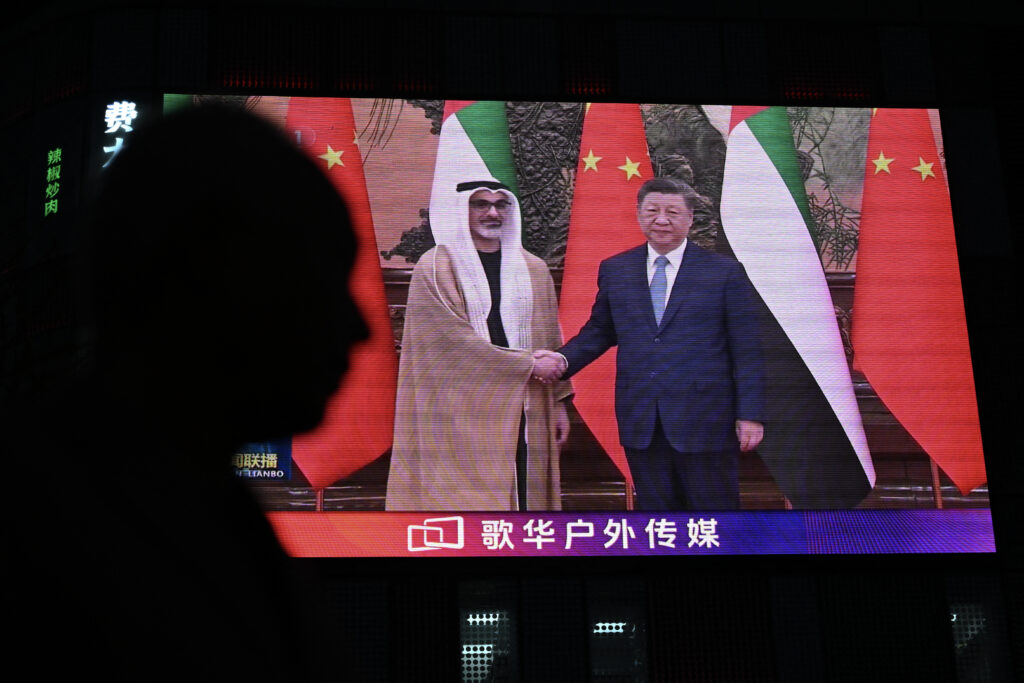
Abu Dhabi Crown Prince Sheikh Khaled bin Mohamed bin Zayed al-Nahyan thus met Chinese President Xi Jinping on 16 April,[5] during which both sides emphasised the need to strengthen bilateral cooperation amid a rapidly changing international environment.[6] Meanwhile, the Chinese and Saudi foreign ministers had a phone call on 4 March, shortly after the outbreak of the war.[7] The latter then visited Beijing on 30 June.[8]
However, while both the GCC states and China seek closer cooperation in security, a significant gap remains in their mutual expectations. China expects them to recognise that the US is not a reliable partner and wants them to pursue a regional security architecture with Iran. By contrast, they expect China to assume a more active role in West Asia and use its leverage over Iran. They look to Beijing to go beyond its calls for restraint, tolerance, and political resolutions, and make more concrete contributions to regional security.
China’s Expectations and Miscalculations of the GCC states in Regional Security
Chinese official rhetoric about the war has often reflected scepticism and enmity towards US hegemony and unilateral military intervention. From Beijing’s perspective, the war presents an opportunity for the GCC states to recognise that the United States may not be a reliable long-term security partner.[9] The American military bases in the Gulf, ostensibly stood up to safeguard their hosts, became among the first targets of Iranian retaliatory attacks. Iran’s subsequent closure of the Strait of Hormuz inflicted more economic damage. These developments reinforced the Chinese message that the interests and security concerns of the Gulf countries were not fully considered in the decision to initiate the war.
China has thus pushed regional states to pursue a more independent approach to security and to strengthen a collective framework.[10] This position was reflected in Mr Xi’s phone call with Crown Prince Mohammed, during which the former stated that “China supports countries in the region in building a shared home characterised by good neighbourly relations, development, security, and cooperation, enabling them to keep their future and destiny in their own hands”.[11]It was a position Beijing had advocated long before the war.[12] Likewise, the Saudi-Iran deal it brokered reflected its broader objective of promoting a security architecture that relies less on US security guarantees, and places greater emphasis on regional cooperation and autonomy.
However, Beijing appears to underestimate the structural and domestic challenges that GCC states face in pursuing such a path. Since the US established multiple bases in the Gulf during the 1990s, the GCC states have relied on Washington as their principal security partner. Decades of military cooperation, arms procurement, intelligence sharing, and institutionalised defence ties have created a high level of strategic interdependence. An independent regional security framework jointly governed by the regional powers therefore requires not only substantial financial resources, but also significant institutional and societal reforms. First, it would be difficult for the GCC states to significantly reduce their reliance on the United States and the European Union for arms and defence capabilities. It would be equally challenging to develop greater self-sufficiency in defence production. At present, the Gulf’s armed forces remain heavily dependent on imported weapons, foreign contractors, and expatriate technical personnel. Building an indigenous defence industry would require cultivating a large pool of domestic scientists, engineers, technicians, and skilled workers capable of supporting advanced military research, production, and maintenance — a long-term undertaking with no guarantee of success. The GCC states have sought to diversify their sources of military procurement by signing defence deals with China and Russia, and, more recently, with Turkey and Ukraine.[13] However, these partnerships have largely served as supplements rather than substitutes for their continued reliance on the United States and Europe for advanced weapons and defence capabilities.
Second, greater military autonomy would require sufficient manpower to sustain an independent defence strategy. Given the relatively small citizen populations of most GCC states, this would likely necessitate some form of compulsory military service. Countries with smaller population sizes that nevertheless maintain a high degree of military self-reliance — such as Israel, South Korea, and Singapore — have all relied on conscription to generate adequate military manpower. But introducing mandatory military service on a comparable scale in the Gulf would face considerable political and social constraints, particularly given the region’s reliance on expatriate labour and the high standard of living enjoyed by most citizens.
A regional security architecture would require China to facilitate greater cooperation between Iran and the Gulf states. This, however, has become particularly challenging given the depth of the GCC states’ anger following Iran’s attacks, which resulted in casualties, significant economic losses, and disruptions to oil exports. The conflict also triggered substantial capital outflows, undermining international investors’ confidence in the region as a safe and stable financial hub. More fundamentally, the Gulf states increasingly view Iran as an adversary and a major source of regional security risks. In the longer term, they are also concerned that Iran could acquire a dominant position in the regional security order. Under these circumstances, persuading them to engage in collective security arrangements with Iran would be extremely difficult.
China may have also underestimated the constraints created by persistent competition and divisions within the GCC itself. These intra-Gulf rivalries remain unresolved, and have continued to shape their responses to regional crises. Prior to the war, one of the most prominent developments was the sharp deterioration of relations between Saudi Arabia and the UAE. This rift has persisted, and has been reflected in the divergent strategies adopted by the two states in response to the war. Shortly after the conflict, the UAE withdrew from Opec and Opec+, reportedly citing dissatisfaction with the regional grouping’s response to the war. Saudi Arabia, meanwhile, has sought to strengthen military cooperation with non-GCC partners. Oman, on the other hand, has pursued a more neutral and conciliatory approach, seeking to mediate with Iran and reduce the likelihood of further attacks. These divergent approaches demonstrate that the GCC states do not share a unified assessment of the regional threat or a common strategy for managing Iran, further complicating China’s efforts to promote a collective regional security framework.
The GCC States’ Expectations and Miscalculations of China in Regional Security
Following China’s release of its Four-Point Proposal on Middle Eastern Security in April 2026,[14] the Al Jazeera news outlet praised Beijing’s balanced, non-aligned diplomatic approach, and its consistent support for political solutions to regional conflicts.[15] The commentary also highlighted China’s role in facilitating the Saudi-Iranian reconciliation, implying that Beijing could emerge as a more responsible major power and a potential alternative to the US in promoting regional stability.[16] The article further argued that the proposal reflected “China’s effort to consolidate its presence as an international actor that favours dialogue and mutual understanding and focuses on shared interests and stability, rather than becoming entangled in traditional political blocs and rivalries”.[17] However, it did not provide a detailed assessment of the document’s practical impact, or its effects on the ground.[18]
While some Gulf countries may hope that China will assume greater security responsibilities, Quite apart from capability — which Beijing does not yet possess — it is unlikely of playing a role comparable to that of the US for at least two reasons. First, China has largely adhered to the principle of non-intervention in its foreign policy. Since the 1980s, it has avoided direct participation in major military conflicts beyond its immediate neighbourhood, making it unlikely that it would abandon this long-standing approach. Second, economic development has remained China’s main national priority since the beginning of the reform and opening-up era. Beijing is more inclined to allocate resources to domestic development than to sustain costly military commitments in distant regions. China also continues to face a range of pressing domestic challenges, including a rapidly declining birth rate, an ageing population, persistent development disparities between urban and rural areas, and between the eastern provinces and western regions, and an uneven economy.
In the face of the war, China has developed multiple layers of strategic buffers to mitigate the risks associated with potential disruptions to oil supplies through the Strait of Hormuz, thereby reducing the economic and energy pressures that could otherwise compel Beijing to become involved in the war. Given its substantial energy demand, Beijing has long pursued a strategy of diversifying its sources of oil imports in order to reduce dependence on any single supplier. International sanctions on Russian oil have spawned durable energy cooperation, aided by an extensive evasion apparatus, as China’s demand for energy complements Russia’s need for export markets. This partnership is further strengthened by the two countries’ shared land border and extensive cross-border pipeline infrastructure, which reduces reliance on vulnerable maritime routes. At the same time, China has invested heavily in renewable energy and other low-carbon technologies, gradually reducing the relative importance of oil in its overall energy mix. Beijing has also steadily expanded its strategic petroleum reserves over the past two decades. Since 2025, it has further increased these stockpiles, enhancing its capacity to withstand short-term disruptions to imported oil supplies. Taken together, these measures have reduced China’s strategic vulnerability to the closure of the Strait of Hormuz.
The GCC states also expected China to use its close ties with Iran to exert greater pressure on Tehran. However, China’s response to the conflict appeared more sympathetic towards Iran, which it portrayed as a weaker party that was attacked while engaged in negotiations with the United States.[19] While China called on Iran to respect the sovereignty and territorial integrity of other states, its statements also demonstrated an understanding of the Islamic Republic’s position and avoided strong criticism of Tehran.[20] By contrast, its criticism of the United States was considerably harsher.[21]
Some policy analysts from the Gulf have noted China’s reluctance to assume a more substantial role in regional security. Bander Al-Dawsi, a Saudi journalist, argued that Beijing seeks to become an indispensable power in West Asia without bearing the costs and responsibilities of regional security.[22] He contended that deep economic interdependence between China and the GCC states does not necessarily translate into strategic reliability,[23] and characterised Beijing’s close political relationship with Iran, alongside its expanding economic ties with the GCC states, as opportunism, rather than balanced diplomacy.[24] He further argued that China’s repeated emphasis on restraint, dialogue, and de-escalation, without corresponding security commitments, has disappointed many GCC states.[25]
The GCC states’ expectations and Beijing’s response have constrained the development of bilateral strategic cooperation. Faced with an expanding war, the Gulf states have sought partners capable of providing concrete and immediate security support. The UAE, for example, has pursued closer security relations with the United States, despite the fact that the American military action led to large-scale Iranian attacks on the Emirates. This reflects Abu Dhabi’s continued reliance on the US as the only actor both willing and capable of providing advanced weapons, air and missile defence systems, and intelligence sharing. Saudi Arabia, meanwhile, has developed a regional security framework with Pakistan and Turkey, including a commitment to mutual defence in the event that one is attacked. In the absence of comparable and concrete security commitments from Beijing, China remains distant from a central role in the Gulf’s security architecture.
Although China appears unwilling to provide additional security commitments to the Gulf states and has maintained close ties with Iran, its bilateral relations with the former are likely to endure. It remains the Gulf’s largest oil buyer, while GCC states have also made significant investments in China’s financial services, downstream energy, renewable power, and logistics infrastructure.[26] In the short to medium term, both sides continue to have strong economic incentives to maintain their relationship: The Gulf states need China as a major market, investor, and economic partner, while China benefits from continued access to the region’s energy resources and investment opportunities. The result is the continuity of a relationship characterised by limited strategic reliance in security affairs, but deepening mutually-dependent economic engagement.
Conclusion
While the GCC states face severe domestic challenges in achieving strategic security autonomy, they have also aware that there is no credible alternative to the United States. As a result, they are not just unlikely, but also unable, to abandon their dependence on it in the near future. Similarly, their concerns about China’s regional security role are unlikely to undermine Beijing’s status as a key economic partner. They continue to seek stronger relations with Beijing in energy, investment, trade, technology, education, civil aviation, and tourism.[27] While a unified approach remains unlikely in the short term, the Gulf states’ diverse and increasingly active efforts to explore alternative security partnerships send a clear message to Washington about their dissatisfaction with the existing US security relationship. In this context, a closer relationship with China forms an important part of their hedging strategy vis-à-vis the US. Overall, in the short to medium term, the status quo is likely to remain.
In the long run, several GCC states’ responses to the security dilemma also suggest that they are gradually moving in a direction broadly consistent with China’s long-standing vision: Resolving conflicts through political dialogue, while strengthening regional security cooperation. Qatar assumed a more prominent mediating role between Iran and the United States despite having been furious about Iranian missile attacks. Saudi Arabia, meanwhile, strengthened its security cooperation through its pact with Pakistan and Turkey. The mutual defence agreement suggests that, at least on paper, the alliance is far more than a loose framework for cooperation, and could potentially evolve into a new regional security architecture.
Nevertheless, achieving greater strategic autonomy will be a gradual and challenging process. Building an effective collective regional security framework will require sustained political commitment and the ability to overcome significant political, institutional, and geopolitical obstacles. Meanwhile, divergence and competition among the GCC states pose another significant challenge. The UAE, Saudi Arabia, Oman, have each pursued different defence strategies in response to Iran’s attacks, reflecting their different threat perceptions and strategic priorities. This lack of a unified regional approach presents a significant obstacle to transforming a regional security framework into the broader regional security architecture envisioned by China.
The war will fundamentally reshape intra-Gulf relations and their relations with the world powers. This already underway, but will take a long time to materialise. What appears more certain is that China will continue to deepen its economic engagement with the Gulf, while staying on the sidelines when it comes to security.
References
Al-Dawshi, Bander. “حبل الصين المشدود بين إيران والخليج ( China’s Tightrope Walk Between Iran and the Gulf).” Al-Arabiya, April 7, 2026. https://www.alarabiya.net/politics/2026/04/07/حبل-الصين-المشدود-بين-ايران-والخليج-.
Alghad. “الصين تدعو إلى شراكة أقوى مع الإمارات وتؤكد سيادة دول الخليج (China Calls for a Stronger Partnership with the UAE and Affirms the Sovereignty of Gulf States.).” Alghad, April 14, 2026. https://www.alghad.tv/اخبار-الغد/news/الصين-يدعو-إلى-شراكة-أقوى-مع-الإمارات-وتدعم-سيادة-دول-الخليج.
Alhasan, Hasan. A New Middle Eastern Quadrilateral Is Taking Shape. May 6, 2026. https://www.iiss.org/online-analysis/online-analysis/2026/05/a-new-middle-eastern-quadrilateral-is-taking-shape/.
Al-Jazeera. “قدمت مبادرة النقاط الأربع.. هل تملك الصين مفتاح الاستقرار في الخليج؟ (Does China Hold the Key to Stability in the Gulf?).” Al-Jazeera, May 16, 2026. https://www.aljazeera.net/politics/2026/5/16/قدمت-مبادرة-النقاط-الأربع-هل-تملك.
Al-Shammari, Rahim. “الحفاظ على توازن الصين في الخليج – رحيم الشمري (Maintaining China’s Balance in the Gulf).” Azzaman.Com, n.d. https://www.azzaman.com/الحفاظ-على-توازن-الصين-في-الخليج-رحيم/.
Mahmoud, Mohamed. “Saudi Arabia, Egypt, Türkiye, Pakistan Move to Deepen Partnership, Cooperation.” Asharq Al-Awsat(Cairo), June 19, 2026. https://english.aawsat.com/gulf/5286181-saudi-arabia-egypt-türkiye-pakistan-move-deepen-partnership-cooperation.
Ministry of External Affairs, Government of India. “Visit of EAM Dr. S. Jaishankar to Qatar, Bahrain, Kuwait, Oman, New York and Brussels (July 05-15, 2026).” Ministry of External Affairs, Government of India, July 4, 2026. https://www.mea.gov.in/press-releases?dtl/41402/Visit_of_EAM_Dr_S_Jaishankar_to_Qatar_Bahrain_Kuwait_Oman_New_York_and_Brussels_July_0515_2026.
Ministry of Foreign Affairs of the People’s Republic of China. “Maintain the Comprehensive Agreement on the Iranian Nuclear Issue, Build a Multilateral Dialogue Platform, and Jointly Maintain Peace and Stability in the Gulf Region (维护伊核全面协议、搭建多边对话平台,共同维护海湾地区和平稳定).” 2020. https://www.mfa.gov.cn/web/zwbd_673032/wshd_673034/202011/t20201118_5856376.shtml.
Ministry of Foreign Affairs, People’s Republic of China. Saudi Foreign Minister Faisal Bin Farhan Al Saud to Visit China. 2026. https://www.mfa.gov.cn/mfa_eng/xw/wsrc/202606/t20260629_11953925.html.
Ministry of Foreign Affairs, People’s Republic of China. Wang Yi Has a Phone Call with Saudi Arabian Foreign Minister Faisal Bin Farhan Al Saud. 2026. https://www.fmprc.gov.cn/eng/wjbzhd/202603/t20260305_11869213.html.
Ministry of Foreign Affairs, People’s Republic of China. 习近平同沙特王储兼首相穆罕默德通电话 (Xi Jinping Holds a Phone Call with Saudi Crown Prince and Prime Minister Mohammed). 2026. https://www.mfa.gov.cn/web/zyxw/202604/t20260420_11895580.shtml.
Qi, Yibin. “美国霸权主义才是中东最大乱源(US Hegemonism Is the Primary Source of Chaos in the Middle East).” China’s Diplomacy in the New Era, March 7, 2026. https://cn.chinadiplomacy.org.cn/2026-03/07/content_118367667.shtml.
Reuters. “India Deepens Defence, Energy Ties with UAE during PM Modi Visit.” Reuters, May 15, 2026. https://www.reuters.com/world/india/india-signs-pacts-with-uae-defence-petroleum-during-modis-visit-2026-05-15/.
Shang, Yanyan. “Gulf Wealth Powers China’s 2025 Investment Boom: From Finance to Energy.” China Briefing, 2025. https://www.china-briefing.com/news/gulf-investment-in-china-2025-finance-energy/.
Shi, Ge. “中国代表就推进中东和平提出四点主张 ( Chinese Representative Puts Forward Four-Point Proposal for Advancing Middle East Peace).” Xinhuanet, June 11, 2026. https://www.news.cn/world/20260611/f7181249038e4caeb7178a2bf7d7b010/c.html.
Soylu, Ragip. “Gulf Turns to Turkey for Air Defence Systems amid Iran Threats.” Middle East Eye, 2026. https://www.middleeasteye.net/news/gulf-turn-turkey-air-defense-systems-iran-threats.
Telci, Ismail Numan. “The Emergence of a Regional Security Framework: Türkiye, Pakistan, Saudi Arabia and Egypt.” Al-Jazeera Center for Studies, May 14, 2026. https://studies.aljazeera.net/en/analyses/emergence-regional-security-framework-türkiye-pakistan-saudi-arabia-and-egypt.
Vakulina. “What Are Ukraine’s New Gulf Defence Deals?” Euro News, 2026. https://www.euronews.com/2026/03/30/what-are-ukraines-new-gulf-defence-deals-here-is-what-zelenskyy-signed.
“Wang Yi Held a Phone Call with Iranian Foreign Minister Araghchi 2nd March(王毅同伊朗外⻓阿拉格⻬通电话).” Ministry of Foreign Affairs of the People’s Republic of China., March 2, 2026. https://www.mfa.gov.cn/wjbzhd/202603/t20260302_11867266.shtml.
“Wang Yi Holds Talks with Saudi Foreign Minister Faisal (王毅同沙特外交大臣费萨尔会谈).” Ministry of Foreign Affairs of the People’s Republic of China, June 30, 2026. https://www.mfa.gov.cn/web/wjbzhd/202606/t20260630_11955133.shtml.
“Wang Yi on the Situation in Iran: Cease Fire and Stop the Fighting, and Restore Peace to the Middle East and the World (王毅谈伊朗局势:停⽕⽌战,还中东和世界以和平).” Ministry of Foreign Affairs of the People’s Republic of China, March 8, 2026. https://www.mfa.gov.cn/wjbzhd/202603/t20260308_11870443.shtml.
“Xi Jinping Meets with Khalid Bin Mohamed Bin Zayed, Crown Prince of Abu Dhabi (习近平会见阿联酋阿布扎比王储哈立德).” Ministry of Foreign Affairs of the People’s Republic of China, April 14, 2026. https://www.mfa.gov.cn/web/zyxw/202604/t20260414_11891401.shtml.
[1] Mahmoud, “Saudi Arabia, Egypt, Türkiye, Pakistan Move to Deepen Partnership, Cooperation.”
[2] Alhasan, A New Middle Eastern Quadrilateral Is Taking Shape; Telci, “The Emergence of a Regional Security Framework: Türkiye, Pakistan, Saudi Arabia and Egypt.”
[3] Reuters, “India Deepens Defence, Energy Ties with UAE during PM Modi Visit.”
[4] Ministry of External Affairs, Government of India, “Visit of EAM Dr. S. Jaishankar to Qatar, Bahrain, Kuwait, Oman, New York and Brussels (July 05-15, 2026).”
[5] Alghad, “الصين تدعو إلى شراكة أقوى مع الإمارات وتؤكد سيادة دول الخليج (China Calls for a Stronger Partnership with the UAE and Affirms the Sovereignty of Gulf States.).”
[6] Alghad, “الصين تدعو إلى شراكة أقوى مع الإمارات وتؤكد سيادة دول الخليج (China Calls for a Stronger Partnership with the UAE and Affirms the Sovereignty of Gulf States.).”
[7] Ministry of Foreign Affairs, People’s Republic of China, Wang Yi Has a Phone Call with Saudi Arabian Foreign Minister Faisal Bin Farhan Al Saud.
[8] Ministry of Foreign Affairs, People’s Republic of China, Saudi Foreign Minister Faisal Bin Farhan Al Saud to Visit China.
[9] Qi, “美国霸权主义才是中东最大乱源 (US Hegemonism Is the Primary Source of Chaos in the Middle East).”
[10] Ministry of Foreign Affairs of the People’s Republic of China, “Maintain the Comprehensive Agreement on the Iranian Nuclear Issue, Build a Multilateral Dialogue Platform, and Jointly Maintain Peace and Stability in the Gulf Region.”
[11] Ministry of Foreign Affairs, People’s Republic of China, 习近平同沙特王储兼首相穆罕默德通电话 (Xi Jinping Holds a Phone Call with Saudi Crown Prince and Prime Minister Mohammed).
[12] “Maintain the Comprehensive Agreement on the Iranian Nuclear Issue, build a Multilateral Dialogue Platform, and Jointly Maintain Peace and Stability in the Gulf Region.”
[13] Soylu, “Gulf Turns to Turkey for Air Defence Systems amid Iran Threats”; Vakulina, “What Are Ukraine’s New Gulf Defence Deals?”
[14] Shi, “中国代表就推进中东和平提出四点主张 ( Chinese Representative Puts Forward Four-Point Proposal for Advancing Middle East Peace).”
[15] Al-Jazeera, “قدمت مبادرة النقاط الأربع.. هل تملك الصين مفتاح الاستقرار في الخليج؟ (Does China Hold the Key to Stability in the Gulf?).”
[16] Al-Jazeera, “قدمت مبادرة النقاط الأربع.. هل تملك الصين مفتاح الاستقرار في الخليج؟ (Does China Hold the Key to Stability in the Gulf?).”
[17] Al-Jazeera, “قدمت مبادرة النقاط الأربع.. هل تملك الصين مفتاح الاستقرار في الخليج؟ (Does China Hold the Key to Stability in the Gulf?).”
[18] Al-Jazeera, “قدمت مبادرة النقاط الأربع.. هل تملك الصين مفتاح الاستقرار في الخليج؟ (Does China Hold the Key to Stability in the Gulf?).”
[19] “Wang Yi Held a Phone Call with Iranian Foreign Minister Araghchi 2nd March(王毅同伊朗外⻓阿拉格⻬通电话).”
[20] “Cease Fire and Stop the Fighting and Restore Peace to the Middle East and the World.”
[21] “Cease Fire and Stop the Fighting and Restore Peace to the Middle East and the World.”
[22] Al-Dawshi, “حبل الصين المشدود بين إيران والخليج ( China’s Tightrope Walk Between Iran and the Gulf).”
[23] Al-Dawshi, “حبل الصين المشدود بين إيران والخليج ( China’s Tightrope Walk Between Iran and the Gulf).”
[24] Al-Dawshi, “حبل الصين المشدود بين إيران والخليج ( China’s Tightrope Walk Between Iran and the Gulf).”
[25] Al-Shammari, “الحفاظ على توازن الصين في الخليج – رحيم الشمري (Maintaining China’s Balance in the Gulf).”
[26] Shang, “Gulf Wealth Powers China’s 2025 Investment Boom: From Finance to Energy.”
[27] “Wang Yi Holds Talks with Saudi Foreign Minister Faisal (王毅同沙特外交大臣费萨尔会谈).”
“Xi Jinping Meets with Khalid Bin Mohamed Bin Zayed, Crown Prince of Abu Dhabi (习近平会见阿联酋阿布扎比王储哈立德).”
Image Caption: News footage on a giant screen outside a shopping mall shows China’s President Xi Jinping (R) meeting with Abu Dhabi’s Crown Prince Sheikh Khaled bin Mohamed bin Zayed Al Nahyan in Beijing on April 14, 2026. Photo: AFP
About the Author
Jia Liu is a Research Fellow at the Middle East Institute