

Editor’s Introduction
Climate change is emerging as a potent threat to global peace and security. Its intensifying impacts – such as rising temperatures, shifts in precipitation, rising sea levels, ocean warming and more frequent and intense extreme weather events – not only aggravate existing vulnerabilities, including food, water, and livelihood insecurity but can also lead to heightened competition over diminishing natural resources, widespread displacement, increased societal tensions and conflict.
The Middle East is one of the most vulnerable and highly exposed regions to the impacts of climate change. It is warming faster than the global average. Already the most water-scarce region in the world, it is predicted to experience more persistent and acute drought owing to increasing temperatures.[1] Meanwhile, the region has long been grappling with deep-seated economic challenges, societal tensions and political instability, which have often precipitated conflict and affected human security. In these circumstances, climate change acts as a threat multiplier, contributing to dwindling natural resources, such as water, declining agricultural productivity, food insecurity, poverty, human displacement, intensified competition for resources and heightened societal tensions, all of which increase the region’s vulnerability to conflict and human insecurity.
This volume of Insights comprises seven chapters written by experts in the field, who bring evidence-based perspectives from across the region to explore the interlinkages between climate change risks and security.
**********
The first two papers underscore how climate-driven challenges exacerbate conflict and tension within conflict-prone regions, given their weak adaptive capacities to deal with climate change.
Johan Schaar’s paper (p. 7) brings insights from Sudan. It examines the two-way interaction between conflict and climate risks. While the causal linkage between climate change and conflict remains tenuous, Schaar’s analysis of the Sudan case indicates that societies trapped in conflict have weak adaptive capacity to deal with climate change, whether reducing emissions, adapting to extreme weather events or protecting vulnerable populations. This deficiency exacerbates human insecurity, including through forced displacement and conflict. On the other hand, climate change may amplify the underlying factors that contribute to tensions and conflict. This, the author notes, risks a vicious circle where a disintegrating society loses its ability to manage and resolve conflicts.
Drawing on examples from Syria and Yemen, Gina Bou Serhal, Serhat S. Çubukçuoğlu and Abdulla Alkhaja (p. 23) demonstrate that water scarcity in conflict-prone regions exacerbates tension and conflict at tribe or societal levels. The authors show how the intensifying impacts of climate change on water scarcity play a hidden role in driving various groups to compete for and weaponise scarce water resources. For instance, in Yemen, one of the most severely water-stressed nations in the world, 70% of conflicts were linked to competition over water resources even before the civil war erupted in 2009. Yemen’s water shortage allows competing groups to increasingly exploit water as a tool of conflict, further worsening water scarcity and the humanitarian crisis even as the consequences of climate change affect the supply of water. In Syria, the authors argue, climate-related drought drove rural Syrians to migrate to urban areas, which were already struggling with resource limitations, compounded by long-standing water mismanagement and inadequate government responses. The resulting competition for water, jobs and services created conditions conducive to the unrest in 2011 and allowed extremist organisations to vie for control over scarce water resources.
**********
The third and fourth papers highlight the interlinkages between climate change impacts and migration.
Leila Dagher, Nadim Farajalla, Hiba Jabbour and Mohamad Zreik (p. 38) show that while conflict remains the primary driver of mass displacement, followed by economic factors, climate change is increasingly recognised as playing a role in shaping the region’s migration patterns. Drawing on examples from Syria, Iraq, Jordan and Lebanon, the authors highlight a vicious circle between resource scarcity, conflict and displacement in the Levant region as natural limitations, compounded by poor governance, constrain development in the region and fuel major disputes and forced displacement. Meanwhile, conflict also plays a significant role in driving resource scarcity. As water becomes scarcer and food security more fragile, people are forced to move in search of stable living conditions, adding a layer of climate-induced migration to the already complex landscape of conflict-driven displacement. The authors also note a reverse displacement trend arising from the Israel-Hezbollah conflict that broke out in 2023, which forced many Syrian refugees in Lebanon to return to their home country. But the sudden influx of people has strained public services, infrastructure and natural resources in Syria, particularly water.
Anuradha Jangra (p. 51) highlights the case of Iraq, which has long faced the problem of internal displacement because of the history of war, conflict with the Islamic State of Iraq and al-Shams (ISIS) and two decades of inter-communal strife. Using migration data, Jangra explores how climate change, especially its implications for water scarcity and desertification, is reshaping migration patterns and in turn aggravating Iraq’s sociopolitical tensions. The influx of migrants into urban centres adds pressure on resources and services, adding fuel to sociopolitical tensions. Amid such tensions, tribes and armed militias have strategically capitalised on the nation’s growing water scarcity to consolidate their political power. As a result, several conflicts involving control of and competition for resources such as water have emerged over the past decade.
**********
The fifth and sixth papers highlight the hidden role of climate change in exacerbating transboundary tensions, especially over shared natural resources.
Ali Bakir and Abdullah H. Bakir (p. 64) analyse the intersection between the impacts of climate change on transboundary water resources and geopolitical relations. Focusing on the Jordan River, shared by Israel and Jordan, the paper emphasises that the increasing impacts of climate change add an extra layer of complexity to the existing tensions between the two neighbours over their shared water resources. The paper highlights Israel’s efforts to use its control over water as both a weapon and bargaining chip to pressure Jordan into making political concessions. It also notes that the Jordanian government’s responses in such circumstances have fuelled public discontent within the country. The paper concludes that dwindling water resources, compounded by ineffective diplomacy, could serve as a catalyst for potential conflict between the two countries.
Pourya Nabipour and Neda Beirami (p. 81) bring another example of how climate change affects transnational tensions and conflict. The paper focuses on the Aras River, which serves as a natural boundary between Iran and Azerbaijan. Using remote sensing data, the authors point out that climate-driven hydrological changes – including erratic precipitation, rising temperatures and altered snowmelt patterns – have introduced significant land cover changes around the Aras River. The socio-economic consequences of these changes include decreased
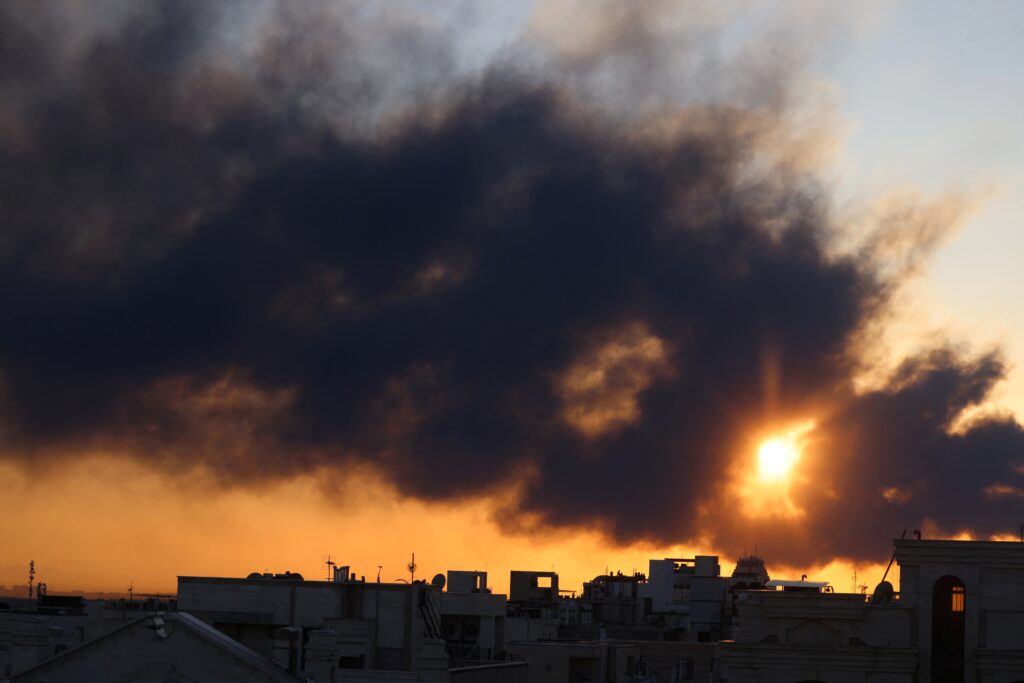
Smoke rises in the horizon following US airstrikes to claw back control over Iraq’s Mosul Dam from ISIS, 18 August 2014. (Photo: AFP /Ahmad al-Rubaye.)
agricultural yields and heightened food insecurity. Bringing historical evidence on the geopolitical tensions between Iran and Azerbaijan over the allocation of and governance over water resources, the paper highlights how the above socio-economic consequences of climate change intensify the existing disagreements and thus exacerbate geopolitical tensions.
**********
The final paper, by Kristian Alexander (p. 92), examines the interlinkage between climate risks and terrorism. Alexander shows how extremist organisations thrive in environments where state structures are weak, populations are desperate and social contracts have broken down. Using ISIS as an example, Alexander shows how such groups have taken advantage of the chaos brought on by climate change, such as droughts and resource scarcity, in Syria and Iraq, where environmental degradation has exacerbated civil unrest. Control over water became a strategic asset for ISIS during Syria’s civil war. The group targeted critical water infrastructure as a means of controlling populations and undermining its adversaries. By controlling dams, water supplies and agricultural resources, ISIS was able to strengthen its influence over local communities that depended on these resources for survival. This tactic not only bolstered the group’s legitimacy among segments of the population but also allowed ISIS to destabilise rival factions vying for control during the civil war.
**********
In sum, this Insight series demonstrates that while climate change does not always directly induce security challenges, it acts as a threat multiplier, intensifying existing sociopolitical and economic tensions. This is especially the case in less-developed countries with limited institutional capacity to manage scarce resources and climate change impacts. By providing evidence-based perspectives to improve our understanding of the potential for climate change consequences to heighten security risks, this Insight series aims to generate insights that could support the crafting of appropriate mitigation strategies.
CLICK HERE FOR THE PDF
About the Author
*Dr Aisha Al-Sarihi was a Research Fellow with the Middle East Institute, National University of Singapore, until December 2024. She is currently an environmental economic adviser at the Ministry of Economy, Oman. The views here do not reflect those of Oman’s Ministry of Economy or the government of Oman.
[1] UNFCCC, “MENA Climate Week 2023: Driving Regional Action on Climate Change”, 8 October 2023.
More in This Series
More in This Series
- Huzeir Ezekiel Dzulhisham
- -