Trump, Israel, and Regional Backlash: Understanding Anti-Americanism in the Middle East
America is a mixed bag for Arabs. Its culture and institutions are respected, but its policies in the Middle East, especially its unwavering support for Israel, are widely despised.
In this webinar, Professor Mustapha Kamel Al-Sayyid examined these contradictions, drawing on public opinion surveys from across the region to show how Arab societies balance admiration with resentment. The talk also highlighted the gap between popular sentiment and government policy and explored what these tensions mean for the future of US–Arab relations.
The lecture was held via Zoom from 3:00 pm to 4:00 pm (SGT) on Wednesday, 15 October 2025.
Watch the full talk here:
Listen to the full event here:
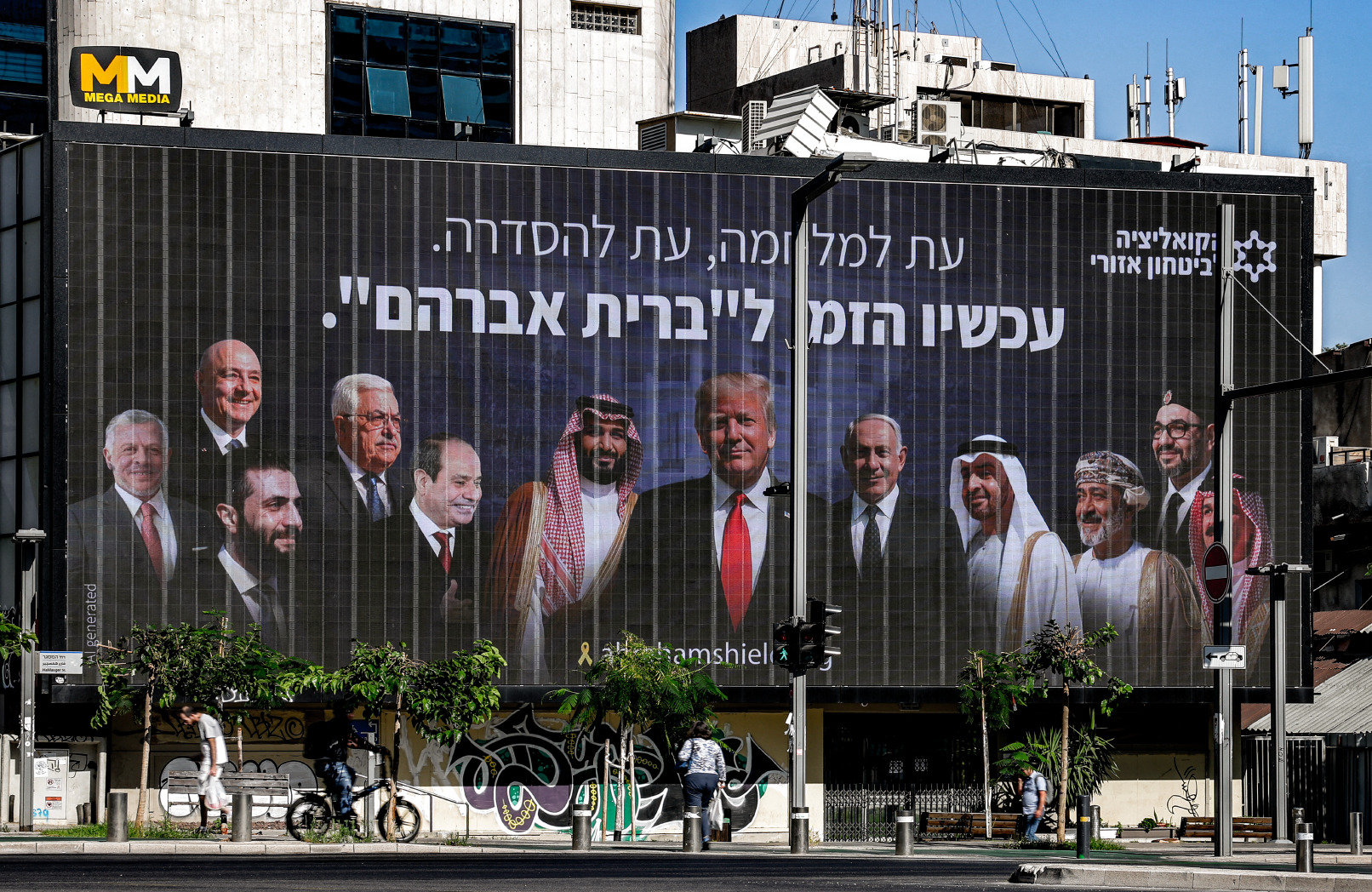
Photo caption: A billboard by the “Coalition for Regional Security” Israeli political-security initiative depicting (L to R) Jordan’s King Abdullah II, Lebanon’s President Joseph Aoun, Syria’s interim president Ahmed al-Sharaa, Palestinian president Mahmud Abbas, Egypt’s President Abdel Fattah al-Sisi, Saudi Arabia’s Crown Prince Mohammed bin Salman, US President Donald Trump, Israel’s Prime Ministe Benjamin Netanyahu, UAE President Sheikh Mohamed bin Zayed al-Nahyan, Oman’s Sultan Haitham bin Tariq al-Said, Morocco’s King Mohammed VI, and Bahrain’s King Hamad bin Isa al-Khalifa, with above the Hebrew slogan “a time for war, a time for settlement; now is the time for the ‘Abrahamic Covenant’” is displayed in Tel Aviv on June 26, 2025. (Photo by Jack GUEZ / AFP)
About the Speakers
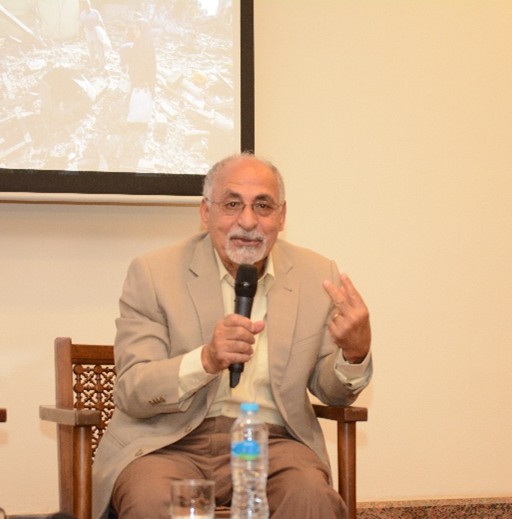
Prof Mustapha Kamel Al-Sayyid Professor of Political Science at the Faculty of Economics and Political Science, Cairo University
Mustapha Kamel Al-Sayyid was educated in Egypt and Switzerland, earning his Ph.D. from the Graduate Institute of International Studies in Geneva in 1979. Since 1982, he has taught Political Science at both Cairo University and the American University in Cairo. His international experience includes a year as a visiting scholar at the University of California, Los Angeles, a semester at Harvard Law School, and teaching two political science courses at Colgate University in the fall of 2005.
In addition to his academic work, Al-Sayyid has held leading roles in both the Egyptian Human Rights Organization and the Arab Political Science Association. He served on the U.S. Social Science Research Council’s Committee on Global Security and Cooperation and spent the summer of 2002 as a visiting fellow at the Carnegie Endowment for International Peace in New York.
Al-Sayyid has published extensively in Arabic, English, and French, focusing primarily on political economy, human rights, and civil society. His work has appeared in World Policy Journal, Middle East Journal, Arab Studies Quarterly, Maghreb-Mashreq, and Cairo Papers in Social Science. He led the core team that prepared the original version of the 2009 Arab Human Development Report and directed Cairo University’s Center for the Study of Developing Countries from April 1995 to November 2004. From 2005 to 2017, he was the founder and executive director of Partners-in-Development for Research, Consulting and Training, a think tank devoted to development issues. A pioneer in human rights education, Al-Sayyid was the first to teach a course on the Politics of Human Rights at both Cairo University’s Faculty of Economics and Political Science and the American University in Cairo.
He remains actively involved in civil society movements in Egypt, contributing regularly to public debates through a bi-weekly column in Al-Shorouk newspaper, occasional articles in other national publications, and interviews with media outlets such as BBC Arabic, as well as German, French, and other international satellite television channels.
Ms Evangeline Cheng Research Associate Middle East Institute, NUS
[Moderator] Evangeline Cheng is a research associate at Middle East Institute, National University of Singapore. Prior to her current role, she spent a large part of her career in learning and development, focusing on workplace learning and action research projects. She is particularly interested in the traditional and emerging dynamics within the geopolitical landscape of the Middle East, especially in relation to Jordan and Egypt. Evangeline holds a bachelor’s degree in communication studies and a master’s degree in Asian studies from Nanyang Technological University.