On 28 February, Iran was attacked by Israel and the United States in what was portrayed as a “pre-emptive” move. In retaliation, Iran launched waves of missiles and drones at Israel, as well as US military installations and other targets, including civilian ones, across all the Gulf Cooperation Council (GCC) countries — Bahrain, Kuwait, Saudi Arabia, Oman, Qatar, and the United Arab Emirates (UAE). While a US attack had been anticipated for weeks — America had carried out the biggest buildup of its military in the region since the 2003 invasion of Iraq from early February — the key questions now are: What are the immediate short-term implications of the US-Israeli attacks, and why now?
Two-Pronged Strategy
While the primary aim of the strikes is Iranian regime change, as announced by President Donald Trump and Israeli Prime Minister Benjamin Netanyahu, these strikes appear to possibly be using two strategies to achieve this objective.
The first is to isolate Iran regionally by provoking confrontational behaviour which stigmatises Tehran as the principal regional threat. After the initial strikes, Pentagon officials reportedly acknowledged to Congress that “Iran was not planning to strike US forces or bases”, and did not present “clear evidence” of an immediate Iranian threat to the US — undercutting a key argument by the administration for going to war.
It is unlikely that the unprecedented scale of Iranian retaliation, which has now affected the whole region, was foreseen. That said, the extensive positioning of armaments suggests equal effort was put into both strike and defensive efforts. Indeed, the US deployed additional air defence systems, such as the Terminal High Altitude Area Defense (THAAD) and Patriot systems that are now critical to protecting Gulf states from Iranian attacks. However, there was possibly a failure to anticipate Iranian attacks on non-military targets.
The second was to mobilise domestic resistance against the regime by crippling Iran’s protest suppression capabilities. Together, both strategies aimed to cripple the regime both externally and internally.
Isolating Iran
Tehran has repeatedly warned of “all-out war” if attacked, and that US military installations across the region were “legitimate” targets for retaliation. Its retaliation strategy has always been consistent — using saturation techniques by overwhelming enemy defence systems using repeated missile and drone strikes.
During the 12-Day War in 2025, the regime responded to Israeli and American attacks by striking Al Udeid base in Qatar, the largest US military base in the region. After the 2020 US assassination of Iranian Revolutionary Guard Corps (IRGC) General Qassem Soleimani, Iran launched missiles at US military bases in Iraq.
Importantly, a critical aspect of Iran’s retaliation strategy has been to expand conflict boundaries by spreading the cost of attacks across the region. The idea is to compel neighbouring Middle Eastern states, particularly the Gulf countries, to intervene and use their influence with Washington to put an end to attacks. Iran certainly understands the Gulf’s low risk tolerance, since any instability jeopardises their wide-ranging economic transformation plans, which are dependent on foreign investment and energy exports to thrive. Furthermore, shock and awe retaliation tactics raise Iran’s leverage in possible future negotiations, proving that it can follow through on verbal threats and must be taken seriously.
However, Iran’s retaliation strategy only reinforces regional threat perceptions of it. These are worsened by counter-strikes which have gone beyond targeting US and Israeli military assets. Airports in Bahrain, Kuwait, Abu Dhabi, and Dubai have been struck by Iranian missiles, throwing civil aviation into chaos. Explosions were also observed in residential neighbourhoods near US military bases such as Al Juffair in Bahrain, located near the headquarters of the US Navy’s 5th Fleet. The images of Dubai’s iconic Burj Al Arab hotel and Palm Jumeirah in flames have shocked the region. Iranian missiles have also struck Saudi Arabia, undermining the 2023 China-brokered rapprochement between both states. Even Oman, the mediator of talks between the US and Iran, was not spared. On 3 March, the Islamic Republic moved to close the Strait of Hormuz, blocking maritime trade routes critical to the Gulf’s energy exports, and ensuring that the impact of the war would ricochet around the world.
The regional anger at the devastation has been enhanced by the fact that Gulf states such as the UAE and Saudi Arabiahad continuously asserted neutrality, openly stating that they would not allow their territories to be used as launchpads for US attacks. While it remains to be seen if they will completely cut ties with Iran, or, indeed, join the offensive, there is no doubt that Iran’s uncalibrated show of force will undermine its hard-won gains in improving its ties with the GCC countries. Tehran is aware of this. In the aftermath of the Iranian strikes, Foreign Minister Abbas Aragchi spoke to his Gulf counterparts, presumably to justify Iran’s position in an effort to control the diplomatic damage.
Nevertheless, the damage has been done, furthering the US-Israeli strategy of isolating the Islamic Republic. The severity of Iran’s attacks potentially provokes regional realignment against it, and reinforces US and Israeli narratives that the Islamic Republic remains a serious threat to Gulf stability. All GCC countries have condemned Iran, and have reserved the right to respond. This collective stance could pave the way for regional recognition and acceptance of US-Israeli aims of regime change in Tehran.
Expanding Opportunities for Domestic Resistance
The US-Israeli strikes are also designed to expand opportunities for Iranian domestic resistance. Since December 2025, has Iran faced massive protests triggered by the collapse in the value of its currency, and high inflation. The authorities responded with a vicious crackdown, killing thousands. But just days before the US-Israel attacks, new protests from university students emerged in multiple cities demanding regime change. It is likely that both the US and Israel perceived these developments as tipping points. This possibly explains the timing of the attacks.
Within Iran, the strikes aim to constrain its protest suppression capabilities and mobilise mass resistance. The state’s capacity for internal repression appears to have been compromised, at least temporarily. Supreme Leader Ali Khamenei and other key leadership figures have been assassinated, disrupting operational chains of command — apart from the Ayatollah, those killed include Defence Council Secretary Ali Shamkhani, IRGC Commander-in-Chief Mohammad Pakpour, army chief of staff General Abdolrahim Mousavi, and Defence Minister General Aziz Nasirzadeh. The US and Israel have also hit Basij and IRGC bases — targeting the institutions responsible for tamping down protests.
Mr Trump and Mr Netanyahu have both called for a popular uprising: The US President exhorted Iranians to “take over your government” when the US is finished with its strikes, while the Israeli leader asked the “brave Iranian people to take their destiny into their own hands”.
To catalyse protest movements, coordinated cyberattacks have been reported. BadeSaba Calendar, a popular prayer app with 5 million downloads, was hacked, and displayed messages urging the country’s military personnel to defect and liberate Iran. That the attacks coincided with student protests, whether deliberate or not, amplifies anti-regime mobilisation. Throughout Iranian history, students have been a potent force for social mobilisation and regime change. University students were fervent supporters of the 1979 Iranian Revolution that toppled the Pahlavi regime. Students were also the driving force behind the infamous occupation of the US Embassy in Tehran following the Revolution, although then Supreme Leader Ayatollah Ruhollah Khomeini later supported the students.
The US and Israel expected that the assassination of Ayatollah Khamenei during the opening salvo of the war would galvanise mass resistance against the regime, demoralise its supporters, and prompt elements that propped it up to surrender. Instead, Khamenei’s death appears to have polarised Iranian society: While many were shown celebrating his death, large numbers also grieved publicly. Whether staged or not, this reflects the enduring challenges facing anti-regime protesters within Iran. Persistent disunity and the lack of effective leadership within internal opposition movements ensures the continued absence of viable alternatives to the regime.
Even if anti-regime movements can develop these necessary capabilities, they face significant opposition from pro-regime elements which, while weakened, are still in control of Iran’s coercive capabilities. At any rate, it remains to be seen whether the US and Israeli attacks will succeed in dismantling both the IRGC and Basij forces to a degree that they are unable to perform their basic function: Ensure regime survival.
Days Ahead
The Iranian regime has undoubtedly been further weakened by the latest attacks, which are still in their nascent stage — Mr Trump has said the US will take “four to five weeks…or longer” — but whether it capitulates is an open question. After all, the Islamic Republic’s governing system was designed for resilience, with political power separated among various institutions, thus allowing it to absorb direct shocks, such as the elimination of key leadership figures, but also maintain continuity of government. What does seem certain, however, is the acceleration of a trend that began with last year’s 12-Day War: A shifting balance of power in favour of Israel, along with renewed regional hostility towards Iran and international support for regime change. Whether this will result in a united regional military action against Iran remains to be seen.
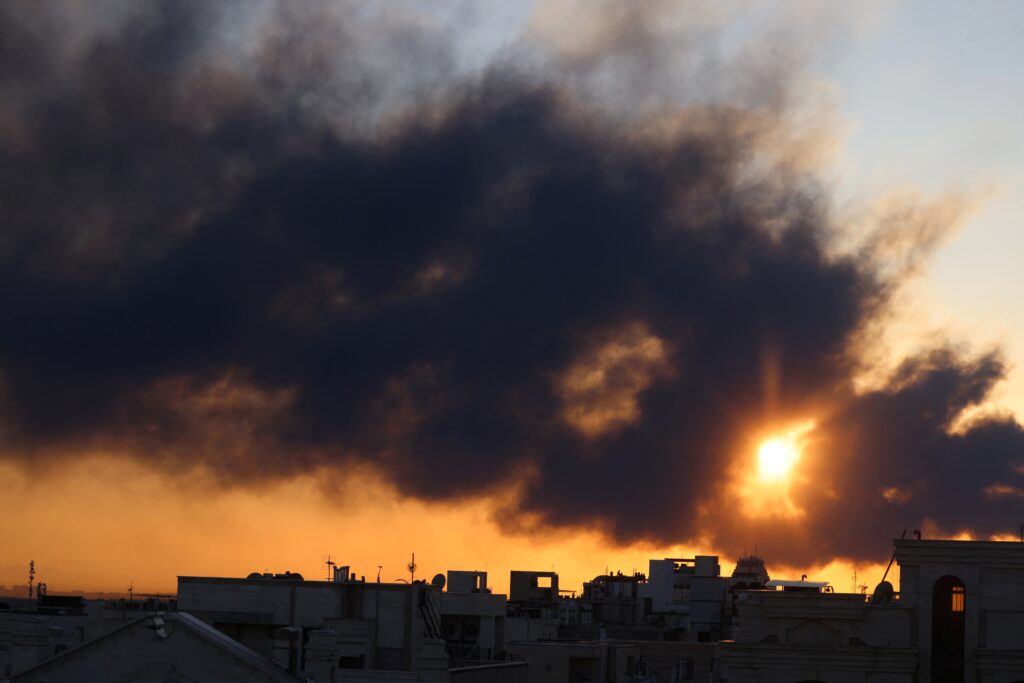
Image Caption: The sun is seen setting through a plume of black smoke following a strike on the Iranian capital Tehran, on 3 March 2026. Photo: AFP
About the Author
Huzeir Ezekiel Dzulhisham is a Senior Analyst in the Dean’s Office at the S. Rajaratnam School of International Studies (RSIS), Nanyang Technological University (NTU), Singapore. He studied political science and specialises in geopolitics and international relations of the Middle East and Iran.