By Mary Ann T treault
Download Insight 104 Tetreault
The past six elections in Kuwait have been unscheduled in that each was held after the dismissal of parliament but before the end of its four-year term. Ordinarily, Kuwaiti elections are held within sixty days of the expiration of a sitting parliament. When the parliament is dismissed early, the resulting ‘snap’ elections must be held within sixty days following the closure of parliament. This leaves the initiative on scheduling with the Amir. The Amir also is legally permitted to suspend a parliament for thirty days. Together, they give the ruler a three-month window within which to schedule ‘unscheduled’ elections, not considering his discretion with regard to whether and when to dismiss a sitting parliament.
The Amir’s obligation to call for elections within sixty days of dissolving the parliament has not always been honored, however. Prior to the reign of the current Amir, Shaikh Sabah al-Ahmad Al Sabah, the parliament had been dismissed early three times. The first two were unconstitutional suspensions.[1] In 1976, Shaikh Sabah al-Salim closed the 1975 parliament and failed to call for new elections to be held within the prescribed sixty days. The parliament as an institution remained in limbo until 1981, after sustained popular pressure forced the Amir at the time, Shaikh Jaber al-Ahmad, to concede to its reinstatement and call for new elections. He used the interim to try to amend the constitution unilaterally, but this was roundly rejected. He did, however, change the electoral system from one where citizens living in ten districts each elected five members, to one where citizens in 25 newly drawn districts each voted for and elected two members.
The new system with its small districts and limited number of votes made it easier and cheaper to manipulate elections by buying votes and running spurious candidates to draw votes from strong candidates disliked by the regime.[2] Prior efforts to manipulate elections had been more obvious, especially in 1967. Turnout fell in the two succeeding elections and when the parliament was closed in 1976, regime and opposition were at loggerheads.
In 1981, turnout returned to its pre-1967 level, with 90 percent of the electorate voting. The 1981 parliament was socially conservative’ for example, it passed an absolute ban on alcohol in Kuwait’but its successor, also socially conservative, was far from politically supine. The 1985 parliament saw the growth of cross-group coalitions. Religious, liberal, tribal, and urban elements, often on opposing sides with regard to social issues, formed an authoritative domestic opposition to financial corruption. It was triggered in part by the continuing fallout from the 1982 collapse of an illegal stock market, the Suq al-Manakh, in which ruling family members were involved and following which support of those who lost heavily in the collapse went disproportionately to wealthy Kuwaitis and their creditors.[3]
The regime also felt assailed by outside forces. The Iran-Iraq war was impossible to ignore with the noise of artillery from al-Faw assailing Kuwaiti ears and oil spilled from attacks on Gulf shipping washing up on their shores. Kuwaitis, including the Amir himself, were the targets of terrorist attacks by people opposing Kuwait’s support for Iraq. Beset from all sides, the Amir dismissed the 1985 parliament when it insisted on investigating the activities of the Central Bank and several cabinet ministers. He did not call for new elections. This parliamentary interregnum lasted until 1992 when, pressed by domestic forces whose large, inclusive, pro-democracy movement had preceded the Iraqi invasion and continued during the occupation, were joined by members of the coalition that had expelled Iraqi forces and pushed the Amir to call for new parliamentary elections to be held in October 1992.
The 1992 parliament served its full term. Despite its resistance to a number of Amiri initiatives relating to governance and financial arrangements, the dominance of religious and tribal conservatives among the elected members divided the opposition and left much of the policy initiative to the government. Since 1977, conflicts between the regime and the parliament had found the rulers seeking allies among religious conservatives and their tribal allies, supporting them against the smaller liberal grouping. In 1996, shortly before the pre-election conclusion of the 1992 parliament, cabinet ministers, who serve as ex officio members of the National Assembly, voted with the conservatives to impose gender segregation on Kuwaiti universities. Only a month before, a leader of the parliamentary liberals had barely survived an assassination attempt by two shooters whose motives for their actions remain unclear.
Like parliaments before it, the 1996 parliament sought to control financial corruption and cronyism. Tribal and some liberal representatives, together with Salafi Islamists, successfully resisted moves to privatize state industries and invest in expensive new state projects, both seen as near occasions of financial shenanigans. Stymied by the opposition, the regime appears to have settled for structural adjustments that promised to deepen divisions between urban and rural Kuwaitis. One was a law making tribal primaries illegal. These pre-election measures, first employed in 1975, allowed dominant tribes in a district to determine their one or two strongest candidates. Urban Kuwaitis resented the authority of the tribal primary,[4] even those who used similar means to select one or two candidates that a whole clan or group would support. The tribal primary law was not enforced for ten years but it remained a potential curb on the dominant tribes whose power and independence were becoming worrisome to the regime.
But these maneuvers were not enough to save the 1996 parliament from premature dissolution. Irritated by the lack of support for his economic initiatives, the Amir closed the parliament in May 1999 and called for new elections within the mandated sixty days. While the parliament was gone, he issued more than 60 decrees, some in pursuit of his privatization agenda. He also attempted to make rejection of decrees he knew would attract parliamentary opposition more difficult by adding one that conferred full political rights on Kuwaiti women.
Kuwaiti women had been excluded from formal political life since the adoption of the 1959 election law. Although they were active campaigners for male candidates, they could neither vote nor run for national office themselves. The conservative coalition in the parliament had kept a women’s political rights bill from being enacted for years, but popular pressure for women’s rights was growing. Could the new parliament sign off on women’s rights and still reject other non-budgetary Amiri decrees? Probably not. So, despite lobbying by women’s groups and even, according to some, by the Amir himself, the women’s rights decree was rejected with the rest.
The 1999 parliament was the last to serve its full four years. Its successor, the 2003 parliament, oversaw a complicated Amiri transition after the death of Shaikh Jaber al-Ahmad, the resignation of his successor, Shaikh Sa’ad al Salim, and the parliamentary appointment of his successor, Shaikh Sabah al-Ahmad in early 2006. Shaikh Sabah had served as acting Prime Minister during the years of Shaikh Sa’ad’s slow decline and, during this time, criticism of his performance had been gentle. He also benefitted from the afterglow of having master-minded the passage of a women’s political rights law through a reluctant parliament in May 2005, and the economic boom generated by Kuwait’s role as a staging area for the 2003 US-UK invasion of Iraq. But when Shaikh Sabah took the title of Amir, more was expected of him than to appoint his close relations to the posts of Crown Prince and Prime Minister, and a clutch of mostly mediocre cronies and other relations to the Cabinet. Popular disappointment set the stage for an unlikely social movement powerful enough to push the Amir to his first parliamentary dissolution.
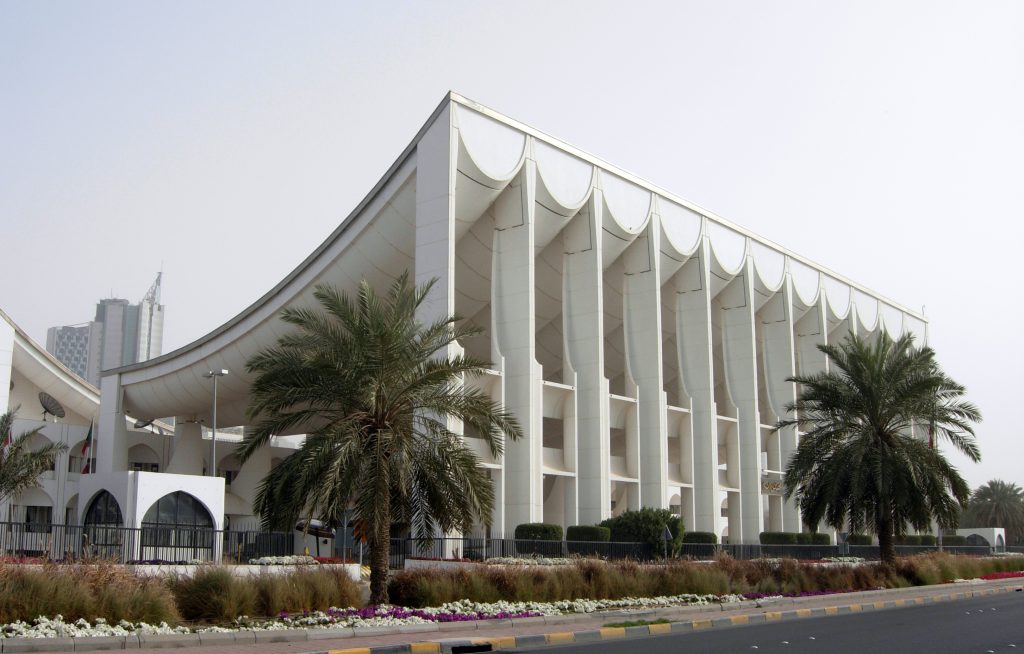
The ‘Orange Movement’ focused on reforming the election law to reduce electoral corruption. This was a cause that had failed to rouse much interest before the spring of 2006 when, on impulse, a dozen young Kuwaitis in orange t-shirts mounted the first ‘We want five’ (nabiha hamza) demonstration on 5 May, outside the palace where a cabinet meeting was going on. Subsequent gatherings, most held across from the parliament building, drew more and more participants. The rallies ended in a clash at the parliament weeks later, where a majority of the elected members (cabinet members participate ex officio) joined the demonstrators and alarmed the rulers by demanding to interpellate the Prime Minister for actions taken against the protesters by state security forces. The Amir dissolved the National Assembly and called for new elections.
In a way, the 2006 election was a rehearsal for the first election held in 2012. The population was up in arms about corruption, the impetus for electoral reform, and angry at the regime’s response to the reasonable demands of Orange demonstrators. The results were bound to be anti-government. But if the 2006 election was scheduled at a time when the expectable results would produce a parliament that would change the election law, it presented a huge scheduling problem for Kuwaiti women, whose rights to vote and run for office were exercised for the first time that year. Prominent women who had only begun to contemplate a run for parliament, were unprepared. Many decided to wait until later. Those who did run were at a disadvantage compared to veteran male candidates, and suffered from the intense focus on corruption, which overshadowed women’s concerns in campaign discourse. Women also encountered structural impediments.[5] They were excluded from the behind-the-scenes vote-trading that operated as a variant of the tribal primary because the organizers, now called the Alliance, did not think a woman could win, they were correct. Orange candidates were spectacularly successful, however, winning a majority of the fifty elected seats. They promptly passed the election reform law they had pledged to support but corruption continued. Indeed, corruption actually spread. According to Transparency International’s Corruption Perception Index, Kuwait ranked number 46 in 2006, 60 in 2007, and 65 in 2008.
Conflicts within the ruling family were spilling over into everyday discourse, while a 2006 change in the media law allowed various factions of the family to appeal to their popular followings through newly acquired newspapers and TV stations. In March 2008, prominent Kuwaiti Shi a, including members of the parliament, publicly mourned Imad Mughnieh, the shadowy Shi i militant assassinated in Damascus and subsequently hailed by Lebanon’s Hizballah as one of its top military minds. Sectarian confrontations in and outside Parliament, including incendiary anti-Shi a television broadcasts over two stations owned by one faction of the ruling family, pushed the entire cabinet to resign on 17 March. A significant success of Al Sabah rule has long been to manage and dampen sectarian conflict. Confronted by growing sectarian ugliness, the Amir dissolved the National Assembly two days later and called for new elections. Multiple conflicts and concerns shaped the 2008 election but it was less contentious than it might have been. The campaign was scheduled to coincide with the UEFA European Championship football matches. To encourage voters to come out, candidates who wanted to get their messages across to sports fans installed gigantic TV screens so that visitors to their campaign tents could mellow out together over snacks and football while they waited for the speeches to begin.
This was the first election held under the five-districts, four-votes law. For those who could tear their eyes from the football action, it exposed unforeseen difficulties in developing successful electoral strategies. Even large, well-organized groups, such as HADAS, Kuwait’s branch of the Muslim Brothers, had little success getting candidates elected. Charismatic candidates from large groups continued to attract heroic majorities but the less magnetic from every group were hard-pressed to draw enough votes to win from an electorate whose visions of electoral possibilities had suddenly expanded to include interesting and attractive people who might not even have been in their districts under the old system. Women fared about as well as HADAS in 2008, but a few came close to winning a seat. At least one (Aseel al-Awadhi) drew promises of ‘next-time’ support from voters who were surprised at her strong showing in the football election. Continued contention between the parliament and the regime brought the 2008 National Assembly down in less than a year thanks to its increasingly insistent demands to interpellate the Prime Minister.[6] The critical language used grew so strident that the 2009 campaign focused on the ‘deterioration of the language of dialogue’ (tadanni’ lughat al-hiwar), which was blamed for the persistent political stalemate in Kuwait.
Unable to capitalize on the distraction of football to limit criticism during the 2009 campaign season, the Amiri decree permitting candidate registration was delayed until the last possible moment, limiting the time for campaigning. The regime also employed a new press law passed in 2006 to crack down on political expression. Empowered by the press law, security personnel arrested several candidates who had criticized Al Sabah cabinet members, including one whose ‘crime’ had been committed more than a year before his arrest.[7] But as promised, voters changed their minds about supporting female candidates: four women won seats in 2009. The pattern of dissolutions followed by snap elections continued, with tactics on both sides escalating at every iteration. Corruption continued as well, as did increasingly frequent attempts, some successful, to interpellate cabinet ministers.
The toll these repeated unscheduled elections exacted fell more on candidates and voters than the regime, which probably saw utility in rising popular’and elite’disaffection with the state of politics. By 2009 and Sheikh Sabah’s third snap election, the legitimacy of elections as such was in doubt. Candidates disliked the hassle and expense of running so often just to serve for a year or two. Prominent liberals with years of parliamentary service refused to run, leaving opposition leadership to a few contentious urban populists and members from large tribes. Citizens found the frequent elections both disruptive and annoying regardless of when they were scheduled and many voters just stayed home.[8] According to state figures, turnout in 2009 fell to just below 60 percent,[9] a significant drop from the average of around 80 percent before the run of parliamentary dissolutions.[10] The 2009 parliament continued to press Cabinet members for explanations of their questionable actions, and it remained resistant to pressures to approve ambitious ‘development’ programs. It also continued to demand to interpellate the Prime Minister, whose reputation for corrupt practices was ballooning.[11] Finally, after receiving a statement supporting the Prime Minister signed by thirty of the fifty elected members, the Amir agreed to let him be questioned, but demanded that the interpellation be conducted behind closed doors. The interpellation was conducted on 8 December 2009 and the subsequent vote of confidence was held the next day. Only thirteen members voted against him, one abstained, and the rest, including all four women, voted in support.
Citizens continued to assert their opposition with demonstrations against government ministers. By February 2011, a scheduled interpellation of the Interior Minister was fearsome enough to force his resignation a week before a scheduled street rally against him. The rally turned into a demonstration on 8 March calling for the resignation of the entire government.[12] The whole government did resign a few weeks later in response to requests to interpellate three ministers from the ruling family. But the Amir did not dissolve the parliament. The furor in the streets and in the parliament persisted throughout the spring and early summer, but the parliament remained. By late summer, strikers went into the streets, and the regime acquiesced to most of their demands. Still, the parliament remained. Popular pressure to confront blatant and endemic corruption reached an explosive level in the fall when prominent newspapers reported that large cash deposits made by members of parliament had alarmed local banks concerned about possible money laundering. The banks took their suspicions to the public prosecutor. As the investigations proceeded and more MPs were implicated, the suspicious deposits in their bank accounts began to look like bribes and the bribes seemed to be coming from the Prime Minister.
Protests intensified and on 17 November, thousands of mostly young Kuwaitis, including many from the tribes, together with opposition members of Parliament, stormed the parliament building. Within weeks, the Amir accepted the resignation of the Prime Minister and appointed a replacement and a new government. A short time later, he dismissed the parliament and called for new elections. There were rumors that he had done so at the behest of members of the 2009 parliament. If this is so, both sides were blind to the influence of scheduling on election results. Why hold an election when the population is furious with the government? Why assume that the government would be the only target of popular wrath? A sensible scheduler would have declared a cool-down period by appointing a new government, being gracious about delays while the government got itself together, and then, taking the opportunity offered by the constitution, calling for a one-month parliamentary recess that could have been extended by declaring an extra-long holiday to celebrate the new year. Whatever the reasons, the scheduling of the election at the height of anti-government rage ended with the election of a profoundly oppositionist body. Liberals, always a loose category in Kuwait, if present at all, were politically invisible. Women were absent entirely.
The parliament elected in February 2012 (2012F) was dominated by hard-liners in the religious and tribal opposition, and included a number of others whose aim was to generate more heat than light. 2012F turned out to be as deaf to popular opinion as the 2009 parliament members who purportedly had urged the Amir to call for new elections. The biggest vote-getter was a tribal MP who had long been the spearhead of the opposition. He promised to continue his pressure to halt corrupt practices and the investment policies he distrusted. Sunni Islamists wanted laws that conformed to their version of Islam. They initiated measures to amend the constitution to make shari a the only source of Kuwaiti law, proposed the establishment of a Saudi-style ‘morality police’ to regulate public behavior of women, and mobilized a large majority in May to approve the second reading of a bill that set death as the maximum penalty for blasphemy, (which the Amir declined to sign). In May, a pro-government member was cited for coming drunk to Parliament and for spitting on another member. He was barred from the floor for two weeks. Sectarian tensions also rose, leading to more repression of the press.
Meanwhile, the 2012 parliament continued to interpellate ministers and its efforts to question the new Prime Minister, Sheikh Jaber al-Mubarak Al Sabah, succeeded on the second try.[13] Finally, the Amir called for Kuwait’s first constitutional one-month suspension of the parliament. Unfortunately, the anticipated cooling-off was derailed when the constitutional court ruled that the authorization of the 2012 parliamentary election had been procedurally flawed. The 2012F parliament was nullified and the 2009 assembly reinstated as though the events of the past months were just a bad dream. The Amir found himself able to reschedule the 2012 election when it would be more beneficial to himself and, given the bizarre situation featuring two parliaments, each with dubious credentials, he could wait for the right time and maybe even reshape the playing field. He was not the only person to realize this. Many in the opposition feared that the government would adopt a 1981 strategy and change the election law to produce the kind of parliament it desired. With the 2012F parliament vaporized and the 2009 parliament refusing to meet, a new cabinet was appointed and sworn in. Meanwhile, responding to a suggestion by the speaker of the 2009 parliament, the Constitutional Court was asked to rule on whether the five-districts law was constitutional. While Kuwaitis awaited the court’s decision, opposition members threatened to boycott any election based on a new election law made without the consent of the parliament. When its decision came down in late September, the court declared that the five-districts law was constitutional. The opposition rejoiced, but the jubilation was premature. The Amir took full advantage of having a parliament that refused to meet. He put off dismissing it and calling for new elections until October.[14] When the anticipated reaction took place, he unilaterally changed the election law, keeping the five districts approved by the Constitutional Court, but changing the number of candidates each voter could choose, limiting it to only one. The ‘Orange’ opposition mounted a boycott. It refused to run candidates and the boycott organization campaigned to keep voters at home on election day. ‘Blue’ government supporters encouraged candidacies from groups that had been shut out of electoral victories since the adoption of the five-districts law because they were so small, and recruited candidates who had never run before. Like a civil conflict anywhere, this one split families and destroyed friendships. Opposition marches were very large and met with increasingly violent police actions. Marchers were beaten, tear-gassed, arrested, and detained. Others were arrested for insulting the Amir, including Musallem al-Barrak, the tribal MP who had led the opposition and made a speech at a rally on 15 October telling the Amir ‘We will not allow you’ to lead Kuwait into authoritarianism.[15] The last march before the election, observed by scores of foreign reporters who had come to cover it, was peaceful. Afterwards, however, demonstrators who had chanted ‘We will not allow you’ during the march were arrested for insulting the Amir.
A combination of boycott, scheduling, and changes in the election law led to the election of a parliament with few ties to the traditional opposition on 1 December’2012D. The boycott by prominent Sunnis allowed a very large number of Shi’a to win victories, seventeen in all. Traditional allies of the Amir, their behavior as MPs was marked by open-mindedness and an avoidance of sectarian pay-back. A moratorium on interpellations was worked out by the speaker and the government. The new parliament voted to accept the five-district, one-vote election law the Amir had decreed the previous October. It also proved to be more open to the Amir’s development plans. Despite its better manners, this parliament also indicated that, at the end of the summer recess, it too would make unwelcome demands. Members want to interpellate ministers they see as incompetent, increase salaries and social support payments, and some even to question the rash of development projects for which contracts had been awarded without benefit of the tender process.
There are some things that scheduling simply cannot fix.
Mary Ann T treault is the Cox Distinguished Professor of International Affairs Emerita at Trinity University, San Antonio, Texas. She writes frequently about Kuwaiti politics.
[1] Mary Ann Tetreault, Stories of Democracy: Politics and Society in Contemporary Kuwait (New York: Columbia University Press, 2000).
[2] Ibid. discusses vote-buying since 1992.
[3] John Whelan, ‘Kuwait ’88: A Model for Development,’ London: MEED Group. Also discussed in Stories
[4] Interviews in Kuwait, 1992 – 2009. Also, Kamal Eldin Osman Salih (2011) Kuwait Primary (Tribal) Elections 1975 – 2008: An Evaluative Study, British Journal of Middle Eastern Studies, 38:2, 141-167, DOI: 10.1080/13530194.2011.581815
[5] Mary Ann T treault, ‘Kuwait’s Annus Mirabilis,’ Merip On Line, 7 September 2007, at http://www.merip.org/mero/mero090706
[6] Mary Ann T treault, Mohammed Al-Ghanim , ‘The Day After Victory’: Kuwait’s 2009 Election and the Contentious Present,’ Middle East Report On Line, July 8, 2009, at http://www.merip.org/mero/mero07080
[7] Ibid.
[8] Ibid., also author interviews with Kuwaiti citizens and reports in local news outlets during the election period.
[9] Voter turnout data for Kuwait http://www.idea.int/vt/countryview.cfm?CountryCode=KW This has reasonable, although incomplete, figures for elections from 1975 on. Page last updated 5 October 2011.
[10] Mary Ann T treault ‘Looking for Revolution in Kuwait,’ Middle East Reports Online, 1 November 2012, at http://www.merip.org/mero/mero110112
[11] Ibid.
[12] ‘Kuwait rally today aims to remove PM,’ Reuters, 8 March 2011.
[13] Mary Ann T treault, ‘Looking for Revolution in Kuwait,’ Middle East Reports On Line, IP, 1 November 2012, at http://www.merip.org/mero/mero110112
[14] Ibid.
[15] Catherine Cheney, ‘Kuwait’s Opposition Crosses the Government’s Red Lines,’ World Politics Review, 1 November 2012, at http://www.worldpoliticsreview.com/trend-lines/12468/kuwaits-opposition-crosses-the-governments-red-lines