Series Introduction
The Changing Character of War in the Middle East and Beyond
Since the privatisation of the American war in Iraq, the commercial market for force in the Middle East has grown exponentially, raising critical regulatory concerns. In addition to protecting people and infrastructure, for instance along China’s Belt and Road, some security contractors now even perform combat-related services such as communications support and drone operations. While professional contractors promise greater flexibility and cost-efficiency than traditional armies do, we have also seen shadowy contractors and mercenaries being deployed with plausible deniability by the likes of Russia and Turkey in places like Syria and Iraq.
This series of Insights brings together academics and industry practitioners to explore the possibilities and challenges presented by such privatisation of the state’s monopoly on the use of force.
CLICK HERE FOR THE PDF
By Qing Liu and Simon Williams*
This article highlights the range of services that Chinese private security companies are providing both within China and abroad, as well as their growing sophistication and competitiveness. The authors contend that there is great potential for Chinese private security companies to increase their global footprint if they commit themselves to keeping up with changing technology and rise to meet international standards and industry best practices.
The first pay-for-use security company in China was established in 1984 as a state-owned enterprise (SOE). For the next 20 years or so, even though only SOEs were allowed to provide security services in the country, the industry flourished. At its peak, there were an estimated 3,000 state-owned security companies. As China began to fully embrace private entrepreneurship in other sectors of the economy, the security industry was privatised and has grown substantially in the last 15 years. Today, there are more than 8,000 private security companies (PSCs), in addition to state-owned security companies, whose numbers have come down from their peak to about 1,000 companies.
Despite the size and importance of Chinese PSCs, the rest of the world is still largely unfamiliar with their function and presence. Owing to misrepresentation in the media that continues to nurture the myth of an all-controlling Chinese state prone to constant market interference, experts in the West tend to write off the private security industry in China as just a tentacle of the People’s Liberation Army (PLA) that affords the state plausible deniability.
Today Chinese PSCs provide a range of technical services domestically and in complex foreign environments, not just to Chinese businesses but also to multinational corporations and foreign governments. Indeed, it must be emphasised that to secure such business, Chinese PSCs have to compete in the global security marketplace against household-name PSCs on the basis of the quality of their services and price point. Sometimes they win; sometimes they lose — including on tenders from the Chinese government. Such is what happens in an open market.
In order to respond to market pressures and enhance their service quality, many Chinese PSCs have adopted global best practices and are even obtaining globally recognised certification of management systems and human rights compliance. Moreover, like their Western counterparts, Chinese PSCs are devising strategies tailored to the needs of their clients and also training and adapting to emerging technologies that can fill gaps in the security space.
Not the PLA in Disguise
Contrary to the widely held misconception and even concern in the West that Chinese PSCs are simply the PLA in disguise, the Chinese private security industry is in fact less government-affiliated than its Western counterparts are. While Western PSCs have provided a range of military and security services directly to their respective governments, Chinese PSCs are prohibited from entering into service contracts with most Chinese state organs, including the PLA, although there is some leeway for procuring contracts from Chinese SOEs. Looking closely at the records of tender awards from such clients, one will realise that Chinese PSCs enjoy no special advantage in securing overseas security contracts from Chinese SOEs: Chinese SOEs are in fact hiring Western PSCs at a faster rate and higher price point. And, contracts such as those involving security for Chinese embassies are most often, with only a few exceptions, awarded to household-name foreign PSCs like Control Risks and Garda World, not Chinese PSCs.
Moreover, the best-of-breed Chinese PSCs are all open books: their incorporation and founding documents are publicly available in company registration databases as are the names of their owners and directors. Transparency of this nature is not always the case with PSCs originating in several other countries, where ownership information can easily be obscured. In addition, leading Chinese PSCs subject themselves to financial audits by well-known accounting firms, ISO certification, human rights certification, compliance checks by Lloyd’s underwriters, and many other inspections and licensing audits by Chinese and foreign governments alike. The media may paint the Chinese PSC sector as an industry of secrecy, but, in reality, it is more transparent than almost any other business sector in China.
An Image Problem
Most clients of Chinese PSCs are large commercial enterprises with a sophisticated understanding of the private security market, the regulations governing it and the range of services offered by PSCs. They know well that Chinese PSCs are competing with Western security companies in know-how and intellectual aspects, not in the use of force, and that sophisticated Chinese PSCs do serve as managers of risk and enablers of business in complex environments — a valuable bridge of sorts between the client and the local operating environment. Within the industry, the reputation of Chinese PSCs is continually improving, particularly in the sectors of manned guarding, risk assessment, security technology integration, and crisis management.
A core image problem hampering Chinese PSCs is that most of them are often associated with low-cost solutions. In itself, being cost competitive is not necessarily a bad thing, as many or even most contracts from Chinese clients are awarded solely on price, once all bidders meet the same minimum quality thresholds. Unfortunately, many Chinese clients have low security budgets and cannot afford quality services even though they know the risks well. This creates a race to the bottom. As long as there is a demand for low-cost services by such clients, there will be ample opportunities for low-cost suppliers to establish thriving businesses. Such a cycle is difficult to stop.
However, the larger players in the Chinese private security industry are not content with limiting themselves to the low-cost niche. With a view to obtaining clients, particularly Chinese SOEs, multinational enterprises, and even foreign governments, they aim to raise their prices and quality. Leading Chinese PSCs are spending time educating Chinese clients about the dangers of working with low-quality security service providers. In addition to highlighting the physical risks involved, they are educating prospective clients on the legal liabilities and reputational risks that can be avoided by spending more on quality private security solutions that meet all relevant laws and exceed industry best practices.
Moreover, Chinese PSCs are trying to improve their image to attract private, publicly traded and state-owned corporate clients from Asia, Europe and the Middle East. In time, more foreign clients will realise the improving quality and service levels available from the best Chinese PSCs, marked by their overseas acquisitions, pole position in the maritime market and market-leading international certification.
Meeting International Standards
With regard to certification, ISO 28007 is now considered the mandatory minimum standard for the private maritime security industry. Hence, most PSCs have sought to acquire this certification. Several Chinese PSCs that have already been involved in the maritime sector for a decade have long held this certification. However, if Chinese PSCs are to expand their client base, especially to include foreign (non-Chinese) clients, they need to go beyond this minimum standard and also achieve management systems certification for their land-based activities.
Considering that the scope of ISO 28007 is limited to the maritime industry, several Chinese PSCs are seeking to achieve ISO 18788/PSC.1. This process, however, has been delayed as a result of the Covid-19 pandemic since the auditors from foreign certification bodies are unable to travel to China at this time. The process is expected to resume later in 2021 and accelerate in 2022.
Chinese PSCs have also taken a keen interest in demonstrating social responsibility and human rights compliance with the International Code of Conduct for Private Security Service Providers (ICoC). This certification is done by the International Code of Conduct Association (ICoCA). It brings an additional dimension of quality assurance to a PSC, allowing it to project itself as a responsible brand and a force for good. For Chinese PSCs, it opens up the opportunity to attract international clients, especially those from Europe, the United States, and international organisations, as well as others that may mandate ICoCA certification for security vendors.
However, some Chinese PSCs and scholars doubt whether a Western regulatory body, such as the Switzerland-based ICoCA, will satisfy the needs of the Chinese private security sector and wonder whether a code of conduct with Chinese characteristics should be designed. This question can be separated into two parts — the international market and the domestic market.
ICoC provides a great platform focused on the international market. It is a framework for Chinese PSCs operating overseas to meet international norms. This is important, and it is also more sophisticated than what most Chinese, or even foreign PSCs, can achieve.
However, it must be remembered that a vast majority of Chinese PSCs operate locally. The Chinese domestic market is less complicated and less dangerous than most foreign markets; furthermore, it does not fall within the operating environment that the ICoC is designed for. But there are many parts of the ICoC that can benefit China.
In fact, industry leaders and market regulators in China have urged the government to develop a Chinese national standard for private security services and suggest incorporating into it several key components of international standards, notably, PSC.1, ISO 18788, and the relevant parts of the ICoC. Industry expects such a national standard to be finalised and published within a year or two.
Responsiveness to Client Needs
Players in the Chinese private security industry need to think seriously about not just how they can tailor their practices for the local market, but also how they can adapt these for the various foreign environments in which they operate. They need to learn from the failures of Western private military and security companies, which owing to insufficient localisation have faced a range of problems from overpaying for imported personnel to language limitations, cultural blunders, human rights abuses, and excessive use of force.
Today, forward-thinking PSCs of all origins want localisation both in their home countries as well as when operating abroad. Chinese PSCs recognise that operating overseas with wholly Chinese security teams is generally not effective — from both a cost and quality perspective. Based on the threats and costs, market-leading Chinese PSCs that operate abroad do employ local nationals if their Chinese personnel do not speak the local language, know the local customs or hold the relevant local licences, and they deploy them alongside the latter.
Lower-end companies, however, often deploy only Chinese teams, without any localisation, including in some cases even without getting the requisite work permits or security permits. This has already caused major scandals when Chinese security guards were arrested or deported for non-compliance and immigration offences, leading to the collapse of several small Chinese PSCs that ventured into the overseas market without necessary preparation.
Hiring third country nationals, in addition to Chinese nationals and local nationals, can be an effective means of forestalling local guard teams conniving with parties to local conflicts. Also, providing non-Chinese clients operating in third countries with security personnel who speak their language can raise the comfort level of such clients. For example, Russian-speaking or Arabic-speaking clients of Chinese PSCs who operate in foreign countries may request security personnel who speak their language. Capable Chinese or foreign PSCs with sufficient budgets to afford foreign staff do occasionally hire both host country and third country trainers and other management personnel as well.
The professional and career backgrounds of the personnel hired by Chinese PSCs are varied. As is common in the security industry globally, many security company staff have prior military or police experience. But the complex circumstances in which security and related commercial services operate today demand a greater diversity in expertise. The top Chinese PSCs also have retired diplomats, insurance experts, doctors, nurses, other medical professionals, salesmen, pilots, interpreters and data analysts within their ranks.
Areas of Growth
As Chinese companies go global with China’s “Belt and Road Initiative” (BRI), so must their security service providers. Many of the countries where BRI projects are fast expanding — particularly those in South Asia, the Middle East and Africa — are considered high-risk areas. This is not necessarily because of any specific government labelling; it is reflective of the reality on the ground. Many local governments simply do not have the resources needed to guarantee the safety of Chinese workers and assets. Criminal and terrorist groups have already been targeting foreign workers, businessmen and diplomats in kidnappings, and Chinese assets and Chinese nationals have become highly attractive targets in the eyes of many of these groups.
While most Chinese companies with projects abroad are still hiring Western or local PSCs, Chinese PSCs are fast becoming competitive. By adopting global standards and building a reputation for consistent and stellar service, Chinese companies can enhance their marketability in this area. They can bank on their common language and cultural affinity to outbid foreign companies to secure contracts from Chinese SOEs and private companies operating abroad.
Two sectors in particular have great growth potential for Chinese PSCs, namely maritime security and crisis management. The maritime security industry is currently going through a period of consolidation. Some Chinese PSCs have successfully grown in this sector in the face of stiff competition from international conglomerates. One such company, HXZA, has grown steadily from its national focus to become an international company, paralleling the global expansion of China’s medium-sized companies in most other sectors. The company’s growth in the maritime sector is due to foreign vessel operators, who now see the quality and effectiveness of HXZA’s solutions as equal, or perhaps even superior in some cases, to the foreign alternatives.
Chinese PSCs also provide protection services to Chinese port management and port construction companies. Even though the projects undertaken by such companies relate to managing or building maritime transportation infrastructure, the industry considers security services in this segment as land security operations since they are different from the armed maritime security services employed aboard commercial vessels.
In the area of crisis management, HXZA is the only Chinese company officially named as crisis response manager for kidnap and ransom insurance policies by a major Lloyd’s insurer. This means the company is quite heavily involved in assisting insured parties prevent and respond to incidents both onshore and offshore.
The success of Chinese PSCs in the private security business will depend on their being able to provide a mix of traditional guarding services and technology-enabled solutions that offer better protective security, involving a combination of on-site, mobile and remote guarding, fire safety services, and risk management for both corporate and government clients. If Chinese PSCs keep abreast of market trends and develop solutions that meet international standards, they can rise to the ranks of the top security providers in the global market.
Conclusion
As Chinese companies increasingly go global, so must Chinese security service providers. Chinese PSCs are already able to provide services ranging from soft services such as logistics planning, journey management and business pathfinding to armed executive protection and site security around the world. But will Chinese and even foreign companies continue mainly to seek Western PSCs? Or will equally qualified Chinese PSCs be able to rise in the market? Only time will tell, and leaders among Chinese PSCs must prepare their businesses to seize market opportunities.
About the Authors
* Mr Qing Liu is Director of the International Alliance of Security and Risk Management Companies (Macau).
Mr Simon Williams is Senior Advisor, International Alliance of Security and Risk Management Companies (Macau).
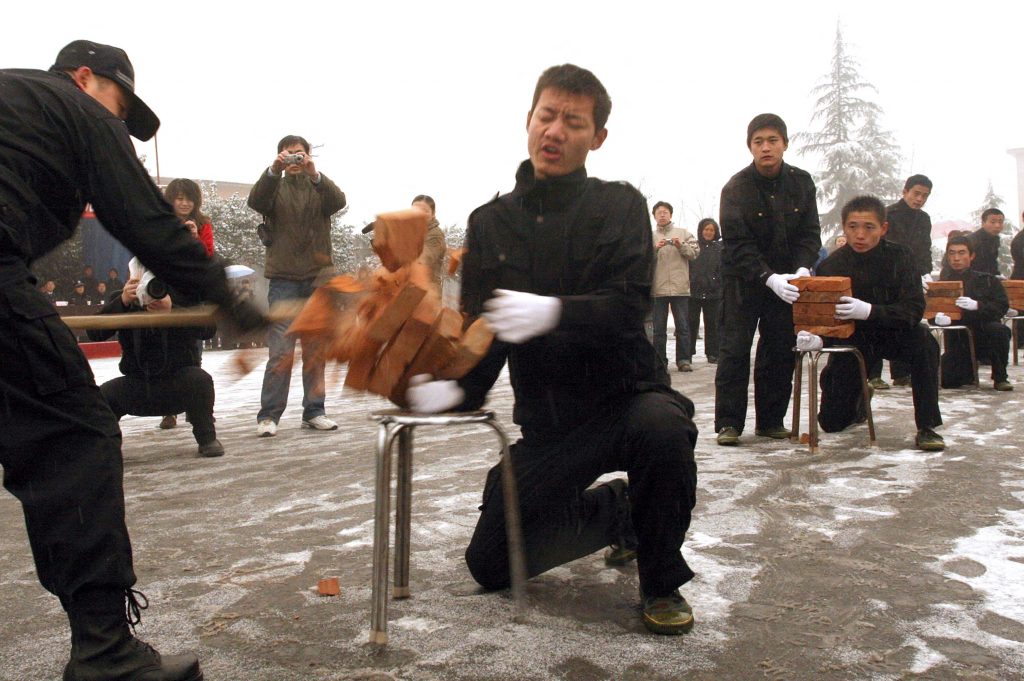
Image caption: A group of Chinese private security guards show off their skills at their training centre in Xian, Shaanxi province, China, 13 January 2008. Photo by STR / AFP.