Why Trump’s Coercive Diplomacy Should Now Focus on ‘Diplomacy’
- Clemens Chay
- -
In a stunning turnaround, US President Donald Trump announced a ceasefire between Iran and Israel, a proclamation that followed the fiercest exchange of strikes between Tel Aviv and Tehran. Israel struck access routes to the Iran’s Fordo uranium enrichment plant and its notorious Evin Prison, which holds political prisoners; the Islamic Republic responded with at least four volleys of missiles.
The sequence of tit-for-tat attacks culminated in what was reported as a calculated — and, indeed, symbolic — Iranian air assault on the forward headquarters of US Central Command, the Al Udeid Air Base in Qatar. The missile attack represented Iran’s retaliation against direct US involvement through its earlier strikes on three nuclear sites.
The US’ entry into the war, while hewing to Mr Trump’s coercive diplomacy approach, stoked fears that the Iran-Israel conflict was heading into a downward spiral. It appears that the US President had anticipated Iran’s ineffectual response — which produced zero casualties, and which he termed as “weak” — and is now holding out an olive branch. Nevertheless, there is much more to do diplomatically.
The Context
Following Israel’s initiation of war with Iran through “pre-emptive strikes” on June 13, Mr Trump had wavered between cajoling Tehran to resume negotiations and threatening both the country and its regime. Following his call for Iran’s “unconditional surrender” on June 17, the American President offered a two-week negotiating window on June 20 — either in the hope that Tehran would relent on its hardline position and agree to terms, including the abandonment of its uranium enrichment, or, as has been reported, as a feint to throw Iran off-guard.
Whatever the case, just two days later, US aircraft dropped 30,000-pound bombs on two Iranian nuclear facilities — Fordo and Natanz — while a third, Isfahan, was hit by submarine-launched Tomahawk missiles.
A Fickle Trump Favours Netanyahu
While the White House initially favoured diplomacy, with the sixth round of nuclear talks originally planned on June 15, Israeli Prime Minister Benjamin Netanyahu’s calculus in conducting an expansive military assault on June 13 changed the thought process of the US President. From a middle course of adopting a defensive posture that offered intelligence, naval destroyers, and aircraft carriers to Israel while applying pressure on Tehran, Mr Trump inched increasingly closer to supporting Mr Netanyahu’s goal of eliminating its arch-rival’s nuclear programme by force.
The shift was clear in the US’ changing public posture: When the Israeli campaign began, Secretary of State Marco Rubio called the strikes “unilateral”, without American involvement. Later, as the success of Israel’s precision strikes against Iranian military leaders, nuclear scientists, and strategic sites became clear, Mr Trump did not hesitate to claim credit by telling CNN: “Iran should have listened to me when I said… I gave them a 60-day warning and today is day 61.”
What is evident now is that Mr Netanyahu has reaped a windfall. The Israeli Prime Minister has long aimed to deny Tehran a nuclear weapon, and he has now realised two goals: First, re-aligning Mr Trump with the assessment that with or without nuclear arms, Iran is a common existential threat. This comes after the Prime Minister was blindsided multiple times in recent months as Washington held direct talks with Hamas and the Houthis. Second, as former US President Bill Clinton said on “The Daily Show”, Mr. Netanyahu has long wanted to fight Iran so “he can stay in office forever and ever”. Indeed, the PM’s government was in a precarious position as recently as June, when he survived a vote to dissolve Israel’s parliament. But with his operation against Iran, the Israeli opposition — including from former Prime Minister Yair Lapid — has closed ranks and rallied behind the government.
Now, with reported discussions between the Israel Defence Forces (IDF) and Mr Netanyahu on war objectives, Tel Aviv remains a potential spoiler in the trajectory towards peace.
US “Surgical” Strikes Risked Widening the War
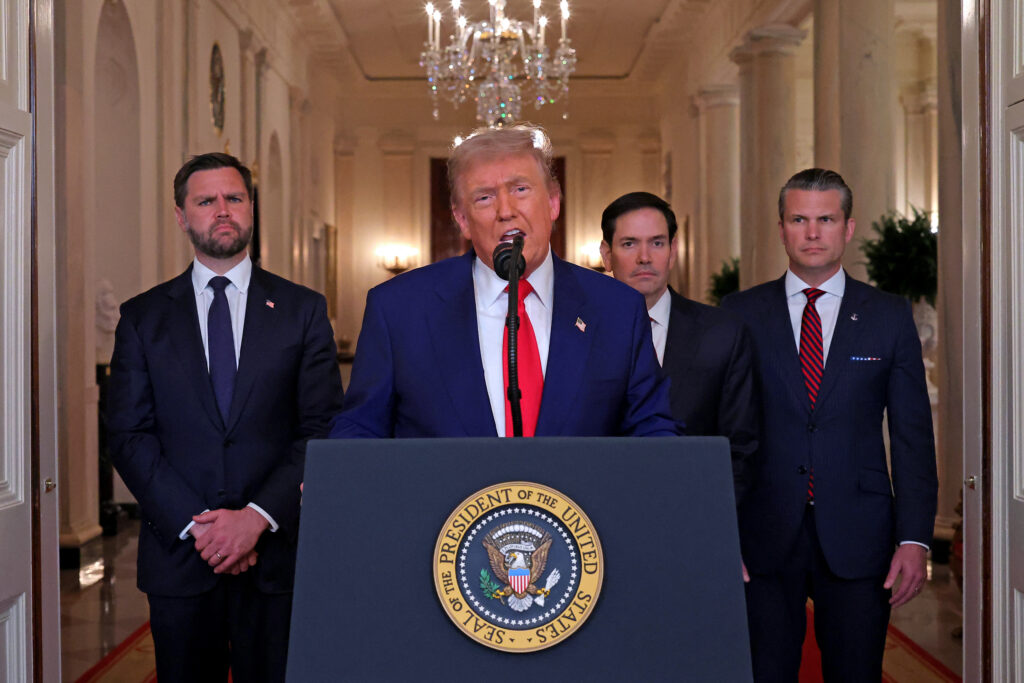
Various post-strike assessments offer a reading of where the Trump administration expected events to lead. In typical chest-thumping fashion, Mr Trump claimed that Iranian nuclear sites were “totally obliterated” shortly after the strikes, and insisted that the regime “must now make peace”.
However, Secretary of Defence Pete Hegseth and General Dan Caine, Chairman of the Joint Chiefs of Staff, were more measured in their remarks during the subsequent press conference at the Pentagon. While Gen Caine said that all three nuclear sites “sustained severe damage”, he noted that a full assessment would take more time. Mr Hegseth, meanwhile, sought to underline that the bombing was a limited action, saying that the mission “was not, and has not been, about regime change”.
But Mr Trump later waded in again, unhelpfully — in a post on his Truth Social account, he again returned to the topic of regime change, stating that it remained a possibility if the current leadership is unable to “make Iran great again”.
To be clear, the recent operations, whether by the US or Israel, have stopped short of decapitating Iran’s top leadership, despite defanging its organisational structure, and targeting organs of state. But fears of a wider war persist. Middle Eastern states, particularly those home to U.S. military bases, were placed on high alert. Not only are tens of thousands of US troops within striking distance of Iran’s short-range missiles, those closest to Tehran, including Iraq and Kuwait, would only have minutes to prepare from an incoming strike. Bahrain — where the US Fifth Fleet is based — activated remote work for 70 per cent of government staff. Elsewhere, Kuwait’s Supreme Defence Council remained in permanent session, as a flurry of calls between Gulf Arab leaders continue in a bid to defuse the situation. This morning, when Qatar announced the temporary closure of its airspace, the region held its breath.
The ‘Major’ Iranian Retaliatory Attack on Al Udeid
Bracing itself for an Iranian response to the American targeting of nuclear sites, wild guesses were taken on which US military bases Tehran would have in its crosshairs. The eventual target was Al Udeid Air Base. The result? All but one of the 14 missiles — some reports placed the number as high as 19 — were intercepted, and no American casualties or damage were reported. Mr Trump later belittled the Iranian effort, posting on Truth Social that it was “weak response”, but extended a hand, saying that “perhaps Iran can now proceed to Peace and Harmony in the region”. Expectedly, the rhetoric from Iran’s Islamic Revolutionary Guard Corps was the complete opposite, calling its operation a “powerful and devastating missile attack”.
Tehran’s message was clear: It has no appetite to take on the US, or, indeed, continue trading blows with Israel. This was a relief for the Middle East, particularly the Gulf Arab states, which have been working around the clock towards de-escalation.
Will the Ghosts of 2003 Haunt Mr Trump?
The announcement of a ceasefire has created some breathing room in the region, although uncertainty remains as missiles continue to fly in both directions. The Trump administration must now focus on the diplomatic dimension of the US President’s coercive diplomacy in its next steps. Trump officials should remind the President that browbeating will not help deliver a peaceful solution, just as the “maximum pressure” campaign during his first term failed to bring Iran to its knees.
For the United States, its actions could be remembered as either the beginning or the end to another Middle East war, and one that this president has been outspoken against. The American decision to invade Iraq in 2003 produced eight years of conflict with massive casualties, spawned the Islamic State, and re-ordered the geopolitical map of the Middle East.
Mr Trump has thus failed to end any of the conflicts that he promised to upon taking office. Israel is still embroiled in Gaza, while Russia and Ukraine are no closer to peace. Iran, meanwhile, remains a work in progress. For Tehran, defiance notwithstanding, time is of the essence. Its leaders must come up with a creative exit strategy that can be forged through directly negotiating with the Americans. But how and whether the ceasefire will morph into a sustainable peace solution will depend on not only outlining clear red lines, but also on the ability of Mr Trump to restrain Mr Netanyahu — who appears reliant on warfare to stay in power.
Image Caption: US President Donald Trump addresses the nation, alongside US Vice President JD Vance (L), US Secretary of State Marco Rubio (2nd R) and US Secretary of Defense Pete Hegseth (R), from the White House in Washington, DC on 21 June 2025, following the announcement that the US bombed nuclear sites in Iran. President Donald Trump said that the US military carried out a “very successful attack” on three Iranian nuclear sites, including the underground uranium enrichment facility at Fordo. “We have completed our very successful attack on the three Nuclear sites in Iran, including Fordow, Natanz, and Esfahan”, Trump said in a post on his Truth Social platform. Photo: AFP
About the Author
Dr Clemens Chay is a research fellow at the National University of Singapore’s Middle East Institute. His research focuses on the history and politics of the Gulf states, with a particular emphasis on Kuwait, Oman and Qatar. At MEI he spearheads a public education series entitled “Bridging the Gulf”. His recent academic publications include a chapter that examines Kuwait’s parliamentary politics in The Routledge Handbook of Persian Gulf Politics (2020), a chapter in the edited volume Informal Politics in the Middle East (Hurst, 2021), and a study appearing in the Journal of Arabian Studies, titled “The Dīwāniyya Tradition in Modern Kuwait: An Interlinked Space and Practice.” His commentaries also feature across different outlets, including ISPI, KFCRIS, and AGSIW. He is currently working on a book project related to Kuwait’s diwaniyas(affectionately known as diwawin, and more widely known as majalis outside Kuwait), the reception rooms for informal meetings that have implications for society, politics and diplomacy.
Prior to joining MEI, Dr Chay was the Al-Sabah fellow at Durham University, where he taught and completed his PhD in Middle Eastern and Islamic studies, and where he also received an MSc in defence, development and diplomacy. He is also a Sciences Po Paris alumnus, having read his BA at the Menton campus.

More in This Series
- Huzeir Ezekiel Dzulhisham
- -