US Attacks on Iran Could Intensify Regional Arms Race, Give Rise to New Blocs
- Huzeir Ezekiel Dzulhisham
- -
In recent weeks, the possibility of a United States attack on Iran has increased dramatically, following the deployment of an aircraft carrier group, multiple missile batteries, and bombers within striking range in and around the Gulf. Potential targets include the Iranian leadership, Iranian Revolutionary Guard Corps (IRGC), nuclear enrichment facilities, and missile facilities.
While Iran has warned of severe retaliation, there is no doubt that any US military strike will further weaken an already embattled Iran, further constrain Tehran’s ability to project regional influence, and even spark regime change. The question now is: What are the possible geopolitical implications of this development?
Two Possible Outcomes
The weakening of Iran’s military capabilities, and possible regime collapse could generate two scenarios which will intensify regional arms races.
First, a weakened Iran shifts the regional balance of power further in favour of Israel. This constrains the destabilising influence of the Iran-supported “Axis of Resistance” — which is already weakened following Israel’s attacks against key militias such as Hezbollah and Hamas — that have plagued the region for decades. In the wake of the Gaza War, regional threat perceptions have shifted more towards Israel, due to its interventionist military campaigns designed to pre-emptively suppress threats in Gaza, Syria, and Lebanon. Moreover expansionist proposals for a “Greater Israel” articulated by far-right political parties, currently dominant in the country’s government, have entrenched regional concern its territorial ambitions.
This concern is prevalent even within Arab states that recognised Israel: The United Arab Emirates (UAE), for example, warned Israel against annexation of the West Bank, calling it a “red line” that could provoke a downgrade of diplomatic ties. After the 2025 strike on Doha, the UAE barred Israel from the Dubai Airshow.
The situation is exacerbated by the widespread belief that the US is unwilling, or unable, to restrain Israeli military campaigns. The US claimed that notice of the Israeli strike on Doha that targeted Hamas personnel came too late for it to act. Whatever the case, the attack on a state that hosts US Central Command and Al-Udeid, the largest American base in the region, created a crisis of confidence among Gulf states, further weakening the established paradigm that partnership with the US would guarantee security against external threats — which had been dented after the 2019 Houthi strikes on Saudi oil facilities. This also reinforced the perception that Middle Eastern states could be targeted if they do not align with Israeli interests.
Second, US attacks may cripple Tehran’s ability to maintain centralised authority over its armed forces and militias. Therefore, neighbouring states are concerned over the possibility of Iranian regime fragmentation, which could lead to the rise of militias and terrorist groups armed with Iranian drones, missiles, and even possibly nuclear capabilities. At the most extreme, the ensuing chaos could lead to a wave of refugees heading towards the Gulf and Turkey.
Intensified Security-Seeking Behaviour
The possibility that these scenarios might materialise could intensify regional arms races. For Gulf states, the need for security is especially acute given ongoing economic transformation programmes, such as Saudi Arabia’s Vision 2030, that are aimed at reducing dependency on oil revenue through investments in tourism, property development, and technology. Yet to sustain international investor confidence, Gulf states would need to prove that they can protect these investments from regional instability.
Existing arms races have created a new security architecture which could become more consolidated considering these possible threats. New initiatives include Saudi Arabia’s 2025 $US 6 billion weapons deal, sharing military technology with Turkey, and the Strategic Mutual Defence Agreement (SMDA) with Pakistan, which specifies “joint deterrence” and collective defence. Riyadh is fostering a new Turkey-Saudi-Pakistan partnership, allowing it to avoid over-reliance on the US for defence. Simultaneously, the Kingdom is diversifying its arsenal, with access to battle-tested Pakistani JF-17 fighter jets, which were used — with reported effectiveness — during the 2025 India-Pakistan conflict, and Turkish Altay tanks.
In the longer term, Middle Eastern states could pursue nuclear weapons development to deter external threats. The Russian invasion of Ukraine and the 2011 NATO bombing of Libya bolstered the case for nuclear deterrence. The lesson that the attacks came after Ukraine surrendered its nuclear arsenal in 1994 in exchange for security guarantees from Russia, and Libya disarmed its nuclear programme to end Western-imposed diplomatic isolation, has not been forgotten.
Nuclear capabilities could level the regional balance of power especially vis-a-vis Israel, which itself possesses nuclear weapons, although it has not declared this capability. For Saudi Arabia and the UAE, this could be done without US assistance, as both have separately pursued military cooperation with nuclear-armed Pakistan and India, respectively. The UAE, in particular, signed an agreement for greater nuclear cooperation with India in January this year.
The urgency of acquiring nuclear weapons may become more acute if Iran loses control of its 400 kg stockpile of enriched uranium in the event it is struck again by the US. The danger is that this stockpile could be used to develop a “dirty bomb” by terrorist militias emerging from ensuing chaos in Iran and seeking geopolitical leverage, or used for nuclear arsenal expansion by opportunistic states. In these extreme scenarios, nuclear deterrence capabilities may be critical to state security.
Regional Realignment
At the same time, receding Iranian influence in the region could lead to a bipolar geopolitical realignment centred around competition between two dominant axes: Saudi-Turkey and UAE-Israel.
The beginnings of this strategic realignment are already taking shape. As Riyadh and Ankara strengthened their military partnership, the UAE has sought to obtain advanced military weaponry by leveraging on its relations with Israel. In 2025, Abu Dhabi reportedly brokered a record US$2.3 billion military equipment deal with the Israeli military contractor Elbit Systems, which makes the Hermes 900 drone — which the UAE is in talks to acquire. Emirati defence conglomerate Edge group also acquired a stake in Israeli tech firm Thirdeye Systems. These deals build on previous joint partnerships with Israeli defence companies that have developed unmanned naval vessels and missile intercepting systems.
It can be inferred that the proposed UAE-India Strategic Defence Partnership was designed to counter Pakistan’s partnership with Saudi Arabia, given tumultuous relations between Delhi and Islamabad. It is also possible that the Saudi-Turkey partnership will include Egypt, which shares similar concerns over Israeli overreach.
Confrontation between members of both axes is most visible in Syria and Yemen. In the former, the ongoing Israeli occupation of the southern part of the country, the 2025 bombing of three Syrian military bases which Turkey intended to take over, and rumoured support for Kurdish and Druze separatists have led Turkish President Recep Tayyip Erdogan to criticise Tel Aviv as being the “primary obstacle” to Syrian stability.
In Yemen, Saudi-UAE tensions have escalated dramatically. In December 2025, the UAE-backed Southern Transitional Council (STC) invaded the Hadhramaut and al-Mahra governates close to Saudi Arabia’s southern border. This led to Saudi airstrikes on the STC controlled port-city of Mukalla to prevent reported arms shipments from the Emirates. Subsequent Saudi led-military campaigns repelled STC territorial gains, and led to its forced disbandment, as well as the withdrawal of UAE forces in Yemen.
Risks and Preferences
Recognition of these risks and uncertainties emerging from an Iran further weakened by a new round of US attacks explains why states countries such as Turkey, Qatar, Oman, and Saudi Arabia have lobbied Washington against striking the Islamic Republic. While there is little love lost between these countries and Iran, all prefer that the country remains predictable, and amenable to negotiations, while keeping its ability to threaten regional stability in check. For a region that has been consumed by one crisis after another over the past three years, there is little appetite for more convulsions.
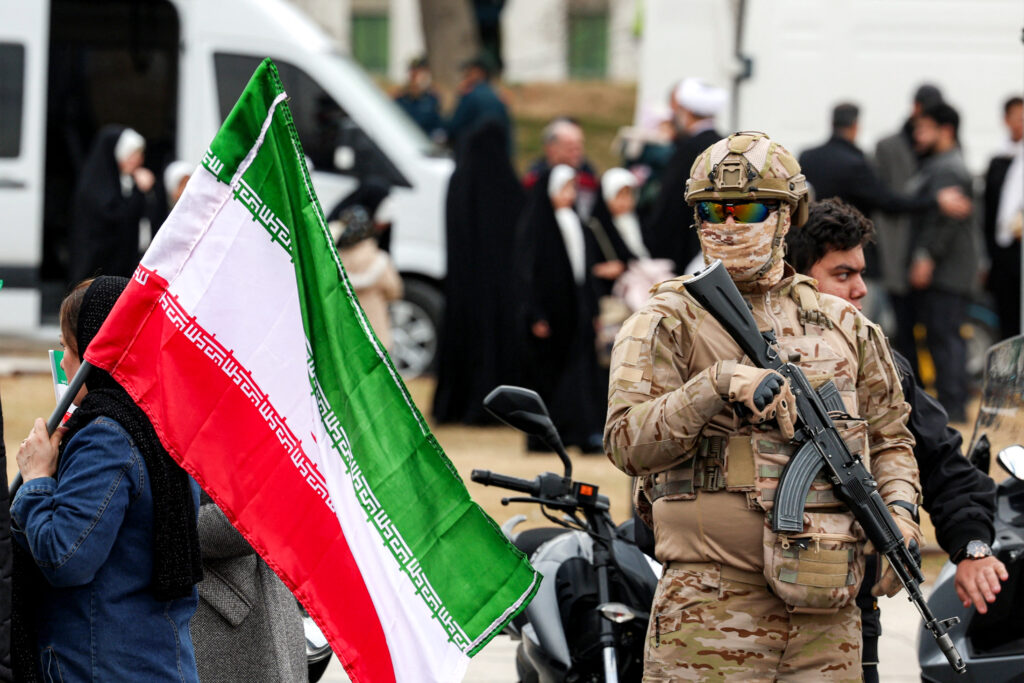
Image Caption: A member of the security forces stands guard during a rally marking the 47th anniversary of the 1979 Islamic revolution in Tehran on 11 February 2026. The Persian calendar date of Bahman 22 celebrates the anniversary of the resignation of the ousted shah’s last prime minister and the formal assumption of power by revolutionary leader Ayatollah Ruhollah Khomeini. Photo: AFP
About the Author
Huzeir Ezekiel Dzulhisham is a Senior Analyst in the Dean’s Office at the S. Rajaratnam School of International Studies (RSIS), Nanyang Technological University (NTU), Singapore.

More in This Series
- Huzeir Ezekiel Dzulhisham
- -