The Gulf Appears Exempt from US Demands on Others
- Clemens Chay
- -
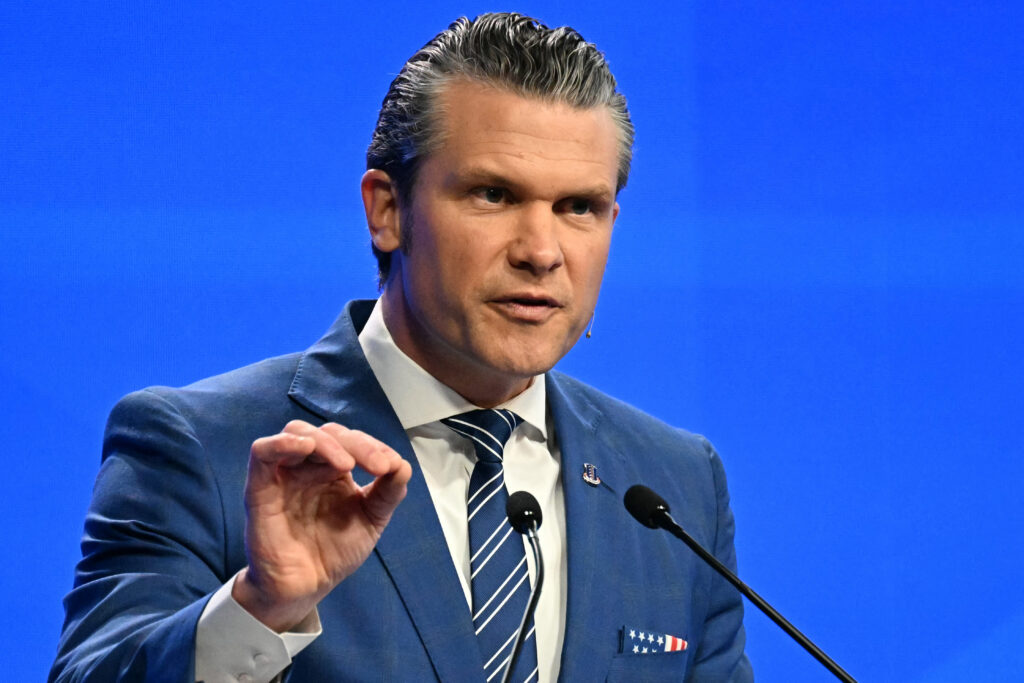
United States Secretary of Defence Pete Hegseth delivered strong remarks at this year’s Shangri-La Dialogue (SLD), reaffirming that America is “here to stay” in the Indo-Pacific, and insisting that Washington is “not interested in the moralistic and preachy approach to foreign policy of the past”. Certainly, when compared to the speech at last year’s edition by Lloyd J. Austin III, who referred to an “open world of rules, rights, and responsibilities”, Mr Hegseth’s comments would have been welcomed by Asian nations, where hectoring about US “values” does not sit well.
That said, Mr Hegseth’s words were exceptionally pointed — particularly when he singled out the threat of China as the raison d’être for US involvement. There is “no doubt” that China seeks to become a “hegemonic power in Asia”, he said, and the US will respond by leading its allies to “execute peace through strength” to deter Beijing. While the speech Mr Hegseth echoed those made by his predecessors during President Donald Trump’s first term — Jim Mattis’ “principled realism”, and Mark Esper’s “Pacific deterrence initiative” — the current defence chief zeroed in on the “threat” at large, without the nuanced use of “coercion” that his predecessors employed.
Further, despite alluding to the “network of allies” that Washington can tap, Mr Hegseth was unabashed about reminding the audience about the Trump Administration’s America First policy. In other words, America will only help its allies if they first help themselves. To be clear, the demands for burden-sharing have been consistent in Mr Trump’s foreign policy across both terms. Before the SLD, the demand was aimed squarely at Europeans, who have been pushed to raise defence spending to 5 per cent of GDP. Now, the US’ Asian partners and allies have been asked do the same.
This burden-sharing demand, however, has not been placed in the one region where the US’ position as security guarantor remains indispensable: The Middle East. Mr Trump came away from his recent Middle East trip with multi-billion-dollar deals, a sizeable portion of which comprised weapons sales. This was a win for a clear business strategy aimed at reorienting the Gulf states back to the US defence industry.
The market for unmanned aerial vehicles (UAVs), or drones, is a case in point. An analysis by the International Institute for Strategic Studies (IISS) revealed that although it was the United States that sparked Gulf states’ interest in UAVs during the early 2000s, these countries have since diversified their shopping — with Turkey and China being preferred suppliers. Now, in the early days of Mr Trump’s second term, American drone technology seems to be recovering some of that market share: Saudi Arabia is working on a package with General Atomics to purchase up to 200 MQ-9 systems, while Qatar obtained approval for a $1.96 billion drone purchase earlier in March. Meanwhile, Doha signed a $1 billion agreement with Raytheon to deliver counter-drone technology; the company also secured a deal to manufacture its jet-powered anti-aircraft drones in the UAE.
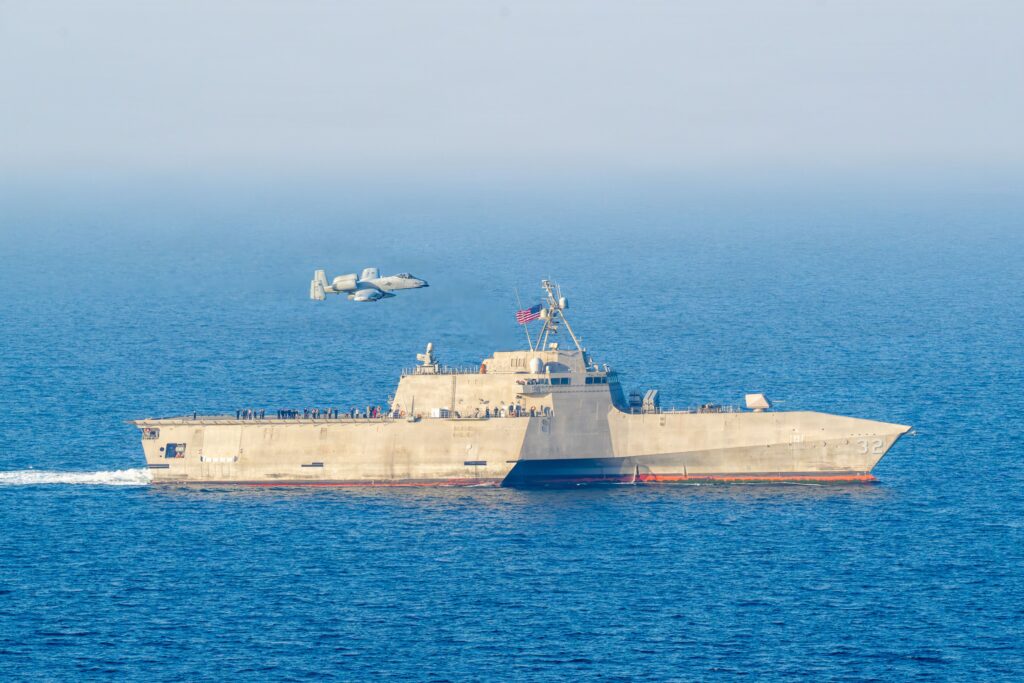
The absence of a burden-sharing demand on the Gulf states is down to the fact that most of them already spend more than 5 per cent of GDP on defence, most of which goes towards US arms purchases. According to a report by the Stockholm International Peace Research Institute, the region’s share of world defence spending (excluding Syria and Yemen) in 2024 is at 9 per cent, far exceeding South-east Asia’s share (2 per cent), but trailing behind Europe’s 26 per cent. The same report also noted that Middle Eastern arms spending is increasing: 2024’s US$243 billion in 2024, represented an increase of 15 per cent from 2023, and of 19 per cent from 2015. Saudi Arabia remained the biggest military spender in the Middle East, and seventh largest globally, forking out an estimated US$80.3 billion. Singapore is ranked 25th globally.
Another facet of American foreign policy outlined by Mr Hegseth that does not apply to the Gulf concerns hedging. In his remarks in Singapore, he warned that “many countries are tempted by the idea of seeking both economic cooperation with China and defence cooperation with the United States”. But hedging is precisely how Middle East observers have characterised the Gulf’s approach against perceived US unreliability, which arose out of the Biden Administration’s Global Posture Review to right-size to focus on China and the broader Indo-Pacific. The reality is that few chess pieces were moved. Indeed, the impact from the events of 7 October 2023 has made the US military presence in the Middle East ever more noticeable.
The Gulf states are banking on their understanding of Mr Trump’s dealmaker tendencies to keep the US president invested in their region — for security or otherwise. But the White House should also be wary that Chinese communications infrastructure remains present in the Gulf’s digital ecosystem, presenting security concerns. After all, it was reservations over the use of Huawei’s 5G technology in the UAE that resulted in the suspension of possible F-35 fighter jet sales under the Biden Administration.
In Singapore, Mr Hegseth warned that countries seeking to hedge between China and the US ought to beware “the leverage the CCP seeks with that entanglement”. It appears Washington sees no need to foist a “them or us” choice on the Middle East, unlike in Asia. But despite the lavish welcome they laid out for Mr Trump during his visit, it should be clear to Washington that American security commitments do not inspire unfettered confidence in the Gulf — China’s growing engagement in the region is not limited to economics, but extends to joint exercises, arms transfers, and growing military engagement. Perhaps the coming US National Security Strategy — which is currently being drafted — will paint a clearer picture, and explain more clearly why some partners are more equal than others for the US.
Image Caption: US Secretary of Defence Pete Hegseth delivers an address at the Shangri-La Dialogue Summit in Singapore on 31 May 2025. Photo: AFP
About the Author
Dr Clemens Chay is a research fellow at the National University of Singapore’s Middle East Institute. His research focuses on the history and politics of the Gulf states, with a particular emphasis on Kuwait, Oman and Qatar. At MEI he spearheads a public education series entitled “Bridging the Gulf”. His recent academic publications include a chapter that examines Kuwait’s parliamentary politics in The Routledge Handbook of Persian Gulf Politics (2020), a chapter in the edited volume Informal Politics in the Middle East (Hurst, 2021), and a study appearing in the Journal of Arabian Studies, titled “The Dīwāniyya Tradition in Modern Kuwait: An Interlinked Space and Practice.” His commentaries also feature across different outlets, including ISPI, KFCRIS, and AGSIW. He is currently working on a book project related to Kuwait’s diwaniyas(affectionately known as diwawin, and more widely known as majalis outside Kuwait), the reception rooms for informal meetings that have implications for society, politics and diplomacy.
Prior to joining MEI, Dr Chay was the Al-Sabah fellow at Durham University, where he taught and completed his PhD in Middle Eastern and Islamic studies, and where he also received an MSc in defence, development and diplomacy. He is also a Sciences Po Paris alumnus, having read his BA at the Menton campus.