Israel Drives a Stake Through US-Arab Relations
- Clemens Chay
- -
After Iran launched missiles at Qatar’s Al Udeid Air base in June, the Gulf Arab state may have believed that was the last time it was a target. But on 9 September, Doha found itself a victim again. This time, the Gulf capital found itself in Israel’s crosshairs when Tel Aviv launched an assault on senior Hamas’ leaders — chiefly, its negotiating team based in the Qatari capital. After the unsuccessful strike, Israeli Prime Minister Benjamin Minister issued a statement claiming “full responsibility” for a “wholly independent Israeli operation” targeting the “top terrorist chieftains of Hamas”. Doha’s foreign ministry spokesperson called the Israeli strikes a “blatant violation of all international laws and norms”.
The Audacity of the Israeli Operation
The brazen Israeli action has sent shockwaves across the region, and will have wider policy repercussions for regional states — notably in their relations with the United States. But the impact of the trauma can be broadly broken down as follows: First, the location of the operation, in an upscale neighbourhood in the capital of a state that has been designated a Major Non-Nato Ally (MNNA) of the United States, and which hosts the largest American military installation in the Middle East. This raises questions over Washington’s complicity in allowing an attack on an important Arab partner.
Second, the timing of the assault, which could not have been more unsettling, having taken aim at Hamas’ negotiating team as it was mulling over the latest US ceasefire proposal. The significance is that Israel, by torpedoing ongoing talks, has shown zero interest in negotiating in good faith. The attack also occurred as the United Nations General Assembly — where the question of Gaza is part of the agenda — convened, further suggesting that Israel pays no heed to international opinion — or law, for that matter.
Third, the scale of the operation bears mentioning, too. Sending more than 10 fighter jets to fire munitions at the capital of a country trying to broker peace — in broad daylight, at that — says more about Israel’s lack of interest in a deal than any speculation about how Mr Netanyahu is using war to ensure his political survival ever could. Khaled Meshaal, one of Hamas’ senior political bureau members, was one of the targets in Qatar, and was previously marked for assassination by the Mossad in 1997. The last attempt on his life was in Jordan in 1997, when Israeli agents managed to spray poison in his ear, causing him to fall into a coma. The late King Hussein — together with pressure from former US President Bill Clinton — successfully obtained the antidote from Mr Netanyahu (who was also Prime Minister at that time).
As far as ceasefire negotiations go, the latest illegal Israeli action will drive a nail in the coffin of hopes for a deal. Putting Israeli decisions in perspective, Tel Aviv clearly feels that dealings with Hamas constitute a zero-sum game that it is “winning” by force.
The Trump Administration’s Tightrope with Arab Partners
Israel could now prove to be a thorn in Washington’s side, not least because it threatens a rupture in relations with Arab partners. US President Donald Trump has tried to put some distance between the United States and Israel, saying that the decision to strike was not made by him, and adding that the Qatar attacks did not help “advance Israel’s or America’s goals”. But Mr Trump also added that eliminating Hamas is a “worthy goal”.
Despite mixed reporting over whether adequate warning of an attack was given to the US, the reality is that the external power with the greatest leverage on Israel failed to exercise it. Nor has the US opposed Israel’s decision to occupy Gaza City.
Regional states, notably the Gulf Arab ones, will now reflect upon their presumed synergy with the Trump Administration. There was much fanfare during Mr Trump’s Middle Eastern trip earlier in May, when he made stops in Saudi Arabia, the United Arab Emirates (UAE), and Qatar, where he delivered a speech to American troops at Al Udeid. Echoing the praise he lavished on the other Gulf leaders, Mr Trump said he did not think the friendship with Qatar “has ever been stronger than it is right now”, adding that he knew Qatari Emir Sheikh Tamim bin Hamad Al Thani “when he was a novice”.
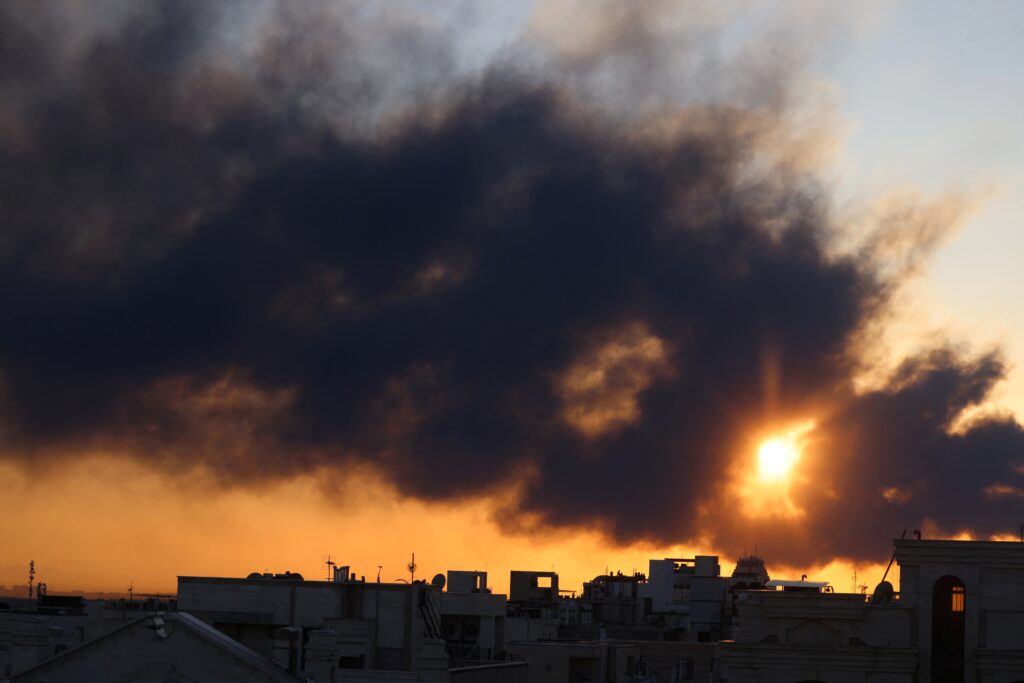
All that goodwill is going up in smoke. Gulf leaders and officials alike have uniformly condemned the Israeli attack. Saudi Arabia called the strikes “criminal assaults”, and Crown Prince Mohammed bin Salman said the Kingdom would “mobilise all its capabilities in supporting the neighbouring country”, while the UAE, which previously said that Israeli annexation of the West Bank was a “red line”, denounced the attack as “reckless conduct that fuels regional tension”. Anwar Gargash, the diplomatic adviser to the UAE’s president, wrote on X: “The security of the Gulf Arab states is indivisible, and we stand wholeheartedly with our sisterly state of Qatar.” It remains to be seen how and whether a collective response will be mustered, although Qatar’s Prime Minister has asserted that Doha “reserves the right to respond”. In a show of Arab unity at a hastily-convened summit in Doha, a call for a review of “diplomatic and economic relations” and the initiation of “legal proceedings” was issued. Mr Netanyahu shrugged this off, refusing to rule out further strikes on Hamas leaders abroad during a press conference with the visiting US Secretary of State Marco Rubio.
In any event, no significant response was forthcoming. Despite talk of a “joint defence mechanism”, only performative statements were issued, reflecting the inability to overcome the trust deficit in Gulf security coordination. Further afield, it is more of the same: Amman has made several diplomatic moves that indicate an increasingly fractious relationship with Tel Aviv, but security imperatives for continued cooperation remain. Likewise, Cairo has frozen ambassadorial exchanges, but still relies on the flow of Israeli natural gas.
Hard Truths for the Gulf States and its Arab Neighbours
The hard truth that the Gulf capitals must accept is that the current US administration prioritises Israel over them — despite all the investment deals, similar “strongmen” leadership styles with Gulf monarchs, and the access to Mr Trump. With a blank cheque handed to Israel, it is hard to see how Washington, long considered an external balancer in the region, will actually balance its relations between Tel Aviv and its most important Arab partners. Doubts have now been cast on US security guarantees, and Gulf leaders will be reminded of the American non-response to the 2019 Houthi attacks on Abqaiq oil facilities in Saudi Arabia, when Mr Trump — then in his first term — said: “That was an attack on Saudi Arabia, and that wasn’t an attack on us.”
As much as Mr Trump attempts to reassure Qatar “that such a thing will not happen again on their soil”, the latest episode will leave the Gulf Arab states and their citizens with a question: Is the United States reliable? The latest scoop by Axios, if true, would leave America’s Arab partners seething. According to the report, Mr Trump had around 50 minutes to object to the Israeli strikes. He reportedly stayed silent.
Israel is Taking the US With it to the Fringes
It is evident that the Trump administration has moved to exercise some damage control. Vice-President JD Vance and Secretary of State Marco Rubio held high-level talks with the Qatari Prime Minister in Washington before Mr Rubio travelled to the region. But the Secretary chose Israel as his first stop on his Middle East itinerary (and Qatar, second), reinforcing the “Israel first” message.
Mr Rubio’s actions while in Israel left no doubt. In addition to inaugurating a contentious archaeological site led by an Israeli settler group in occupied East Jerusalem, he cast doubt on a diplomatic solution to the Gaza War. While other countries have used the term “barbaric” to describe Israeli conduct in Qatar, he used it to refer only to Hamas. There was nary an attempt to put a modicum of distance between both sides: Mr Rubio was still in Israel when the Gaza City offensive was launched.
Meanwhile, the rest of the world continues beating its chest. The UN General Assembly overwhelmingly endorsed the two-state solution, with 142 out of 193 member states voting in favour. Later, a UN inquiry found that Israel has committed four out of five genocidal acts defined by the 1948 Convention on the Prevention and Punishment of the Crime of Genocide. None of these actions has made a difference.
The era when Iran was the disruptive regional foe is now a bygone one. Gulf leaders are now wary that Israel’s unchecked military power may encourage further illegal, unilateral actions. A disruptive Israeli hegemon also threatens their vital economic transformation projects at home. But their views hardly matter. A defiant Mr Netanyahu, with Washington firmly behind him, continues to push the boundaries of what is deemed acceptable, and there is little sign that he will stop.
Perhaps the only brake can come from within Israel itself. The country is increasingly turning into a pariah state engaged in forever wars of its own creation. For Israelis, Mr Netanyahu’s role as a spoiler in ceasefire talks means that the hostages may never come home. There are a growing number who are increasingly making their frustration with the current state of affairs known. If there is anyone who can get Mr Netanyahu’s attention, it is them.
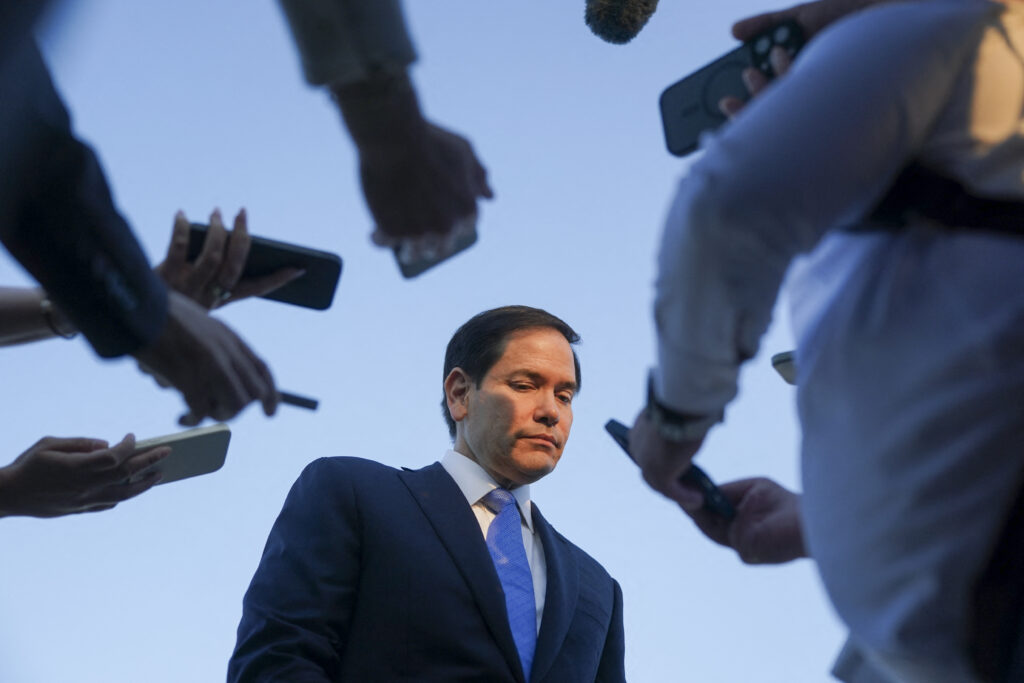
Image Caption:US Secretary of State Marco Rubio speaks to the press as he departs Tel Aviv for Qatar following an official visit, at Ben Gurion International Airport, near Lod, Israel, 16 September 2025. Israel heavily bombarded Gaza City on 16 September 2025 witnesses told AFP, after US Secretary of State Marco Rubio backed Israeli Prime Minister Benjamin Netanyahu’s new offensive there and its stated goal of eradicating Hamas. Photo: AFP
About the Author
Dr Clemens Chay is a research fellow at the National University of Singapore’s Middle East Institute. His research focuses on the history and politics of the Gulf states, with a particular emphasis on Kuwait, Oman and Qatar. At MEI he spearheads a public education series entitled “Bridging the Gulf”. His recent academic publications include a chapter that examines Kuwait’s parliamentary politics in The Routledge Handbook of Persian Gulf Politics(2020), a chapter in the edited volume Informal Politics in the Middle East (Hurst, 2021), and a study appearing in the Journal of Arabian Studies, titled “The Dīwāniyya Tradition in Modern Kuwait: An Interlinked Space and Practice.” His commentaries also feature across different outlets, including ISPI, KFCRIS, and AGSIW. He is currently working on a book project related to Kuwait’s diwaniyas(affectionately known as diwawin, and more widely known as majalisoutside Kuwait), the reception rooms for informal meetings that have implications for society, politics and diplomacy.
Prior to joining MEI, Dr Chay was the Al-Sabah fellow at Durham University, where he taught and completed his PhD in Middle Eastern and Islamic studies, and where he also received an MSc in defence, development and diplomacy. He is also a Sciences Po Paris alumnus, having read his BA at the Menton campus.
More in This Series
- Huzeir Ezekiel Dzulhisham
- -