Iran in Flux: A New Wave of Social Defiance Challenges the Hardliners
- Zeynab Malakouti
- -
During Iran’s 12-Day War with Israel, one of the key narratives that emerged was a surge in Iranian nationalism, which some observers credited for keeping the country together — and the government intact in the wake of external calls for regime change. After the war, however, significant social changes began to emerge within the country. Ordinary citizens, subjected to bombing — including of civilian areas — from an Israeli Air Force which quickly established dominance over Iranian skies, quickly concluded that the country’s strategy of ensuring its security by relying on the “Axis of Resistance”, guided by the Islamic Revolutionary Guard Corps (IRGC), was ineffective. It became clear to them that Israel was technologically and militarily superior to Iran, leaving it particularly vulnerable to further strikes.
Iran’s situation has been compounded by the re-imposition of United Nations Security Council sanctions, the United States’ lack unwillingness to return to the negotiating table, worsening economic conditions, and domestic challenges such as electricity and water shortages. After rallying around the flag, Iranians are now beginning to warm to the idea that the regime’s woes present them with an opportunity to secure some breathing space from unpopular laws that restricted their choice of dress, and even transport. Meanwhile, the authorities appear to have recognised the risks of confronting citizens over relatively minor acts of civil disobedience, and have turned a blind eye to them.
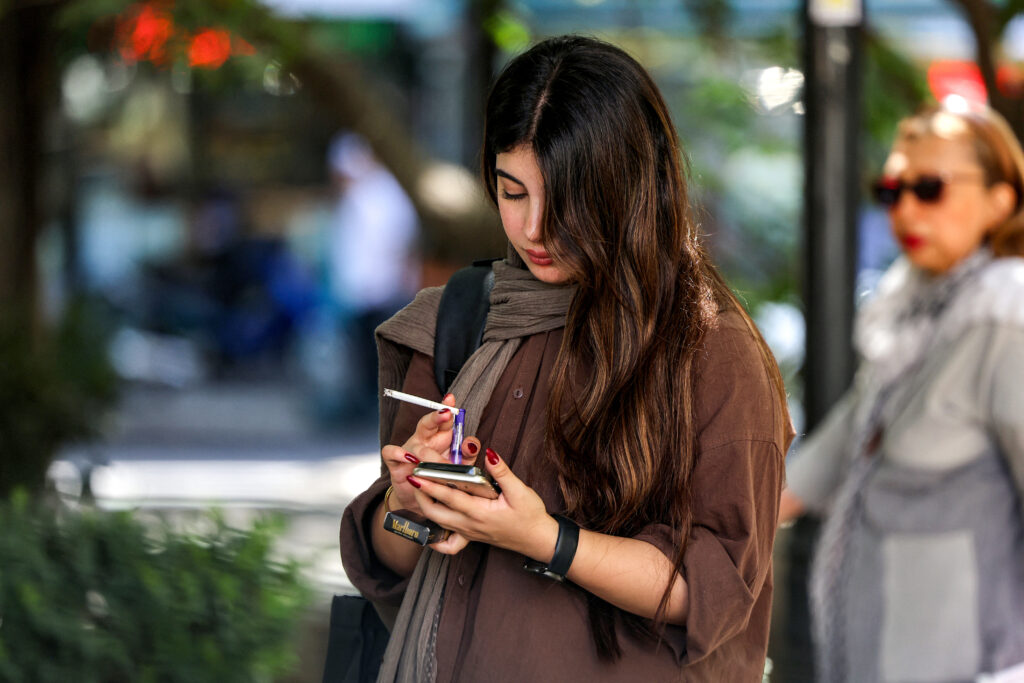
One sign of this is changes to the way men and women — particularly the latter — dress, especially in major cities and certain districts. The number of women not wearing headscarves has risen, and clothing styles have shifted. In Tehran, many Gen Z women now wear sleeveless tops and skirts, while men can be seen in the streets wearing shorts. Before the war, women driving without a hijab were repeatedly warned that failure to comply could result in their cars being confiscated. Now, however, there is no serious enforcement by the morality police, and no warnings are issued to women who do not wear hijabs. During the war, some people received SMS warnings from the police to comply with the hijab law, which led the government to not only apologise, but admit that the messages had been sent by mistake.
Equally startling as the sight of uncovered women is the absence of the morality police, who, though reined in since the election of reformist Masoud Pezeshkian as president, were nonetheless conspicuous on the streets of Tehran and other cities. Politicians, too, have adopted unusual stances on laws they backed vociferously in the past. Recently, Mohammad-Reza Bahonar, a figure close to hardliners, and a member of the Expediency Council — which advises the Supreme Leader and helps shape domestic and foreign policy — stated in an interview that “there is no longer any legal obligation to enforce the hijab law or to impose monetary fines, as decided by the Supreme National Security Council”. He added that “the paradigms in the Islamic Republic are currently undergoing reform.” Following this, a protest against Mr Bahonar was organised by extreme hardliners, but was eventually cancelled without any explanation.
Choosing to wear, or not, a hijab is mostly a matter of personal choice elsewhere, but not in Iran. For the Islamic Republic, the hijab is not just a religious practice, but also a symbol of identity, and a fundamental pillar of the country after the 1979 revolution. Because of this symbolic significance, upholding the hijab law is viewed as fundamental, as any breach could be perceived as undermining the Revolution, potentially leading to the gradual erosion of other foundational pillars. In fact, the garment’s political history predates the Islamic Republic. When Reza Shah Pahlavi banned it in 1936, it was a symbolic move to signal Iran’s progression towards a secular, modern nation, in the vein of Kemal Ataturk’s Turkey, and an exercise of state control of the religious clergy. This caused unhappiness across wide swathes of the country, and divisions between the so-called urban elite and the more religious rural population, and clerics. After 1979, the imposition of the hijab law was, in essence, a repudiation of Iran’s secular past — but making it mandatory caused an uproar as well, and massive protests erupted. Since then, the law has periodically been a focus of mass unrest.
In September 2022, the death of Mahsa Amini while in the custody of the morality police for violating the hijab law provided a flashpoint for one of the most significant mass movements in Iran for decades — the “Women, Life, Freedom” protests. The government responded by cracking down. Women who defied the law were subject to punishment, and this reached its peak during the presidency of Ebrahim Raisi, who pledged to strictly enforce the law. This period saw increased pressure on women to comply, including car confiscations, threats of social deprivation, and a surge in the closure of cafés and restaurants which admitted patrons without the garment.
After the 12-Day War, however, women without the hijab are common on the streets of the country, and are not harassed. It must be noted, however, that the law remains in place, although it is not enforced by the government of President Pezeshkian, who had previously declared that he would not “stand against the people”.
Social defiance is not confined to the hijab. In major cities, the number of women riding motorcycles is rising, although they are not allowed to do so — women, in fact, are barred from obtaining a motorcycle licence in Iran. However, police often choose to ignore such violations. There has also been a noticeable rise in permits for music concerts and other events, such as mixed-gender running groups wearing sports clothing not aligned with the Islamic Republic’s dress codes, or gatherings in cafés and restaurants featuring live DJs. In some cases, if a particular incident goes viral on social media, one or two people are detained overnight — a symbolic move by the authorities to signal to their supporters that Iran still upholds Islamic norms, but little other action is taken. The authorities have even encouraged musicians who left the country after 1979 to return, assuring them that they can do so without fear of arrest.
While the relaxation of social restrictions has mollified some, others — especially those who favour regime change or a return to the monarchy — have pushed the view that it is but a token gesture, a bet by the authorities that relatively minor steps will act as a valve to release anger and prevent bigger displays of unhappiness. Extreme hardliners are in the opposite camp: They believe such actions are antithetical to the idea of an Islamic republic. Hardline members of parliament have recently repeated their demand for stricter enforcement of the hijab law, viewing the growing number of women without the garment as a threat to Islam and the ideological foundations of the 1979 Islamic Revolution.
The Islamic Republic’s domestic position is currently at its weakest since the revolution, and it urgently needs public support, particularly as the possibility of another attack from Israel and the US remains very real. This has created a situation where any harsh crackdown could spark widespread unrest, creating an opportunity for civil society to seek a new contract with the Islamic Republic through acts of peaceful resistance. Nonetheless, more intractable issues could still mobilise Iranians en masse. These include the worsening economic situation, which has given rise to widespread poverty and unemployment, and frequent cuts to water and electricity supplies. President Pezeshkian, though nominally a reformist, could be at risk, too. His campaign promises include easing strict moral policing, improving Iran’s ties with countries around the world (except Israel), and working towards national unity. If he fails to deliver, or is blocked from doing so, many would see his campaign slogans as empty rhetoric, affecting his chances of re-election. Perhaps more importantly, it would add to the increasing questions over the path the Islamic Republic has taken its people on.
Image Caption: A woman not wearing the hijab headscarf holds a cigarette as she browses a phone along a street in Tehran on September 15, 2025, a day ahead of the anniversary of the protest movement sparked by the death in custody of 22-year-old Iranian Mahsa Amini who was arrested for allegedly violating the dress code for women. The women-led protests that broke out after Amini’s death on September 16, 2022, challenged not only the rule of the obligatory headscarf that has been a key pillar of the regime but also the very existence of the clerical-based system, rattling Iran’s leadership over autumn and winter 2022-2023. Photo: AFP
About the Author
Dr Zeynab Malakouti is a Research Affiliate at the Middle East Institute, National University of Singapore (NUS). She holds an LLM in Human Rights from the University of Reading, UK, and a PhD in International Law from the University of Leeds, UK.