Gulf Countries are Reshaping the Global Renewable Energy Map
- Chenjie Song
- -
The Gulf’s pivot to clean energy is among the most consequential, yet often underappreciated, shifts in the global energy transition. In late June, the emirate of Sharjah commissioned its largest solar plant, a project expected to cut CO₂ emissions by 66,000 tons per year.
Far from an isolated effort, this is one of many initiatives the United Arab Emirates (UAE) has undertaken to expand its renewable energy capacity. In January 2025, the country announced a landmark US$6 billion solar-plus-storage project, combining 5 GW of solar photovoltaic capacity with 19 GWh of battery storage. At almost the same time, Saudi Aramco unveiled a joint venture to begin lithium production, signalling a strategic move into the critical minerals space essential for battery production.
These announcements mark a decisive shift from planning to implementation. Across the Gulf Cooperation Council (GCC), renewable energy has evolved from a long-term ambition into a central pillar of economic strategy, one backed by national policy frameworks and sovereign wealth investment.
In the past five years, Gulf states have gone from near-zero renewable energy capacity to recording some of the highest growth rates globally. The region is now the fastest-growing renewable energy market outside China, with players such as Saudi Arabia, the UAE, and Oman scaling up solar and wind capacity at exponential rates.
This acceleration is not merely the outcome of government pledges. A string of high-capacity project awards highlights this transition from rhetoric to results. In 2023, Saudi Arabia alone awarded 5.5 GW of solar capacity as part of its national target to install 130 GW by 2030, up from less than 5 GW today. The UAE’s recently-announced project will deliver 1 GW of round-the-clock clean power, the largest of its kind globally. If current trajectories hold, renewable capacity across the region is expected to triple within five years, with around 30 per cent of GCC power capacity to be sourced from renewables by 2030.
Several structural and strategic factors drive this momentum. First, hydrocarbon revenues in the region have seen a dip. The volatility of oil markets, seen recently in Opec-led production cuts, has periodically constrained government budgets. In May 2025, Aramco issued US$5 billion in bonds and explored asset sales amid revenue shortfalls. These moves underscore a growing urgency to diversify energy and revenue sources, which have now become a financial imperative. Abu Dhabi’s clean energy firm Masdar, for instance, raised a US$1 billion green bond to finance future projects, reflecting growing investor appetite for Gulf-backed sustainable ventures.
At the same time, surging domestic energy demand is sharpening the region’s focus on energy efficiency. Driven by population growth, industrialisation, and high cooling and desalination needs, electricity consumption across the GCC is expected to rise substantially in the coming decade. Deploying renewables enables these states to meet demand without expanding fossil fuel use, which would free up oil and gas for export, and enhance fiscal returns.
These dynamics are reinforced by the Gulf’s unmatched geographic and technological advantages. Due to high solar irradiance, low land costs, and rapidly declining solar and storage technology prices, clean energy generation is more cost-efficient than gas-powered electricity in many areas. In the UAE and Saudi Arabia, solar bids have broken global records for low-cost electricity, reinforcing the commercial logic for sustained investment in large-scale renewable generation.
Beyond domestic energy transitions, Gulf countries are actively positioning themselves as future exporters of clean energy. An example of how this strategy manifests itself is hydrogen power. Saudi Arabia, the UAE, and Oman are each investing heavily in hydrogen production for export, targeting distinct markets: The UAE and Saudi Arabia supply blue hydrogen to Asia, while Oman is focused on exporting green hydrogen to Europe. According to the International Energy Agency, the Middle East could account for over 20 per cent of global hydrogen-focused renewable capacity by 2028. These strides suggest that Gulf states intend to remain central energy suppliers in a decarbonising world, albeit through different fuels.
These ambitious projects underway raise a fundamental question: Is the Gulf’s clean energy push reshaping the global renewable energy landscape?
At present, the Middle East still accounts for just 1 per cent of global installed renewable capacity. Even with rapid growth, this figure is unlikely to rival China or the EU’s cumulative capacity in the short term. However, in terms of growth rate and project scale, the GCC is beginning to outpace both Europe and the United States.
At the same time, sovereign investment from the region is shaping global renewable energy flows. Saudi Arabia’s Public Investment Fund (PIF), Abu Dhabi’s Mubadala, and other Gulf-backed entities are actively directing capital into wind and solar projects across the UK, Central Asia, and North Africa. In addition to expanding access to clean energy globally, these financial flows create valuable feedback loops of technology transfer and regional market integration. Under these terms, the GCC’s financial clout is accelerating the global energy transition through multiple routes, anchoring capital flows whilst expanding infrastructure and generation capacity.
As the global energy balance tilts toward Asia and the Middle East, the Gulf is poised to play an increasingly influential role in shaping the trajectory of the energy transition, especially in clean fuels and capital deployment. The region’s so-called “green revolution” reflects broader strategic foresight that takes energy security, national finances, and international influence into joint consideration. While historically dependent on hydrocarbons, renewables are now becoming a core pillar of national development strategies.
Though challenges remain, in the foreseeable future, Gulf countries are certain to emerge on the global energy map with growing impact. In the years ahead, the region’s role in the world’s energy future will certainly be shaped not just by its oil reserves, but increasingly by its renewables.
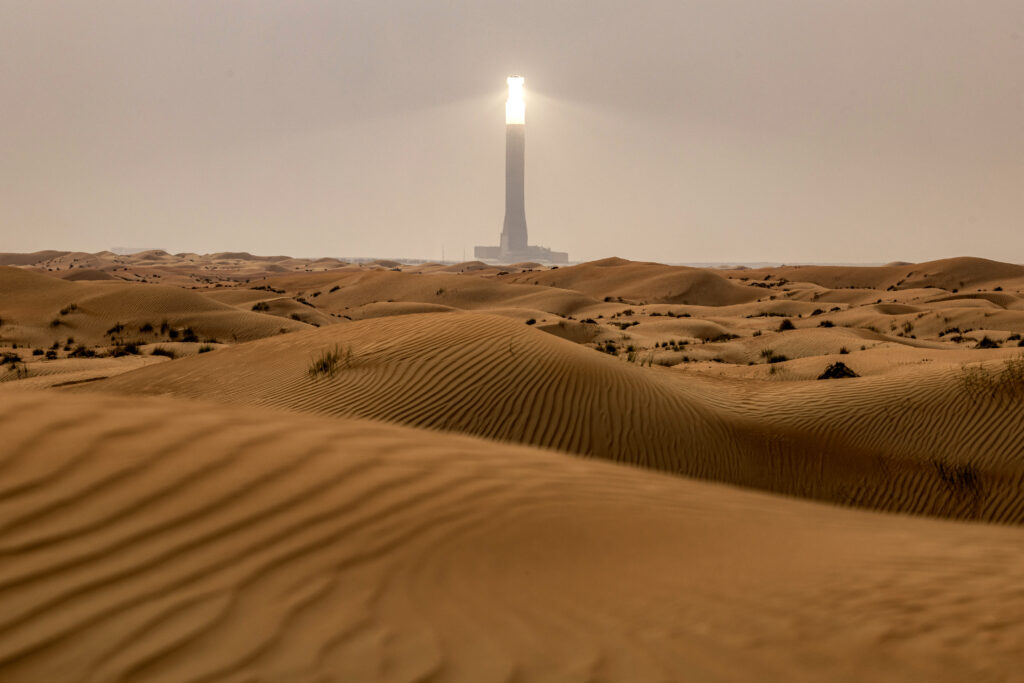
Image Caption: The tallest solar power tower in the world at 260 metres is pictured at the concentrated solar thermal power (CST) Noor Energy 1 solar complex at Mohammed bin Rashid al-Maktoum Solar Park, about 50 kilometres south of Dubai, on 19 July 2025. Photo: AFP
About the Author
Chenjie Song is a policy consultant based between the United Arab Emirates and China. She holds an undergraduate degree in Sociology and Political Science from the University of Chicago. Her writings focus on energy geopolitics and China-Gulf engagement, with a broader interest in international affairs and global current events.