Gaza Outlook Remains Dim, Despite Some Progress
- Clemens Chay
- -
Earlier this week, Israel partially re-opened the Rafah border crossing between Gaza and Egypt, almost two years since it was shut, renewing hope among residents of the devastated enclave, and raising confidence that a ceasefire that began last October would move into its second stage. This followed the inauguration of the Board of Peace — an initiative ostensibly designed to coordinate international involvement in Gaza’s reconstruction — by United States President Donald Trump at the World Economic Forum in Davos in January. There was a glaring omission in the announcement of the board, however: Gaza was not mentioned at all. Instead, the body was positioned as an “international organisation that seeks to promote stability, restore dependable and lawful governance, and secure enduring peace in areas affected or threatened by conflict”.
This universal framing reveals a dual purpose. First, the board aims to operate in conflict zones where the United Nations has been deemed ineffective — or so the argument goes. Second, and more tellingly, it establishes a structure fundamentally subordinate to its chairman, Mr Trump, who retains “exclusive authority to create, modify, or dissolve subsidiary entities as necessary or appropriate to fulfil the Board of Peace’s mission”. The implication is stark: While nations may vote or participate, Mr Trump remains the ultimate arbiter of what the board will or will not do.
Where Gaza is concerned, Jared Kushner, Mr Trump’s son-in-law, unveiled a presentation featuring skyscrapers lining the Strip’s coast, new cities, and plans for a Washington investment conference to attract private capital. Mr Kushner, also the architect of the Abraham Accords that normalised relations between Israel and several Arab states, declared at Davos: “Let’s plan for catastrophic success.”
The reality is less novel. Behind the polished veneer of the Board of Peace lies a repackaged “Gaza Riviera” vision first floated in March 2025, which drew immediate criticism for its detachment from conditions on the ground.
Progress or Profits?
In many ways, the Board of Peace represents progress from UN Security Council Resolution 2803, adopted last November — except for one critical distinction. Reconstruction will now be monetised, with the chairman demanding US$1 billion in membership fees from countries seeking permanent seats, while also standing to profit from prospective waterfront development in Gaza. Out of the 60 invitations sent out by the Trump administration — including to Singapore — just 26 countries have signed on to the initiative.
From an organisational perspective, the founding executive committee of the board includes top Trump Administration officials, private equity chief Marc Rowan, World Bank President Ajay Banga, and former United Kingdom Prime Minister Tony Blair, among others. Nickolay Mladenov, a former UN Middle East envoy, was appointed High Representative of Gaza, spearheading the difficult task of turning the fragile ceasefire into sustainable peace.
Mr Mladenov faces a Herculean task: Coordinating with the 15-member National Committee for the Administration of Gaza (NCAG) — a Palestinian technocratic body — while formulating a programme acceptable to Palestinians, Israelis, and Americans alike. The NCAG, led by Ali Shaath, a former deputy planning minister under the Palestinian Authority, comprises technocrats charged with rebuilding Gaza while remaining strictly apolitical. This mandate is deliberately narrow: The committee has no authority to address sovereignty, demilitarisation, or governance.
However, the conflict’s roots remain fundamentally political, focusing on competing claims to land and self-determination that persist to this day. The silver lining may be this: Gaza’s future has advanced through the Trump Administration’s determination to progress from ceasefire to demilitarisation, governance, and reconstruction. This shift equally reflects a willingness to follow through on the 20-point peace plan issued last September.
The reality on the ground, however, presents a mixed picture. Following Hamas’ release of 20 living hostages last October, the Israeli military only recently retrieved the remains of the final Gaza hostage, while Israel returned 15 unidentified Palestinian remains from the war. This final exchange signals, in some measure, a willingness among the parties to move forward. Humanitarian aid into the Strip has also increased, although the UN and its partners warn that it represents little more than a Band-Aid for now. The reopening of the Rafah crossing provides another glimmer of optimism, but so far, only for “limited passage of residents”.
Whether the reopening proves sustainable remains at Israel’s mercy — as does the ceasefire itself. In air raids conducted by Israeli forces on January 31, more than 30 were killed across the Strip, marking a pattern of deadly strikes that has persisted since last October’s truce.
Major Sticking Points Unanswered
Despite bold declarations at the top, three major sticking points remain unresolved — each with direct bearing on ground realities. First, Hamas’ disarmament has yet to occur, which in turn affects Israeli threat perceptions. When Phase 1 rolled out, Hamas deployed armed fighters and police across Gaza to reassert authority, creating a patchwork of competing armed groups — including those backed by Israel — vying for influence.
President Trump’s claim that Hamas would “likely” surrender its weapons, coupled with a warning to choose “the easy way or hard”, has yet to materialise. At this stage, Hamas’ decisions directly affect Palestinian factionalism and the viability of any unified leadership, though the group recently stated it is prepared to transfer governance of Gaza to the NCAG. That disarmament remains purely theoretical months into the ceasefire, alongside continuous Israeli strikes, is a dangerous omen for any lasting peace.
Second, Israel’s withdrawal to the so-called “yellow line” under Phase 1 was meant to be temporary. But the Chief of Staff of the Israel Defense Forces, Lieutenant-General Eyal Zamir, called the line “a new border,” raising fears it could become permanent — a concern heightened by reports that Israel has been moving yellow markers deeper into Palestinian territory.
Third, and directly linked to security concerns, is the establishment of an International Stabilisation Force (ISF) mandated by Mr Trump’s peace plan. This effort has stalled amid widespread reluctance, mainly a result of ambiguity over its mandate, and Israeli insistence that Hamas disarm before such a force is deployed.
The Paradox of Peace
Gaza’s future remains trapped within a security paradigm. Israeli control over the Strip depends on how it assesses the threat posed by Hamas and the radicalism it has instilled in supporters. Conversely, Hamas’ willingness to cede control rests on Israeli commitment to withdrawal, and the viability of alternative Palestinian leadership. This mutual intransigence has produced a deadlock that Mr Trump’s Board of Peace will struggle to resolve, leaving the President reliant on coercion and threats.
More worryingly, Israel’s security Cabinet approved 19 new West Bank settlements last December, while reports indicate excess soil from Tel Aviv is being prepared for settler farm expansion — evidence that its territorial ambitions extend far beyond Gaza. Meanwhile, Mr Trump himself appears increasingly distracted by mounting tensions with Iran, and the looming US mid-term elections, suggesting Gaza may no longer command the presidential attention it once did.
Ultimately, the Board of Peace reveals how progress in Gaza remains beholden to one man. President Trump has stated this categorically: “I don’t need international law.” The only constraint on his power, he asserts, is his “own morality.” The question then becomes: When his term ends in three years, will the board simply wither away — along with Gaza’s prospects for peace?
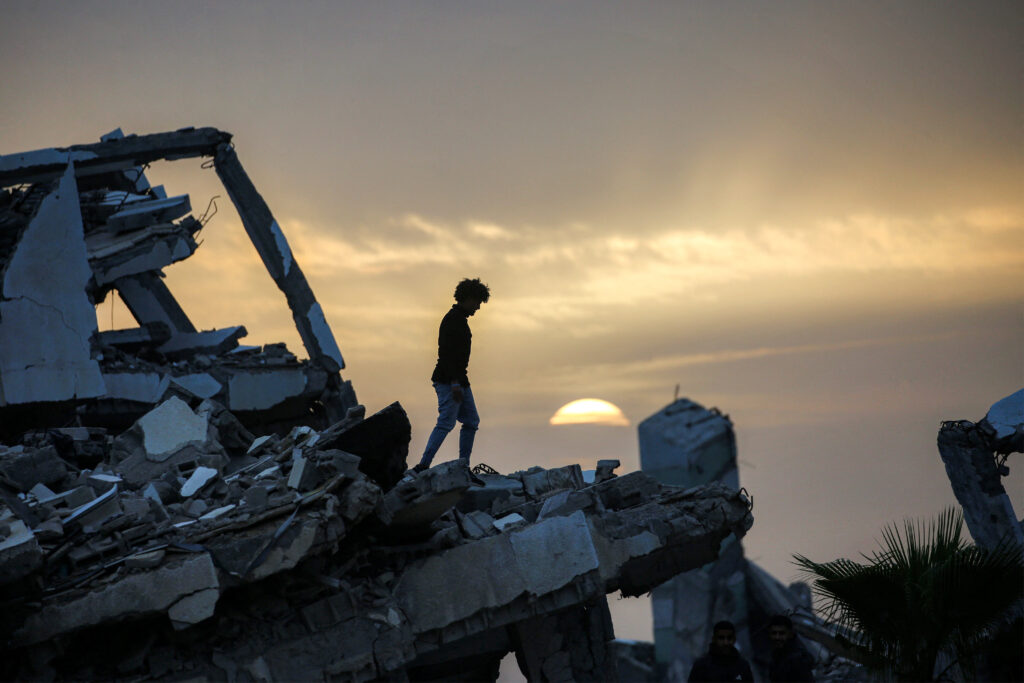
Image Caption: A youth walks along the ruins of a destroyed building in the Zahra neighbourhood, southwest of Nuseirat in the central Gaza Strip, at sunset on 6 February 2026. Since 10 October 2025, a fragile US-sponsored truce in Gaza has largely halted the fighting between Israeli forces and Hamas, but both sides have alleged frequent violations. Photo: AFP
About the Author
Clemens Chay is Senior Fellow for Geopolitics at the Observer Research Foundation Middle East.

More in This Series
- Huzeir Ezekiel Dzulhisham
- -