Beyond Gaza: The Rising Threat of Direct Houthi-Israel Confrontation
- Damien Tan
- -
On 4 May, Houthi forces fired a ballistic missile and struck Tel Aviv’s Ben Gurion Airport. Attempts by Israeli defence forces to intercept the missile with the long-range Arrow system failed, marking a qualitative and significant escalation in Houthi attacks on Israeli territory. In the aftermath of the strike, Israeli forces retaliated by striking key installations and Houthi infrastructure in Yemen. The retaliatory campaign targeted military and logistics facilities, including the strategic port of Hodeidah, Sana’a International Airport, and several cement factories and logistics hubs in and around the capital.
The strike on Ben Gurion Airport on 4 May reveals a growing weakness in Israel’s deterrent posture. Despite facing advanced Israeli air defences and the threat of retaliation, the Houthis continue to adapt and escalate the conflict, underscoring their resilience and the limits of Israel’s current strategy. The recent US-Houthi ceasefire in the Red Sea also allows the Houthis to recalibrate their efforts and concentrate more directly on Israel.
As their missile campaign against Israel escalated, the confrontation between the Houthis and the IDF is shifting from a proxy dimension to a more direct and self-sustaining conflict.
Israel’s retaliatory airstrikes may be insufficient to deter future Houthi attacks. The group has developed a resilient supply chain to circumvent disruptions to key infrastructure. At sea, Iranian arms shipments continue to flow via covert maritime routes, illustrating the group’s ability to sustain weapons inflows despite increased surveillance and interdiction efforts, especially by the US Navy. On land, weapons and components are funnelled through Oman into Houthi-controlled northern Yemen via informal desert crossings and tribal smuggling networks. These combined maritime and overland channels reduce the strategic effectiveness of strikes on shipping hubs like Hodeidah, which Israel has struck several times, most recently on 10 June. Overall, Israel faces the same challenge that plagued US President Donald Trump’s Operation Rough Rider, his predecessor’s Prosperity Guardian effort, and the Saudi-led coalition in Yemen for over a decade: The Houthis’ ability to harass shipping and target infrastructure despite being under intense pressure from sustained aerial campaigns.
Additionally, the Houthis have steadily increased their technical sophistication as the conflict has progressed, demonstrated by their deployment of hydrogen-powered drones, more advanced Unmanned Aerial Vehicles (UAVs), and ballistic missile technology. While this progress relies heavily on Iranian support, it suggests the group is now capable of launching longer-range and more sustained attacks.
These factors may further embolden the Houthis. Additionally, the successful strike on Ben-Gurion Airport is likely to enhance their confidence and morale, reinforcing their resolve and encouraging the pursuit of additional targets within Israeli territory. In future, they might target other strategically significant targets, such as Ashkelon’s energy infrastructure, the port of Eilat, or military bases in Israel’s south. Given the Houthis’ growing capabilities, these sites are not just operationally feasible — they have the added value of being symbolically resonant. This is especially notable if the Houthis believe the US will not act because of the separate ceasefire they negotiated with Washington.
Another advantage for the Houthis’ is the heavy demands their attacks place on Israel’s missile defence systems. Repeated missile attacks from a variety of actors have proven that having a capable defence platform does not deter adversaries who can reliably — and cheaply — procure missiles, rockets and other offensive weaponry. This is especially sobering because groups attacking Israel often do not even need to hit their targets to be effective. Sending up expensive interceptors against weapons that are a fraction of the cost will also eventually take a toll on the Israeli economy, which has already grown moribund after more than a year of war.
Given these, Israel’s broader goal would be to effectively degrade Houthi capabilities and re-establish deterrence by demonstrating its ability to strike at the core of the Yemeni group’s resistance and survival networks. One likely strategy is to target the Houthi leadership directly, which has already been hinted at by Prime Minister Benjamin Netanyahu, who said in a video statement on 16 May that “(Israel is not) willing to sit on the sidelines and let the Houthis attack us. We will hit them far more, including their leadership and all the infrastructure that allows them to hit us”. The execution of such a strategy may include clandestine missions, such as In the Houthis’ case, targeted assassinations of senior commanders via precision drone strikes could also be deployed.
Another tactical option would be to target Houthi supply architecture. Iranian arms shipments continue to flow via covert maritime routes and overland smuggling networks that run through Oman, particularly via the Dhofar border region into Yemen’s Mahra governorate, highlighting key logistical chokepoints. While US naval efforts have increased interdictions in the Red Sea, they have not fully neutralised the network, in part due to the scale of the maritime domain. Israel, facing a more direct threat, may pursue a more aggressive, intelligence-led approach which emphasises pre-emptive strikes, covert sabotage, and targeted maritime interdiction missions.
With fewer political restraints and a narrower operational scope, Israel could prioritise the neutralisation of high-value shipments and vessels suspected of transporting advanced missile components, potentially achieving greater tactical disruption, even if the broader network remains intact. While these operations are complicated by longstanding intelligence blind spots, given that Yemen was never a primary focus for Israeli security services, the recent shift to a more direct conflict means that attention and resource allocation towards the Houthi threat is likely increasing.
The need for Israel to adopt a new strategy in the wake of Houthi successes reflects the limits of a long-standing strategic paradigm rooted in Ze’ev Jabotinsky’s Iron Wall — the belief that only overwhelming strength can compel hostile neighbours to accept the country’s permanence. Despite Israel’s overwhelmingly superior military, it is continually being tested by a group over 1,000 km away, a clear indication that its deterrence has failed. As the perception of vulnerability grows, Israel finds itself increasingly isolated internationally, misaligned with Washington, and at risk of becoming entangled in a drawn-out, asymmetric conflict with the Houthis. Without a strategic recalibration that goes beyond the Iron Wall’s logic, the erosion of deterrence will continue to exact a growing cost.
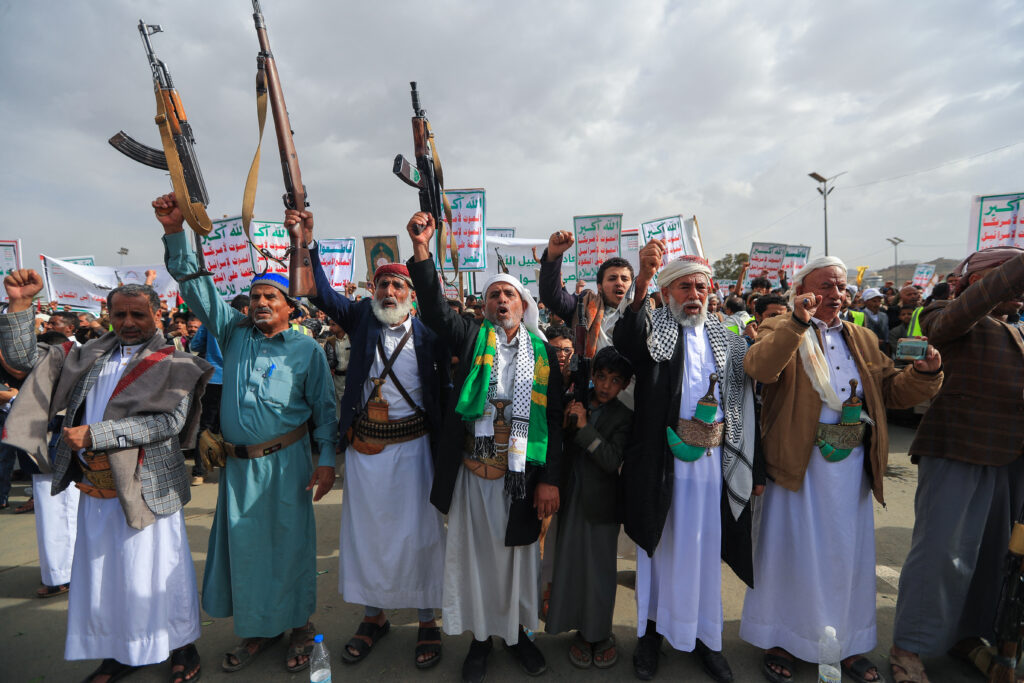
Image Caption: Yemenis brandish their rifles and chant during a rally in solidarity with Palestinians and the Gaza Strip and in condemnation of Israel and the US, in the Houthi-run capital Sanaa on 30 May 2025. Photo: AFP
About the Author