
Amid Global Uncertainty, Indonesia Eyes the Middle East to Boost its Clout
- Muhammad Zulfikar Rakhmat, Yeta Purnama
- -
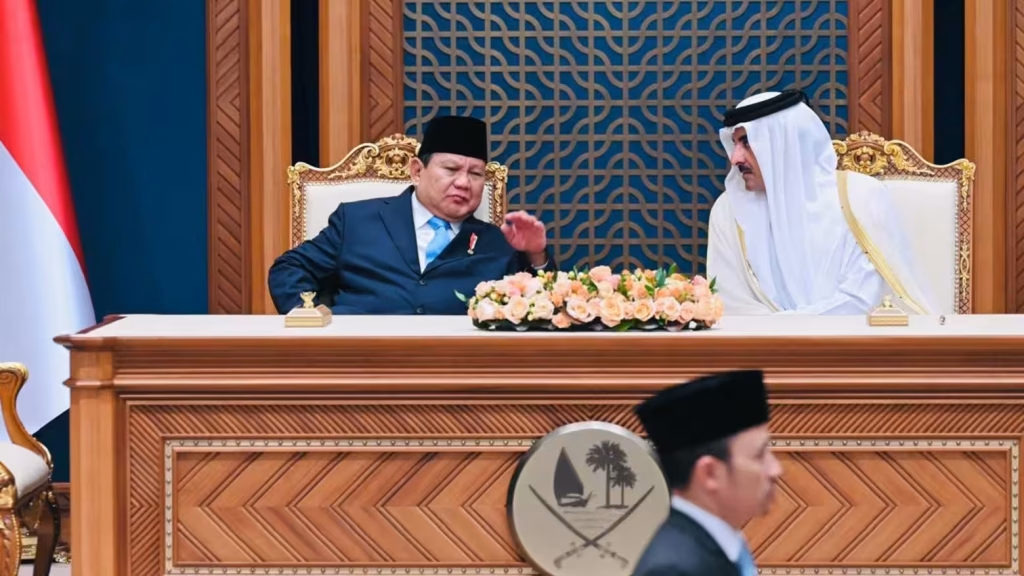
Indonesian President Prabowo Subianto’s recent six-day tour of the Middle East, which took him to the United Arab Emirates, Turkey, Egypt, Qatar, and Jordan, heralded a significant shift in Jakarta’s foreign policy, and places the region squarely within its strategic calculus. In each capital, the president inked agreements that revolved around sectors central to Indonesia’s interests: Defence, energy, education, agriculture, media, investment, and humanitarian assistance.
In the United Arab Emirates, the state visit culminated in a flurry of agreements. A Letter of Intent to launch a Nature and Climate Partnership was signed between the UAE’s Ministry of Foreign Affairs and Indonesia’s Coordinating Ministry for Food Affairs. The two countries updated their cooperation framework in marine and fisheries with a Second Amendment Protocol to their Memorandum of Understanding. The Indonesian National Police (POLRI) and the UAE Ministry of Interior also agreed to deepen cooperation in security and counter-terrorism, while another MoU brought Indonesia’s Ministry of Religious Affairs into alignment with the UAE’s General Authority for Islamic Affairs and Endowments. In agriculture, a new agreement between Indonesia’s Ministry of Agriculture and Al-Ain Farms focused on dairy production investments.
Beyond these sectoral deals, economic collaboration took a giant leap. A Principle Agreement was signed to expand the Cirata Photovoltaic Solar Power Plant. PT PLN (Persero) and Abu Dhabi’s Masdar agreed to develop the 100-Megawatt Jatigede Floating Solar Power Plant. Indonesian state-owned arms manufacturer PT Pindad partnered with Ninety Degree General Trading LLC. Mr Prabowo and UAE President Mohammed bin Zayed also witnessed the signing of agreements covering technology, renewable energy, health, culture, tourism, mining, infrastructure, and government modernization.
From the Gulf, Mr Prabowo flew to Ankara, where he and Turkish President Recep Tayyip Erdoğan convened the first High-Level Strategic Cooperation Council between their nations. There, the defence sector took centrestage. Both governments announced a Joint Venture between strategic defence firms, deepening Turkey’s involvement in Indonesia’s fifth-generation fighter jet and submarine programmes. A notable agreement between Republikorp and Baykar will establish a drone manufacturing facility in Indonesia.
Military cooperation was not the only item on the table. A Bilateral Investment Treaty and a Joint Statement of Intent to promote investment were signed, while additional memoranda covered energy, higher education, religious education, the medical sciences, trade, industry, agriculture, and broadcasting.
Meanwhile, in Egypt, Mr Prabowo met President Abdel Fattah el-Sisi and signed a suite of MoUs in politics, economics, defence, security, education, and cultural relations.
While in Cairo, the Indonesia leader delivered two statements at the 11th Developing Eight (D-8) Summit, on investing in youth, and the situation in Palestine and Lebanon. On the sidelines, Prabowo also held bilateral meetings with various leaders in attendance to strengthen diplomatic relations with fellow D-8 countries, which include Malaysia, Nigeria, and Pakistan.
A similar flurry of activity ensued in Qatar, where the Indonesian leader and Emir Sheikh Tamim bin Hamad Al Thani oversaw the signing of a pivotal Memorandum of Understanding establishing an annual Strategic Dialogue mechanism between the two countries. This agreement laid the groundwork for cooperation across a broad spectrum: Politics, security, energy, agriculture, youth, health, technology, tourism, migrant protection, and multilateral engagement. The highlight of the visit was Qatar’s US$2 billion commitment to support infrastructure and natural resource development.
Jordan, Mr Prabowo’s final stop, capped the whirlwind six-day swing through the region. In meetings with King Abdullah II, the two leaders issued a joint call for a ceasefire in Gaza and expanded humanitarian assistance. But symbolism was matched by substance. Three new MoUs were signed, covering defence, religious and educational cooperation, and agriculture. Indonesia’s Agriculture Minister Andi Amran Sulaiman who preceded the President to Jordan, signed a landmark agreement with Jordan’s Ministry of Agriculture. The deal included provisions for research, training, market access, and food supply chains.
This agreement illustrated Jakarta’s evolving diplomatic playbook. Food security, long treated as a domestic concern, is now a geopolitical instrument. Agricultural diplomacy is emerging as a pillar of Indonesia’s regional influence strategy, particularly with countries dependent on food imports.
Across all five capitals, Mr Prabowo’s engagements signalled a shift of sorts: While China and India remain pillars of Indonesian foreign policy, the Middle East is growing in importance. This is a result of the different strengths that each of the countries visited can bring to bear: Capital and renewable energy expertise from the UAE, defence industry depth from Turkey, and educational and cultural connectivity from Egypt. Meanwhile, Qatar contributes financial muscle, while Jordan enables agricultural diplomacy and humanitarian alignment.
Indonesia’s approach has thus shifted from reactive diplomacy to proactive, multi-dimensional statecraft, reflecting Jakarta’s efforts to deal with a shifting world order. With the United States pursuing more protectionist trade policies under Donald Trump, Indonesia’s traditional export markets face new headwinds. Diversifying its partnerships with Middle Eastern powers is not merely strategic — it is imperative.
Indonesia and the Middle East share vulnerabilities and strengths. The Arab states are capital-rich, but food-dependent. Indonesia is resource-rich with a vast consumer base, and agricultural potential. Deepening bilateral and multilateral ties offer both sides resilience amid the volatility of Western-dominated trade networks.
What began as a diplomatic tour now appears to be the opening act of Indonesia’s next geopolitical pivot. And this time, it is being driven not by ideology or alignment, but by long-term necessity and strategic clarity. But whether Mr Prabowo — who is dealing with increasing discontent at home, and whose Middle East trip has been criticised in some quarters as well-meaning, but grandiose and unrealistic — can pull off his bid to grow Indonesia’s international clout remains in doubt.
Image Caption: Indonesian President Prabowo Subianto, left, meets Qatari Emir Tamim bin Hamad bin Khalifa Al Thani in Doha on 13 April. Both countries agreed to set up a US$4 billion joint fund that will be invested through Indonesia’s new sovereign wealth fund, Danantara. Photo: Indonesia’s presidential office
About the Author
Muhammad Zulfikar Rakhmat, a researcher at Jakarta-based Center of Economic and Law Studies, is an MEI Research Affiliate.
Yeta Purnama is a researcher at the Centre of Economic and Law Studies in Jakarta.
More in This Series
- Huzeir Ezekiel Dzulhisham
- -