After Suwayda, an Israel-Syria Deal is Off the Table — for Now
- Damien Tan
- -
On 16 July, Israeli forces carried out several strikes on key Syrian government buildings, including the presidential palace, the Ministry of Defence, and the army headquarters, the first direct major attack on the nascent government in Damascus by Israel since the fall of the Assad regime. The strikes, aimed at sending a warning to Damascus for its perceived failure to protect members of the Druze minority in the Suwayda region, represent a dramatic rupture from recent back-channel peace efforts, underscoring how quickly the security landscape has deteriorated.
Suwayda Clashes Tanked Talks
The violence was triggered on 13 July, when clashes broke out between Druze and Bedouin armed groups in Suwayda and surrounding regions. The fighting led to reports of extrajudicial killings and abuses against civilians on both sides. The Syrian government attempted to stabilise the situation by deploying its forces to Suwayda. However, this instead contributed to escalating violence, leading to serious accusations of atrocities against the Druze community by the Syrian military. This prompted Israel to react by launching airstrikes targeting Syrian government forces and Bedouin fighters, ostensibly to protect the Druze. Having expanded operations deeper into southwestern Syria, Israel demanded the withdrawal of all government forces from the area. Syrian President Ahmed al-Sharaa subsequently acquiesced, framing the decision as a necessary measure to avoid a broader military confrontation with Israel. The confrontation is a dramatic setback for quiet diplomatic efforts for peace between Syria and Israel, which had initially appeared promising, casting serious doubt over the possibility of a deal anytime soon.
An Early Appetite for Peace
Before the Suwayda clashes, both countries had indicated an appetite for peace negotiations. Syria was discreetly exploring the possibility of a comprehensive peace agreement with Israel, viewing it as a potential gateway to long-term security, economic recovery, and regional reintegration. In June, Israeli Prime Minister Benjamin Netanyahu reportedly requested US mediation in negotiations with Syria aimed at achieving a peace agreement. There were compelling strategic and security incentives for both Tel Aviv and Damascus to pursue a renewed version of the post-Yom Kippur War ceasefire, an arrangement that had ensured relative stability for over four decades. Additionally, Turkey’s expanding role in post-Assad Syria created overlapping strategic concerns that encouraged Israeli openness to a limited agreement with Damascus. For Israel, even a narrow ceasefire or deconfliction deal offered potential leverage over Ankara, providing a means to influence developments such as Turkey’s attempts to establish a wider military presence in Syria, including its T4 airbase project near Palmyra.
These negotiations appeared to be progressing, if slowly, despite several major obstacles. Among these, sovereignty over the Golan Heights is possibly the most intractable. For Israel, which seized the strategically high ground in 1967 and effectively annexed it in 1981, the Heights are vital to its security. Syria, on the other hand, views Israel’s occupation of the area as a core violation of its sovereignty. Israel is also highly sensitive to the rise of hardline Islamist governance on its borders, and had previously conducted strikes in Syria as a warning to the government for its tolerance of sectarian instability and extremist actors within its ranks. The March 2025 coastal clashes, which saw government-aligned factions responsible for a systematic massacre of nearly 1,500 Alawite civilians, deepened Israeli apprehensions. While President Al-Sharaa has been attempting to establish himself as a unifying figure and promised to protect minority rights to stabilise the country, his record thus far has been unconvincing. Even though the United States and the Gulf states largely refrained from responding to credible reports implicating the Syrian government in the coastal massacre, the Suwayda clashes have further underscored the President’s apparent inability, or unwillingness, to rein in the extremist factions that are part of his administration.
Reinforced Concerns Over Syrian Leadership
US Special Envoy to Syria Thomas Barrack described the events surrounding the clashes as “(coming) at a very bad time” and stated that they “create another very confusing chapter” in the region. This sentiment is shared by Arab and Turkish officials, who have voiced serious concerns about the breakdown in Israeli-Syrian relations, as well as the broader instability unfolding in a Syria that was expected to be on a path towards recovery. Collectively, their remarks reveal just how severely the Suweyda clashes have set back the progress of Israeli-Syrian negotiations.
Israel’s dominant position — vis-à-vis both Syria and the wider region — in its has paradoxically reduced the incentive for diplomatic compromise. Israeli foreign policy has historically been comfortable dealing with a fragmented and enfeebled Syria. Tel Aviv prefers not to rush into a lasting agreement without careful deliberation, confident in its ability to indefinitely manage the security situation in Syria through military means. The Suwayda clashes have not only reaffirmed the asymmetry between Israeli and Syrian military capabilities, but have also further weakened the latter’s negotiating position, as Damascus appears unable to stabilise its southern provinces — an essential prerequisite for a peace deal. As long as Israel perceives no pressing urgency to reach an agreement, and given that Syria currently lacks any substantial leverage or incentives to offer, it is likely that Tel Aviv will maintain an uncompromising stance, continuing to press for its demands without offering significant concessions.
As importantly, the violence in Suweyda has all but reinforced Israeli concerns of Syrian inclusivity and its treatment of minority groups, particularly regarding the Druze. Israeli Druze, who wield an outsized influence in the country’s politics due to their high rates of military service, have exerted heavy pressure on their government to respond decisively to reports of atrocities committed against their brethren across the border, with whom they maintain a strong communal and cultural affinity — many rushed across the border in a show of solidarity despite government warnings against this. Any steps towards an agreement will now have to include steps to ensure a repeat of Suweyda does not occur, including credible accountability mechanisms, and a transparent investigation and prosecution of those responsible for the violence. Without such measures, it is unlikely that Israel would be willing to continue negotiations with a government that cannot effectively manage sectarian tensions.
Finally, the Suwayda clashes have raised questions about whether President Al-Sharaa’s grip on power is tenuous. For any agreement with Israel to be viable and diplomatically tenable, it needs the imprimatur of a leader of a cohesive and stable state. The clashes in Suwayda and the coast, among others, reveal not only a sectarian divide between groups, but also call into question how much authority the President wields over the military. Far from being a cohesive and professionalised force, the new Syrian military is largely composed of loosely-affiliated Islamist rebel militias that operate with minimal oversight or accountability. Without a demonstrable capacity to centralise authority, uphold the rule of law, and ensure internal coherence, Israel would see little utility in negotiating with a counterpart that cannot effectively enforce or guarantee the terms of any future agreement.
Is Peace Still Possible?
Before the crisis in Suwayda, the prospects for a peace agreement between Israel and Syria, likely manifesting as an updated formal ceasefire, were conceivable, particularly given Washington’s interest — and pressure — in reaching such a deal. However, the outlook has significantly diminished in the near term. The clashes have exposed the fragile nature of President Al-Sharaa’s government, underscoring the need for substantial and sustained reforms in Syria before meaningful negotiations can resume.
However, there are still concrete and pragmatic incentives for a deal. As mentioned, the US is exerting significant pressure on Israel to reach a deal. Washington has conveyed its disapproval of Israel’s departure from negotiations. President Donald Trump has telegraphed his desire to be seen as a peacemaker in the Middle East, and wants to be seen as the enabler for comprehensive deals between Israel and Arab states, and, indeed, widen the circle of countries in the Abraham Accords. As Iran showed, however, there are limits to his influence on Israeli decision-making. Turkey, the other major external player in Syria, has also aimed a warning at Israel, threatening intervention against attempts to fragment the country following the airstrikes on Damascus. While Ankara is unlikely to risk direct confrontation with Israel, Tel Aviv would be prudent not to dismiss its concerns too overtly, as they concern critical interests.
President Al-Sharaa has also shown a willingness to continue the dialogue, agreeing to Israeli demands to withdraw his military, and deploying the less-lethal internal security forces instead. Thus far, Israel has limited its strikes in Syria to largely symbolic targets, and, notably, has refrained from targeting Syria’s political leadership. By leaving Syria’s political elite intact, Israel has also signalled that it still sees value in maintaining a channel for dialogue, rather than foreclosing political resolution altogether. It is important to note that Israel derived little tangible security benefit from the recent clashes, and it is a reasonable assumption that, despite setbacks, it would still prefer to work towards a deal, provided its concerns are addressed.
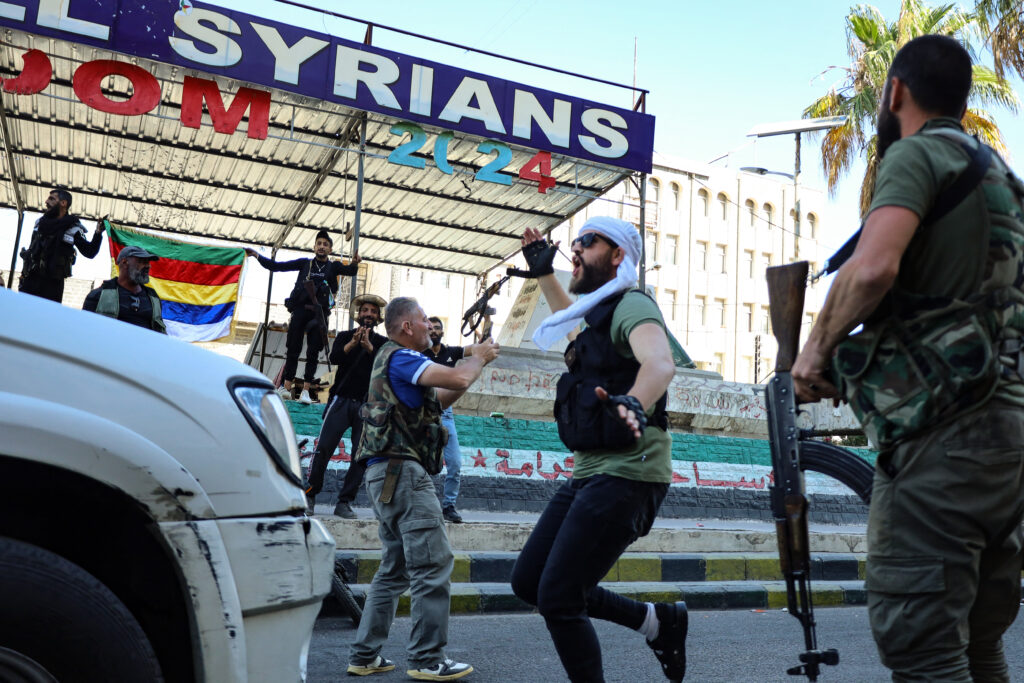
Image Caption: Syrian Druze fighters celebrate after Syrian government forces pulled out of the southern Sweida governorate, on 17 July 2025. The Druze heartland Sweida has been gripped by deadly sectarian bloodshed since 13 July, with hundreds reportedly killed in clashes pitting Druze fighters against Sunni Bedouin tribes and the army and its allies. Photo: AFP
About the Author
Damien Tan is a Research Assistant at the Middle East Institute, National University of Singapore, with experience in policy research in government and academia. His research focuses on international security and Middle East foreign policy. He is currently a final-year undergraduate student at the National University of Singapore.

More in This Series
- Huzeir Ezekiel Dzulhisham
- -