The United States occupies a paradoxical position in world politics today. Its military power remains unmatched in scale, reach, and technological sophistication, yet its ability to convert that power into durable political authority has visibly declined. This tension between material primacy and eroding prestige has become one of the defining features of contemporary American foreign policy. Central to Donald Trump’s rise to the presidency was the claim that America had lost strength and confidence abroad and at home, a theme he articulated in his inaugural address in 2017, where he spoke of “American carnage”, and pledged to restore American primacy. The US’ recent intervention in Venezuela, framed here as the Caracas Intervention, can be explained against this broader background.
Earlier phases of American politics rested on identifiable projects of order, most notably Cold War containment and, later, the post-1991 effort to extend a liberal institutional framework. During the Cold War, military intervention was embedded within a strategy designed to advance liberal order in a bipolar system. Post-Cold War, intervention was increasingly justified through claims of liberal expansion, even though force remained central. In those cases, coercion was accompanied by a political narrative about the kind of order being defended or constructed. That narrative has largely receded. Military primacy remains intact, but it is no longer anchored in a political project capable of translating itself into global authority.
The 9/11 attacks, and the subsequent US experience in Iraq in 2003, marked a decisive shift in American understanding of its power. Beyond the removal of Saddam Hussein, the dissolution of state institutions and the failure of political reconstruction demonstrated that military superiority alone could not generate political order. The failure in Iraq, compounded later by the withdrawal from Afghanistan, came to symbolise strategic failure, rather than strength, reflecting a failure of political authority and credibility, and reinforcing scepticism towards ambitious projects of political reconstruction through force.
This legacy has shaped the events in Venezuela. The removal of President Nicolas Maduro has not been followed by an American effort to define or shape the political order that should follow. Despite earlier recognition of María Corina Machado as a leading opposition figure, President Trump made clear that she would not assume presidential authority. What distinguishes the US’ actions in Venezuela from recent episodes is precisely this absence of political follow-through, setting it apart from both Cold War practices, and the more expansive ambitions of the early post-Cold War period.
In the past, American intervention has repeatedly produced compliance without reconstruction, as in Iran in 1953, where the removal of Mohammad Mossadegh consolidated power around the Shah. In Guatemala (1954), Jacobo Árbenz was replaced by authoritarian rule conditioned on alignment with Washington. Panama (1989), where the capture of Manuel Noriega restored canal control while political restructuring remained limited. As with those episodes, leadership removal functioned as an objective in its own right, while the question of domestic political order was deferred once strategic aims were secured.
The question that follows is how US foreign policy will shape future reliance on military force: Caracas represents a return to intensified American global power projection. First, over the past three decades, repeated intervention and force modernisation were enduring features of American “order-rebuilding”, which since 2017 has become synonymous with “making America great again”. This pattern reflects an understanding of leadership grounded in hierarchy and command, rather than institutional constraints. Its significance lies in the possibility that future changes of government in Washington are unlikely to alter this course in any fundamental way, as military build-ups have shifted from a predominantly defensive rationale towards more expansive and forward-oriented approaches. The dramatic increase in post-9/11 defence spending is directly linked to a period of sustained military intervention that preceded the Trump presidency. This increases the likelihood of further US military intervention.
The Caracas case is built upon a series of interventions including Operation Provide Comfort in northern Iraq, Operation Gothic Serpent in Somalia, Operation Uphold Democracy in Haiti, Operation Deliberate Force in Bosnia and Herzegovina, Operation Allied Force in Serbia and Kosovo, Operation Enduring Freedom in Afghanistan, Operation Odyssey Dawn in Libya, and the intervention against the Islamic State in Iraq and Syria. These cases show how primacy has been maintained through repeated deployment of force across regions, rather than through negotiated governance or shared authority.
Second, advances in warfare technology have reshaped how the use of force is considered and justified. By reducing exposure to risk, such technologies lower the anticipated political costs of military action, and make intervention more manageable. Edward Luttwak argued that technologically-mediated warfare in advanced states has increasingly prioritised casualty avoidance, producing what he terms “a post-heroic condition” that alters political calculations about the use of force. The Caracas operation was conducted without American fatalities, reinforcing the perception that decisive military action can be undertaken at limited domestic political cost, thus encouraging expectations of further intervention.
Third, the limited capacity of international organisations to mediate or restrain military intervention has increasingly marginalised their role, despite their formal mandate to promote political cooperation and economic development as foundations of trust and transparency in international relations. Regional organisations are therefore affected in parallel. These were designed to operate in environments where political disputes unfolded gradually, and where member states retained sufficient autonomy to negotiate outcomes. The contemporary shift towards rapid and technologically-enabled intervention compresses decision time, and redistributes leverage away from multilateral forums, weakening regional organisations even before substantive political disagreement emerges. Institutions have not disappeared from American strategy, but their function has narrowed. They are employed when they align with American objectives, and set aside when they constrain freedom of action. This development does not signal a rejection of the international order itself, but rather a reconfiguration in which authority derives less from institutional consent and more from demonstrated military capability.
In this context, legality increasingly functions as post hoc justification, rather than prior constraint. Legal arguments are displaced by the immediate strategic and military outcomes, therefore, legality itself becomes a mere language of protest, as illustrated In Venezuela.
Fourth, sustained power projection remains central to the endurance of superpower authority. A substantial body of International Relations scholarship conceptualises superpower authority as a social relationship sustained through recognition and shared expectations about capability and resolve (Keohane, 1984). Daryl Press (2005) shifts the emphasis from recognition to enforcement, arguing that credibility is forged through demonstrated willingness to incur costs, and that power endures because it is periodically exercised to shape adversarial calculations. The analytical tension therefore lies between authority sustained through continuously reproduced recognition, and authority restored through enforcement. In the absence of a credible political project capable of commanding consent, leadership is enacted through demonstration, rather than persuasion. Military action thus functions not only as an instrument of coercion, but also as a signal of resolve to domestic, allied, and adversarial audiences, reaffirming endurance in a context where authority can no longer be assumed.
Domestic political dynamics in the US play a critical role in shaping how power is articulated and enacted. The Republican Party’s approach to power projection is particularly compatible with this condition. Within contemporary Republican strategic culture, military force is treated both as an instrument of deterrence, and a central foundation of the international order. Leadership is understood to rest on the visible willingness to act, rather than on institutional embedding, or negotiated restraint. This orientation helps explain why interventions directed at symbols of political authority, including heads of state, retain appeal even when the prospects for political reconstruction are limited. Power, in this view, is preserved through use, rather than restraint.
Venezuela illustrates how these dynamics converge in practice. The intervention there was not framed as a democratic transition, nor was it accompanied by a detailed plan for political succession. Instead, it reflected a narrower objective: The removal of an adversarial leadership, and a demonstration of American resolve. Economic pressure, sanctions, and financial isolation complemented military primacy, reinforcing a mode of influence that relies on coercion. Security concerns were elevated, while institutional pathways and political alternatives remained secondary. This approach also carries implications beyond Venezuela. The absence of a political project accompanying intervention sets a precedent that could shape American behaviour in other contested settings, including Iran. As in earlier cases, regime removal may be treated as sufficient, even as the question of political order is deferred or displaced. The lesson drawn from Iraq appears not to be restraint, but caution towards political reconstruction. Force persists, while politics recede.
Throughout the post-Cold War record, American military intervention has been applied where economic resilience and military capacity were already limited or degraded. The 2003 invasion of Iraq followed more than a decade of sanctions that had deteriorated state capacity. The US acted in Venezuela years after the country suffered economic collapse, institutional erosion, and financial isolation, reducing effective resistance. Though the vulnerabilities differed, all American interventions, from Operation Provide Comfort in northern Iraq between 1991 and 1996, to the campaign against the Islamic State in 2014 and the strikes against Iran in 2025, exploited the institutional weaknesses of its foes.
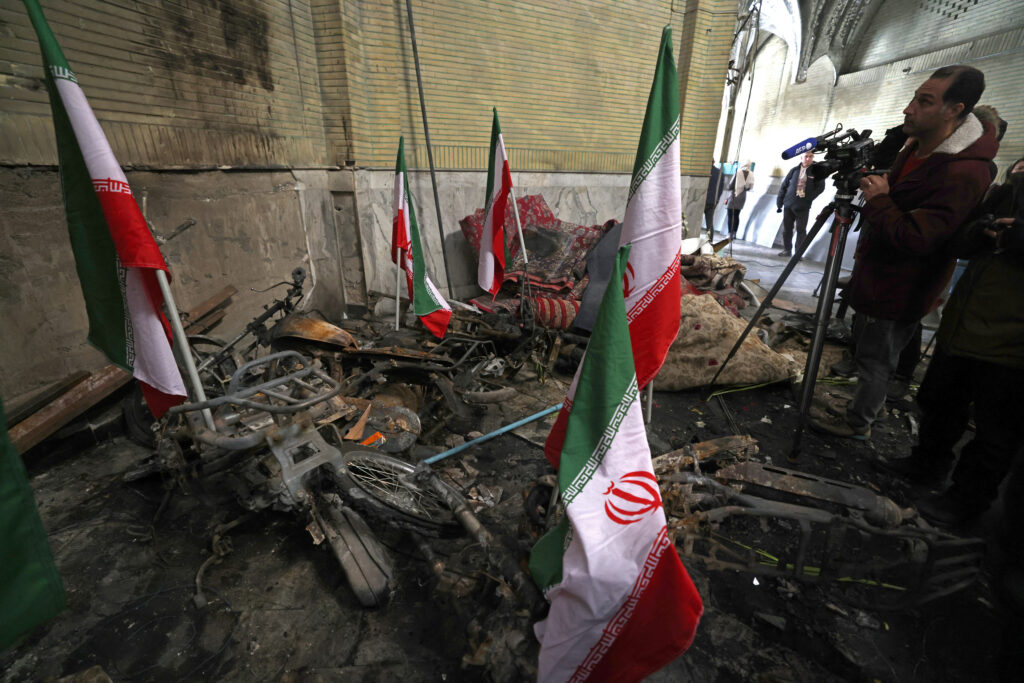
Iran occupies a structurally distinct position from earlier targets of American intervention. Unlike previous targets, Iran retains some measure of economic diversification, indigenous military production, and layered deterrent capabilities. Two recent developments further clarify this distinction. First, Iran’s direct missile and drone attacks against Israel in April 2024, and again in October 2025, demonstrated its capacity, although limited, to project force beyond proxy networks and to impose costs directly on a technologically-advanced adversary. Second, the US strike on Iran’s plant in June 2025, conducted under Operation Midnight Hammer, illustrates both the limits and the character of contemporary intervention against a resilient state. According to official US Department of Defence reporting, the operation relied on specialised deep penetration munitions developed over more than a decade, and was a discrete enforcement action rather than the opening phase of a broader campaign. These developments indicate that while future intervention against Iran is possible, any actions are likely to be confined to limited and technologically mediated enforcement directed at specific capabilities, not a full-scale invasion. Nevertheless, eliminating the country’s leadership remains in the realm of possibility.
The prospect of eliminating leadership without sustained follow-on intervention has become increasingly plausible in contemporary American practice. This development is reinforced by advances in warfare technology, the subordination of legality to strategic outcomes, and an established American record of targeted killings, including Abu Musab al Zarqawi in Iraq in 2006, Osama bin Laden in Pakistan in 2011, and Qassem Soleimani in 2020. These cases reflect a practice in which leadership removal is treated as a discrete act. In the Middle East, where political order has long been shaped by sustained violence, leadership targeting no longer constitutes an exceptional escalation. Established patterns of retaliation, reinforced by recent Israeli strikes that killed senior Iranian military commanders, including top leaders of the Islamic Revolutionary Guard Corps, have lowered the threshold for leadership targeting, making such action a plausible extension of existing enforcement practices.
In this regard, the regional structures that may facilitate or constrain American intervention in Iran are worth examining. Central among these are evolving security arrangements in the Middle East, where most states display deep war fatigue, reluctance to mobilise their societies for further conflict, and diminishing tolerance for prolonged instability. At the same time, the decline of radical and revolutionary rhetoric across much of the region has reduced the political resonance of a regime such as Iran’s. The relationship between Israel and several Arab states illustrates this shift. Following the 7 October 2023 attacks on Israel, and the ensuing war in Gaza, patterns of coordination and restraint revealed an emergingsecurity alignment that prioritises stability over confrontation. These regional conditions shape the environment in which any American action towards Iran would be received, resisted, or tacitly accommodated.
Two factors are likely to shape any further American action against Iran. First, the US retains decisive leverage over Middle Eastern security arrangements through its military presence, alliance coordination, arms provision, and, most importantly, crisis management. This leverage gives Washington disproportionate capacity to influence and determine degrees of escalation. Second, Iran continues to be treated in both American and Israeli strategic calculations as an enduring threat, regardless of fluctuations in its regional reach. Closely connected to these factors is Mr Trump’s adherence to the practice among recent US Presidents of distinguishing between the Iranian regime and the Iranian people. This distinction increases the possibility of an attack on the top leadership in Iran, as was the case of Nicolas Maduro.
This framing intersects directly with Israel’s position within the regional security calculus. Tel Aviv has long defined the regime in Tehran as an existential threat, a view that continues to structure escalation dynamics. The convergence between this posture and the Trump Administration’s openly confrontational stance towards Iran has been evident in unusually explicit public threats issued in late 2025 and early this year. In response to Iran’s repression of domestic protests, Mr Trump warned that the US was “locked and loaded and ready to go” should killings occur, a position he reiterated days later by warning that Iran would be “hit very hard” if violence against civilians intensified. On 13 Jan, he doubled down, encouraging Iranians to keep protesting, asserting that help was “on its way”, before again warning Tehran of “very strong action” if it carried out a threat to hang some protesters — a warning that appears to have had some traction. Together, these signals illustrate how regional threat perceptions and American political messaging mutually reinforce a readiness for selective enforcement.
The Caracas operation is best understood through its consequences, rather than its stated reasons. Although the justifications echoed earlier cases, including the removal of Manuel Noriega because of his involvement in narcotics trafficking, the rationale itself mattered little. What carries analytical weight is the intervention itself, and its consequences. This is helpful for understanding the case of Iran. In the current American moment, declared motives, whether humanitarian or security based, are secondary. What seems to matter is the projection of power and the effects it produces. This brings us to the next point: What would the consequences of an American attack directed at Iranian leadership be?
At the international level, such an action would be unlikely to provoke direct counter intervention from other major powers. China, while maintaining economic and diplomatic ties with Iran, has little incentive to jeopardise its broader relationship with the US over a confrontation in the Middle East. Its response to the American attack on Iran’s nuclear facilities last year was instructive. Following Washington’s withdrawal from the Joint Comprehensive Plan of Action (JCPOA) in 2018 and the re-imposition of US secondary sanctions, China National Petroleum Corporation (CNPC) did suspend investment in Iran’s South Pars natural gas project, both in response to American pressure as well as to minimise tensions amid trade talks between Beijing and Washington. The decision reflected the risks Chinese firms faced of exclusion from the US financial system. Although Beijing criticised the sanctions regime, there were practical limits to its willingness to absorb economic costs on Iran’s behalf. Current trade tensions and tariff disputes further reinforce this dynamic, by demonstrating Washington’s readiness to use economic pressure against strategic competitors, increasing the deterrent effect on China.
Russia is similarly constrained by competing strategic priorities, particularly the demands of its war in Ukraine, and the need to manage relations with Western states. Increased American pressure on Kyiv to accept a negotiated settlement would further narrow Moscow’s incentives to escalate on Iran’s behalf, as preserving flexibility in Europe would take precedence over confrontation in the Middle East. Under these conditions, neither Beijing nor Moscow is positioned to provide meaningful protection to Tehran in the event of an American strike.
The reaction of Arab regimes would be more complex, but no less constrained. An American attack on Iranian leadership would likely remain limited. Saudi Arabia has already adopted a position of attuned neutrality towards Iran, prioritising regime stability and economic transformation over confrontation. Other Gulf states have adopted similarly pragmatic postures, guided by conventional considerations of state interest that continue to align closely with the United States. While rhetorical opposition might be expressed — Saudi Arabia, Oman, and Qatar have reportedly warned the White House behind the scenes that any attack would risk blowback, both to the US economy and to the Gulf states themselves — sustained resistance to American action would be unlikely in the absence of direct threats to their own security.
These conditions suggest that American power projection in the Middle East continues to operate within permissive regional and international environments. A further point to make here is that for Mr Trump, the pursuit of historical significance has been a consistent feature of his foreign policy outlook. In the Middle East, however, his record remains comparatively limited when measured against the region’s historical benchmarks. Major turning points in Middle Eastern history have been defined by war rather than diplomacy, and transformative moments have been associated with the use of force, rather than symbolic adjustment. At the same time, American leverage in the region is so extensive that actions such as the relocation of the US Embassy to Jerusalem during Mr Trump’s first term, while diplomatically consequential, did not amount to historical rupture. This reflects the exercise of existing dominance. That said, the US President’s Middle East policies, despite their high-key signature, fall short of the scale traditionally associated with enduring historical legacy in the region.
Against this background, the incentive to undertake decisive military action against Iran increases. This would not necessarily be aimed at regime removal, nor at political reconstruction. Rather, it would be designed to impose lasting constraints, if not severe damage, to Iran’s military capacity and regional reach.
The intervention in Venezuela has frequently been interpreted through the politics of oil, an explanation reinforced by subsequent American decisions to remain engaged in, and directly influence, the management of the country’s energy infrastructure. Resource access therefore cannot be dismissed. But oil alone does not explain the US action, which prioritised political authority and regional leadership control, rather than production optimisation or long-term economic reconstruction. This sequence matters. Oil became governable only after enforcement had been demonstrated. In this sense, control over the energy sector followed power projection, rather than caused it. The Caracas operation thus reflects a broader pattern in which resource management is subordinated to the assertion of authority, with economic governance emerging as a consequence of intervention, rather than its primary trigger. Oil provided strategic incentive, but the decisive reason remained enforcement-driven power projection consistent with contemporary American interventionist practices.
A more persuasive account situates oil within a wider framework of power projection. The Caracas operation reflected a convergence of factors already identified in this article: Enforcement-oriented intervention, leadership targeting without political reconstruction, advanced military capability, weakened institutional constraint, and permissive regional and international conditions. The operation signalled “resolve”, restored deterrence, and demonstrated the capacity to act decisively in a weakened state environment, objectives consistent with contemporary American intervention practices across regions not defined primarily by energy concerns. In this sense, Venezuela should be understood not as an exception driven by resource extraction, but as a case in which energy politics intersected with a broader pattern of enforcement-driven hegemony.
Consequently, an attack on Iran appears increasingly plausible, insofar as it represents the most likely extension of the current effort to reassert American power through coercion, which will serve as a warning to others in US crosshairs, including Greenland.
That said, even if there were no immediate US attack on the Iranian regime, the Islamic Republic would confront the most consequential set of choices since its establishment in 1979. It would face a stark dilemma between substantial political and ideological opening, including the abandonment of entrenched hard-line positions, and continued resistance under intensified American pressure. Either course would undermine the regime’s internal power structures and long-term stability.
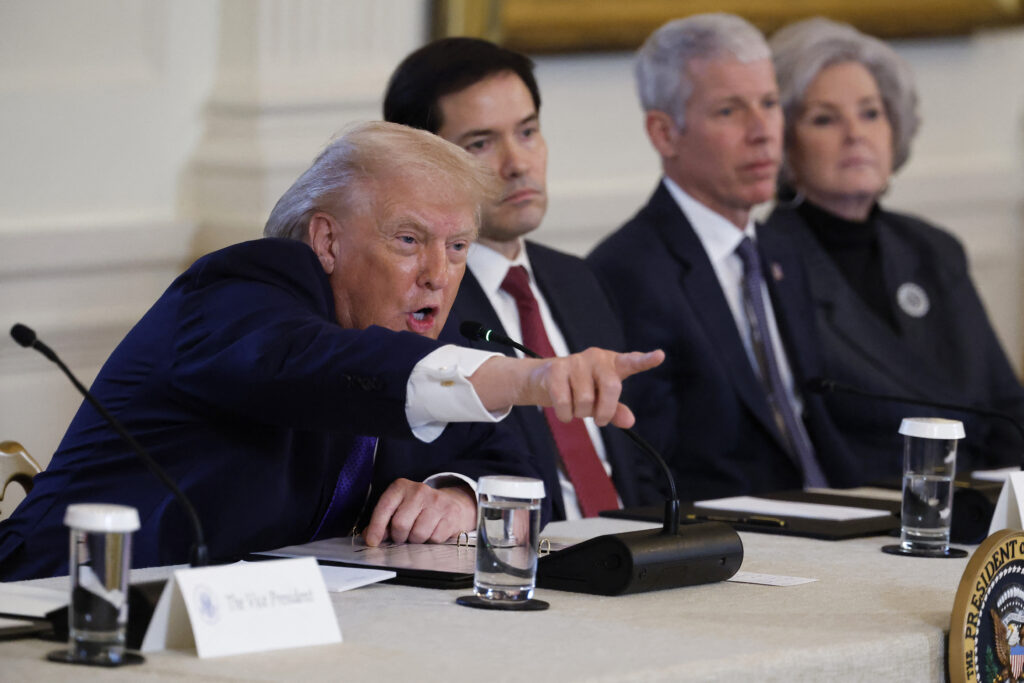
Image Caption: US President Donald Trump takes questions from members of the media during a meeting with oil and gas executives in the East Room of the White House on 9 January 2026 in Washington, DC. Mr Trump is holding the meeting to discuss plans for investment in Venezuela after ousting its leader Nicolás Maduro. Photo: AFP
About the Author
Nath Aldalala’a is Professor of International Relations at the Department of Political Science and Madani Studies, International Islamic University Malaysia (IIUM)