The enduring threat posed by the Islamic State (IS) in Syria remains a critical concern, as evidenced by a series of recent incidents that highlight the terrorist group’s persistent operational capabilities. The latest development occurred on 6 January 2026, when a security operation in Al-Adliya, in the Al-Kiswah area south of Damascus, led to the arrest of an IS suicide bomber with an explosive belt, silencers, hand grenades, a firearm, and ammunition, which were reportedly intended for assassination plots. This incident follows closely on the heels of a foiled plot to carry out suicide attacks targeting churches and New Year’s celebrations in Aleppo on 1 Jan 2026. This followed a deadly assault in Palmyra on 13 December 2025, which killed two American soldiers and injured two Syrian service personnel, which IS officially claimed responsibility for. These incidents highlighted the challenges faced by the interim government, and provided a strong indicator that IS is actively rebuilding its capabilities, posing a significant danger of further fragmenting Syria if robust countermeasures are not effectively implemented.
IS: Tactical Adaptations
Since the collapse of Bashar Al-Assad regime, IS has been targeting Syrian Democratic Forces-controlled areas in north-east Syria, and government-controlled territories. According to a Syrian Observatory Human Rights (SOHR) report, IS has carried out more than 277 operations in Syria since early 2025, many of which rely on suicide bombers. Deir Ezzor province continues to be the focal point of IS operations — a result of the gradual withdrawal of American troops from the area. In parallel with lone actor tactics, the group also utilises guerilla warfare strategies. This involves small units conducting hit-and-run attacks to destabilise security, a departure from its previous strategy of attempting to control large geographical areas.
IS’ operational model involves supporting groups that may not openly declare allegiance to it, but which have adopted similar strategies. One such group is Saraya Ansar al-Sunnah, a Sunni rebel faction which reportedly broke away from Hay’at Tahrir Al-Sham (HTS). The group was behind the explosion that took place on 26 Dec at a mosque of the Alawite minority sect in Homs Governorate, resulting in eight fatalities.
IS’ Dual Retaliation: New Syria and the United States
The Palmyra strike represents a significant escalation in the long-standing animosity between IS and Ahmed al-Sharaa, which is rooted in the terrorist group’s rejection of the Syrian President’s metamorphosis from a hardline jihadist leader of HTS to a more politically pragmatic figure. IS’ propaganda has consistently portrayed Mr al- Sharaa as an agent of the US, a narrative propagated by the group since the March 2025 issue of al-Naba, its official newsletter. The al-Sharaa government’s decision to join the US-led coalition against IS on 10 November 2025 further fuelled this narrative, and has resulted in a bullseye being drawn on the president’s back — he was the target of two assassination plots by the group.
In retaliation for the deaths of the two Americans, President Donald Trump promised “serious retaliation”, and he made good on his threat on 19 September with Operation Hawkeye, a raid that hit several IS targets in the central desert, including infrastructure and weapons storage sites, killing senior operative Omar Abdul Qader, who planned to attack the US. In response to Syria’s joining of the anti-IS coalition, the group has targeted American assets in the country, and has escalated its attacks on affiliates of the Ministry of Defence.
Potential IS abductions Amid Sectarian Tensions
Although IS primarily has the Syrian government and the US in its sights, the United Nations suspects that it may also be taking aim at Syrian minority groups again. Recent reports found that 38 Alawite women and girls, ranging in age from 3 to 40, were abducted in broad daylight from across multiple Syrian governorates beginning in March 2025.
In several instances, families of those abducted have allegedly received threats, discouraging them from pursuing investigations or publicly disclosing their plight. Seventy-four cases of Alawite girls and women being kidnapped were documented in August 2025 by international human rights organisations, which noted that authorities had not taken any concrete steps to resolve these cases — even the kidnappers’ identities unknown. But while direct links to IS remain unconfirmed, past atrocities committed by the terrorist group against Yazidi women, who belong to the Kurdish-speaking ethno-religious community in northern Iraq, have raised concerns that the pattern is being repeated on Alawite women and girls.
National investigations into these abductions have been criticised, and have sparked anger as the government struggles to contain escalating sectarian tensions. The Alawite minority, which held significant power under the Assad regime, is a choice IS target: Zeroing in on it exacerbates existing societal divisions, further undermining trust in the Syrian government’s ability to protect vulnerable communities within Syria. Targeting Alawites also serves to punish them for their perceived loyalty to the Assad regime, and their historical role in the Syrian power structure. It is worth noting that the attacks against Alawites often elicit a muted or indifferent response from other Syrian groups, due to past grievances and abuses attributed to the previous regime.
IS’ Threat Extends from Syria to Turkey
Syria is not the only country affected by IS activities. A raid which took place on 29 Dec on a suspected IS house on the road to Elmalik village in Turkey led to three police officers being killed, underscoring the direct and dangerous spillover of the terrorist group’s activities into neighbouring countries. Rather than being an isolated event, the incident provides a stark illustration of how IS, while primarily operating from its strongholds in Syria, has extended its violent reach to destabilise regional security through coordinated attacks and the establishment of operational cells in other countries.
Such cross-border operations demonstrate IS’ strategic intent to inflict terror beyond its immediate conflict zones, making the fight against the group a trans-national effort requiring international cooperation and intelligence-sharing to dismantle its networks and prevent further atrocities.
SDF: Exploiting IS Attacks for Autonomy
IS is just one challenge for the Syrian government. Damascus has been actively integrating fighters from numerous former opposition factions into its security forces to establish order and fill the void left by the former regime’s security apparatus. But the Kurdish-led SDF, which controls several territories in north-east Syria, continues to be a significant barrier to this effort: It has a deep desire for self-governance and control over local resources, particularly the oilfields in its backyard. It was reported on 19 Dec that the Syrian government expressed openness to the SDF reorganising its roughly 50,000 fighters into three main divisions and smaller brigades, as long as it cedes some chains of command and opens its territory to other Syrian army units. However, it is still unclear whether that would convince the group to give up territorial control. A meeting held on 4 Jan between the Syrian government and SDF commander Mazloum Abdi was aimed at advancing an agreement for integration, but no significant progress was achieved.
This lack of resolution was further exacerbated by daily clashes between the SDF and Syrian government forces. The SDF has been accused of using heavy machine guns, as well as drones, in eastern Deir Ezzor, leading to the deaths of seven individuals, injuries to dozens, and the displacement of tens of thousands of civilians, with more than 46,000 people reportedly fleeing their homes. This underscores the government’s inability to assert control and de-escalate tensions within Syria.
The SDF appears to be seeking to leverage on the current instability to achieve greater independence from Damascus by underscoring its indispensable role in maintaining regional security. This strategic positioning could ultimately pave the way for it to pursue increased autonomy, further complicating the Syrian’s government’s attempts to consolidate control.
SDF: Losing Control on Prisons?
However, the SDF has its own blind spots. As confrontations between it and Syrian government forces in Aleppo intensified, a significant breach occurred: The escape of an unknown number of prisoners from the Al-Shafiq prison, which is under the Kurdish group’s control. The exact number of escapees has not been specified, but the incident is particularly alarming given the SDF’s crucial role in preventing IS’ resurgence. The SDF has been a primary actor in the fight against IS in north-eastern Syria, and has detained many suspected fighters and their families. Any breach in security at these prisons could lead to the re-entry of trained and radicalised individuals into the conflict, posing a significant threat to regional and international security.
IS: A Useful Enemy for Iran and Russia in New Syria?
Recent reports have indicated that Iranian militias handed over their weapons to IS before withdrawing completely from Syria following the collapse of the Assad regime. These reports reveal a re-established relationship between IS and Iranian-backed militias in Syria, specifically in the Deir Ezzor area. These militias, who count foreign fighters alongside the Iranian Revolutionary Guard Corps (IRGC), had been active in IS zones, and appeared to be jointly engaged in the illicit transfer of weapons and ammunition across the border between Syria and Iraq. This implies that Iran may be leveraging the perceived ineffectiveness of the US and Syrian government in combating IS. In addition, it could collaborate with IS to assassinate President al-Sharaa due to converging strategic interests: Tehran perceives the president to be a significant threat to its regional influence, since he deposed a crucial ally in the Assad regime.
On its part, Russia, although affected by the collapse of Assad’s regime, still maintains a limited presence, primarily at itsair and naval bases on the Syrian coast — Khmeimim Air Base and the Tartus Naval Facility. It could leverage the difficulties faced by the current government, particularly in combating terrorism and uniting diverse ethnic groups, to solidify its influence and safeguard its interests. Russia might, under certain circumstances, collaborate with IS as a useful enemy to ensure its geopolitical goal of maintaining a strategic foothold in the region. In December 2024, there were unverified reports that social media videos showing Syrian rebels finding uniforms resembling those used by IS at a Russian military base located north-east of Damascus were being circulated, raising the possibility that the Kremlin was collaborating with the terrorist group.
Assad’s Allies Pursue Independent Agendas
Further complicating the situation are independent efforts to destabilise the country by key figures from the former regime. Major-General Kamal Hassan, al-Assad’s former military intelligence chief, and Rami Makhlouf, the ousted Syrian regime leader’s cousin, are reportedly establishing militias among Syria’s Alawite minority. Makhlouf announcedlast April the formation of a new “elite” military force of 150,000 fighters, with an additional reserve force of a similar size to isolate the Syrian coast from the rest of the country. The fractured landscape significantly increases the risk of groups like IS taking advantage of the instability to re-establish their presence and influence within the country.
2026: A Test for Interim Syrian Governance
This year is set to pose a critical test for the Syrian government, as its ability to address and mitigate internal sectarian tensions will directly impact the potential for an IS resurgence. The group’s strategy hinges on exploiting the delayed integration of SDF into a unified national structure, a factor that continues to fragment security efforts and governance across the region. This delay, coupled with existing sectarian tensions among communities such as the Kurds, Druze, and Alawites, and efforts by other countries and former regime actors, provides the terrorist group with ample opportunities to recruit more fighters, and expand its influence.
A Whole-Society Approach: A Disconnect in Syria
In an interview at the Doha Forum in Qatar in December, President al-Sharaa stated that the “law rules in Syria.” However, this assertion stands in stark contrast to the documented operational presence and ongoing threat posed by IS, as well as the deeply entrenched internal conflicts and divisions among various ethnic groups. This disconnect suggests that a comprehensive, “whole of society approach” to counter-terrorism, which would necessitate addressing underlying societal fractures, is not being implemented effectively, or worse, is failing to achieve its stated objectives.
Conclusion
Despite significant territorial and leadership losses, the recent IS attacks show the terrorist group is still a threat to be reckoned with. While the international coalition’s efforts, including those by the US and Syrian forces, have been effective, the lack of internal unity within the interim Syrian government remains a significant and enduring challenge. This, coupled with continuing sectarian challenges, will significantly hinder attempts to forge a “New Syria”, and pave the way for a broader IS resurgence.
Thus, just a year after an initial wave of optimism for a new era of governance and stability — fanned in large part by a full-throated embrace from the White House, and the West — the prospect of a stable and secure Syria seems more distant than ever.
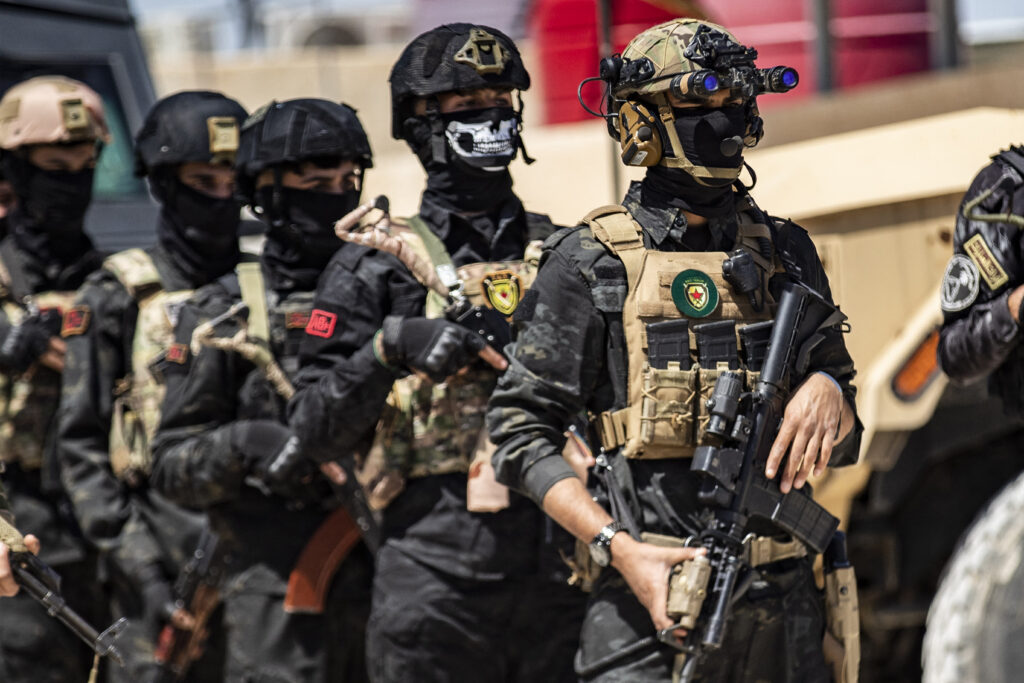
Image Caption: Members of the Syrian Kurdish Asayish security forces stand guard at the Kurdish-run al-Hol camp, which holds relatives of suspected Islamic State (IS) group fighters in the northeastern Hasakeh governorate, on 18 April 2025. Photo: AFP
About the Author
Dr Ghada Farag Sayed Soliman is a Research Fellow in the International Centre for Political Violence and Terrorism Research at S. Rajaratnam School of International Studies (RSIS), Nanyang Technological University (NTU), Singapore. Her research focuses on extremism in the Middle East and North Africa region.