In early August, Lebanon’s Cabinet met to officially endorse an American proposal to disarm Hezbollah by the end of the year. Now, the government is demanding that the Lebanese Armed Forces (LAF) submit an actionable plan by the end of this month to begin the process.
The disarmament of Hezbollah was a key Israeli demand for its agreement to the ceasefire to end the 2024 conflict between both sides. Hezbollah had agreed to remove its arsenal and combatants from the area south of the Litani River, which borders Israel. However, the group has fiercely refused the idea of complete disarmament. A day after the government’s announcement, the movement’s new Secretary-General, Naim Qassem, denounced it as a “grave sin”, arguing that Hezbollah’s military power defends the Lebanese people against the threat of Israeli aggression.
In essence, the escalation between the Lebanese government and Hezbollah over the latter’s weapons is nothing new: It has been the central issue in the country’s politics since the end of its civil war in 1990. Numerous agreements and UN resolutions called for all non-state groups to lay down their arms, and allow the LAF to exercise a monopoly over the use of force on behalf of the state. But in the 1990s and 2000s, Iranian and Syrian interference inside Lebanon made sure that successive governments were too weak to challenge Hezbollah. In 2008, after the then-prime minister, Fouad Siniora, ordered the dismantling of Hezbollah’s telecommunications network, which allowed it to monitor most of the country, the non-state group took to the streets. Beirut then became a battlefield for one week (about 100 people died). Since then, no other government has dared to defy Hezbollah. Until now.
From that perspective, the government’s plan to disarm Hezbollah is the biggest challenge the group has ever faced at the domestic level. It reflects a new reality in Lebanese politics after Hezbollah was effectively neutered by Israel. Today, the group has neither the political clout nor the military power it enjoyed just a year ago. Throughout the 2024 war, the Israel Defense Forces (IDF) and the Mossad shattered the illusion that Hezbollah was the strongest terrorist organisation in the Middle East: They eliminated its most important military commanders, stunned its foot soldiers in the “pager attack”, and destroyed the bulk of its missile and rocket inventory.
Against that backdrop, while Qassem might reject the disarmament plan, he is widely perceived as a mere apparatchik who lacks the charisma of his predecessor, Hassan Nasrallah, who was killed in an Israeli airstrike last year. Its main backer, Iran, which has its own troubles to contend with, expressed its support, but refrained from going further — Foreign Minister Abbas Araghchi stated that “we support any decision the group makes, but we do not intervene”. Tehran, severely weakened after the 12-Day War with Israel in June, has no desire to get trapped in a Lebanese crisis that could draw the wrath of the IDF (and possibly the US) again.
These circumstances mean that, for the first time in over three decades, the Lebanese government has a stronger hand than Hezbollah. The politics in Beirut —usually characterised by self-interest and corruption — has created more optimism. In January, Joseph Aoun, former commander of the LAF, was elected president, putting an end to a three-year institutional crisis that left the country without a president. A month later, a new government was formed, led by Nawaf Salam, a former president of the International Court of Justice.
Despite this, there are still many ways the process of disarming Hezbollah could be derailed. Most of the policy discussions so far on the topic focus (rightfully so) on the operational challenge of taking Hezbollah’s weapons. But this is only the short-term, and arguably easiest, objective. Any action against the Hezbollah’s arsenal needs to be conceived within the broader framework of the Disarmament, Demobilisation and Reintegration (DDR) processes that have been central in other countries facing similar challenges (for example, Colombia and the Farc insurgency, and Sri Lanka and the Tamil Tigers). In the Lebanese context, it is yet unclear how the state could ensure that Hezbollah’s combatants demobilise and reintegrate. The sectarian dimension of the conflict – most of the fighters are Shia — has the potential to re-ignite longstanding grievances from the community.
Furthermore, though Hezbollah is weak, the Lebanese state is poor. Since 2019, the country has experienced one of the worst financial crises of the past two centuries. The Lebanese currency has been devalued by 99 per cent, plunging the banking system into disarray, and shrinking the national budget to 24 per cent of its pre-crisis level. Today, the Lebanese state cannot provide salaries to its employees to meet basic living expenses, and most public services have deteriorated.
Mindful of this financial catastrophe, the new government knows it needs to secure external support, in particular from Gulf states. In his first months in office, President Aoun prioritised visits to Saudi Arabia, Qatar, the United Arab Emirates, and Kuwait. However, Gulf rulers remain cautious, and want to see the government neutralise Hezbollah before they start reinvesting in the country. This creates a delicate conundrum for the decision-makers in Beirut: They need foreign assistance to carry out their plans, but will not get it unless they first demonstrate they can deliver on the disarmament of Hezbollah.
In addition to this “Catch-22” situation, the Lebanese government must cope with the enduring assertiveness of Israel. The IDF still occupies five positions in the south of the country, and conducts daily airstrikes against alleged Hezbollah targets. Seen from Tel Aviv, these sorties are meant to pressure Hezbollah to back off from the border, but they also complicate the LAF’s mission: The strikes are a breach of the ceasefire, and also provide convenient evidence for Hezbollah to say that it should keep its weapons to “resist” the IDF — in short, any move against it serves Israeli, not Lebanese, interests.
This is where Western mediation is crucially needed. Until now, two countries have played a key role in brokering last year’s ceasefire: France and the US. However, in both cases, the Lebanese have reasons to doubt Western partners will uphold their commitments. France has expressed clear support for the government and the LAF, but the French military is unlikely to confront Hezbollah, and Paris lacks leverage over the Israelis. Meanwhile, the US administration praised the Lebanese plan, but is reluctant to restrain Israel to offer the LAF some breathing space. In July, when asked about US guarantees to prevent Israeli strikes on Lebanese territory, American special envoy Thomas Barrack caved and stated that Washington “has no business in trying to compel Israel to do anything”. Lebanese decision-makers will surely look at the absence of US pressure against Israel’s new offensive plan in Gaza City as further evidence that the Trump Administration will not intervene if the IDF escalates again in Lebanon. If that happens, the LAF could find itself caught between Hezbollah’s fighters resisting the disarmament plan and the Israeli Air Force taking matters into its own hands.
All told, the process of disarming Hezbollah is far from being a sure thing, despite promising factors. The key to achieving it by the end of the year will be to establish clear milestones that can gradually convince Gulf states to provide financial support, and the US to prevent a new cycle of violence.
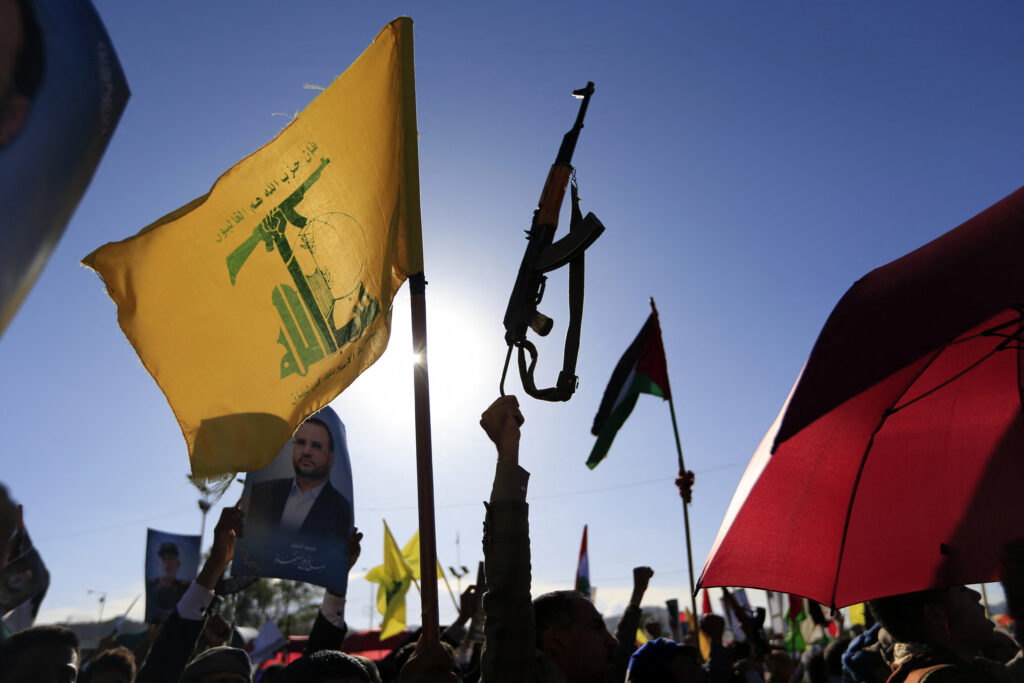
Image Caption: Yemenis raise a Lebanese Hezbollah flag and a rifle during a rally held in the Huthi-controlled capital Sanaa on 4 October 2024, in protest against Israel’s attacks on Lebanon and the ongoing war between Israel and Hamas militants in the Gaza Strip. The US military said on 4 October that it struck 15 targets in areas of Yemen controlled by Huthi rebels, who have fired missiles at Israel and repeatedly attacked global shipping in the Red Sea. Photo: AFP
About the Author
Dr Jean-Loup Samaan is a Senior Research Fellow specialising in Middle East strategic affairs, with a particular focus on Israel–Hizballah conflict and the evolution of the Gulf security system. Prior to joining MEI, he held various positions in the policy sector. He worked as a visiting scholar with the RAND Corporation (2007-2008) and as an advisor at the directorate for strategic affairs of the French Ministry of Defense (2008-2011). He then gained extensive experience in the domain of military education and training, first as a deputy director for the Middle East Faculty of the NATO Defense College (2011-2016) and as an associate professor in strategic studies with the UAE National Defense College (2016-2021).
Dr Samaan has written four books as well as various articles for academic and policy journals. He holds a PhD in political science from University of Paris La Sorbonne (2009) and an accreditation to supervise research (2017) by the doctoral school of Sciences Po, Paris.