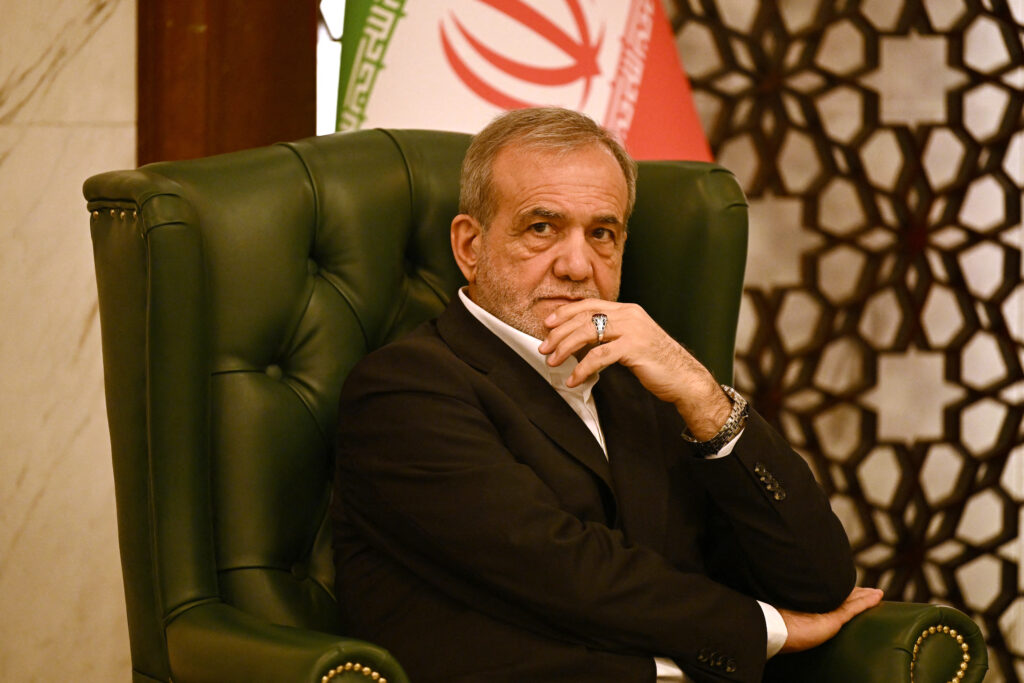
From the start of his presidency in July 2024, Iran’s Masoud Pezeshkian has faced a cascading series of crises. Mr Pezeshkian, a reformist elected after the death of Ebrahim Raisi in a helicopter crash, was a surprise candidate — the Guardian Council, which vets all contenders, was expected to only green-light hardliners — and ran on a “national unity” platform. As soon as he took power, trouble hit: Hours after he was inaugurated on 30 July, Ismail Haniyeh, the political leader of Hamas, who was in Tehran to attend the festivities, was assassinated in an operation widely attributed to Israel.
The killing triggered intense political pressure on Mr Pezeshkian to respond forcefully. However, his government managed to ward off calls for immediate retaliation, citing Iran’s fragile economic state, and the risk of sparking a broader regional conflict. Recently, Foreign Minister Abbas Araghchi shed more light on the debate that took place then, saying that although Mr Pezeshkian was not against retaliation, a key issue was the timing of a response. The Supreme Leader, Ayatollah Ali Khamenei, who makes the final decision on security matters and much else, apparently felt the same way. While Iran managed to dodge a bullet then, worse was to come.
Barely two months later, on 17 September, thousands of pagers used by members of Lebanon’s Hezbollah militia — the most fearsome of Iran’s “forward defence strategy” elements, were detonated simultaneously. A day later, walkie-talkies used by Hezbollah met the same fate. In all, more than a thousand of the militia’s leaders and fighters were killed or maimed. On 27 Sept, Israel dealt the hammer blow: An airstrike on Beirut killed Hezbollah Secretary-General Hassan Nasrallah. On October 1, a rocket struck in retaliation by the Lebanese group the town of Majdal Shams in the Golan Heights, killing 12 Druze teenagers who were playing football. In response, Israel launched a ground incursion into Lebanon, accompanied by intense airstrikes that significantly weakened Hezbollah’s military capabilities. Simultaneously, Iran launched ballistic missile targeted at Israel to retaliate against killings of Nasrallah and Haniyeh.
In between these exchanges, Hamas leader Yahya Sinwar was killed on 16 October by Israeli troops. Footage of him weakly trying to swat away a drone while severely wounded dealt another psychological blow to the so-called Axis of Resistance. Then, in December, another key piece of the axis, the regime of Bashar Al-Assad in Syria, was overthrown by rebel forces. The Islamic Republic was now battered, bereft of allies, and practically defenceless.
Israel pressed its advantage, and the final blow came with the outbreak of the 12-day war between Iran and Israel, which began with airstrikes on targets in Tehran and other areas on 13 June. The Israel Defense Forces (IDF) quickly established air superiority, and continued pummelling the Islamic Republic at will. In response, Iran hurled missiles and drones, but although these caused deaths and damage, they were largely ineffectual as a deterrent. The IDF strikes paved the way for the United States to enter the conflict, which it did on 22 June, hitting the buried nuclear site at Fordow with bunker-busting bombs, and further damaging the Natanz and Isfahan facilities with bombs and missile strikes.
The strikes, which also targeted nuclear scientists and government and military officials, raised fears that regime change was among Israeli goals. During the conflict, President Pezeshkian was himself injured in an attack while attending a meeting of the Supreme National Security Council. But despite the chaos that enveloped Iran, his administration managed to prevent shortages of basic household necessities and fuel. Although petrol distribution was rationed — limited to 15 litres per allocation — essential supplies remained largely available to the public. In addition to ensuring access to basic household necessities, a wave of nationalism emerged, bringing together both supporters and critics of the government under the slogan “For Iran”. This shift subdued Iranians’ own anger towards the regime, and instead gave officials another opportunity to revise and reform their internal policies.
Mr Pezeshkian’s presidency has been defined by his navigation of this volatile environment — making cautious decisions amid intense domestic pressure and an increasingly unstable regional landscape. During his first year in office, Iran did not witness any major protests despite the worsening economic conditions caused by ongoing sanctions. The President and his Cabinet should receive some credit: They have made efforts to reconcile with the public wherever possible. For instance, the enforcement of morality laws related to the hijab has been relaxed, and he has openly opposed the implementation of the mandatory hijab law.
Despite managing to limit the disruption to Iranians’ normal lives during the 12-Day War, the country faces crippling shortages, particularly of water, and, ironically in a country with significant oil resources, electricity. The government’s solution has been to implement scheduled power and water cuts for several hours a day. The situation is so alarming that authorities have resorted to declaring public holidays — sometimes for days at a stretch — in an effort to reduce consumption and manage the shortages.
The lack of social and political rights is another thorn in Iranians’ side. A new law proposed by the government, titled the “Bill to Counter the Publication of Fake News Content in Cyberspace”, sparked a backlash — even among Mr Pezeshkian’s supporters — who see it as a betrayal of his earlier promises to protect free speech. Critics argued that the Bill signalled a shift towards greater online censorship and repression.
The timing of the Bill, tabled shortly after the 12-Day War, raised further concerns. In the aftermath of the conflict, a wide range of opinions — including calls for regime change and support for foreign intervention — circulated on social media. Inside Iran, traditional domestic media outlets such as state television and newspapers remain heavily censored, and do not reflect the diversity of public opinion. As a result, many Iranians turn to Persian-language satellite channels based abroad, such as Iran International and BBC Persian, for alternative sources of information, and express their opinions through social platforms such as X, formerly known as Twitter, and Instagram.
Under the proposed Bill, routine online activity could have been criminalised, with legal cases filed against citizens who express their views in cyberspace. It outlined penalties, including fines, bans from media-related work, and prison sentences. In times of crisis or wartime, it would have permitted harsher sentencing. Notably, the Bill extended beyond traditional media, targeting individuals, influencers, and online platforms — particularly those with large followings.
For many, this move represented not only a direct assault on media freedom, but offered a convenient pretext to punish individuals for expressing dissenting opinions under the guise of combating fake news. The tidal wave of public pressure led to the withdrawal of the Bill on 30 July 2025, a rare win for public opinion in the country. Nevertheless, popular platforms like Telegram, Facebook, X, Instagram, and YouTube remain largely restricted.
Dealing with public expectations is just one facet of Mr Pezeshkian’s challenges, however. Hardliners — many of whom still dominate parliament following the 2024 elections — have strongly criticised his moderate stance towards Israel, the United States, and the West. This extended to even giving an interview to the American media personality — and outspoken fan of President Donald Trump —Tucker Carlson. For his troubles, Mr Pezeshkian was condemned by opponents, some of whom called it a shameful appearance. While his statements regarding Israel were strongly critical in the interview, his tone towards the US was more measured, indicating an openness towards diplomacy. In response to questions about the chant “Death to America”, and whether Iran poses any threat to US citizens, he said the slogan does not target the American people or government officials, but rather condemns crimes, atrocities, bullying, and the use of force. However, hardliners have sought to undermine his approach, attempting to portray diplomacy as weakness. They have even framed Israel’s attack as a direct consequence of Mr Pezeshkian’s approach.
From the start, Iran’s new president has faced a multitude of problems, but has managed to navigate them with minimal damage to his standing — thus far. But many problems persist, and, in some cases, have intensified. The aftermath of the 12-Day conflict, heightened security concerns due to Israel’s deep infiltration of Iran, ongoing political and social problems, and a severe shock to the country’s labour market all present significant hurdles. According to a report by JobVision, a job-seeking platform, hiring advertisements dropped by 23.5 per cent in the two weeks following the war compared to the prior period, accompanied by a wave of redundancies in the private sector. Mr Pezeshkian will need to address all these issues in the coming years. For now, a surge of post-war nationalism offers some political cover for the government, but a decisive and sharp change remains imperative.
Image Caption: Iran’s President Masoud Pezeshkian attending a meeting with the Governor of Basra during his visit to the Iraqi city on 13 September 2024. Photo: AFP
About the Author
Dr Zeynab Malakouti is a Visiting Fellow at the Middle East Institute-NUS. She holds an LLM in Human Rights from the University of Reading, UK, and a PhD in International Law from the University of Leeds, UK.