*The writer was a speaker at MEI’s Annual Conference this year – this article expands on his perspectives.
You do not need to be a fortune teller to figure out what will happen in the Middle East, you need to be a gambler. High-stakes gambling seems to be what drives conflicts and their underlying logic. But even when gambling, we need to take account of underlying trends. There are possibly two key geopolitical trends currently unfolding in the region that may guide one in placing a bet: One is “The Return of Empires”. The other is “The Age of Quantum Politics”.
The Return of Empires is possibly the most evident trend. The rise of Revisionist and Expansionist power has never been more obvious in the region’s recent since the occupation of Kuwait. We have seen attempts to revive the Ottoman Empire after the Arab Spring. This became obvious in 2016, when Turkish President Recep Tayyip Erdogan said in a speech marking the anniversary of the death of Kemal Ataturk that “Turkey is larger than Turkey. We cannot be imprisoned in 780,000 square kilometres. The borders of our hearts are elsewhere”. In his 2001 book “Strategic Depth”, the former Turkish Prime Minister wrote that “Turkey is the heir of the Ottoman Empire, and must use this historical depth to become a central power”.
Away from the region, we have seen a resurgence of Russian Czarism in Crimea. Today, this trend is illustrated vividly by the way Israel is using its military power in the region. It is the only country in the region that has launched military strikes against five different countries in the same year, reaching targets as far as 2,300 km away from it. This capability, coupled with actual occupation of land in Syria and plans to re-occupy Gaza, has opened a Pandora’s Box in the region. Jordan’s recent decision to revive conscription, which it abandoned since the Madrid Conference in 1991, can only be seen as a re-evaluation based on the status quo-shattering events in the region.
Empires are not built on military might alone. Identity plays a huge role. This is why the strong public endorsement from Prime Minister Benjamin Netanyahu for the vision of Greater Israel is an attempt to create a historical claim based on Jewish identity — Israel’s current exercise of power and its expansionist policies should not be seen as separate. This is happening at a time when the region is dropping the sectarian discourse towards Iran, and Iranians dropping “Death to America, Damnation to the Jews” chants, even at the height of the 12-Days War.
The problem with rising empires, as the British, and other European ones experienced, is the rise of non-state actors when imperialistic power is unchecked. For Israel, the Intifidas should serve as a reminder that oppressed people will eventually start taking matters into their own hands.
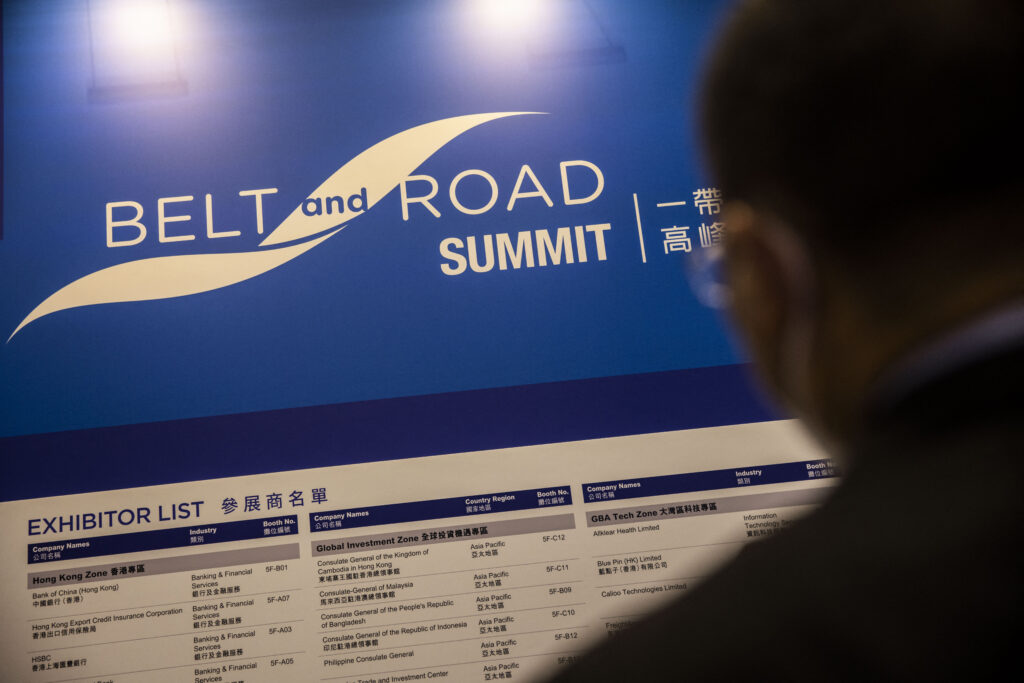
On the other hand, there is a new approach to geopolitics, similar to that of quantum physics, where the dynamics that govern relations and behaviour have totally changed. I like to call it “Quantum Politics”. In The Age of Quantum Politics, geopolitical factors take a back seat to geo-economics. When the movement of goods, money, people, and knowledge are the driving forces, geopolitical differences, including ideology, identity, and political orientation, are not the decisive factors in countries’ relations with each other. The drivers are economic corridors that transcend political differences and Comprehensive Economic Partnership Agreements are policy, not politically, oriented. This is what we are seeing in the Middle East: The Belt and Road Initiative, and the proposed India-Middle East-Europe Corridor (Imec) are motivated by trans-continental economic visions, replacing trans-regional identities like Arabism or Islamism. The economic corridors in the region are changing relationships, reversing the friend-foe binaries and the zero-sum calculus that have long shaped the history of the region. This calculus has an impacted the national security considerations for Gulf countries. As issues of health, climate, and energy, among others, became paramount, security has become about building roads, not walls. We have seen a manifestation of this in the episodes of rapprochement in the region: The Abraham Accords, the Saudi-Iranian peace deal, and the ending of the embargo of Qatar among them. Syria, the most recent example, is attempting to reinvent itself along economic, not ideological, lines — ports and special economic zones are now the tools of choice, not Baathism or Islamism.
In the international arena, this tendency was manifested in the manner Gulf countries maintained relations with both the US and China, and Russia and Ukraine, while also developing new relations with India, Latin America, and Africa as well as joining institution like BRICS. A world order where you do not need to “belong” within a single sphere of influence but one that is “networked”, and where movement across different hubs of that network is easier, is the only way to prosper.
So What Lies Ahead?
The United States during the second term of President Donald Trump has already started to shift towards geoeconomics, instead of geopolitics. Tariffs are his hammer, not warships. Even President Putin has talked about an economic corridor between Russia and the US as an approach to stabilise ties. Inexorable as these trends are, “black swans” may upend, or even derail, them.
Nuclear fallout is already a gray swan. The attacks near the Zaporizhzhia nuclear facility in Ukraine resulted into a huge outcry from the international community, but the Israeli attacks on Iran’s Fordow, Natanz, and Isfahan nuclear facilities — which made radioactive fallout a clear and present danger in the region — raised less condemnation from Europe let alone the United States which eventually joined the attack.
This is not the only nuclear danger that we are becoming inured to. Russia’s open threat to use tactical nuclear weapons in Ukraine signals that we are entering an era where such arms are not seen as a deterrent of last resort, but a tactical advantage on the battlefield.
While we are on idioms featuring animals, several others are worth considering:
“White elephants” — huge opportunities that appears so fantastical that they go unnoticed. For the Middle East, one example is a “World Without Enemies” — a situation that seemed within grasp not too long ago, with the Abraham Accords, a Saudi Arabia-Iran peace deal, and rapprochement with Turkey gave rise to optimism. as well as the roadmap with the Houthis was bringing us in the Arabian Peninsula closer to a world where we don’t have enemies. Unfortunately, many people are not ready for that world and use enemies as a political north for their local politics compass.
“The Phoenix”: The elements for global religious terrorism, or jihadism, to rise from the proverbial ashes are gathering. An unrestrained Israel now faces a religiously-motivated non-state actor claiming to be David facing off against Goliath: The Houthis. Al Qaeda and ISIS may be bowed, but a sinister wind is stirring in Saa’na.
But all is not lost. In the Gulf, the momentum towards cooperation based on shared interests is picking up, buttressed by drives to develop national identities instead of empires. The Gulf Cooperation Council countries are working towards this in their relationships with Turkey, Iran, and Israel, as well as with Yemen, Lebanon, and Syria. This, I believe, is the enduring reality: A world that is built on partnerships, not alliances or ideological affinity.
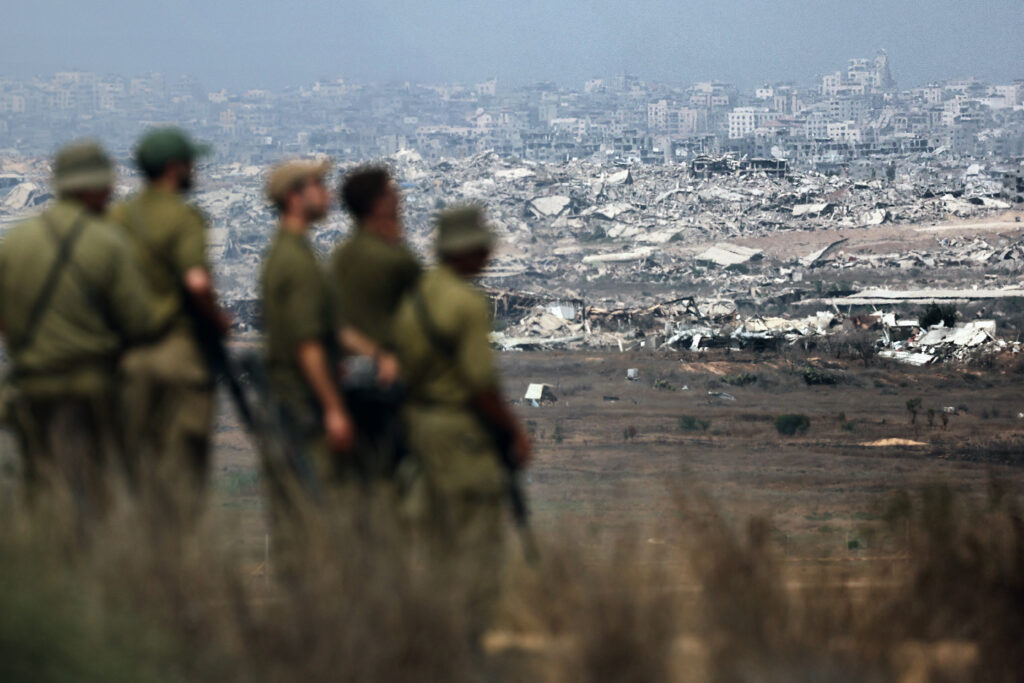
Image Caption: Israeli army soldiers look at destroyed buildings in the Gaza Strip as they stand on the border with the Palestinian territory, on August 13, 2025, while the war between Israel and the Palestinian Hamas militant group continues. Photo: AFP
About the Author
Mohammed Baharoon is the Director of the Dubai Public Policy Research Center (b’huth), which he co-founded in 2002. Before that, he worked as Editor for Gulf Defense Magazine, and a number of media outlets. He focuses on the interplay between geostrategy and policymaking in governance, stability, capacity building, and future-proofing. Mohammed has also worked as Deputy Director of Watani (the UAE’s first initiative on national identity), and was also a founding member of the board of the Bussola Institute, a think- tank in Brussels that focuses on the changing and emerging aspects of the partnership between the EU and GCC member states.