Introduction
On 23 June 2025 — a day after America struck Iranian nuclear facilities —President Donald Trump announced that a “complete and total” ceasefire had been agreed to between Israel and Iran as the first step towards ending the current conflict between the two nations. Before long, however, both sides accused the other of violating the truce, and Mr Trump was forced to wade in, and expressed anger at both sides — reserving particularly sharp words for Israel. Since then, a fragile ceasefire has held, but concerns remain over whether the Iranian nuclear project has really been set back. Questions have also arisen over the resilience of the Islamic Republic’s regime.
The Impact of the US Strikes on Iran’s Nuclear Programme
Following Israel’s operations against Iran, which began on 13 June, speculation had swirled over whether the US would enter the fray. President Trump helped fuel the uncertainty by switching between issuing threats and calling for a return to talks, before announcing that he would make a decision in two weeks. This turned out to be a ruse — barely two days later, on 22 June, the US launched Operation Midnight Hammer, which struck Fordow, Natanz, and Isfahan, three of Iran’s key nuclear sites. The results of the US action, however, remain unclear, and have touched off a political firestorm in America: Mr Trump claimed that the Iranian sites were “obliterated”, but a report from the Defense Intelligence Agency — which is part of the Department of Defense — cast doubt on this. Subsequent competing claims — Central Intelligence Agency (CIA) director John Ratcliffe said the strikes set Iran’s programme back several years, but the International Atomic Energy Agency’s (IAEA) chief said it was months — have further muddied the waters.
It is worth noting that the Iranian nuclear programme is fundamentally composed of four key elements: Enriched uranium, nuclear scientists, physical nuclear facilities, and accumulated expertise in nuclear weapons manufacturing. Israeli and American actions have killed nuclear scientists and damaged facilities, but Iran is still left with the other two elements. The IAEA reported last May that Iran possesses over 400kg of uranium enriched to 60 per cent purity, well above the level needed for civilian purposes, and very close to weapons grade. The uncertainty over the effectiveness of the strikes has thus raised concerns that the conflict might have to be resumed in future.
On 25 June, the Iranian Parliament approved suspending its commitments under the Nuclear Non-Proliferation Treaty (NPT), setting off alarms over the country’s future intentions, particularly given news reports that suggested the existence of secret nuclear installations. Such developments could lead to an escalation of tensions not only between Iran, US, and Israel, but also with the broader international community, at a time when Tehran has been severely weakened.
A Weak and Infiltrated Iran
Israel’s Operation Rising Lion has compounded the chaos and vulnerability within Iran. Just three days after it began its offensive, the Israel Defence Forces (IDF) claimed total air superiority, allowing pilots to strike at will. Revelations that operatives from Israeli intelligence, the Mossad, began penetrating deep into Iran months in advance to carry out assaults on key nuclear and military sites, and to take out high-ranking commanders as well as the top scientists involved in its nuclear programme, magnified the Islamic Republic’s vulnerabilities. Adding to its troubles, one report alleged that Israel also conducted a cyberattack targeting Iranian information servers. The attack reportedly exploited vulnerabilities in Indian-origin software used within Iranian government offices. The software, which is also deployed in other Gulf countries, including Saudi Arabia and the United Arab Emirates, contained backdoors that allow the transfer of sensitive data to Israel and has the capability to disable military equipment and enable remote control operations, thereby compromising defence capabilities. In a fit of paranoia, Tehran has carried out a significant crackdown domestically, including mass arrests and deportations, particularly among Afghan immigrants, who have been accused of cooperating with Israel. Beset by internal turmoil, isolated by its allies, its proxies — apart from the Houthis — decimated, and practically defenceless, Iran is now the weakest it has been since the 1980-1988 war with Iraq.
National Unity to the Fore – for Now
Nevertheless, the ceasefire agreement was presented as a victory by Supreme Leader Ayatollah Ali Khamenei’s regime, which has emphasised Iran’s “steadfastness”. In a sense, this is true. While the country has been wracked by domestic disgruntlement against the regime for years — most recently in the form of the “Woman, Life, Freedom” movement sparked by the death of 22-year-old Mahsa Amini while in the custody of the morality police — the Israeli and American attacks have brought out the fierce nationalism of Iranians. Opposing factions have set aside their differences, and have been united in standing up for the country in the face of foreign attacks, while the regime’s forces of repression have used lethal force and arbitrary arrests to quell embers of dissent, particularly in areas with Kurdish and Baluchi populations.
Outside of the country, however, the situation has been different. On 17 June, Reza Pahlavi, the exiled former crown prince of Iran, called for Iranians to prepare for the potential collapse of the current government, urging them to protest and “reclaim Iran”. Additionally, Mahmoud Moradkhani, the exiled nephew of Iran’s Supreme Leader, indicated that he believes the collapse of Iran’s regime is the only path to real peace. These calls have gone unheeded, however, both because of the sense of national unity fostered by the attacks, and a long-held distrust of exiled opposition figures.
Current Regime’s Existing Challenges
The regime’s future nonetheless remains in doubt. Both Israel and the US have alluded to regime change, with the former openly threatening to kill the Supreme Leader, calling him a direct threat. The US, however, has voiced its opposition to such a plan, but Ayatollah Khamenei is not taking chances. It has been reported he has handed over his powers to the Islamic Revolutionary Guard Corps (IRGC), and he and his family have been moved to a secret underground bunker for their protection. He has also identified potential successors, which do not include his son, Mojtaba. Regardless of who the chosen one is, if the regime survives, the animosity towards Israel and the West will continue, given how deeply this is embedded in its ideology and religious beliefs.
A Repeat of Iraq?
There have been comparisons made between Iran’s current situation and the 2003 US-led invasion of Iraq, which resulted in the collapse of Saddam Hussein’s regime. While the military operation in Iraq was a success, it was a strategic failure. The collapse of Saddam’s regime, exacerbated by US decisions such as the de-Baathification effort, and the dismantling of the Iraqi military, sparked unanticipated reactions, eventually bringing about a civil war and giving rise to the Islamic State.
The possibility of a collapsed Iranian regime also carries significant risks, including regional instability and the potential for the resurgence of terrorist groups, particularly ISIS. Even before its war with Israel, Iran has had to contend with a significant internal security threat from extremists. In January 2024, for instance, ISIS claimed responsibility for twin bombings in Kerman in southern Iran, which led to the death of 84 individuals. The collapse of Ayatollah Khamenei’s regime would give the terrorist group the opportunity to resurge in Iran and prompt a repeat of what happened in Iraq.
What’s Next?
A Potential Nuclear Agreement with the US is Challenged: As described above, doubts about whether Iran’s nuclear ambitions have been severely throttled continue to linger. The US’ current focus is on drawing Iran to negotiations from a position of strength. A key condition for any successful agreement is the establishment of mechanisms to monitor Iran’s remaining nuclear capabilities. The absence of complete international oversight and conflicting information about nuclear materials create significant challenges, suggesting that any agreement will take time to achieve, if at all. This makes American threats of future military action if Iran does not comply with international demands a possibility. A dangerous cycle of escalation thus cannot be ruled out. Furthermore, despite being cowed, Tehran has continued with its fiery rhetoric: The issuance of a fatwa by a high-ranking Iranian cleric against President Trump and Israeli Prime Minister Benjamin Netanyahu, which declared that they are “enemies of God” because they threaten the Supreme Leader, can be interpreted as a signal of continued hostility. This is an obstacle to diplomatic solutions, increasing the risk that Iran’s opponents will pursue regime change in Iran, which would likely entail the dismantling of IRGC’s extensive influence, including its control over the economy, military, and internal security apparatus.
Internal Transfer of Power Within the Existing Regime: This scenario involved the potential succession of a new leader within the existing regime — either because of the Supreme Leader’s death, or because he steps down voluntarily — possibly involving figures nominated by the Supreme Leader or the IRGC. This would not tamp down Iran’s enmity towards Israel and the West, however, and would mean tensions would continue.
Potential for Internal Conflict: The most extreme scenario is an internal collapse leading to civil war. This could be triggered by escalating protests, potentially leading to the simultaneous uprising of various ethnic groups such as Kurds, Baloch, Arabs, and opposition factions, resulting in a protracted and violent conflict akin to the Syrian civil war. Another possibility is that Iranians, who are already extremely unhappy with the regime, take matters into their own hands and mobilise to spark a popular reckoning. At various times, both Israel and the US have appeared to encourage this scenario: Mr Netanyahu, by addressing Iranians directly and calling on them to “stand up for their freedom against an evil and oppressive regime”, and Mr Trump, with his exhortation to “make Iran great again”. Israel has been particularly active in pursuing this course. Its bombing of Evin Prison on 24 June was part of a broader series of strikes against instruments of state repression and propaganda intended to undermine regime control. This, however, will be no less bloody — the IRGC and Basij paramilitaries continue to wield immense power, and Iran has shown no compunction against using them against its own citizens in the past, with predictable consequences.
Other obstacles to this scenario include the absence of a cohesive opposition movement, which lacks a widely-accepted leader who can fill the power vacuum that would replace the current regime. The most favourable scenario for many Iranians involves a shift towards a democratic system of governance, with Reformists gaining the upper hand over the Principlist faction, accompanied by a gradual loosening up of society, openness to dealing with the West, and economic liberalisation.
Conclusion
The 7 October 2023 attacks by Hamas on Israel have resulted in a series of striking consequences that will have a far-reaching impact on the Middle East. Israeli retaliation has neutered Hamas and Hezbollah in Lebanon, Iranian proxies that — particularly in the case of the latter — formed the backbone of Iran’s forward defence strategy. A third pillar of this strategy, the regime of Bashar Al-Assad in Syria, collapsed last December. That leaves the Houthis in Yemen and the Popular Mobilisation Forces in Iraq as the remnants of Tehran’s network of proxies. The IDF and US military strikes have further weakened and isolated Iran. This has left the regime facing a complex set of challenges, both internal and external, that threaten its stability. The suspension of Iran’s participation in the NPT represents a direct threat to the fragile ceasefire between it and Israel, increasing the risks of a dangerous escalation of the conflict. Repeated security breaches within Iran highlight significant vulnerabilities in its security apparatus and raise questions about the extent of Israeli intelligence penetration. The regime’s weakness, combined with paranoia, will test its ability to maintain control and authority, particularly once the nationalism that was sparked by external attacks wanes once an uneasy peace takes hold. The central question, therefore, remains whether Iran is willing to get back into the “World Order flow”, or continue its current path and risk the eventual collapse of the Islamic Republic.
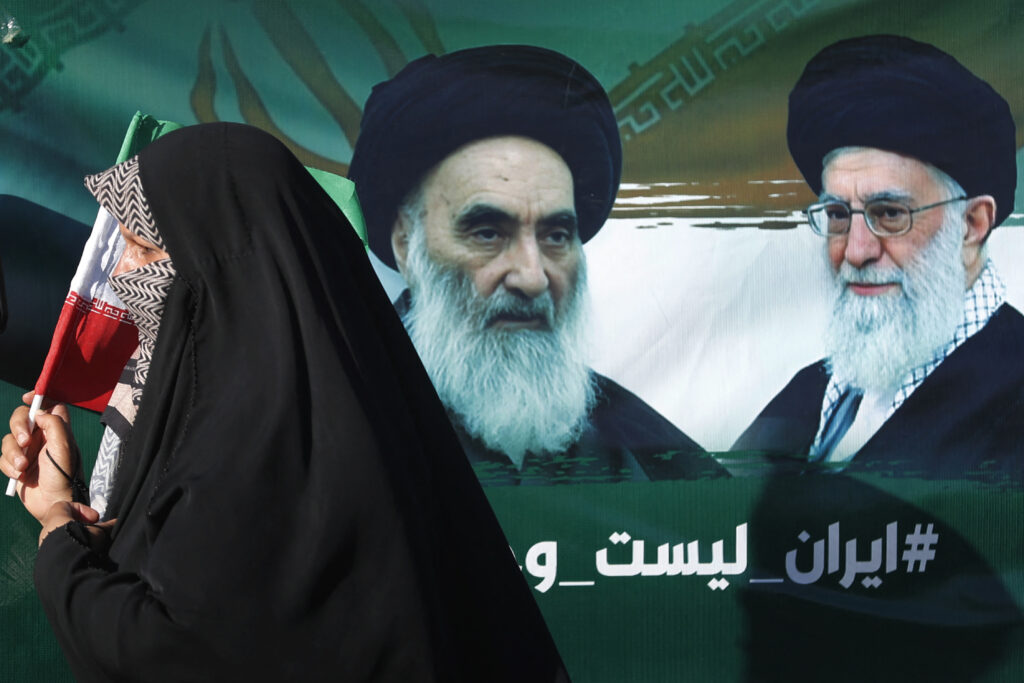
Image Caption: An Iraqi woman walking past a portrait of Iraq’s top Shiite cleric Ayatollah Ali al-Sistani and Iran’s supreme leader Ayatollah Ali Khamenei during march in the Kadhimiya district of Baghdad on 21 June 2025, to protest against Israel’s strikes on Iran. Photo: AFP
About the Author
Dr Ghada Farag Sayed Soliman is a Research Fellow in the International Centre for Political Violence and Terrorism Research at S. Rajaratnam School of International Studies (RSIS), Nanyang Technological University (NTU), Singapore. Her research focuses on extremism in the Middle East and North Africa region.