*The writer was a speaker at MEI’s Annual Conference this year – this article expands on her perspectives.
“Great Power Competition,” a phrase much bandied about in academic and think- tank circles in the United States over the last decade, is worth closer scrutiny — and some scepticism — as a framing device to describe US policy-making in the Middle East. Washington and Beijing have operated in separate, self-assigned roles that have rarely brought head-to-head competition. Russia’s steady and then dramatic loss of influence there and its absorption in its war on Ukraine have meant no US administration has viewed the Kremlin as more than a nuisance factor in the Middle East since the fall of the Soviet Union in 1991.
But from the outset of the 21st Century, successive US administrations have progressively sharpened both rhetoric and policy towards the People’s Republic of China and Russia. Beijing’s inexorable rise as an economic and military power of near-peer status to the US — with a very different value set it aimed to see reflected in a recasting of the international order — crystallised US concerns. The increasing repression of Vladimir Putin’s Russia at home, and violent interventions abroad, provided persistent cause for the US, and, increasingly, its Nato allies.
Yet, “Great Power Competition” is a very recent addition to the US official lexicon, first surfacing as a framing device in the Trump Administration’s National Security Strategy of 2017, applied initially to both Beijing and Moscow. The Biden Administration brought additional nuance to this policy line on China, but the February 2022 Russian invasion of Ukraine drove US policies in a direction more reminiscent of the Cold War effort to contain and deter the Soviet Union in its globally destabilising activities.
While the second Trump Administration has yet to issue a National Security Strategy, initial moves suggest it is set on treating China as a strategic adversary to be managed chiefly through coercive tariffs, economic decoupling, deterrence, and severe restrictions on US technology (somewhat confusingly, President Donald Trump also evinces the desire to fashion a very personal relationship with his Chinese strongman counterpart). On Russia, Mr Trump has veered sharply from two decades of US policy (and his own 2017 NSS) that treated Russia as a progressively more hostile, aggressive force – globally, and in particular in Moscow’s former Soviet space. While Mr Putin’s destabilising ways have not changed, Mr Trump has taken a sharp turn away from trying to curb Moscow, appearing determined to treat Russia as a near-peer, despite its destructive track record in the 21st Century, and its fading credibility as a great power.
Since the end of the Cold War, the US has not treated the Middle East as a particular regional field of competition with any power — not the PRC, and, even less so, Russia. In fact, Washington and Beijing have operated in the region in singular lanes, pursuing economic and other national security interests in wholly different roles, with only recent and episodic head-to-head competition. Throughout and since the end of the Cold War, the US has carried the weight of one particular role — external balancer and security guarantor — for a region of enormous (energy) consequence for the global economy.
The region provided the US with unstinting “opportunities” to exercise this role — civil conflicts were punctuated by major and minor wars; four civil wars and four popular uprisings leading to regime change in 2011 were followed by a rancorous political conflict in the Gulf. Iran’s “gray zone” attacks on Gulf shipping, its bold attack on Saudi oil infrastructure in 2019, and its long-standing promotion of regional proxies fostered a climate of increasing insecurity in the region among the US’ Arab partners and Israel. With the explicit articulation of this role in January 1980 (the Carter Doctrine), the US operated against the predations of both external and regional threats (the USSR, Iraq, Iran) — periodically as leader of ad hoc coalitions, more often alone.
China, by contrast, has operated in a fashion that clearly conveyed it had no interest in competing for, or even sharing, the US security role. If anything, Beijing has benefited from the US’ singular commitment to policing the three vital chokepoints in the Middle East to ensure the free flow of energy and international commerce. Lip service aside during times of regional conflict and upheaval, Beijing has largely stayed out of even the diplomatic fray, and has certainly avoided membership in even the most collaborative of multilateral security efforts (counter-piracy and counter-Houthi escort of commercial traffic in the Bab el-Mandeb). China has instead focused exclusively on ensuring access to Gulf and other regional energy resources, pursuing lucrative infrastructure projects in the region, and ensuring ties of influence with key Arab states and Iran. As Dr Jonathan Fulton has noted, the region has experienced a deepening and widening of PRC engagement, concomitant with China’s global rise, but it is not the primary venue for competition with Washington. The theatre for US-China competition, while global, has more often been the United Nations, East Asia, or the South China Sea, far less so the Middle East, with the occasional exception (for example, the effort across several administrations to beat back Huawei’s march across the region).
Whether this self-assignment of differing, seemingly non-competitive roles by the US and China holds long into the future is an open question. The Middle East has been dramatically altered since 7 October, 2023, with dramatic changes in power dynamics between two long-time enemies, Israel and Iran. The near-dismantling of Iran’s “Axis of Resistance” has deprived Tehran of a set of tools four decades in the making, which threatened a widening set of Arab states alongside Israel: Abrupt regime changes in Lebanon and Syria, which were wholly unfavourable to Tehran, military strikes between Iran and Israel which left Iran bereft of air defences, and a relentless 12-day Israeli campaign that decimated Iran’s military and security leadership, as well as the infrastructure for its nuclear and ballistic missile programmes. These crippling effects were compounded by American strikes which largely disabled Iran’s key uranium enrichment sites.
Israel’s stature is now greatly enhanced, but even the Gulf countries see the state as potentially threatening to their ambitious economic development plans, in its widening circle of military action. One long-standing hegemon, Iran, is greatly diminished, but still dangerous and unbowed. But unfinished business remains in both Tehran and Gaza: The former brings risk of renewed conflict with Israel, while the latter provides the fuel for open-ended instability and radicalisation extending well beyond Palestinian communities. Meanwhile, a host of non-state actors — ISIS, and the Houthis among them — are looking to expand their presence and impact in the region and beyond.
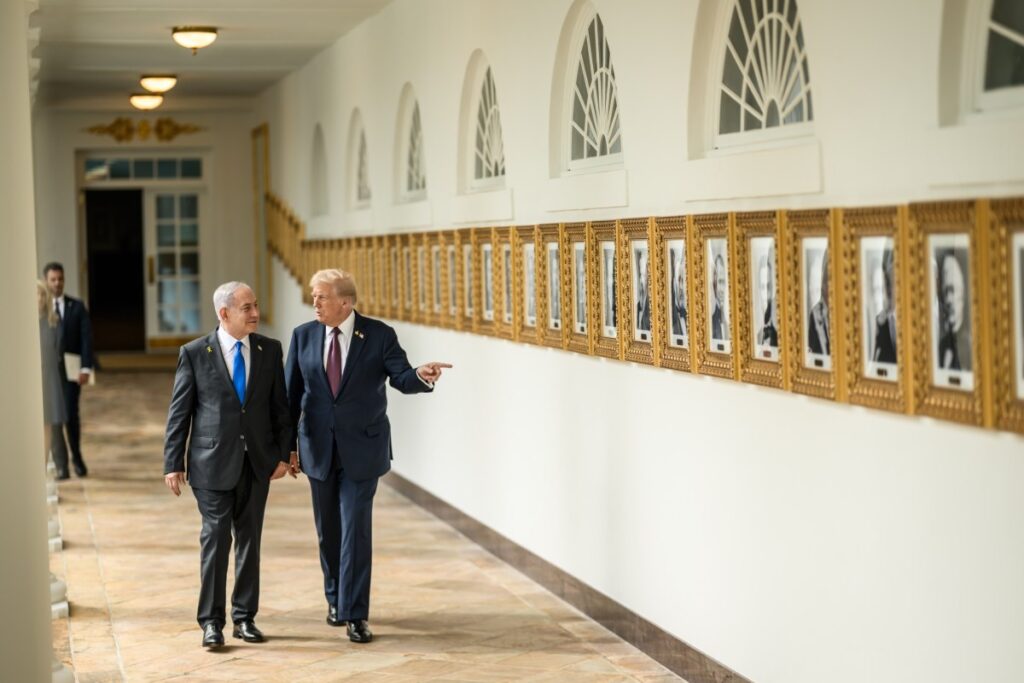
This is the backdrop for what, from the Trump Administration’s standpoint, is not at all a sphere of competition with China, and even less so with Russia. Rather this administration is sharply and transactionally focused on only a handful of countries there — Saudi Arabia, the United Arab Emirates, and Qatar, with which Washington has already struck hugely lucrative commercial and investment deals in Mr Trump’s first trip abroad — and Israel, the partner with whom the President longs to obtain a resounding foreign policy win by ending the Gaza conflict as a stepping-stone to a major expansion of the Abraham Accords, beginning with Saudi Arabia. Iran is theoretically the other priority, a prospective foreign policy win if the administration can hammer out a nuclear agreement. But the President’s own attention to this effort has waxed and waned; Mr Trump has repeatedly suggested that he did not see the need per se to have a formal agreement with Tehran following the “obliteration” of Iran’s nuclear programme in June. Two months after the 12-day war, the question remains an open one – will the administration return to the negotiating table, or leave the task of policing what remains of Iran’s nuclear and missile programmes indefinitely to Israel?
More broadly, the administration appears determined to off-load regional security issues — dealing with the Houthis, stabilising a Syria newly-liberated of the Assad regime — to regional partners, or to no one at all: It has methodically shut down a small but vital US force presence in north-eastern Syria that had been critical to maintaining relentless pressure on ISIS for the past decade, for instance. Mr Trump returned to office revisiting his earlier distaste for US military involvement in the region, sharply questioning the logic of what many in the region had come to expect was an open-ended US security commitment to the Middle East.
Today, the relevance of that historical security commitment to the region is in question in Washington itself (having long been a point of anxiety among Gulf partners, notwithstanding the steady state of US force deployments and interventions in the region). Indeed, the isolationist spirit is evident across the administration, strongly, if erratically, anchored in the Oval Office. Mr Trump has been willing to engage the US military in short bursts of action — a replay of the Biden Administration’s campaign against the Houthis, and the dramatic use of massive penetrating ordnance for the first time to disable two key Iranian nuclear sites. But he has just as quickly wrapped up the operations each time, lest his administration appear it was following the kind of decades-long US military engagement in the region that he has long derided.
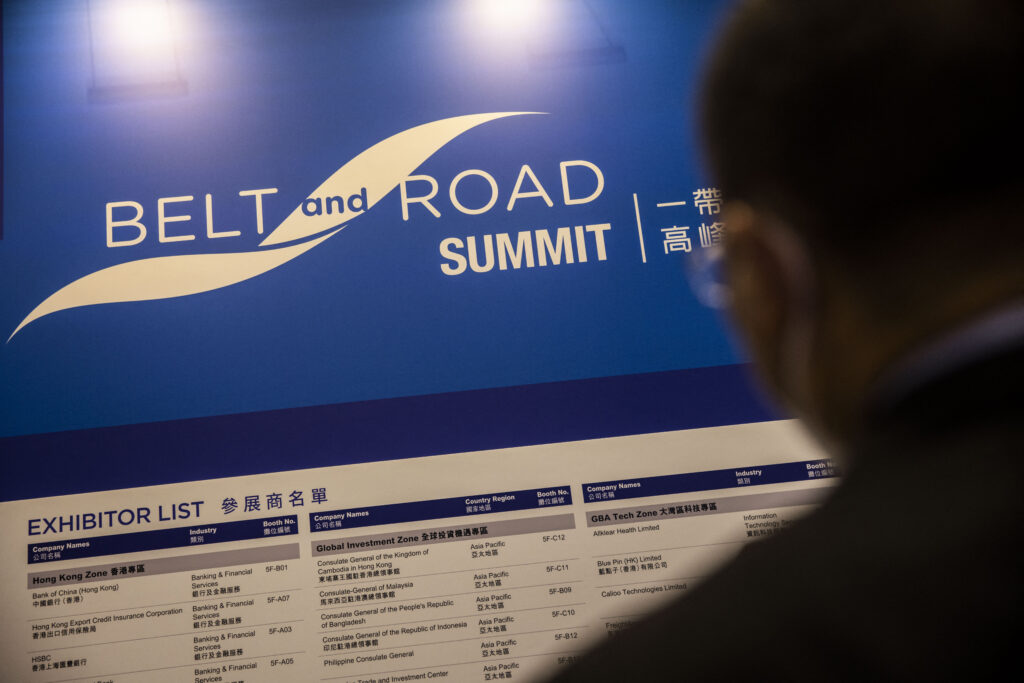
On the other hand, the sizeable accrual of economic stakes in the region by China since Xi Jinping’s 2012 rise to power and his renewed focus on the region pose a significant question about Beijing’s future approach, and whether it can or will stay largely oriented around an economic role. The vault in PRC energy consumption in the last two decades produced a huge Chinese thirst for Middle East fossil fuels that may level off in the near future, but Beijing’s reliance on the region — and its vulnerability — will persist for some years yet, given the approximate 40 per cent of its energy imports the region provides. That energy dependence is manifest in the five “Comprehensive Strategic Partnerships” (CSPs) Beijing has forged with Saudi Arabia, the UAE, Iran, Iraq, and Algeria, but so are the wider economic ties that have directed state-owned enterprise engagement and investment. The steady march of the Belt and Road Initiative across the Middle East would suggest logically that Beijing will eventually confront the need to define a regional security role and presence to protect those interests. Yet recent experience suggests China will look out only for itself in the narrowest of terms — cutting deals to protect its investments (with the Houthis to forestall attacks on PRC vessels transiting the Red Sea) and avoiding political-security entanglements — even where it ostensibly enjoys very lopsided leverage with one of the key destabilising actors in the region, Iran, whose actions directly threaten other CSP states.
The Trump Administration appears poised to put both propositions squarely to the test, and a security void seems unavoidable. An America that fully steps back from a decisive military — and diplomatic — role in the region will leave no external balancer/guarantor available for the first time in eight decades. The PRC is unwilling, Russia is unable, and the European Union shows little appetite to step into the role, given the primacy of the Ukraine fight to the continent’s security. That leaves Israel as the unmatched regional military power, but one increasingly isolated due to the Gaza conflict, and now viewed as a regional destabiliser by even the Gulf countries.
The region in late 2025 is fragile, latently volatile and newly “plastic” in the aftermath of 7 Oct, offering equal measures of risk and opportunity for the peoples of the Middle East. This is likewise the case for the US and Europe, long-accustomed since 2001 to seeing the region largely in terms of the threats it produced: Terrorism, refugee waves, energy volatility. Yet, the Middle East two years into the Gaza conflict requires, perhaps more than ever, a great power that can engage deeply in regional diplomacy, wield its military heft occasionally as both deterrent and remedy, and, most importantly, be convenor and leader of multilateral campaigns, military and diplomatic. Only the United States in the eight decades since the end of World War II has demonstrated the will and capacity to fulfill this role. No Arab state for the moment is able to do so alone: Building a regional Arab coalition to methodically address the stabilisation needs of the newly-liberated Lebanon and Syria, and eventually Gaza, is the logical answer, but intra-regional leadership rivalry, an inward focus on their own development needs, and lack of prioritisation of such complex, long-term tasks severely impede the chances of such a multilateral undertaking gaining traction.
The dilemma is clear — in the absence of either regional collective efforts or great power engagement, the Middle East risks losing the precious window of opportunity for a widening and durable stability. “America First,” if it presupposes a reduction of US interests in the region to purely commercial deal-making without serious security and diplomatic engagement, risks delivering an unpleasant lesson. The launch of the 12-day war was a shocking bookend for the Gulf to Mr Trump’s triumphal progress through Riyadh, Doha, and Abu Dhabi exactly one month earlier. Economies in the midst of an energy wealth-fuelled push to diversify — through tourism, trade, transportation, and the new frontier of AI — require stability and security. The prospect of open-ended conflict between Israel and Iran alone — without the constraining influence of either Washington or Beijing —paints a forbidding future.
Most ominously, if circumstances — a major crisis, most likely — prompts a re-think in Washington, the Trump Administration is poorly organised and staffed to drive effective policy efforts as it sharply reduces the size of key intelligence agencies and put at risk their non-political role, while slashing State Department staffing, budget, and expertise. That should give pause and concern not just to European and American regional partners, but perhaps to Beijing as well.
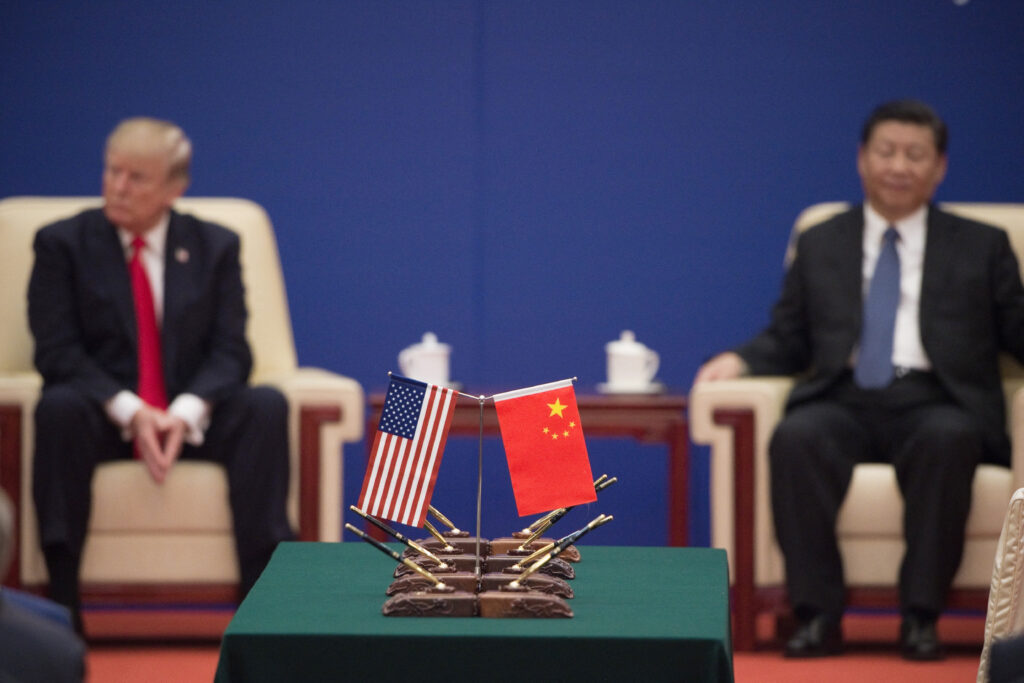
Image Caption: US President Donald Trump (L) and China’s President Xi Jinping attend a business leaders event inside the Great Hall of the People in Beijing on 9 November 2017. Donald Trump urged Chinese leader Xi Jinping to work “hard” and act fast to help resolve the North Korean nuclear crisis, during their meeting in Beijing on 9 November, warning that “time is quickly running out”. Photo: AFP
About the Author
Ambassador Leaf served as Assistant Secretary of State for Near Eastern Affairs from 2022-2025, overseeing 21 diplomatic posts, US$7.5 billion in foreign assistance, and policies and programmes from Morocco to Yemen. Appointed in January 2021 as Senior Director for the Middle East and North Africa and Special Assistant to President Joe Biden, Ambassador Leaf left The Washington Institute for Near East Policy, where she had directed the Arab Politics Programme from 2018-2021. She served as the US Ambassador to the UAE from 2014-2018, and was previously Deputy Assistant Secretary of State for the Arabian Peninsula and as Deputy Assistant Secretary of State for Iraq.
Her earlier assignments included Basra, Rome, Director of the Office of Iranian Affairs, Sarajevo, Tuzla, Paris, Cairo, Tunis, Jerusalem, and Port-au-Prince. Awarded the Distinguished Honor Award by former Secretary of State Antony Blinken, Ambassador Leaf received numerous Superior and Meritorious Honor Awards throughout her career.
In addition to her position as Senior International Policy Adviser at Arnold and Porter, a storied US law firm with a global practice, she is a Distinguished Diplomatic Fellow at the Middle East Institute of Washington, D.C.