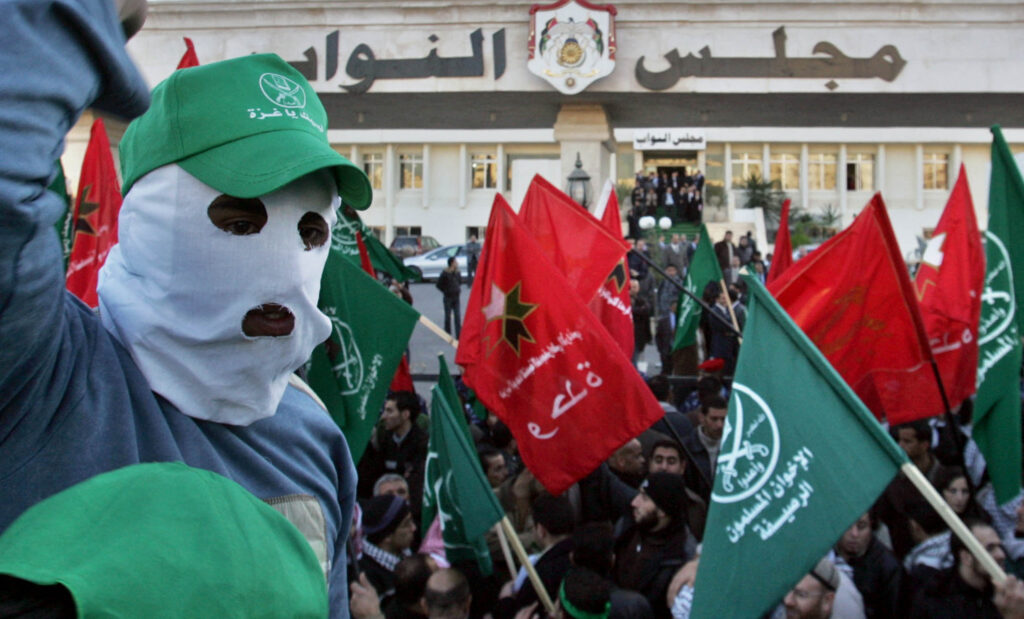
These are not directly related events, but they do reflect the same broad theme. The authoritarian state in Jordan has become dangerously disconnected from society, and fissures of opposition are testing the capacity of the Hashemite monarchy and its autocratic regime to control political dissent. The ongoing house arrest of Prince Hamzah in 2021 is less important than the fact that the alleged coup-mongering involvement implicating him also drew upon dissidents within Jordan’s tribal community, which has long been perceived as a bedrock of monarchical loyalty. Much like Palestinian-Jordanians, who constitute a majority of the populace, those tribes have become inured by the chronic problems besetting the government, among them a feckless parliament, endemic corruption, worsening inequality, high unemployment, and Jordan’s powerlessness in the face of Israeli aggression against Palestine.
For that reason, expressions of popular opposition over the past decade have become encaged by increasingly tight restrictions. Normally, Jordan is what we would call a “soft” or “liberalised” autocracy. While the monarchical regime and its security institutions command vast unelected power, officials have long tolerated legal opposition groups—including the Muslim Brotherhood, whose Jordanian branch was founded in 1945—that compete in parliamentary elections, enrich civil society, and organise frequent protests. However, recent crises have tested that patience. The 2011-12 Arab Spring uprisings spawned thousands of peaceful demonstrations demanding democratic reforms, while the refugee influxes and terrorism associated with the Syrian Civil War put authorities on war-footing. The Gaza War that began in October 2023 spurred a new wave of popular protests. Many were led by the Brotherhood, some of whose more hardline activists called for full-throated support for Hamas and armed resistance against Israel.
The signs of de-liberalisation have been impossible to ignore. Not only have authorities cracked down on many protests and activist networks, but they have also enacted controversial laws, such as the 2023 Cybercrimes Law, that penalise an impossible broad range of speech. In this context, the outlawing of the Brotherhood is another sign that Jordan’s royal autocracy will brook no resistance in its relentless efforts to shape and discipline political life. The imperative for survival takes precedence over all else. The trigger for the prohibition was extreme: a cell of militant Brotherhood members had been manufacturing missiles and drones for the purpose of attacking targets in Jordan. We may never know how much of this is true, because investigations of such conspiracies take place behind closed doors. What is true, however, is that this event gave the government an expedient reason to prohibit the flag-bearer of Islamist ideology, which palace voices regard as an existential threat, and outlaw all talk of its activities and ideas.
Crucially, this has not yet affected the Brotherhood’s sister organisation, the Islamic Action Front political party, which won 31 out of 138 seats in the September 2024 elections for parliament’s Lower House. The IAF operates independently from the Brotherhood, which functions as a giant social movement with educational, charitable, and religious wings. Nonetheless, the Brotherhood ban is a worrying sign. Not only is Jordan de-liberalising at remarkable speed, but space for citizens to engage real problems like the moribund economy and political freedoms is rapidly shrinking.
Sean Yom, Associate Professor of Political Science at Temple University and Senior Fellow at Democracy in the Arab World Now (DAWN)
Members of the Muslim Brotherhood in Jordan were certainly surprised by how quickly the government moved against the organisation, following revelations of an alleged plot against the kingdom. The movement is as old as independent Jordan itself, but relations have been difficult for decades. Jordan’s main Islamist political party, the Islamic Action Front (IAF), were also alarmed but so far have managed to maintain their legal standing and their 31 seats in parliament, while emphasising that their leadership and organisation is actually separate from that of the Brotherhood. For the government, the bomb plot appeared to be the final straw in what they see as increasing signs of radicalisation in response to Israel’s actions in Gaza. The state followed a containment strategy for decades, but now seem to see the Brotherhood — or at least key members — as dangerously close to more revolutionary forms of Islamism, even as the organisation still pitches itself as peaceful, democratic, and reformist. However this ultimately plays out, it’s impossible to view this crackdown without the broader context of the Gaza war and increasing domestic and regional frustration, for both government and opposition. And certainly these moves bring the Jordanian state closer to key regional allies like Egypt, Saudi Arabia, and the UAE, all of which already had far harsher stances on the Muslim Brotherhood.
Curtis R. Ryan, Ph.D., Professor of Political Science at Appalachian State University
Jordan’s decision to outlaw the Muslim Brotherhood (MB) is not unprecedented, but it marks a significant escalation in the ongoing tensions between the monarchy and the Islamist movement. The government has a history of cracking down on the MB, with the Islamic Action Front (IAF), its political wing, previously banned from participating in elections in 2015. Despite this, the IAF’s strong showing in the 2024 parliamentary elections has demonstrated the continued relevance of the movement. Although it remains a minority in parliament, its performance signals public dissatisfaction with the monarchy’s governance, particularly regarding regional issues like the Gaza conflict.
The recent crackdown follows a series of arrests of MB members allegedly involved in terrorist activity, heightening the government’s efforts to contain the group. However, this approach risks pushing the Brotherhood underground, which could lead to a more radicalised and covert network, similar to the situation in Egypt in the 1990s. For years, Jordan attempted to monitor the group through a strategy of containment, but this has proven ineffective. The threat now is that a more clandestine and radicalised Brotherhood could pose a serious risk to national security.
Evangeline Cheng, Research Associate at the Middle East Institute, National University of Singapore (NUS).