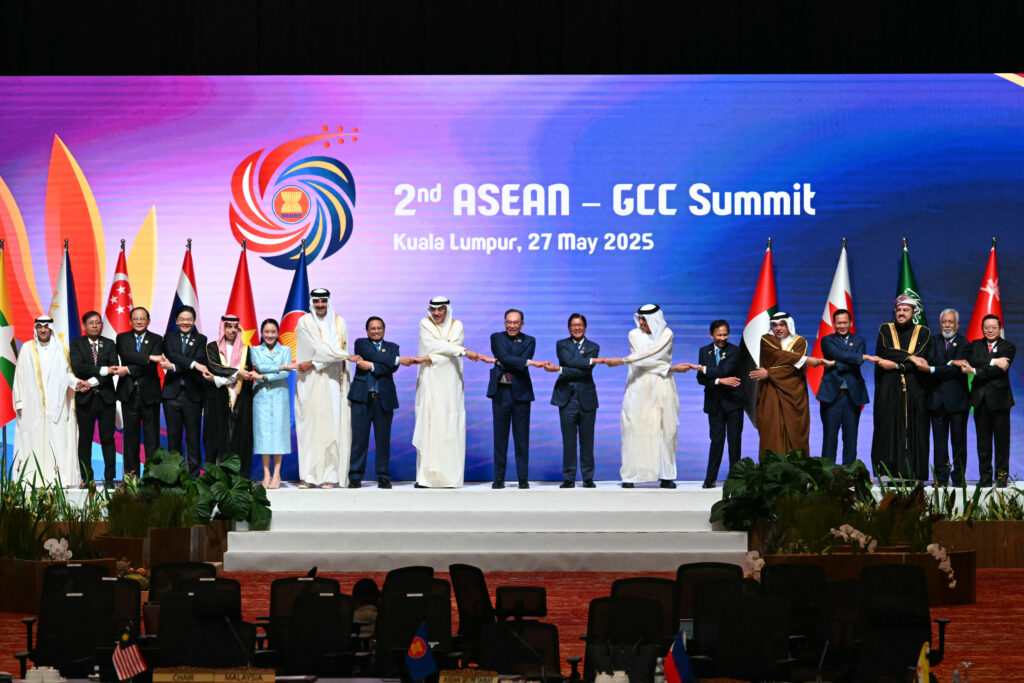
After the 46th ASEAN Summit held in Kuala Lumpur this week, Asean and Gulf Cooperation Council (GCC) leaders staged the second summit between the two groupings. For the first time, the summit also featured a meeting with Chinese Premier Li Qiang. The three-way summit saw leaders pledge to deepen and strengthen their growing partnership while increasing trade volumes substantially.
Though only in its second iteration, the Asean-GCC Summit was nevertheless significant for a number of reasons.
First, a major impetus for the Summit was shared concern for global uncertainty and rising tensions between the US and China, the two largest economies in the world. In response, both ASEAN and the GCC have expressed interest in diversifying their economic and strategic engagements, not to mention seeking out new markets and connections. This has afforded them common ground upon which to build their relationship in the coming years, including exploring the possibility of an Asean-GCC FTA.
Second, the Summit was a further reflection of Asean’s longstanding commitment to an open regionalism and the growth of economic interdependence, both within South-east Asia, and with external powers and other regional organisations.
Finally, the presence of China signals a recognition on the part of both South-east Asia and the Gulf states of the growing role that Beijing has been playing in both regions. On China’s part, the presence of Premier Li was a signal that it also sees value in cultivating its relations with these two regions, even as Beijing struggles to deal with domestic economic challenges and the repercussions of the ongoing trade war with the US.
Now that the summit has taken place, the key is to follow up on suggestions in order to show that there was more to the gathering than merely a ‘feel good’ factor. Senior officials will have to maintain the momentum by pursuing the opportunities that their leaders sketched out. Meanwhile, should there be a third Asean-GCC Summit, an increase in the level of representation of all parties involved will send a strong signal that are prepared to ‘walk the talk’.
Prof Joseph Liow, Chairman, MEI
Here are a few reasons why this inaugural trilateral summit was significant:
First, it reiterated the mini-lateral trend embraced by some of the member states of the Gulf Cooperation Council. Of late, for instance, they have joined Brics and I2U2 as full members, and the Shanghai Cooperation Organization as dialogue partners. It is not that they have forsaken global inter-governmental organisations, but that these smaller forums with more narrowly-conceived interests align with their aspirations as ‘middle powers’ as well as to diversify their diplomatic, economic, and security partnerships.
Second, the summit was the first major diplomatic outing for the Gulf states following the visit of US President Donald Trump to Saudi Arabia, Qatar, and the UAE two weeks ago. The bromance between the US and its hosts resulted in multi-billion dollars’ worth of procurement and investments across multiple civilian and defence sectors, underscoring the vital significance of the US relationship for these states. Cognisant of how this would be perceived in the context of great power rivalry, a senior executive of the Qatar Investment Authority noted during the visit that the fund would continue to look for investment opportunities in China. The following day, QIA’s application to purchase a 10 per cent stake in China Asset Management Co, the country’s second-largest mutual fund company, worth around US$500 million, duly received regulatory approval by the Chinese authorities. In a similar vein, the trilateral summit was an opportunity to signal the continued depth and resilience of Gulf-China, and, more broadly, of Gulf-Asia engagement.
Finally, the summit was a bellwether of the vigour of South-South ties, amidst challenges to global supply chains due to the increasing adoption of industrial policies by many countries, and the tariff wars. In this regard, Singapore’s role is particularly significant: It not only has an enormous stake in the maintenance of a global, open, and rules-based economy, but is also the only party within Asean that has free trade agreements with both China and the GCC.
Dr Li-Chen Sim, Associate Fellow, US Middle East Institute
The inaugural Asean-GCC-China summit represents a noteworthy development in cross-regional diplomacy, even if its long-term impact remains to be seen. In an increasingly multi-polar world, the summit signals an interest in exploring a pragmatic model of Global South cooperation that blends political flexibility and economic complementarity.
Politically, the summit reflects the value placed on regional stability and dialogue, even amid different political systems. Asean, China, and GCC states all face common pressures to seek policy reform, governance resilience, and regional autonomy. The joint statement’s expression of concern over the Middle East situation shows an alignment among all three parties over the ongoing humanitarian crisis in Gaza, in sharp contrast to US President Donald Trump’s avoidance of the issue during his Gulf visit.
Economically, the three sides bring complementary strengths. Asean offers resources and a youthful population, China contributes industrial capacity, and the GCC provides energy wealth and capital. As the global economy reels from trade tensions and fragmented supply chains, such partnerships may help buffer shocks. Areas such as clean energy, the digital economy, and infrastructure development offer space for practical collaboration, though much will depend on implementation beyond high-level declarations.
Nevertheless, China’s high-level attention to the summit reflects its aspiration to shape a development-oriented model of multi-lateral collaboration for Global South countries. This model focuses on comparative advantages of each party, rather than ideological confrontation, and draws on China’s framing of a non-zero-sum global order. China hopes the framework will attract broader participation from Global South countries and contribute to a more connected South-South cooperation network. Whether this narrative will be genuinely embraced by the Gulf countries, however, remains to be seen.
Ultimately, the summit’s significance will depend less on the symbolic gestures made at the summit, and more on whether sustained, inclusive follow-through can occur. As such, it may be best viewed as a starting point, rather than a milestone.
Dr Lin Jing, Research Fellow, MEI
Image Caption: (L-R) Secretary General of the Gulf Cooperation Council (GCC) Jasem Albudaiwi, Myanmar’s Permanent Secretary of the Ministry of Foreign Affairs Aung Kyaw Moe, Laos’ Prime Minister Sonexay Siphandone, Singapore’s Prime Minister Lawrence Wong, Saudi Arabia’s Foreign Minister Prince Faisal bin Farhan al-Saud, Thailand’s Prime Minister Paetongtarn Shinawatra, Emir of Qatar Sheikh Tamim bin Hamad Al Thani, Vietnam’s Prime Minister Pham Minh Chinh, Crown Prince of Kuwait Sheikh Sabah Khaled al-Hamad al-Sabah, Malaysia’s Prime Minister Anwar Ibrahim, Philippines’ President Ferdinand Marcos Jr, Ruler of the UAE’s Emirate of Ras al-Khaimah Sheikh Saud bin Saqr al Qasimi, Sultan of Brunei Hassanal Bolkiah, Bahrain’s Crown Prince Salman bin Hamad al-Khalifa, Cambodia’s Prime Minister Hun Manet, Oman’s Deputy Prime Minister for Relations and International Affairs Sayyid Asaad Tariq Taimur Al Said, East Timor’s Prime Minister Xanana Gusmao, and ASEAN Secretary-General Kao Kim Hourn pose for a group photo at the 2nd ASEAN-Gulf Cooperation Council (GCC) Summit after the 46th Association of Southeast Asian Nations (ASEAN) Summit in Kuala Lumpur on 27 May 2025. Photo: AFP