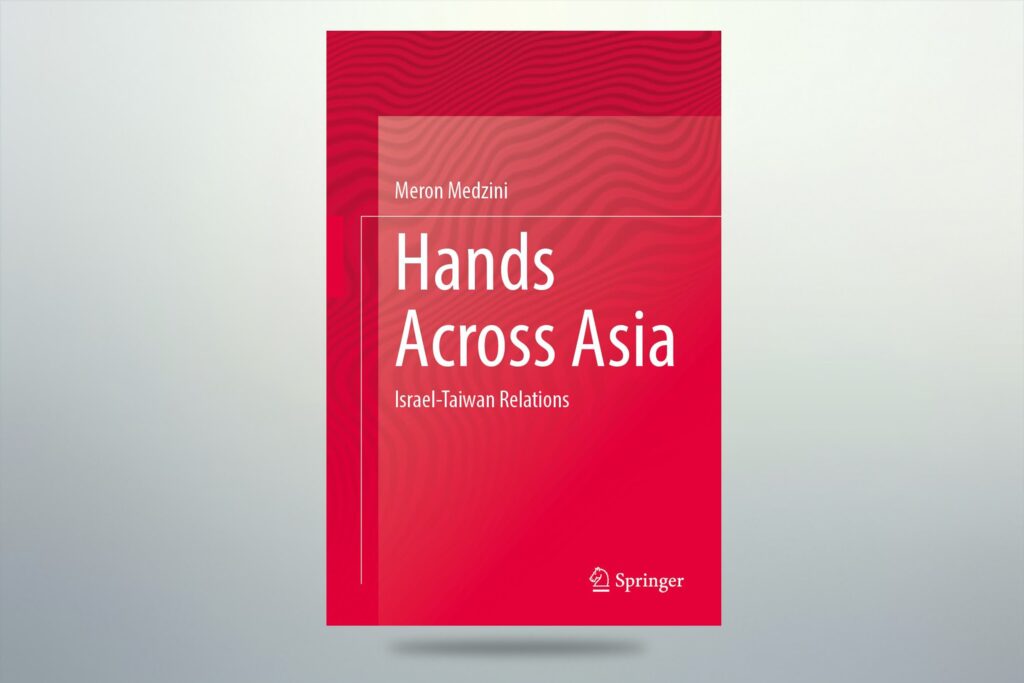
Taiwan and Israel are rarely analysed together, but Meron Medzini’s Hands Across Asia insists that they should be — because doing so reveals not a curiosity of comparative politics, but a recurring logic of survival rooted in their integration into what he describes as a US-led “security and techno-industrial orbit” that continues to shape their strategic environment, regardless of wider debates about the durability of a global American order.
This is not a book about bilateral ties in the conventional sense, nor is it an exercise in moral analogy between two “small democracies that [could] stand up to large totalitarian regimes”. Professor Medzini’s core intervention is sharper and more unsettling. He treats Israel and Taiwan as a “single analytical problem set”: Political entities whose existence is openly contested by proximate adversaries, whose diplomatic status is constrained by great‑power politics, and whose security strategies are shaped less by ideology than by structural necessity. Each watches the other’s crises not for solidarity, but to assess US credibility, test societal resilience, and draw lessons in deterrence — a shared logic of survival that transcends formal recognition or official policy statements.
That logic is not just conceptual; it is visible in real time. In the opening weeks of 2026, China’s military posture around Taiwan has remained assertive. The People’s Liberation Army concluded large‑scale live‑fire drills that simulated, in effect, a blockade around the island’s main ports and airspace. Beijing characterised these exercises, codenamed Justice Mission 2025, as necessary to “resolutely thwart” Taiwanese separatism and external interference, even as Taipei described them as “highly provocative”, and Washington warned that they “increase tensions unnecessarily”.
At the same time, the peace process in Gaza remains fragile. Since a truce took effect in late 2025 following years of devastating conflict, breaches have continued: Repeated air and ground operations by Israeli forces have resulted in dozens of deaths, including civilians and journalists, underscoring that ceasefire conditions are contested and contingent, rather than stable. In both theatres, adversaries are probing limits and patrons are testing commitments, and neither Israel nor Taiwan can treat existential threats as a matter of abstraction rather than daily reality.
Prof Medzini’s authority on the subject is unquestioned: The Israeli scholar, whose career includes lauded stints in government, academia, and journalism, began his engagement with Taiwan when he made a visit in 1970, long before its transformation into a technologically sophisticated participatory democracy. Teaching Far Eastern international relations in Jerusalem and Tel Aviv decades later, he encountered an intellectual void: Taiwan scarcely existed in Hebrew‑language scholarship, just as modern Israel was largely absent from serious study in Taiwan. Hands Across Asia emerged from this asymmetry, accelerated by the Covid‑19 pandemic, when mutual curiosity deepened as both societies watched each other manage crises, technology, and state capacity under pressure.
What distinguishes the book is its refusal to lean on the familiar “small states” trope. Prof Medzini is not interested in size as destiny, nor in celebrating resilience for its own sake. Instead, he focuses on constraint. Israel and Taiwan are, in his telling, among the very few polities whose neighbours explicitly deny their legitimacy as sovereign entities. This condition produces what he calls “parallel lives” — histories shaped by permanent insecurity, early authoritarianism justified by survival, and eventual transitions into innovation‑driven democracies that compensate for material scarcity with human capital.
That emphasis on human capital is not rhetorical. Prof Medzini is explicit that neither Israel nor Taiwan survives because of abstract values, or moral claims on the international system. They survive because they have made themselves indispensable. Israel’s defence‑innovation ecosystem and Taiwan’s dominance in advanced semiconductor manufacturing bind both states tightly into American strategic and techno‑industrial networks. Their value is functional before it is ideological. In this sense, the author offers a corrective to liberal narratives that treat democratic solidarity as the primary glue of alliances. In practice, usefulness precedes affection.
Nowhere is the book more unsentimental than in its treatment of the United States. Washington is undeniably the lynchpin of both countries’ external security, but Prof Medzini documents a persistent, deeply-ingrained suspicion about American reliability. Vietnam in 1975 and Afghanistan in 2021 loom large in the strategic memory of policymakers in Taipei and Jerusalem alike. Alliance, in this view, is never a substitute for self‑reliance. It is a force multiplier that may one day be withdrawn.
This scepticism explains why the book pays close attention to indigenous military capacity. Israel’s Iron Dome and Taiwan’s Hsiung Feng missile programmes are not merely technical achievements; They are political statements aimed as much at Washington as at adversaries. They signal that both states are prepared to operate even if the American umbrella frays. The US role, therefore, is not simply about reassurance and deterrent signalling outward. It is also about managing a credibility gap that neither Israel nor Taiwan believes can ever be fully closed.
The book’s most analytically useful comparison lies in its discussion of military doctrine. Prof Medzini contrasts Taiwan’s so‑called “porcupine strategy” with Israel’s long‑standing preference for pre‑emptive action, but he does so without implying convergence or emulation. Taiwan’s approach — layered deterrence designed to make invasion prohibitively costly — is a function of insularity and escalation control. Israel’s doctrine, often associated with the Ben‑Gurion tradition, reflects the opposite condition: A lack of strategic depth that leaves no room to absorb blows. These are not cultural choices, but geographic imperatives. The insight here is not that Taiwan should become Israel, or that Israel offers a template to be copied, but that survival logic produces different answers to the same existential question.
The author is equally clear‑eyed about the limits of ideological alignment. While Taiwan emerged as one of Israel’s biggest sympathisers after the 7 October, 2023 attacks, Israel has maintained a conspicuously low profile on cross‑Strait tensions. This is not hypocrisy, but structure. Since normalising relations with Beijing in 1992, Israel has had to balance democratic affinity with Taiwan against economic and diplomatic exposure to the People’s Republic of China. Commercial interdependence imposes restraint. The book thus undercuts any simplistic reading of democratic blocs by showing how recognition politics and market access continue to discipline behaviour.
One of Hands Across Asia’s quieter but more enduring contributions is its articulation of what Prof Medzini calls a “strategic grammar” of informal diplomacy. In environments where formal recognition is blocked, security cooperation often precedes and substitutes for diplomatic normalisation. This pattern, traced from early Nationalist Chinese support for Israel to contemporary quasi‑diplomatic exchanges between Taipei and Tel Aviv, offers a way of thinking about “grey‑zone” international relations that extend well beyond this particular pairing.
Taken together, these arguments explain why the book feels unexpectedly timely. Written before the most recent events in Gaza and the Taiwan Strait, it nonetheless equips readers to understand why policymakers in both places watch each other’s crises so closely — not for solidarity, but for lessons about deterrence, alliance behaviour, and adversary intent.
Hands Across Asia will not appeal to those seeking moral reassurance or easy analogies. Its value lies in its restraint. Prof Medzini shows how states operate when legitimacy is contested, guarantees are conditional, and survival depends on being too useful to abandon. In an era where recognition is increasingly politicised and security is once again in flux, that is not just a historical observation. It is a framework many readers may find themselves returning to sooner than expected.
Image: Springer Nature