*The writer was a speaker at MEI’s Annual Conference this year – this article expands on his perspectives.
Introduction
Iran’s foreign policy is shaped by a dense web of interconnected dynamics — international, regional, and domestic. These layers intersect with security, economic, and societal legitimacy issues, forming a uniquely complex strategic environment. This paper unpacks the multifaceted nature of Iran’s foreign policy by analysing how global power shifts, regional shifts, and internal challenges interact to shape Tehran’s strategic behaviour. The 12-Day War, a brief but revealing regional conflict, acted as a recent turning point that exposed the limits of Iran’s alliances, the burdens of its economic fragility, and the resilience of its domestic public. In this evolving context, Iran’s post-war foreign policy revolves around three inter-related pillars: Military power, economic resilience under sanctions, and the struggle for domestic legitimacy. As such, Iran finds itself caught between the hard imperatives of power and the growing pressures to reform, both at home and abroad.
Iran’s political architecture is inherently complex. Governed by a hybrid theocratic republican system and influenced by both formal institutions and non-transparent “deep state” networks, the formulation of foreign policy in Tehran defies straightforward analysis. The system is deeply stratified, and must respond to overlapping pressures across three main spheres: The international environment, the regional order in West Asia, and the internal political-social landscape.
Each of these layers is dynamic, and each influences the others. Security concerns inform economic calculations; public opinion shapes elite manoeuvring; regional partnerships are recalibrated in response to global shifts. This multi-dimensionality became obviously visible in the aftermath of the 12-Day War with Israel and the United States, a conflict that saw Iran involved in a brief but intense military escalation in the region, which revealed both Tehran’s strategic depth and its vulnerabilities.
In this paper, Iran’s foreign policy is analysed through the lens of its multi-layered context. It begins by exploring changes in the international system and Iran’s place in a world no longer dominated solely by the West. It then turns to regional developments and shifting alliances in West Asia. Finally, it assesses the domestic sphere, particularly the issue of legitimacy, growing public pressure, and economic hardship.
International Dynamics: Towards a Fragmented World Order
Over the last two decades, the global order has undergone a fundamental transformation. The post-Cold War unipolar moment dominated by the United States has given way to a more pluralistic, contested, and fragmented system. Powers like China, India, and Russia have increasingly asserted themselves economically, militarily, and diplomatically. Scholars have referred to this evolution as the onset of a “West-less”, or “less Western”, world order.
Iran, shunned by the West since the 1979 revolution, has sought to exploit these global shifts to break out of isolation. Tehran’s “Look East” policy, centred on strategic alignment with Moscow and Beijing, has been a cornerstone of its foreign policy. However, the limitations of this orientation became strikingly apparent during the 12-Day War. Despite public expressions of support, neither Russia nor China offered Iran meaningful assistance or deterrence. Their cautious posturing made clear that their strategic interests do not necessarily align with Tehran’s when direct conflict looms.
This realisation is pushing Iran to recalibrate its global strategy. While strategic partnerships with Eastern powers remain valuable, there is growing recognition in Tehran that such alignments cannot substitute for diversified economic and diplomatic engagement, including selective, pragmatic outreach to Western actors.
Thus, the international dimension of Iran’s foreign policy is increasingly characterised by strategic hedging: Attempting to balance East and West while maintaining autonomy. Yet this is a fragile act, one that becomes harder to sustain amid sanctions, military tensions, and domestic unrest.
The Regional Arena: Repositioning in a Changing West Asia
Iran’s immediate geopolitical environment, West Asia, has been transformed by multiple upheavals: The 2003 US invasion of Iraq, the 2011 Arab Spring, the rise and fall of Isis, and shifting patterns of normalisation and conflict. Iran responded to many of these changes with a strategy cantered on asymmetric warfare and support for non-state actors in Iraq, Lebanon, Syria, and Yemen. Through these relationships, it created strategic depth and deterred direct confrontation.
However, this model has come under pressure. First, regional frustration with conflict has increased incentives for de-escalation. Second, Iran’s non-state allies have at times acted independently, or even counter-productively — perhaps most devastatingly, Hamas’ 7 October 2023 attacks, which triggered actions that have landed Iran in its current predicament. Third, new diplomatic initiatives, such as the 2023 Saudi-Iran normalisation brokered by China, have signalled a shift towards further regional pragmatism.
The 12-Day War further complicated these dynamics. Iran found itself militarily and diplomatically isolated in key moments. Despite years of investment in regional proxies, Israeli offensives succeeded in decimating them with relative ease, leaving them unable or unwilling to respond in a coordinated fashion. The war exposed the limits of Iran’s proxy-based deterrence, and forced reflection on the sustainability of its regional posture.
In response, Iran has begun reshaping its regional diplomacy. Engagement with neighbours like Iraq, Qatar, the United Arab Emirates, Saudi Arabia, and even the Taliban-led Afghanistan is no longer merely tactical — it is increasingly seen as strategic for both security stability and economic recovery. As Iran moves towards a post-conflict regional environment, soft power, diplomacy, and trade are being re-emphasised over military projection alone.
Internal Pressures: Crisis of Legitimacy and Societal Resilience
While global and regional dynamics are crucial, internal pressures may be the most decisive factors shaping Iran’s foreign policy. The Islamic Republic faces a mounting legitimacy crisis. Decades of authoritarian governance, deep economic mismanagement, and repression have generated widespread disillusionment, especially among younger Iranians. Cycles of protest, such as those seen in 2009, 2017–18, and 2022, reflect enduring demands for political reform, greater civil liberties, and international re-integration.
Iran’s economic crisis, intensified by US-led sanctions and Iran’s own structural issues, has devastated purchasing power, driven emigration, and undermined public services. Inflation remains high, the currency continues to depreciate, and unemployment, especially among youth, is persistent. In this context, Iran’s confrontational foreign policy, seen as a driver of sanctions, is increasingly unpopular domestically.
Ironically, the 12-Day War triggered a moment of national unity, as many Iranians, despite their frustrations, rallied in defence of the nation against perceived external aggression. Yet, this temporary solidarity came with a price: The public’s post-war demands for accountability and reform have intensified. Citizens expect the government to reward their loyalty with greater political openness and economic relief, not more isolation.
As a result, the Moderate and Reformist political factions, sidelined in recent years by Hardliners, are regaining ground. Their re-emergence reflects the growing internal recognition that domestic cohesion is essential for strategic patience, and that foreign policy must serve the people, not just the ideological objectives of the elite.
Strategic Recalibration: Three Interlinked Axes of Foreign Policy
In the aftermath of the 12-Day War, Iran finds itself at a critical juncture, compelled to rethink and recalibrate its foreign policy amidst a fractured and increasingly volatile international landscape. The conflict highlighted not only the limits of military might, but also the intricate interplay between armed power, economic resilience, and domestic political legitimacy. Iran’s leadership now confronts the reality that survival and influence on the regional and global stage require a more nuanced, multi-dimensional approach, one that balances hard power with diplomatic engagement, economic innovation, and internal stability. This strategic recalibration unfolds across three interlinked axes, each shaping and reinforcing the others, as Tehran navigates the challenges of sustaining deterrence, circumventing crippling sanctions, and addressing mounting domestic pressures. Together, these pillars represent Tehran’s response to an era defined by fragmentation, uncertainty, and the pressing need for pragmatic diplomacy.
-
Military Power and War Diplomacy
Military capability, particularly asymmetric power through the Islamic Revolutionary Guard Corps and proxy networks, remains central to Iran’s deterrence posture. Tehran continues to use war diplomacy, where displays of strength and the threat of escalation are used as tools of negotiation and defence.
Yet, the war underscored that military power without diplomatic or economic support risks overextension. Iran’s leadership is increasingly aware that reliance on military tools must be balanced with political engagement. A shift from confrontation to conditional co-operation, especially in the region, is emerging as a pragmatic necessity.
-
Economic Sustainability and Sanctions Navigation
Iran’s economic strategy remains focused on sanctions evasion and resilience-building. This includes developing barter trade systems, relying on oil sales to Asian partners, and enhancing ties with neighbouring economies.
Still, sanctions continue to sap the state’s capacity. There is a growing awareness in Tehran that sustained recovery requires more than economic manoeuvring: It may demand strategic compromise, particularly in nuclear negotiations and regional diplomacy.
In this context, Iran is increasingly exploring regional economic integration as a buffer against Western pressure. Infrastructure projects, free trade zones with Gulf states, and participation in Eurasian economic blocs are now seen as key to economic survival.
-
Domestic Legitimacy and Political Reform
Perhaps most critically, Iran’s foreign policy is now tightly bound to domestic legitimacy. Public opinion is no longer marginal, it is central. As socio-economic conditions worsen, citizens increasingly view foreign policy through a personal lens: How it affects inflation, employment, and international mobility.
Tehran faces a dilemma: Continue hardline resistance to the West and risk domestic revolt, or pursue reform and re-integration and risk elite fragmentation. The post-war environment may offer an opening for Reformist voices to argue that domestic stability and foreign pragmatism are not in conflict, but mutually reinforcing.
Conclusion: Between Power and Pressure
Iran’s foreign policy is increasingly shaped by the tensions between its reliance on power and the intensifying pressures of political, economic, and societal transformation. The aftermath of the 12-Day War revealed both the strengths and vulnerabilities of Tehran’s strategic posture — the limitations of its alliances, the diminishing returns of proxy warfare, and the heightened salience of domestic legitimacy. In a world marked by global fragmentation and regional recalibration, Iran’s pursuit of military deterrence, economic resilience, and internal stability is becoming more inter-dependent and precarious. As the state navigates persistent sanctions and international isolation, it confronts growing demands for reform from a public increasingly critical of costly foreign engagements. This moment presents both risk and opportunity. Without substantive adjustments, particularly in aligning foreign policy with domestic needs, Iran risks deepening internal dissent and strategic marginalisation.
Yet, the re-emergence of pragmatic and reformist voices suggests a potential pivot towards more adaptive and responsive policymaking. Ultimately, Iran’s future strategic relevance will depend not only on its ability to project power abroad but also on its capacity to manage pressure at home, recalibrate regional ties, and adapt to the evolving contours of a post-unipolar world order.
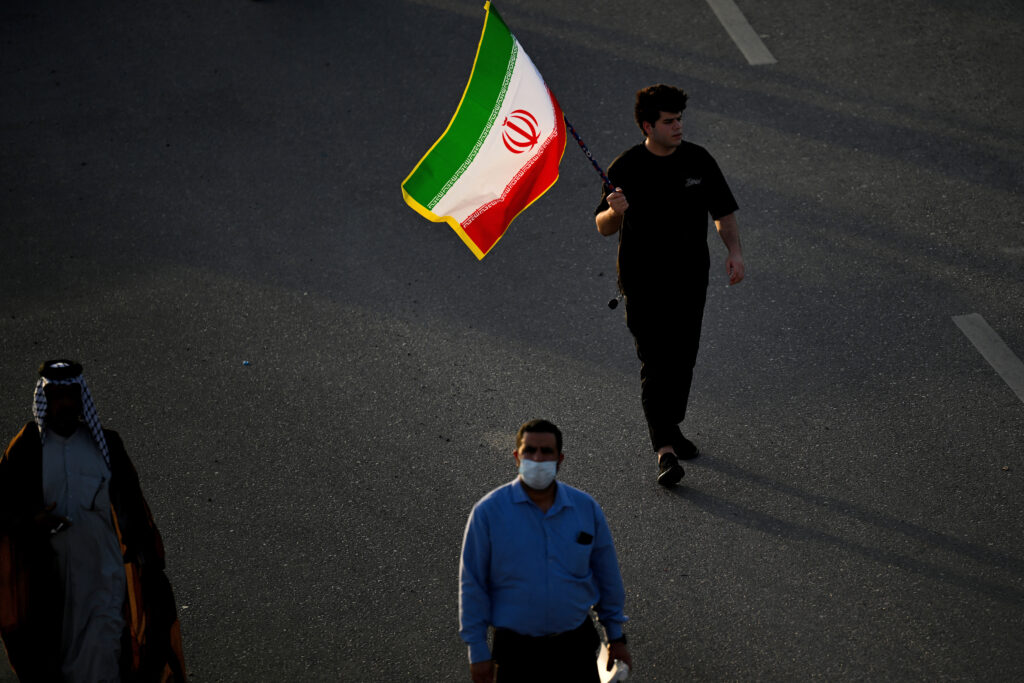
Image Caption: An Iraqi man holds an Iranian flag as people march during celebrations to mark the ceasefire between Israel and Iran in the southern city of Basra on 24 June 2025. Iranian President Masoud Pezeshkian announced the “end of the 12-day war” imposed by Israel, in a message to the nation carried by the official IRNA news agency on June 24. Photo: AFP
About the Author
Dr Alam Saleh is Senior Lecturer in Iranian Studies at the Centre for Arab and Islamic Studies at the Australian National University. He is also Reviews Editor for the British Journal of Middle Eastern Studies. He received his PhD, MA and BA from the School of Politics and International Studies at the University of Leeds. Dr Saleh is a Fellow of the Higher Education Academy, and has previously taught undergraduate and graduate courses on International Relations, Security Studies and Middle East Politics at Lancaster, Exeter, Durham, Leeds, and Bradford universities.
He has also been engaged with policy practitioners and external professional bodies such as the UK Ministry of Defence, Nato, the European Council on Foreign Relations, and has also consulted for Transparency International Defence & Security, Unicef, and the BBC.