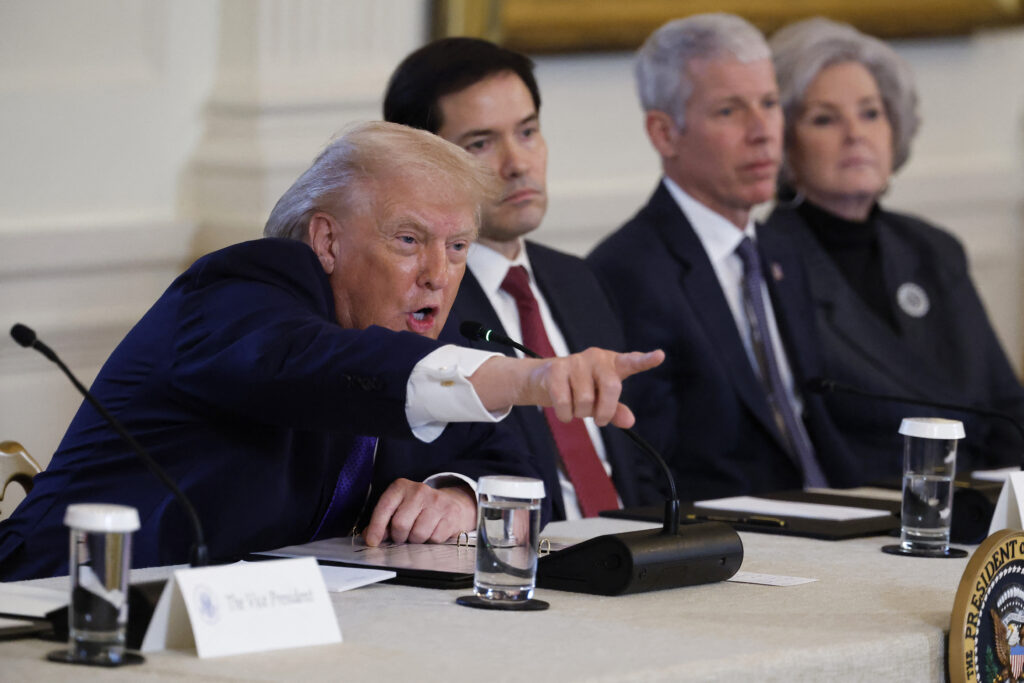
The Israeli attack on Iran in June 2025, which also spurred the United States into action, derailed tentative nuclear talks between Washington and Tehran. President Donald Trump claimed that the US attack on the three nuclear sites of Fordow, Natanz and Isfahan on 22 June demolished those facilities, and paved the way for Iran to return to the negotiation table. The reality is more complex. Iranian authorities were already at the table, and have consistently been open to talks — but not under the shadow of attack, and not with the precondition of dismantling Iran’s uranium enrichment facilities.
Events are moving fast, and red lines are becoming more pronounced. The Iranian Foreign Minister Abbas Araghchi declared uranium enrichment to be a matter of national pride in an interview with Fox News,[1] harking back to former President Mahmoud Ahmadinejad. Benjamin Netanyahu, Israel’s Prime Minister, has been adamant that the country will not tolerate a nuclear Iran. These two positions are diametrically opposed, and present serious risks of another military clash, with far-reaching implications for the region.
The three European signatories (E3) to the 2015 Joint Comprehensive Plan of Action (JCPOA) — France, Germany, and the United Kingdom — have taken steps to keep the doors of diplomacy open. But this requires Iran to be at the table. In the absence of revived nuclear talks, the E3 have threatened to take the matter to the United Nations Security Council and seek international snap-back sanctions on Iran. This would be another blow to Iran, deepening its economic crisis. Meanwhile, the Gulf Cooperation Council (GCC) has expressed a desire for a diplomatic end to the crisis. Oman was instrumental in the commencement of talks between Iran and the United States in April 2025. Other GCC member states have also been vocal about avoiding further clashes.
The 12-Day War of June 2025 did not fundamentally change Iran’s willingness to negotiate, but it made the ruling regime keenly aware of the existential threat it faces. Not reaching a negotiated deal could impact the survivability of the regime, while surrendering its uranium enrichment capability is feared for the risk it poses of opening the path to foreign intervention, and possibly regime change. Neither of these scenarios are acceptable to Iran — both put the future of the regime at risk. The authorities are thus attempting the impossible: Crafting a position between the outright rejection of talks, and giving in to demands that amount to what they see as complete surrender. A nuclear deal gives them a measure of insurance against another external attack, but the conditions demanded by the US leaves them vulnerable to a loss of credibility amongst its base.
The Political Thinking in Iran
The Iranian leadership operates between two competing priorities. Since 1979, Iran’s state identity has been largely based on revolutionary anti-Americanism, and the rejection of Israel. Significant aspects of Iranian regional policy are guided by these principles, and the recent war only reinforced the belief amongst the Iranian leadership that Israel, and the United States, present an existential threat. This belief has made the authorities even more sensitive to external and internal threats.
Seeking an expedient approach to ensure the survival of the ruling regime is not alien to the political ethos of the Islamic Republic of Iran. Concern with regime survival has been a constant challenge for the leadership. This has periodically forced it to sidestep its ideological agenda and favour pragmatism. Indeed, late Ayatollah Ruhollah Khomeini articulated this tension when he declared in a blunt statement that the interests of the state can supersede religion.[2] Not surprisingly, navigating these competing agendas has resulted in contradictory statements and policies in Tehran.
Sanctions are crippling Iran’s economy, broadening domestic discontent, and increasing regional isolation. The experience of war with Israel and the US brought home the threat to the ruling regime. Iran seeks to mitigate these threats by reaching a nuclear deal that would remove sanctions, revive its economy, and pacify internal discontent. Its recent meeting with the E3 provided a reminder of these goals.[3]
However, there are significant challenges to reaching a nuclear deal. Earlier this year, Iran entered talks in a much weaker position than it did a decade ago. Iran’s strategic position in the region has been seriously undermined. Iran’s allies and proxies have been effectively neutered, if not eliminated. Israel’s war on Gaza has depleted Hamas. In Lebanon, Hezbollah has been pushed back to the north of Litani river, away from the border with Israel, has lost key commanders and its longstanding leader Hassan Nasrallah, and has had much of its once-fearsome arsenal of rockets and missiles destroyed. The newly-buoyant Lebanese government is now pushing it to disarm. In Syria, once the corridor through which Iranian arms flowed to Hezbollah, Bashar al-Assad has lost power to Ahmed Al-Sharaa, who is seeking accommodation with the US and the West, which may give rise to a reshaped relationship with Israel. Of Iran’s proxies, only the Houthis in Yemen remain a threat, but they are perhaps more of an irritant than a real danger. These events have radically changed the regional landscape. Iran can no longer use its proxies as a shield to engage in shadow war. Its deterrence strategy proved ineffective in the face of overwhelming power as Israel and the United States struck targets at will after achieving dominance over Iranian airspace just days into the war. Iran’s retaliation against Israel may have been unavoidable, but it was an admission of failure for its doctrine of “forward defence”.[4]
The developments over 2024 and 2025 have opened a new chapter in Iran-Israel hostilities. For the first time, both sides engaged in direct combat, and Mr Netanyahu has made it clear that he will not rest until Iranian nuclear capabilities are dismantled, what is dubbed the “Libya model”,[5] the 2003 agreement that saw Tripoli give up its nuclear, chemical, biological and missile programmes. Israel’s advocacy against Iran carries weight in Washington and impacts US strategic calculations. President Trump appears especially susceptible to PM Netanyahu’s narrative on Iran. The changing geostrategic landscape highlights the existential threats facing Iran’s regime.
Parameters of Any Future Deal
During the early stages of the US-Iran talks in April, President Trump seemed to accept a deal resembling the JCPOA, although the outlines were much less comprehensive: An arrangement that subjected Iran to a strict international inspection regime to eliminate the risk of nuclear weaponisation in return for sanctions relief. This deal would have put a cap on uranium enrichment, and put in place an internationally-verifiable process to deal with the existing enriched uranium. This development was welcomed at a GCC ministerial meeting, which viewed a diplomatic resolution of the dispute over Iran’s nuclear programme to be important for regional and international security and stability, even if talks did not go as far as they would have wished, i.e., the inclusion of curbs on Iran’s missile programme and regional adventurism.[6]
However, halfway through the negotiation process, the dynamics changed, and Mr Trump adopted a zero-tolerance position in relation to enrichment in Iran, arguably due to pressure from Mr Netanyahu. Soon after, first Israel, then the US, attacked, making the Iranian leadership even more wary of President Trump and the credibility of any US-brokered agreement.
President Trump appears to have settled on a maximalist approach, making dismantling Iran’s uranium enrichment facilities a precondition for negotiations. This presents a difficult, if not an insurmountable, challenge to the prospects for future nuclear talks. Iran’s default position has been defiant and uncompromising on enrichment. Maintaining the uranium enrichment process is presented as Iran’s sovereign right under the Non-Proliferation Treaty (NPT), to which it is a signatory. Iran has vowed to rebuild its nuclear facilities, while the question of nuclear deterrence is being discussed in the public domain.[7] This highlights the risk of further escalation of tensions and the resumption of open confrontation.
The Iranian leadership also insists that its missile programme and proxy strategy are off the table. In effect, it seeks to reproduce an exclusive nuclear deal with the same parameters that governed the JCPOA. This does not align with President Trump and Israel’s maximalist approach.
Reformist Alternative?
Observers often ask how the Reformists are responding to this crisis. Is there an alternative to this deadlock, especially since the JCPOA was signed under the presidency of Hassan Rouhani, who was widely considered to be in Reformist camp?
President Masoud Pezeshkian ran a campaign on a Reformist agenda, emphasising economic recovery as opposed to ideological priorities. This harked back to Mr Rouhani’s electoral campaign in 2013, which focused on reviving the economy on the back of a nuclear deal. But in reality, Mr Pezeshkian’s 2024 electoral victory did not signal change. The Iranian President has no appetite to challenge the Supreme Leader, and has simply echoed his dictums. In early 2025, before the April commencement of talks between Iran and the US, he stated: “I believed that engaging in talks would be better, but the Leader stated that we will not negotiate with the US, and we will proceed in line with the Supreme Leader’s directives.”[8]
Meanwhile, other voices in Mr Pezeshkian’s government have been systematically sidelined. Notably, Javad Zarif was forced out of his role as adviser to the president by the judiciary. Mr Zarif had served as Foreign Minister in the reformist government of Mr Rouhani, and led Iran’s delegation at nuclear talks that resulted in the JCPOA. With him sidelined and Mr Pezeshkian’s timid attitude towards the Supreme Leader, the Reformist camp simply does not register on the political landscape.
Instead, hardliners hold the important cards, taking their cue from Ayatollah Khamanei: After the Israel/US attacks in June, the Supreme Leader hardened his views on the parameters of talks and regime red lines.
Conclusion
Against the background of continuing tensions, the Iranian leadership seeks to walk a tight rope between its ideological principles and political expediency. As stated earlier, a return to negotiations on Iran’s nuclear programme may be seen as a necessary compromise to ward off further Israeli/US military strikes. But Iranian authorities are not prepared to put everything up for negotiation. The regime has sought to limit talks to technical discussions on the level of uranium enrichment and the removal of sanctions, dismissing any attempt at broadening the scope of negotiations to dismantle the nuclear programme, or modify its foreign policy in relation to proxies.
Israel’s war on Gaza and the subsequent dismantling of different groups aligned with Iran in the conflict has presented the region with an urgent challenge. Iran is on the backfoot, and sees a compromise deal as an urgent need. But crossing its red line and giving up on uranium enrichment is a bridge too far. The authorities are seeking a compromise for the sake of regime survival, but not one that gives rise to new dangers. But it is negotiating from a position of extreme weakness, and the US — with Israel’s prompting — will be in no mood to be charitable. Unless the Islamic Republic finds a way to climb down from its hardline position, darker days lie ahead for it.
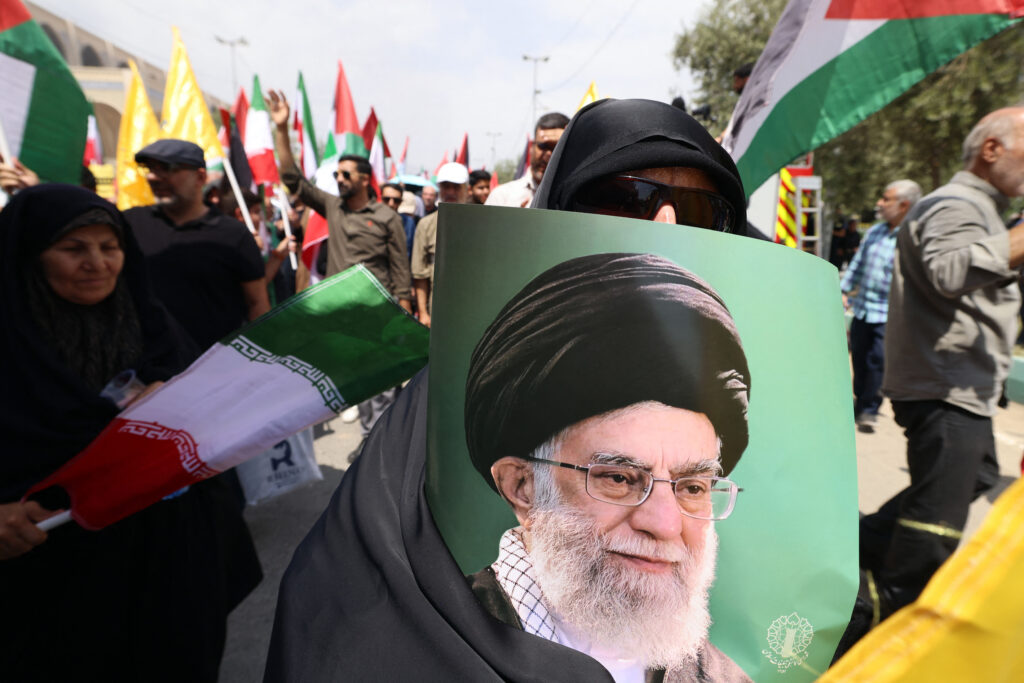
Image Caption: A demonstrator carries a portrait of Iran’s Supreme Leader Ayatollah Ali Khamenei during a rally in solidarity with Palestinians and in condemnation of Israel and the US, after Friday prayers in Tehran, on 25 July 2025. Photo: AFP
About the Author
Shahram Akbarzadeh is Professor of Middle East and Central Asian politics at Deakin University, and Non-Resident Senior Fellow at the Middle East Council on Global Affairs (Doha). He has published extensively on Persian Gulf regional security and foreign policy making.
End Notes
[1] Fox News (21 July 2025): https://www.foxnews.com/world/iran-not-give-up-nuclear-enrichment-top-official-confirms-exclusive-fox-news-interview?msockid=0baa0c85b9ae659d03571a9eb854647c
[2] Leila Brännström. ‘Law’s Comprehensiveness and Sovereign Leadership: On the Juridico-political Thinking of Ayatollah Khomeini and Carl Schmitt’, Political Theology, Volume 23, 2022 – Issue 1-2. https://doi.org/10.1080/1462317X.2021.2017536
[3] AP, Europeans and Iran meet in Istanbul as the return of sanctions looms over nuclear deadlock. 25 July 2025, https://apnews.com/article/iran-e3-nuclear-istanbul-snapback-sanctions-f8fa3bb6e939545872b33220702bb46d
[4] Shahram Akbarzadeh, William Gourlay and Anoushirvan Ehteshami, ‘Iranian proxies in the Syrian conflict: Tehran’s ‘forward-defence’ in action’, Journal of Strategic Studies, Volume 46, No 3, 2023. https://www.tandfonline.com/doi/full/10.1080/01402390.2021.2023014
[5] Reuters 9 July 2025: https://www.reuters.com/world/middle-east/us-israel-diverge-how-pursue-iran-endgame-after-strikes-diplomats-say-2025-07-08/
[6] Merza al-Khuwaldi: ‘GCC Countries Welcome Iran-US Negotiations, Call for Addressing Pending Security Issues’, Asharq al-Awsat, 3 June 2025.
[7] ‘Iranian Calls For Nuclear Strike Or Preemptive Missiles Strike Against Israel’, MEMRI. 30 July 2025. https://www.memri.org/reports/iranian-calls-nuclear-strike-or-preemptive-missiles-strike-against-israel
[8] ‘Pezeshkian: I was in favor of negotiations, the Supreme Leader said not to negotiate with the United States,’ BBC Persian, 2 March 2025, https://www.bbc.com/persian/articles/c3rnpq39wz2o.