*The writer was a speaker at MEI’s Annual Conference this year – this article expands on his perspectives.
The Primacy of Sino-American Relations in China’s Middle East Policy
When discussing China’s foreign policy, it is crucial to first acknowledge that its most consequential bilateral relationship remains with the United States. Sino-American dynamics, whether cooperative or competitive, profoundly shape China’s diplomatic approach in the Middle East — as they do anywhere else in the world, except Asia. Despite the region’s historical significance and China’s growing engagement, Beijing continues to frame its Middle East policy predominantly within the broader context of its relationship with Washington.
For decades, America’s presence and influence have been deeply entrenched in the region — politically, militarily, and economically. The United States has significantly shaped the rules, alliances, and geopolitical alignments in the Middle East. China, in expanding its regional footprint, must navigate within these established frameworks. Thus, to a large extent, China’s Middle East policy is continuously calibrated with an eye on US responses and perceptions.
However, it is important to recognise that the United States exerts more substantial leverage over China’s regional strategy than vice-versa. American actions, including sanctions, technological controls, and strategic alignments with countries like Israel or key Gulf states, significantly constrain or define China’s available diplomatic and economic options in the region. Hence, China’s Middle East narrative is still very much shaped and constrained by the overarching Sino-American relationship.
Neutral Pragmatism: China’s Balanced Approach to Arabs and Israelis
Second, contrary to certain perceptions, the Chinese government does not possess inherent favouritism towards either the Arab states or Israel. It is true that after recent regional developments, notably the prolonged conflict in Gaza, China has appeared diplomatically closer to the Arab side, causing some observers to speculate about a pro-Arab tilt, and a deliberate distancing from Israel. However, this perception does not capture the fundamental nature of China’s balanced and pragmatic foreign policy approach.
In reality, China maintains strategic neutrality and strives to sustain balanced relationships with both sides, driven by economic interests and long-term strategic stability. Its apparent diplomatic positioning is mostly situational, and influenced by immediate regional tensions or broader international diplomatic contexts. Gestures of support towards Arab states during conflicts or moments of crisis do not signify a permanent strategic shift, but rather a tactical diplomatic response to current circumstances.
In essence, China’s strategic logic is guided by pragmatism and long-term mutual interests, rather than permanent ideological or geopolitical alignments. China seeks to avoid being drawn into regional rivalries or conflicts, preferring instead a role that facilitates economic collaboration, trade, and investment with all regional partners.
Understanding the Middle East’s Strategic Value to China
Third, when analysing the strategic importance of the Middle East to China, three primary factors stand out prominently: Political influence, market potential, and industrial and supply-chain cooperation. As a result, Arab countries currently possess greater immediate strategic value to China than Israel.
Politically, Middle Eastern countries hold substantial sway in international forums, and their support is crucial to China in various multilateral institutions. They play significant roles in shaping international consensus, from the United Nations to bodies like Opec+, which directly impacts global energy prices and economic stability.
Economically, the region represents a vast, increasingly affluent, and rapidly modernising market for Chinese products and investments. Gulf states, particularly Saudi Arabia, the United Arab Emirates, and Qatar, are major economic partners in energy, infrastructure, and technology sectors. The Belt and Road Initiative (BRI) has further cemented these relationships through substantial infrastructure and economic integration projects.
When it comes to industrial and supply-chain cooperation, Arab countries —especially those in the Gulf region — are essential partners for China’s economic diversification efforts. Joint projects in renewable energy, electric vehicles, artificial intelligence, and high-tech manufacturing have flourished, significantly enhancing regional industrial capabilities while benefiting China’s global supply chain.
However, this dynamic could shift dramatically if Israel were to increase its technological cooperation with China, especially by sharing advanced or sensitive technologies currently restricted by Western export controls. Israel’s strengths in cyber technology, artificial intelligence, military innovation, and advanced manufacturing make it potentially one of China’s most strategically valuable partners globally. Thus, if Israel chooses to deepen its technological exchanges with China, it could quickly become a top-tier priority, surpassing other regional states in strategic significance.
The Evolving Complexity of China–Iran Relations and the Israel–Iranian Challenge
The China-Iran relationship, frequently overstated in external narratives, is best understood as one of constrained pragmatism, rather than strategic alliance. While the 25-year cooperation agreement signed in 2021 created an impression of long-term alignment, its implementation has been modest. Trade in energy remains the backbone, but Iran’s heavily-sanctioned economy, volatile domestic politics, and prioritisation of regional proxy conflicts have limited its integration into China’s broader Middle East economic framework.
In recent years, Iran’s relative weight in Beijing’s strategic calculus has declined as the Gulf monarchies have emerged as more stable, economically lucrative partners. Nevertheless, Iran still offers value to China as an alternative energy source, a geopolitical counterweight in the Gulf, and a diplomatic conduit to actors that seldom engage directly with the West.
The persistent hostility between Israel and Iran adds a further layer of complexity. An extended or intensifying confrontation risks undermining the stability China requires for secure energy flows and uninterrupted infrastructure projects. It would also complicate Beijing’s balancing act — maintaining functional ties with Tehran while preserving potential technological cooperation with Israel. Managing this tension will test China’s diplomatic agility, compelling it to preserve credibility with both sides without eroding its posture of neutrality.
Conclusion
China’s engagement with the Middle East is no longer peripheral — it has become a structured and deliberate element of Beijing’s global strategy. Yet, it remains framed within the gravitational pull of its complex relationship with the United States. Every major initiative — whether in Gulf energy corridors, technology partnerships, or conflict mediation — still unfolds against the backdrop of the Sino-American rivalry.
Pragmatic neutrality continues to define China’s posture, but it is a neutrality with a hierarchy. The Gulf states now anchor Beijing’s approach, offering both economic returns and political stability. Israel and Iran, while important, occupy conditional tiers — Israel for its potential in advanced technology, Iran for its geopolitical weight and alternative energy routes. But both are constrained by structural and political realities that limit their ability to become China’s primary partners.
The region’s perception of China will hinge on whether Beijing can evolve from being seen primarily as a trade and infrastructure partner into a more engaged strategic actor. Economic presence without visible political commitment risks reinforcing the view of China as a cautious, even risk-averse, power — one valued for investment, but absent from the harder questions of regional security and governance.
The next phase of China’s Middle East policy will test whether it can sustain its balancing act amid sharper Israel-Iran tensions, Gulf diversification strategies, and the unpredictable spillovers of regional conflicts. Strategic patience and selective engagement have so far preserved China’s flexibility; the challenge ahead is to determine whether this approach can deliver enduring influence, or whether it will leave Beijing reactive to events shaped by others.
Ultimately, China’s success in the Middle East will depend on matching its economic footprint with credible diplomatic weight — offering stability not just as a by-product of commerce, but as a deliberate contribution to the region’s long-term order. In a landscape where economic interests and political realities are inseparable, this transition will define whether China is perceived as a decisive stakeholder, or merely a well-resourced visitor.
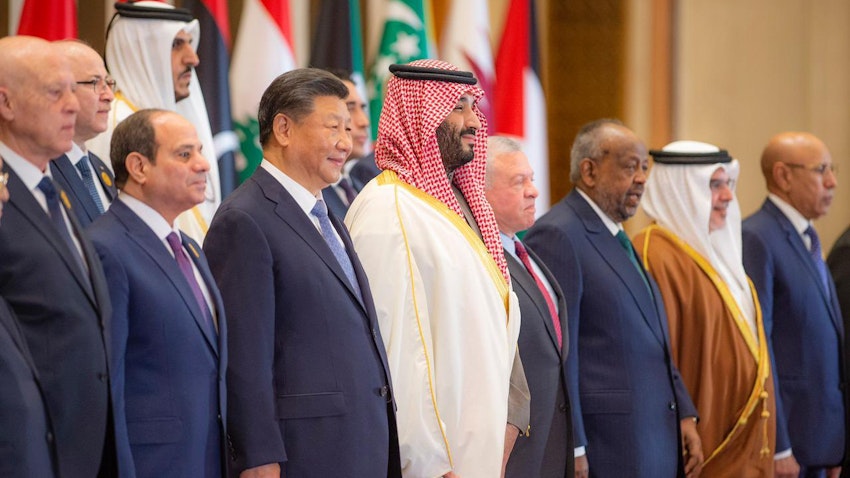
Image Caption: Saudi Crown Prince Mohammed bin Salman and Chinese President Xi Jinping at the Arab-China Summit in Riyadh on 9 December 2022. Photo: KSAmofaEN/X
About the Author
Dr Zhaoyi Zhu is a Chinese scholar specialising in Middle Eastern studies, international economics, and Sino-Middle Eastern relations. He holds dual PhD degrees — one in Middle Eastern History from Tel Aviv University, and the other in Economics from Beijing Normal University. Fluent in English, Hebrew, Arabic, and familiar with French and Persian, Dr Zhu previously studied at Cairo University, and served as a visiting scholar at Yale Law School in 2022.
Currently, he is Executive Director of Middle East Institute at the PKU HSBC Business School, and founding director of the Israel Center and Middle East Institute at the Pangoal Institution. Dr Zhu has authored several works, including “The Rock of the Desert: Anti-Semitism and Conspiracy Theories”, and “5000 Years of Jewish Civilisation”. His research primarily focuses on global economic dynamics, China’s strategic interactions with Middle Eastern countries, digital governance, and the geopolitical impact of technology.