There is cautious optimism that the newly-announced plan[1] to end the Gaza conflict might finally bring closure to a war that has dominated both global and domestic politics — including in Singapore — since the Hamas attack on Israel on 7 October 2023. Nearly two years on, Gaza lies in ruins, its people devastated, and Israeli hostages, both living and dead, remain unreturned. Yet, the new peace initiative lands in a charged context.
In September, the United Nations’ (UN) Independent International Commission of Inquiry concluded that Israel’s conduct in Gaza constitutes genocide under international law.[2] Meanwhile, momentum for a Palestinian state has grown, with France, the United Kingdom, Canada, and others recognising Palestine, while Saudi Arabia and France co-hosted a high-level UN meeting to galvanise further international support for this cause.[3]
It is in this context of legal condemnation, widening diplomatic recognition of Palestine, and heightened regional tensions — sharpened by Israel’s settlement expansion and annexation plans in the West Bank, which drew a rebuke from the United Arab Emirates[4], as well as by the strike on Doha[5] — that United States President Donald Trump, together with Israeli Prime Minister Benjamin Netanyahu, unveiled the peace plan.[6] For its supporters, the plan offers the possibility of ending a war that has divided global opinion. Yet, it also reprises earlier formulas, and leaves the fundamental questions of Palestinian statehood unresolved, beyond a cursory nod to the “aspiration of the Palestinian people”.
A Workable Framework, Backed by a Desperate World
The plan, unveiled to much ceremony at the White House, sets out a framework for an end to hostilities.[7] Its focuses on the immediate release of hostages, the dismantling of Hamas’ military infrastructure and its governance role in Gaza, phased Israeli withdrawals, and the creation of a trans-national administration in Gaza supported by Arab and Muslim states. International oversight would be vested in a new “Board of Peace” chaired by Mr Trump, and which includes figures such as former British Prime Minister Tony Blair. Prima facie, it appears to be a strategically sound and feasible plan, one that seeks to combine Israeli security interests with regional and international support. At the same time, it offers the hope of ending the suffering in Gaza and laying the groundwork for transformation.[8]
Presented as a realist, workable framework that the region can live with, the proposal seeks to align disarmament with reconstruction, pairing security guarantees for Israel with the promise of rebuilding Gaza’s shattered economy under external supervision. By involving Arab and Muslim states in both governance and investment, it situates Gaza within a wider regional project of stability and recovery, echoing the shift across the Middle East towards development and normalisation. Syria’s recent re-integration into the Arab fold despite years of conflict serves as a model for how regional actors prioritise reconstruction and stability over unresolved political disputes. In that sense, the plan is a functional roadmap that regional actors can rally around. At the same time, it sends a signal that armed resistance and liberation movements, particularly those framed in Islamist jihadist terms, have no place in a region that is reorientating itself towards socio-economic advancement.
The proposal has received broad international support.[9] Mr Netanyahu declared it consistent with Israel’s war aims,[10] while Arab and Muslim states, including Saudi Arabia, the United Arab Emirates, Egypt, Turkey, and Indonesia, issued a joint statement backing the plan, and pledging to work with the United States on its implementation.[11] European governments such as France and the United Kingdom also welcomed the proposal, reflecting a desperate yearning among world leaders for an end to the war. This reception is largely down to the urgency of the moment: After years of devastation and deadlock, almost any proposal that carries the possibility of halting the bloodshed is embraced as progress.
It also reflects deeper recognition that only the US and Israel can decisively shape the terms of a settlement. In the politics of Middle East, where security dilemmas dominate and power asymmetries persist, peace initiatives between Arabs and Israelis have always depended on US-Israeli leadership as the central enabling variable. Every major Arab-Israeli agreement since 1978 has borne this imprint. The current proposal is no exception, merely an affirmation of the region’s enduring reality.
New Application of Old Principles
Although presented as a breakthrough, the plan borrows liberally from Mr Trump’s 2020 Peace to Prosperity vision.[12] Its central pillars are unmistakeably familiar. First, the demand for Palestinian demilitarisation remains the bedrock of the framework. Just as the 2020 plan required security guarantees before political progress, the 2025 version conditions a ceasefire on dismantling Hamas’ military infrastructure. The emphasis on regional buy-in is also a direct continuation, since the 2020 vision framed Arab and Muslim states as guarantors of Palestinian reform and peace with Israel. In 2025, the same actors are tasked with training Gazan police, and legitimising a trans-national authority. Finally, the proposal avoids a clear commitment to Palestine statehood, echoing the earlier plan’s ambiguity. While it promises better governance and economic investment, it defers questions of borders, recognition, and sovereignty. By contrast, Arab and Muslim states framed the plan as a path towards full Israeli withdrawal, the rebuilding of Gaza, and a just peace on the basis of a two-state solution in accordance with international law[13] — an interpretation that goes beyond Washington’s own terms.
Seen this way, the proposal is basically a wartime adaptation of an existing formula. It reflects a long-standing pattern in US peace initiatives, which have followed the same sequence — Israel’s security first, Palestine sovereignty later. From Jimmy Carter’s Camp David Accords to Bill Clinton’s Oslo process and George W. Bush’s Roadmap for Peace, Washington-led efforts have prioritised security guarantees while deferring pertinent questions of a negotiated two-state solution involving borders, recognition, and statehood. Both of Mr Trump’s initiatives added the emphasis on “prosperity”, offering Palestinians the promise of aid, and economic and infrastructure development as an incentive. But prosperity risks function in place of sovereignty for Palestine — a trade-off made feasible by the post-2020 regional climate as Gulf states shifted their priorities towards stability, modernisation, and countering Iran.
What is also significant about the latest iteration, when compared to Israeli-Palestinian peace frameworks before 2020, is not only its Gaza-specific focus, but also its deliberate sidelining of the Palestinian Authority (PA). The PA has long been endorsed by the United Nations, the European Union, Arab states, and many other governments as the legitimate representative of the Palestinian people. However, Mr Trump and Mr Netanyahu have repeatedly insisted that in its current form, the PA cannot govern Gaza, citing its lack of legitimacy, its policy of paying stipends to prisoners’ families, and its history of anti-Israel incitement. Instead, they want a new transitional administration in Gaza, backed by Arab and Muslim states, but without Palestinian representation at its core.
Such an authority may appear technically feasible — especially if strongly funded and resourced — but would be fragile because it raises serious questions of legitimacy and ownership. Can a governing body that lacks Palestinian identity and consent truly lay the foundation for a sustainable peace? Historical experience offers little reason for optimism. Transitional governments imposed from outside, whether in Iraq in 2003 or Afghanistan after 2001, proved incapable of commanding local trust, and collapsed into cycles of violence once international support weakened. In the Middle East itself, attempts to create externally-backed transitional authorities in Syria after 2012 similarly failed to gain traction, showing how fragile arrangements which lack deep-rooted legitimacy and popular buy-in are. It is the key reason Arab countries which offered to provide troops or funding for a peacekeeping force, including Saudi Arabia, Jordan, and the UAE, have insisted that they must be invited into Gaza by the PA, thus conferring legitimacy upon them.
The absence of genuine Palestine ownership also risks sowing the seeds of future resistance. When communities feel excluded or stripped of agency, new militant groups often emerge to fill the void. After the US invasion of Iraq, groups such as Al-Qaeda in Iraq, and later, Isis, rose directly from the vacuum of failed governance. In Gaza itself, Hamas’ ascent was shaped by frustration with the Oslo process and the PA’s perceived failures. If the new plan sidelines Palestinians again, the conditions may be ripe for another militant movement to take root even if Hamas is successfully dismantled. There appears to be no provision in the plan to hedge against this risk, reflecting the continuity of frameworks that prioritise security arrangements without addressing political grievances — a recipe for sparking a nationalist militancy.
A Promising Plan for the Region but Palestinians?
In the end, the US proposal reflects both the urgency of the present and the uncertainty of the future. It has been welcomed as a roadmap that could end the destruction of Gaza, but its sustainability is far from assured. Like the Abraham Accords before it, the plan’s fate appears tethered to the personality and priorities of a single US administration. The failure of the Biden Administration to advance Trump-era frameworks suggests that regional actors may once again find themselves dependent on Washington’s political cycles, raising doubts whether this momentum can outlast Mr Trump’s tenure.
Even if Israel’s war on Hamas is ended, the region’s deeper fault lines will remain. Iran-Israel hostility continues to shape the strategic landscape, leaving space for proxy confrontations in which the Palestine question can still be exploited, leaving it as an unfathomable paradox at the heart of Middle East politics. This is all the more striking given the recent wave of international recognition of Palestinian statehood.
Amid this, two larger unresolved questions linger: Where is the Palestine state supposedly recognised by 157 UN member states, yet lacks lived sovereignty? What would it take for the emergence of a Palestinian government that earns the legitimacy of its own people and much of the world, but which can also secure recognition from the two actors without whose assent peace remains unattainable — the United States and Israel?
About the Author
Nazhath Faheema is a PhD student in International Relations at the S. Rajaratnam School of International Studies, Nanyang Technological University, Singapore. Her research explores how religious ideology, identity politics, and political narratives shape state foreign policies — particularly in the case of Muslim-majority states and Israel, in contexts ranging from hostility and estrangement to engagement.
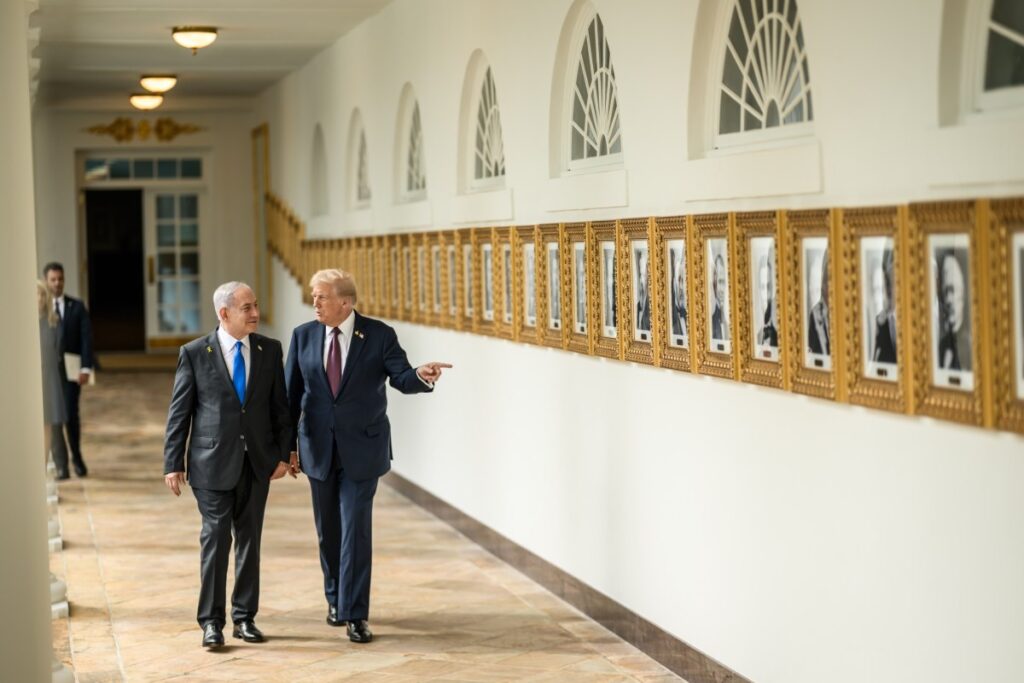
Image Caption: President Trump and Israeli PM Netanyahu at the White House, where they unveiled the latest proposal to end the war in Gaza. While the plan has been widely welcomed, it only gives cursory attention to the underlying issue that is central to the conflict — Palestinian statehood.
Photo credit: The White House.
End Notes
[1] “Pres. Trump, Netanyahu Announce ‘Comprehensive Plan to End the Gaza Conflict’ [FULL],” YouTube video, 43:02, September 30, 2025, https://www.youtube.com/watch?v=2ITaOMRT_6Y
[2] United Nations. Independent International Commission of Inquiry, Legal Analysis of the Conduct of Israel in Gaza Pursuant to the Convention on the Prevention and Punishment of the Crime of Genocide, A/HRC/60/CRP.3, 16 September 2025, Human Rights Council (Sixtieth Session), United Nations, https://www.un.org/unispal/wp-content/uploads/2025/09/a-hrc-60-crp-3.pdf
[3] United Nations. “France Leads Wave of New Recognitions of Palestine at UN Summit,” UN Press Release, September 22, 2025, PAL/2251, https://press.un.org/en/2025/pal2251.doc.htm; Patrick Wintour, “UK, Canada and Australia Announce Formal Recognition of Palestine, with Wave of Israel’s Allies to Follow,” The Guardian, September 21, 2025, https://www.theguardian.com/world/2025/sep/21/uk-canada-and-australia-announce-formal-recognition-of-palestine-with-wave-of-israel-allies-to-follow
[4] Samia Nakhoul, “UAE Presses Netanyahu to Back Trump Gaza Plan, Warns Against West Bank Annexation,” Reuters, September 29, 2025, https://www.reuters.com/world/asia-pacific/uae-presses-netanyahu-back-trump-gaza-plan-warns-against-west-bank-annexation-2025-09-29/
[5] Helen Regan, “Israel Strikes Hamas Leadership in Qatar in Unprecedented Attack. Here’s What to Know,” CNN, September 10, 2025, https://edition.cnn.com/2025/09/10/middleeast/israel-strikes-hamas-qatar-explainer-intl-hnk
[6] Robert Tait, “What’s in Trump’s 20-point peace plan for Gaza?” The Guardian, September 29, 2025, https://www.theguardian.com/world/2025/sep/29/trump-peace-plan-gaza-israel-hamas; Trump 20-Point Plan,” CNN video featuring Kaitlan Collins, September 29, 2025, https://edition.cnn.com/2025/09/29/politics/video/trump-20-point-plan-kaitlan-collins-vrtc
[7] “Trump 20-Point Plan,” CNN video.
[8] “Trump-Netanyahu Gaza Peace Proposal: What’s in the 20 Points?” BBC News, September 30, 2025 https://www.bbc.com/news/articles/c1dq9xwngv2o.
[9] Rushdi Abualouf and George Wright, “Leaders in Middle East and Europe Welcome Trump’s Gaza Peace Plan,” BBC News, September 30, 2025, https://www.bbc.com/news/articles/c1dq9xwngv2o.
[10] Trevor Hunnicutt, “Netanyahu Says He Supports Trump’s Peace Proposal to End War in Gaza,” Reuters, September 29, 2025, https://www.reuters.com/world/middle-east/netanyahu-says-he-supports-trumps-peace-proposal-end-war-gaza-2025-09-29/.
[11] “Joint statement by the Foreign Ministers of Qatar, Jordan, UAE, Indonesia, Pakistan, Türkiye, Saudi Arabia, and Egypt Welcome U.S. President’s Sincere Efforts to End the War in Gaza,” Ministry of Foreign Affairs (Qatar), September 29, 2025, https://mofa.gov.qa/en/latest-articles/statements/joint-statement-by-the-foreign-ministers-of-qatar–jordan–uae–indonesia–pakistan–t%C3%BCrkiye–saudi-arabia–and-egypt-welcome-us-president-s-sincere-efforts-to-end-the-war-in-gaza.
[12] “Peace to Prosperity: A Vision to Improve the Lives of the Palestinian and Israeli People,” WhiteHouse.gov (Trump Administration), archive, https://trumpwhitehouse.archives.gov/peacetoprosperity/.
[13] Ministry of Foreign Affairs (Qatar), “Joint Statement by the Foreign Ministers.”