Saudi’s Boxing Venture: Knockout, or More of the Same?
- V Shakthii Vel
- -
Imagine a boxing match on Alcatraz Island, or under the neon blaze of Times Square[1]. Audacious? Yes. Impossible? Not if Saudi Arabia is behind it. Such surreal spectacles are not just pipe dreams — they are part of the Kingdom’s latest push into the global sports arena.
Boxing is the latest — and possibly flashiest — piece in Saudi Arabia’s broader transformation strategy under Vision 2030. What started with football, Formula 1, and LIV Golf has now turned towards the ring[2]. But this is not just about the fights. The message, the money, and the machinery of soft power arguably count for more.
‘Money Talks Loudest—and Now it Speaks Arabic’
Boxing has always been a money game. Top fighters routinely walk away with millions — win or lose. In recent years, however, the sport’s popularity has dipped, weighed down by rival promoters, multiple sanctioning bodies, and a glut of championship belts that left fans frustrated and top fighters isolated from one another. Sensing an opportunity, Saudi Arabia has moved to fill the void. Through its Riyadh Season, the Kingdom pushed forward plans for a new boxing league that will bring together the top names in the sport across multiple weight classes[3]. The format promises a clear ranking system, a pathway for fighters to move up or down the ladder, and, crucially, the financial muscle to make the best fights happen — while persuading rival promoters to set aside their egos to work together[4]. Backed by its Public Investment Fund (PIF), Riyadh Season has set out with the aim to reshape boxing entirely, marrying spectacle with substance, and offering purses reportedly two to three times higher than anywhere else[5].
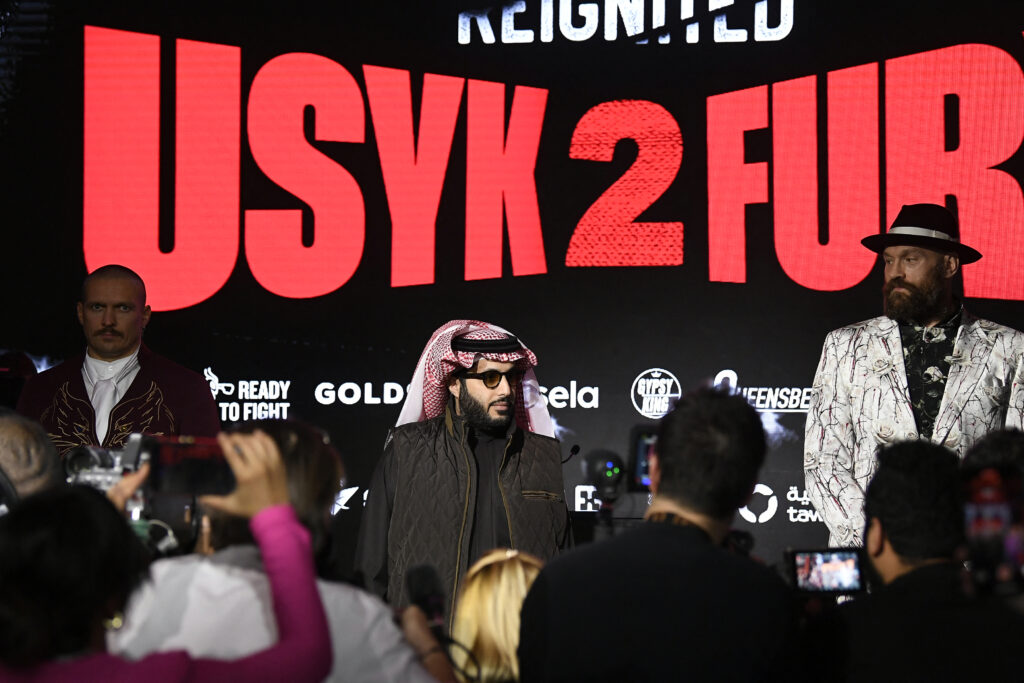
Saul “Canelo” Álvarez, the undisputed super middleweight champion, is said to be on track to become boxing’s first billion-dollar man, thanks to a US$400 million, four-fight deal backed by Riyadh Season[6]. Briton Anthony Joshua, a former heavyweight champion, has earned tens of millions from his bouts against in the Kingdom. Two other headliners, Tyson Fury and Oleksandr Usyk, each walked away with over US$100 million for their headline fights in 2024[7]. With figures like these, Saudi Arabia has quickly become boxing’s new centre of gravity — and its most lucrative arena.
Enter the Kingmaker
What is new is not just where the fights happen, or the sky-high prize money — but who is calling the shots. Turki Alalshikh, chairman of Saudi Arabia’s General Entertainment Authority (GEA) and a close ally of Crown Prince Mohammed bin Salman, has emerged as the sport’s new kingmaker. With state-backed funding and a taste for spectacle, he aims to reshape boxing, not just with cash, but with vision[8].
His ambitions go well beyond hosting generation-defining fights. Demonstrating this reach, in November 2024, he acquired The Ring, boxing’s most storied publication[9]. Soon after, he acquired the X, formerly known as Twitter, account of a prominent boxing journalist (with over 300,000 followers) and rebranded it as the official account of magazine[10].
“It’s not about the money,” Terence Crawford, one of the sport’s top pound-for-pound boxers, told ESPN. “Turki is succeeding because he treats boxers like friends and partners, not enemies to be exploited. He’s here to fix the greatest sport in the world. And he will do it[11].” His sentiments were echoed by Eddie Hearn, arguably boxing’s most influential promoter, who insists Saudi Arabia is breathing new life into boxing. “Boxing gets stale. The same weigh-ins. The same press conferences,” he said. “You’ve got to keep evolving. And Alalshikh? He’s torn the script up[12].”
As head of the Saudi Boxing Federation, Mr Alalshikh is central to Saudi Arabia’s effort to brand itself as a global entertainment powerhouse[13]. His projects are closely aligned with the Crown Prince’s grand vision for the Gulf nation.
Vision 2030 Takes the Ring
All of this feeds into something bigger: Vision 2030, Saudi Arabia’s master plan to diversify its economy away from oil exports and reshape its global image. Sport is a core pillar of that plan, viewed not just as entertainment, but as diplomacy, investment, and image-making combined. From sponsorship of football superstar Lionel Messi to high-octane golf deals, the Kingdom is crafting a new brand: Young, ambitious, and open to the world[14]. By securing hosting rights for major sporting events, the oil-rich nation is aiming to boost tourism, create business opportunities, and generate revenue from ticket sales, sponsorships, and broadcasting rights[15].
While it is not the only sport that the Kingdom has made big investments in, Mr Alalshikh said “there is a big opportunity in boxing”, adding that “you must improve the market. You must fix all the problems”. Before Saudi Arabia’s intervention in boxing, the sport grappled with several systemic issues that hindered its growth and appeal. A primary issue was the proliferation of multiple sanctioning bodies — such as the World Boxing Association (WBA), World Boxing Council (WBC), International Boxing Federation (IBF), and World Boxing Organisation (WBO) — each recognising its own champions within the same weight classes. This fragmentation created confusion among fans and fighters alike, as multiple “world champions” in a single division diluted the significance of each title. Over decades, these bodies operated as much as businesses as regulators, leaving fighters entangled in bureaucracy and fans frustrated — underscoring why a unified league, like the one proposed in Riyadh, could finally cut through the morass and deliver the marquee matchups audiences crave[16].
Compounding the problem was the absence of a centralised ranking system. Each organisation maintained its own rankings, often influenced by sanctioning fees, promotional relationships, and behind-the-scenes negotiations rather than consistent performance metrics. This made it difficult to determine clear contenders for title shots, and fuelled disputes over matchmaking, leaving the sport’s top fighters in limbo while fans waited for true titanic clashes[17].
The rivalry between promoters, which made the sport feel fragmented and prevented the biggest fights from happening, added further woe. Star fighters were frequently tied to competing promotional outfits with conflicting agendas, delaying or entirely blocking dream match-ups. A striking example came from the United Kingdom, where Frank Warren and Eddie Hearn — two of Britain’s leading boxing promoters—had reportedly never met until Alalshikh suggested a five-versus-five Riyadh Season. Both men agreed, and their handshake marked the start of a collaboration that finally brought fighters from opposing camps into the same ring, easing long-standing tensions and delivering the high-profile bouts fans had been waiting for[18].
With Alalshikh at the helm, Saudi Arabia has confronted boxing’s long-standing obstacles head-on. By bringing rival promoters to the same table, streamlining rankings, and building a unified league, the Kingdom has transformed the sport’s fractured landscape into a high-stakes, globally compelling arena that fans and fighters alike can rally around.
Criticism and Shortcomings
But while Saudi Arabia’s takeover of boxing has been game-changing thus far, notable challenges and limitations remain. One is broader scepticism about the motivations behind the Kingdom’s push into the sport. Many critics view the flood of investment and sudden interest not purely as a sporting initiative, but as an effort to polish Riyadh’s global image — so-called “sportswashing”. The spectacle of high-profile fights and celebrity appearances commands headlines, but critics warn it risks overshadowing serious concerns, from human rights to political freedoms[19].
Then there is the attraction itself. Despite the glitz and spectacle of Saudi fight nights, the energy often falls short of the electric buzz seen in Las Vegas or packed London arenas. Even at major events like the “Day of Reckoning”, held in Riyadh on 23 December 2023 and featuring eight bouts — including two headline-grabbing heavyweight clashes, Anthony Joshua vs. Otto Wallin and Deontay Wilder vs Joseph Parker — many Saudis were largely unaware that something big was happening.
Fans do not turn out in droves to mob top boxers during fight week, and crowds watching the action often seem subdued. In one telling moment during the featherweight world-title bout between Nick Ball and Rey Vargas in March 2023, the arrival of football coach Jose Mourinho generated noticeably more excitement than the action in the ring. Some spectators even left before the main event, while viewers at home often describe the ambience as flat, or “soulless”[20]. In sports, passion is key — a lesson anyone who followed football or other games during the Covid-19 pandemic, when fans were kept out of stadiums, can identify with.
One major reason for this is that Saudi Arabia is not in the top-tier of tourism destinations, unlike, say, Las Vegas. The nation’s reputation as an ultra-conservative country, the ban on alcohol, and other strictures do not appeal to the party sets who throng boxing bouts in the West. The country’s tourism infrastructure is also still evolving to support large-scale international sporting events. On both counts, the Kingdom is working to overcome obstacles. It has worked hard to overcome its reputation as a citadel of conservatism, drawing top-drawer music acts such as Coldplay, and even hosting hard rock legends Metallica. It is also investing heavily in initiatives to boost its appeal as a sports tourism hotspot. Partnerships with the streaming service Dazn to broadcast Riyadh Season events internationally aim to reach a wider audience, while measures such as e-visas for tourists — first introduced ahead of Formula E in 2018 — simplify access for visitors. Beyond these steps, the Kingdom is expanding attractions and infrastructure across multiple fronts, from Qiddiya and Sports Boulevard to the historic and scenic Al-Ula region, alongside major promotional partnerships, all intended to position Saudi Arabia as a more compelling tourism destination[21].
‘Fight Capital’
The Kingdom’s influence is undeniable — Forbes has even dubbed Saudi Arabia the new “fight capital” of the world[22]. Riyadh has demonstrated how it can muscle its way through years of wrangling and mismanagement, and reshape the trajectory of a fractured sport — through money.
However, money may open doors, but it does not automatically establish culture, legitimacy, or sustainable fan engagement — the latter arguably the most important factor. Boxing is by no means Saudi Arabia’s first major foray into sports. In football, the Saudi Pro League’s splashy signings, including Cristiano Ronaldo, Karim Benzema, and Sadio Mané, generated immediate global attention, but the buzz has largely faded. Questions still linger about the league’s long-term sporting credibility and global resonance, with low match attendances and limited fan engagement underscoring the fact that household names, let alone ageing ones, do not underpin a sustainable sports ecosystem[23].
The Kingdom’s foray into golf, through the LIV–PGA merger saga, is another case in point. Despite interventions by political figures such as United States President Donald Trump, and the Public Investment Fund’s (PIF) billions behind it, a merger deal to unite the sport has not moved forward. Through LIV Golf, the PIF sought to preserve an independent tour and secure Yasir al-Rumayyan, its governor, a place as co-chairman of the PGA Tour Enterprise. The PGA Tour resisted merging under these terms, and eventually rejected the financial incentives and torpedoing plans for a single, unified golfing circuit. As a result, the golfing world remains in limbo, with Riyadh potentially seen as a disruptor, rather than a unifier. This saga illustrates that financial power alone cannot overcome structural, reputational, and institutional hurdles, and that embedding a new entity in a traditional sporting ecosystem requires much more[24].
Taken together, these examples should serve as a reminder to the Kingdom that money, while necessary, is just the first step. While its venture into boxing looks promising, it remains to be seen whether the Kingdom can address its limitations and will move beyond headline-grabbing paydays to truly claim the crown as boxing’s new ring general.
Image Caption: Britain’s Tyson Fury (R) and Ukraine’s Oleksandr Usyk (L) in a press conference ahead of their undisputed heavyweight world championship rematch, in Riyadh on 19 December 2024. Photo: AFP
About the Author
V Shakthii Vel is a communications specialist at the Middle East Institute-National University of Singapore, with several years of experience in the field. He holds a bachelor’s degree in Mass Communications with Public Relations from the University of Northumbria.
End Notes
[1] https://www.theguardian.com/sport/2025/may/03/times-square-boxing-saudi-arabia-new-york-logistics
[2] https://www.cnbc.com/2025/04/24/cnbc-sport-saudi-boxing-deal-looks-different-than-other-investments.html
[3] https://www.straitstimes.com/sport/combat-sports/boxing-saudi-wealth-fund-holding-talks-to-create-boxing-league-sources-say
[4] https://www.sportspro.com/news/joshua-dubois-saudi-arabia-boxing-investment-hearn-warren-turki-alalshikh-matchroom-frank-smith-interview/
[5] https://www.dailymail.co.uk/sport/boxing/article-14516463/boxers-bombshell-Saudi-boxing-league-earn.html
[6] https://ringmagazine.com/en/news/i -alvarez-to-become-first-ever-billion-dollar-boxer-richard-schaefer
[7] https://bigfightweekend.com/fan-culture/riyadh-season-boxing-takeover/
[8] https://www.nytimes.com/athletic/6298589/2025/04/25/turki-al-sheikh-boxing-saudi-arabia/
[9] https://www.forbes.com/sites/brianmazique/2024/11/11/oscar-de-la-hoya-confirms-sale-of-ring-magazine-to-turki-alalshikh/
[10] https://www.essentiallysports.com/boxing-news-why-did-boxing-reporter-michael-benson-vanish-overnight/
[11] https://www.nytimes.com/athletic/6298589/2025/04/25/turki-al-sheikh-boxing-saudi-arabia/
[12] https://www.theguardian.com/sport/2025/may/02/times-square-boxing-eddie-hearn-interview
[13] https://ringmagazine.com/en/news/turki-alalshikh-is-appointed-president-of-the-saudi-boxing-federation
[14] https://www.dazn.com/en-US/news/boxing/vision-2030-riyadh-season-saudi-arabia-boxing-legacy/d9rtd7r5scg0151b9t48rfnkz
[15] https://www.arabnews.com/node/2589460/business-economy
[16] https://www.bbc.com/sport/articles/ckdd40kz1e2o
[17] https://www.theguardian.com/sport/the-balls-of-wrath/2015/feb/02/transnational-boxing-rankings-board-sport-titles#:~:text=The%20TBRB%20initiative%20is%20now,support%20Toledo%20is%20looking%20for.
[18] https://www.bbc.com/sport/boxing/68028654
[19] https://www.nytimes.com/athletic/live-blogs/usyk-vs-fury-live-updates-fight-results-ring-walks-time/kGJM6Mf3nqcK/gcgZR6RwaMRI/
[20] https://www.bbc.com/sport/boxing/articles/c4n1yd21dylo
[21] https://www.arabnews.com/node/2587813
[22] https://www.forbes.com/sites/brianmazique/2024/02/21/saudi-arabia-has-become-the-fight-capital-of-the-world/
[23] https://mei.nus.edu.sg/publication/mei-perspectives-series-38-saudi-arabias-football-gold-rush-is-the-party-already-over/
[24] https://www.theguardian.com/sport/2025/apr/03/golf-liv-series-pga-tour-reunification-talks