Introduction
President Donald Trump’s decision on 14 May 2025 to lift sanctions on Syria is a significant shift in United States foreign policy towards the country, ending its years of global isolation. In addition to the major economic implications for the country, the policy reversal also indicates that the interim leader of Syria, Mr Ahmed Al-Sharaa, the former head of Hayat Tahrir Al-Sham (HTS), is now acknowledged as its legitimate leader. His past association with Al-Qaeda (AQ) is now largely viewed as history, and the bounty placed on him by the US has effectively been withdrawn. However, despite the dissolution of HTS, many members of the group continue to wield significant influence over key ministerial positions in the governance and leadership structures of what is now referred to as the “New Syria”. This is particularly evident in critical ministries such as defence, foreign affairs, interior, and justice.
Their ongoing control over key ministries raises concerns regarding over whether Mr Al-Sharaa, HTS’ foundational beliefs, and the group’s operational methods have been truly revoked, or are simply being presented in a more favourable light. Additionally, the presence of AQ and the effective integration of Syria’s many armed factions under a unified command, compounded by sectarian tensions that have left the minority communities vulnerable and fearful for their safety and rights under a predominantly Sunni-led government, as well as the influence of external powers, present critical challenges for the country.
Arab and Global Leaders Support the Lifting of Sanctions
The lifting of sanctions has sparked joy among Syrians, and garnered support from Arab leaders. In particular, Saudi Arabia and the United Arab Emirates (UAE), as well as Qatar, have welcomed the decision as a strategic move towards re-integrating Syria into the Arab fold. Europe has also welcomed it. It is seen as a crucial step for the country towards economic recovery and rebuilding efforts that have been severely hampered by years of conflict and international censure. The lifting of sanctions came after a meeting with Mr Al-Sharaa in Riyadh during Mr Trump’s first official foreign trip since taking office last January, with the US aiming to reach significant economic and geopolitical goals. The three-day visit to the Gulf started in Saudi Arabia — whose leader, Crown Prince Mohammed bin Salman, personally lobbied Mr Trump to remove the sanctions — and included Qatar, and the United Arab Emirates. Syrians hope that this change would lead to increased foreign investment, humanitarian aid, and an overall improvement in living conditions.[1] However, Mr Al-Sharaa’s and the Syrian interim government’s ability to overcome the country’s current challenges and HTS’ extremist past will be critical in determining whether this newfound optimism can translate into lasting peace and stability.
Al-Sharaa’s Transformation and the ‘US-Made’ Narrative in New Syria
The former US Ambassador to the Middle East, Robert Ford, revealed the covert involvement of Western nations in Syria during his lecture at the Baltimore Council on Foreign Affairs earlier this month. He specifically mentioned that both American and British entities played an indirect role in facilitating Mr Al-Sharaa’s ascent to power. Mr Ford was part of a team invited by a UK-based non-governmental organisation focused on conflict resolution to assist Mr Al-Sharaa, who was a senior AQ commander in Mosul in northern Iraq at the time, to transition into the political sphere.
Mr Ford mentioned that he met Mr Al-Sharaa on two occasions for training purposes, beginning in 2023 and continuing into 2024, just months before his arrival in Damascus. A third meeting occurred in January 2025, after he ascended to power. The ambassador explicitly stated that Mr Al-Sharaa has not apologised for the terrorism carried out by his group during its previous incarnation as Jabhat al-Nusra, an AQ affiliate, nor for the violence inflicted by HTS. This raises the concern of how much — or even whether — his ideology and that of other former HTS members have shifted towards moderation. Additionally, being perceived as “US-made” can lead to accusations that the Syrian leader is a Western agent, rather than a national patriot, potentially undermining his credibility among Syrians and other factions. In conflict zones like Syria, the legitimacy of local leaders or factions is often subject to the influence of propaganda.
HTS’s Ideological Shift or Change of Narrative?
HTS, a Salafi jihadist group previously known as Jabhat al-Nusra (JAN), has undergone a lengthy and intricate evolution in its ideological framework since its establishment in 2012. It now attempts to present itself as a more moderate alternative to other extremist groups. This evolution has been marked by a gradual and pragmatic approach, even during periods when the group was associated with both the Islamic State in Iraq and the Levant (ISIL) and, later, AQ. Throughout these phases, HTS maintained a discourse that was distinct in both form and substance from that of its parent organisations. It has distanced itself from the global jihadism characteristic by focusing on the Syrian context, framing its struggle as part of the revolution against the regime of Bashar al-Assad. This enabled HTS to attract other rebel groups in Syria to its side. However, Mr Al-Sharaa’s prior affiliation with AQ, specifically through his role in Jabhat al-Nusra, underscores his strong commitment to Salafist jihadist principles. This raises questions about whether he has indeed abandoned his original ideas.
As HTS established itself as the interim power in Damascus, it saw a need to shed its “militant organisation” label, both to present a more acceptable face to the international community as well as foster better relations with countries like Turkey and others that had previously viewed it with suspicion.
The group’s formal dissolution was announced on 29 January 2025. In the lead-up to this, it gradually transitioned from defending a rigid jihadist narrative to adopting a more pragmatic Islamist approach focused on governance and stability. However, since an ideological shift requires time for internal adaptation and consistent policy implementation to align with a more moderate stance, there are significant concerns that HTS’s core ideology may persist among its members, and has just been swept under the rug as part of a public relations effort. These concerns speak to the complexity of the task facing the interim government.
Hurras Al-Din, and AQ: A Complex Dynamic in the New Syria
HTS’ shift and its eventual dissolution did not win unanimous support from its members, with some factions expressing dissent. One was Hurras al-Din’(HAD), the AQ-affiliated faction that splintered from HTS in 2018 and remains a challenge for the interim government. This split was driven by the perception that HTS was deviating from the goals of jihad, particularly given its acceptance of the Turkish presence in Syria and its coordination with Ankara.
Despite HAD’s dissolution on 29 January 2025, its fighters were told to keep their weapons in case of further conflict. This was a response to Israel’s defence minister’s statement that its troops would remain in Syria “indefinitely’’, controlling hundreds of square kilometres of Syrian land it seized, and that current occupation of Mount Hermon — the United Nations’ buffer zone in the Golan Heights — as well as parts of the Quneitra and Daraa governorates would continue. The group’s dissolution, however, has not spared it from continued US airstrikes — part of a broader and an ongoing campaign against remnants of AQ and ISIS in Syria.
AQ’s future in the new Syrian landscape relies significantly on the potential for escalation of sectarian conflict in the country. There are already fears that the situation is descending into chaos. Since the fall of Assad’s regime, the Alawite community has been subjected to a growing wave of violence and retaliation. In March, they were victims of a surge of retaliatory violence by members of the Syrian National Army (SNA) that is believed to have resulted in more than 1,000 deaths in the provinces of Latakia and Tartous, which are regions known for their strong support of former President Assad. Although Mr Al-Sharaa vowed to uphold justice and punish those responsible, nobody has been arrested yet.
Meanwhile. Saraya Ansar Al-Sunnah, a rebel breakaway faction from HTS, is targeting religious minorities, with a notable focus on the Alawite community in the Hama and Homs countryside in pursuit of its strategy is to establish a presence in rural areas outside HTS’ control, perhaps in preparation for a future military confrontation with it.
Weeks after the massacres that targeted the Alawite minority, the Druze community, an offshoot of Shia Islam that is often viewed with suspicion by many hardline Sunnis due to its secrecy, has also been attacked. On 6 May, an audio recording featuring a Druze religious leader allegedly blaspheming the Prophet Mohammed was circulated. This recording incited violent confrontations between armed Druze and Sunni factions in southern Damascus, in which over 100 were killed. In response, Druze leaders condemned the recording as a fabrication intended to incite precisely this type of conflict.
As a result of this violence, fear among minority groups in Syria has been growing. Mr Al-Sharaa’s promises to the Druze, Alawites, Christians, and Kurds that a practical approach based on reconciliation and unity among all groups in the community will be achieved remains elusive for now.
If sporadic violence in certain areas degenerates to this level — possibly triggered by the movements of remnants of the previous Syrian regime or direct interventions by Iran — AQ may capitalise on this situation to reestablish its influence and fuel sectarian tensions, leveraging its historical expertise in such conflicts. It is worth noting that the interim government has reportedly entered into an agreement with the Druze province of Suwayda, located in southern Syria, to integrate it into state institutions, and thus provide it with some measure of protection. The attacks on minorities may thus have an unintended effect — pushing them to buy into the integrated Syria vision in exchange for security. On the other hand, if attacks against them continue, they may be forced to turn to other armed groups instead, further fragmenting the country.
The Integration of Armed Groups Continues as a Major Challenge
Another significant challenge is the potential for divisions among HTS members, especially among those who disagree with the pragmatism of the interim government in Syria. In such a scenario, AQ could present itself as an alternative for local jihadists who may be dissatisfied with HTS’ direction or policies, contributing to the challenges in integrating armed factions in Syria.
Perhaps very much aware of that risk, Mr Al-Sharaa conducted a meeting on 24 December 2024 that involved representatives from over 15 armed factions in Syria who reportedly agreed to voluntarily dissolve and integrate into the new Syrian army. In March, this meeting bore fruit when an agreement was signed between the Kurdish-led Syrian Democratic Forces (SDF) and the interim Syrian government. But despite these efforts by the interim government, the situation remains complex. For example, on 17 May, the Syrian Minister of Defence urged small armed groups that have not yet integrated to do so within a 10-day timeframe, warning of unspecified consequences for those who fail to comply. However, the deadline passed without significant change, and no action has been taken against the holdouts.
A proposal for individuals to serve in the military within their specific geographical regions further illustrates the complexity of the problem. While it is seen as having positive aspects, particularly in potentially improving local stability and fostering a sense of social affiliation among military personnel and their communities, the proposal has also generated concerns. Among them are that mandating regional service could inadvertently solidify existing geographical and sectarian divisions within the military itself. Such an arrangement could also lead to fragmented loyalties based on regional identities, rather than a national one.
Given these factors, the goal of a unified force appears to be a distant one. The challenge lies in developing a framework for integration that takes into account the diverse factions and structures that exist among the armed groups in Syria.
Foreign Fighters in Syria Remain a Significant Challenge
Adding to the mire is the fact that many Syrian armed groups count foreign fighters within their ranks. Uyghurs, who are primarily from Xinjiang in China, and are often referred to as “Turkistanis” by Syrians, form a significant number — more than 10,000 — but other major groups include Chechens and others fighters from Russia. Arabs from Jordan, Egypt and Tunisia, among others are also present in significant numbers, as are people from France, the United Kingdom, and Germany.
While the US has reportedly indicated its acceptance of the interim government’s efforts to incorporate thousands of foreign fighters into the SNA, how these rebels will respond to the process of integration is unknown. Since December 2024, thousands of foreign fighters have been considered for integration into military roles in the new defence ministry. In an interview with The New York Times in April, Mr Al-Sharaa announced that his government might consider granting Syrian citizenship to foreign fighters who have resided in Syria for many years, and who steadfastly sided with HTS’ efforts to overthrow the Assad. This raises concerns that the fighters, who were drawn to Syria from around the world because of diverse ideological, religious, or political motivations, may turn the country into a sanctuary for extremists.
Perhaps fearing this, the White House laid out five conditions to take its relationship with Syria to the next phase — the withdrawal of all foreign fighters from the country was the first. This is an exceedingly difficult condition to meet. Foreigners have fought in Syria for years, and thus have deep-rooted ties with the groups they represent. Beyond this, their long involvement in the conflict has given rise to social ties, through marriage, for instance.
The Influence of Regional Powers in the New Syria
Syria’s challenges do not merely stem from internal fault lines. Since the fall of the Assad regime, the country has become a focal point for regional powers such as Turkey and Israel, as each pursues its own interests in Syria through military and political means. Reports suggest that Israel’s strategy towards the interim Syrian government is centred around preventing the new administration from stationing military forces south of Damascus, and advocating for a complete demilitarisation of specific regions, namely the Quneitra, Daraa, and Suwayda governates. This approach is intended to maintain security along its borders and mitigate potential threats. Israel also aims to position itself as a guardian of the Druze minority residing in southern Syria, and to maintain its control over certain territories by declaring that its forces will remain “indefinitely” in areas such as the buffer zone and Mount Hermon. These actions underscore Israel’s ongoing agenda of territorial expansion and occupation, particularly in the Golan Heights, which are designed to undermine the authority of the central government, and inhibit the formation of a unified force that could pose a threat in future.
Turkey, meanwhile, has significantly increased its influence in Syria of late. It has supported HTS, allowing Ankara to exert significant influence over the country, and established a substantial military presence in northern Syria aimed at countering Kurdish forces, particularly the Syrian Democratic Forces (SDF), which it views as crucial for its national security.
The influence of foreign actors are yet another obstacle to the new government’s efforts to consolidate control and assert national sovereignty.
Conclusion
While the US announcement that it is lifting sanctions on Syria is a significant development, the factors outlined above pose significant challenges for Syria and its leadership. The overriding concern is whether the leopard that is HTS can change its spots and shed its extremist past. The interim Syrian government relies on the political initiative of the mostly former HTS members among its ranks. This involves several key elements: Integrating all armed groups into the SNA, declaring respect for human rights, and committing to govern all religious and ethnic groups in Syria equally. It remains to be seen whether they can work together — and with others in Syria — to formulate a comprehensive and inclusive approach to defuse the Syrian powder keg.
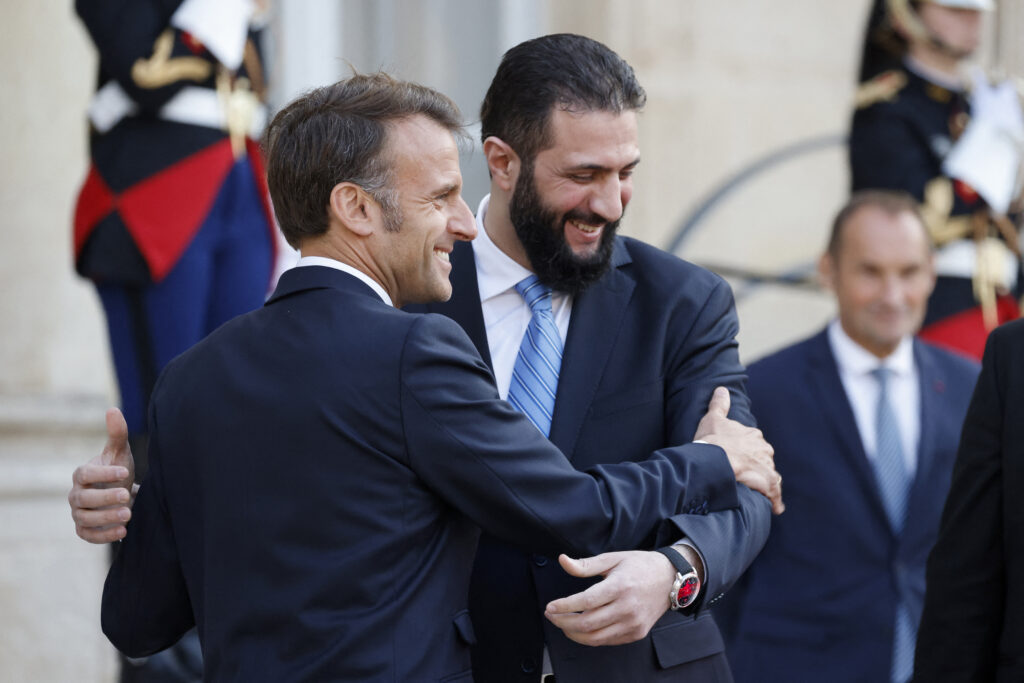
Image Caption: French President Emmanuel Macron (L) and Syrian President Ahmed al-Sharaa greet each other after a joint press conference following a meeting at the Elysee Palace in Paris, on 7 May 2025. Syrian interim President Ahmed al-Sharaa arrived in Paris on 7, state media reported, on his first visit to Europe since overthrowing longtime ruler Bashar al-Assad in December. Photo: AFP
About the Author
Dr Ghada Farag Sayed Soliman is a Research Fellow in the International Centre for Political Violence and Terrorism Research at S. Rajaratnam School of International Studies (RSIS), Nanyang Technological University (NTU), Singapore. Her research focuses on extremism in the Middle East and North Africa region.