On 10 May 2025, Eghtesaad24, a mainstream media outlet on Iran’s economic affairs, published an interview with Professor Fan Hongda of Middle East Studies at Shanghai International Studies University, covering a total of 16 issues closely related to Iran, including China-Iran relations and ongoing Iran-US negotiations. The interview was conducted in English and published in Persian on Eghtesaad24. With the consent of the publisher, the original English version of this interview is available here.
1. China has invested only $618 million in Iranian projects from 2018 to 2022, mostly in infrastructure. Meanwhile, China has invested $22.5 billion in Saudi Arabia, $13 billion in Iraq, $4.6 billion in Kuwait, $1.8 billion in Qatar, $19.3 billion in the United Arab Emirates (UAE), and $2.5 billion in Oman. Even China’s investment in tiny Bahrain was more than double its investment in Iran. Do you see any other reason for the Chinese’s reluctance to invest heavily in Iran, other than fear of facing US sanctions? I don’t have the specific investment amounts announced by Beijing in various Middle Eastern countries, but I believe that China’s investment in Iran is far lower than those in the above-mentioned Arab countries. This is basically common sense in the current Chinese Middle East research community. As for why China has not been able to invest more in Iran, sanctions are indeed the core factor, and Iran’s investment and business environment are also important reasons. From an economic perspective, the risks of investing in Iran are far greater than the expected returns. Another point worth mentioning is that the two countries currently lack trustworthy investment channels.
2. Some believe that the US sees the Chabahar port project in Iran as a counter to China’s Belt and Road Initiative, as it seeks to undermine and marginalize China’s international transportation project that extends through Pakistan to Central Asia, Russia, and European countries. What do you think? Is it possible that the US could even grant India an exemption from sanctions to cooperate in Iran’s Chabahar port, even if this would help Iran’s economic situation? If the United States sees the Chabahar Port project as a countermeasure to China’s Belt and Road Initiative, it can only be said that Washington’s means of containing Beijing are too limited. Although there are some descriptions of international competition about the Chabahar Port, a world power like China will not and should not regard this Iranian port project as a threat. I sincerely hope and believe that the Chabahar Port project can be carried out more smoothly. This is very important for Iran’s development.
3. How did China agree to President Nixon’s visit and abandon hostility with the US decades ago? It seems that Trump wants to repeat Nixon’s approach this time towards Iran? Will he succeed? What are the similarities and differences between the US-China relationship then and the US-Iran relationship today? At that time, China faced a strong threat from the Soviet Union, and its national development encountered serious difficulties. China had to seek diplomatic changes. Because of the Cold War, Washington also needed China, which was in fierce confrontation with the Soviet Union. It was the practical interests that brought China and the United States closer to each other. I don’t think there is a fundamental conflict of national interests between Iran and the United States now. Tehran and Washington should definitely get closer to each other. Whether Trump can replicate Nixon’s success depends largely on whether Iran has its own Mao Zedong. Tehran must understand that in the eyes of Americans, Iran and China are not countries of the same international level. Trump does want to ease relations with Iran, but the easing of bilateral relations has greater positive significance for Iran.
4. If you are in contact with academic or diplomatic circles in China, what is their prevailing view of the Iran-US negotiations? Are they optimistic about its outcome? Do they think that if an agreement is reached, Iran will lean towards the West or will it continue to remain close to China and Russia? According to my understanding, the Chinese academic community was quite pessimistic about the Iran-US negotiations before they started, and now there is some change but it is still not optimistic. They think there are too many difficulties and it is unlikely that Tehran and Washington can reach a consensus. But I am optimistic that Iran and the United States can reach an agreement this time. And I think Iran will not abandon China and Russia even after easing relations with the United States. I insist that China will benefit from the improvement of Iran-US relations.
5. To what extent are China and Russia willing to stand by Iran beyond rejecting resolutions issued by the US? Will those two countries, especially China, risk their trade interests with the US and stand by Iran if it takes military action against Iran? I believe that China and Russia will give Iran some support. But Iran must not pin its fate on other countries. Iran can certainly protect itself through flexible policies and the increased strength that comes with them. Why should Iran rely on other countries? Continued confrontation with the United States can only hurt Iran more. Actively easing relations with the United States can solve many of the difficulties Iran is facing, such as the lifting of sanctions.
6. Can we talk about the existence of a China-Iran-Russia axis? Some believe that such an axis does not exist. What is your opinion? Do these three countries have anything in common in their relationship other than hostility towards the United States? Is there any potential for expanding cooperation between the three countries? I don’t think the China-Iran-Russia axis really exists. This is largely determined by the three countries’ desire to develop relations with major European and American powers. It is true that all three countries have obvious contradictions with the United States, but this is not a solid foundation for the formation of an axis. At present, they all have the desire to shape a new international order and promote stability in some regions. Economic and trade cooperation is also an important area where the three countries can benefit from each other.
7. Which of China and Russia has more leverage in Iran’s decision-making and why? Although I don’t want Iran’s decision-making to be influenced by external factors, there is no doubt that Russia, not China, is more valued by Tehran so far. China’s advantage is economic capacity, while Russia’s capacity is focused on security. Moreover, compared with China, Russia’s attitude towards Iran is more positive. The close high-level interaction between Moscow and Tehran has already explained the problem.
8. Is China prepared to take the place of the United States after that country’s withdrawal from the Middle East? Some believe that China is simply looking for trade and business deals with regional countries and prefers that the United States be present in the region at its own expense and ensure the security of waterways because Beijing does not want to spend money to ensure the security of the region. What is your opinion on this argument? Personally, I think China has no plans to replace the United States in the Middle East, because Beijing should know that it does not have the hard power of the United States in this region. But it is obvious that China is going beyond economic and trade cooperation in the Middle East and actively promoting regional peace and security. China supports the strategic autonomy of Middle Eastern countries, so I don’t think Beijing is happy to see the stationing of US troops here.
9. How do you see the prospects for Iran’s trade and economic relations in light of the 25-year agreement? How do you assess the current status of this agreement and the parties’ implementation of it? I have always been optimistic about the economic and trade relations between China and Iran. Especially after the sanctions on Iran are lifted, I believe that the cooperation between the two countries in this field will be strengthened. But on the other hand, I have to say that I have not read the text of the 25-year agreement and do not know its details. Therefore, I cannot give an evaluation on the implementation of the agreement.
10. Isn’t China concerned about the Iran-US agreement and the possibility of losing trade and investment opportunities in the petrochemical, mining, and other sectors of Iran? Will Iran’s imports of European and American goods and technologies not pose a threat to China? Is it possible that China will sabotage or sabotage the Iran-US negotiations process because of this? How? China is very clear that after Iran and the United States reach an agreement and sanctions are gradually lifted, the competitiveness of the Iranian market will definitely increase. However, sanctions have made it impossible for powerful Chinese companies to cooperate with Iran. Moreover, China has developed its own competitive excellence and is not afraid of competition from Europe and the United States in many fields. Therefore, I don’t think Beijing will obstruct the Iran-US negotiation process. At the same time, Iran must understand that diplomatic diversification is the most suitable option for its national interests.
11. Which one will China choose in the dilemma between China’s economic trade interests with the US and its trade relationship with Iran? Some in Iran believe that China has no serious will to expand trade and investment cooperation in Iran due to the high volume of trade with the US and its coincidence with the trade war, in addition to the risk of facing punishment for violating US sanctions with Iran. What is your opinion? In terms of economic and trade cooperation, Tehran cannot expect Beijing to choose between Iran and the United States. In 2024, the trade volume between China and the United States was 688.3 billion US dollars, while the trade volume between China and Iran in the same year was only more than 13 billion US dollars. Therefore, if Beijing must make a choice, the result will be something Tehran does not want to see. Fortunately, I think both the Chinese government and the private sector have a strong desire to expand cooperation with Iran, but the reasons mentioned above restrict the actions of the Chinese side.
12. Nearly 90 percent of Iranian oil is exported to China, and nearly 15 percent of China’s oil imports have come from Iran. Isn’t China worried about facing punishment for violating sanctions from Trump? To what extent have Chinese refineries succeeded in circumventing US sanctions? In fact, although the sanctions imposed by the United States have had an obvious negative impact on China-Iran economic and trade cooperation, such as Chinese companies being sanctioned by the United States for cooperating with Iran, Beijing has also been working hard to circumvent US sanctions and maintain cooperation with Iran. For example, in the field of oil trade. According to a report by Iran’s Mehr News Agency on July 27 last year, China’s imports of Iranian crude oil through Malaysia reached 1.456 million barrels per day in June of that year, ranking second in history. However, due to risk aversion, it is very understandable that Beijing prefers to cooperate with safer oil countries when it has a choice.
13. China succeeded in mediating between Iran and Saudi Arabia. How was this possible? Does China intend to play a similar role in not normalizing, which seems impossible, but at least reducing tension in Iran-Israel relations? Will China be able to play such a role, and will Iran and Israel accept such a role? Isn’t it difficult to maintain a balance in China’s relations with countries in the region, from Iran to Saudi Arabia and Israel? I think there are several reasons why China succeeded in mediating between Iran and Saudi Arabia. First, these two Middle Eastern powers had a strong desire to ease relations. Second, Iraq and other countries had conducted multiple rounds of mediation between the two countries. Finally, China maintains good relations with both Iran and Saudi Arabia, and China is willing to implement its global security initiatives.
Beijing is absolutely willing to continue to play the role of mediator. But I firmly believe that Iran-Israel détente will only happen after Iran-US reconciliation, so frankly speaking, I don’t think Beijing can play a big role in Iran-Israel détente. Because according to the current situation, neither the United States nor Israel would want China to play a prominent role in this process. It is very likely that Tehran would not like such a role of China at that time either.
14. Despite the close relations between Iran and China, China has officially questioned Iran’s sovereignty over the three islands in the Persian Gulf and repeated the claims of the United Arab Emirates and the Gulf Cooperation Council. What do you think is the reason for this? Was it because of the higher volume of trade relations between China and Arab countries? I remember that in the joint statement of the Cooperation and Development Summit between China and the Gulf Arab States Cooperation Council in December 2022, the issue of the three islands in the Persian Gulf was explicitly mentioned for the first time in recent years. To be honest, I still don’t know why China agreed to this clause. I have always believed that China should conduct bilateral rather than multilateral diplomacy with Arab countries. Once entering multilateral diplomacy, China has no advantage.
15. It seems that despite China’s offer to mediate and help facilitate the talks between Iran and the United States, this offer was not accepted by the United States. Shouldn’t Chinese officials be worried about being left out of these talks, like the Europeans? Wouldn’t this be detrimental to China’s interests? I absolutely don’t think Washington will agree to China’s involvement in the US-Iran negotiations. It is easier to solve the problem through direct negotiations with Iran, so why would Washington want more countries to be involved? Moreover, China has been regarded by the United States as its biggest challenger. I believe Tehran also does not want more countries to be involved in this process. When the two conflicting parties or even one of them does not want the other party to intervene in the negotiations, it is actually difficult for the third party to take an active role even if it is worried about its own interests being damaged.
16. What do you see as the biggest challenges and opportunities in the Iran-China relationship? The serious lack of political mutual trust and people-to-people exchanges will be a key factor restricting the further deepening of China-Iran relations.Economic complementarity and consensus on international development will become the driving force for deepening relations between the two countries.
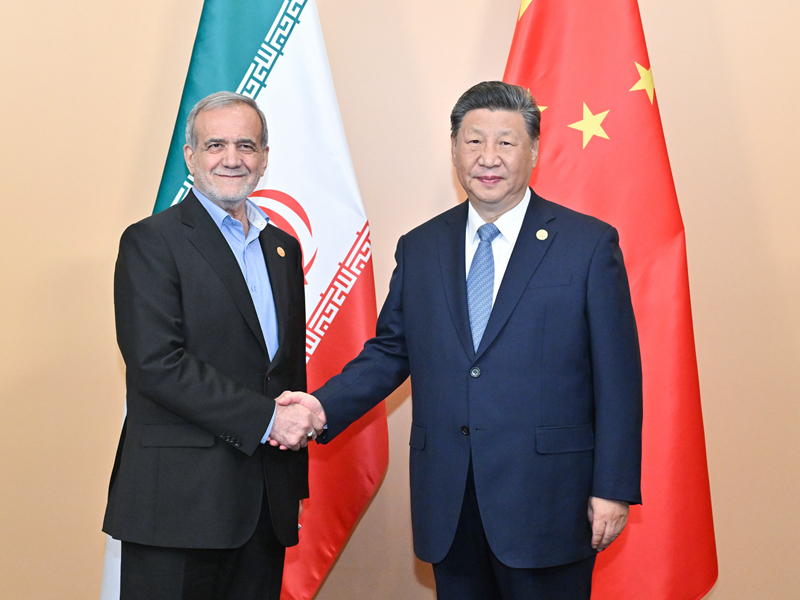
Image Caption: Chinese President Xi Jinping in a meeting with Iranian President Masoud Pezeshkian on the sidelines of the 16th Brics Summit, reaffirming Beijing’s commitment to deepening friendly cooperation with Tehran amid shifting global and regional dynamics. Photo: The State Council of the People’s Republic of China
About the Interviewee
Fan Hongda is a Professor at the Middle East Studies Institute of Shanghai International Studies University, China.
*Please note: This interview is only my personal opinion and does not represent the views of my institute,my university or the Chinese government.