It is no surprise that the Middle East is President Trump’s first official overseas trip of his second term. The region is home to one of the primary foreign policy achievements of his first term – the Abraham Accords – and in the years between his presidencies his orbit has deepened their economic ties to the region, in particular the Gulf. It is also home to several active crises the president is eager to resolve, namely in Gaza, Yemen, and Iran.
There is also a sense in the administration that this trip is an opportunity to roll back some of China’s influence in the region – primarily by offering more economic engagement – and I would expect many of the administration officials to make this point with their regional partners. The president does not intend to get bogged down in the ongoing diplomatic efforts, however, he is expected to keep this trip focused on the economic opportunities at hand. There is significant expectation that he will announce major deals that benefit both the region and the American economy – particularly in the technology and security realms – and to triumph the diplomatic agreements he has brokered in the past. I anticipate a great deal of fanfare and future-focused messaging from the U.S. and its partners on this trip.
Grant Rumley
Senior Fellow, The Washington Institute for Near East Policy
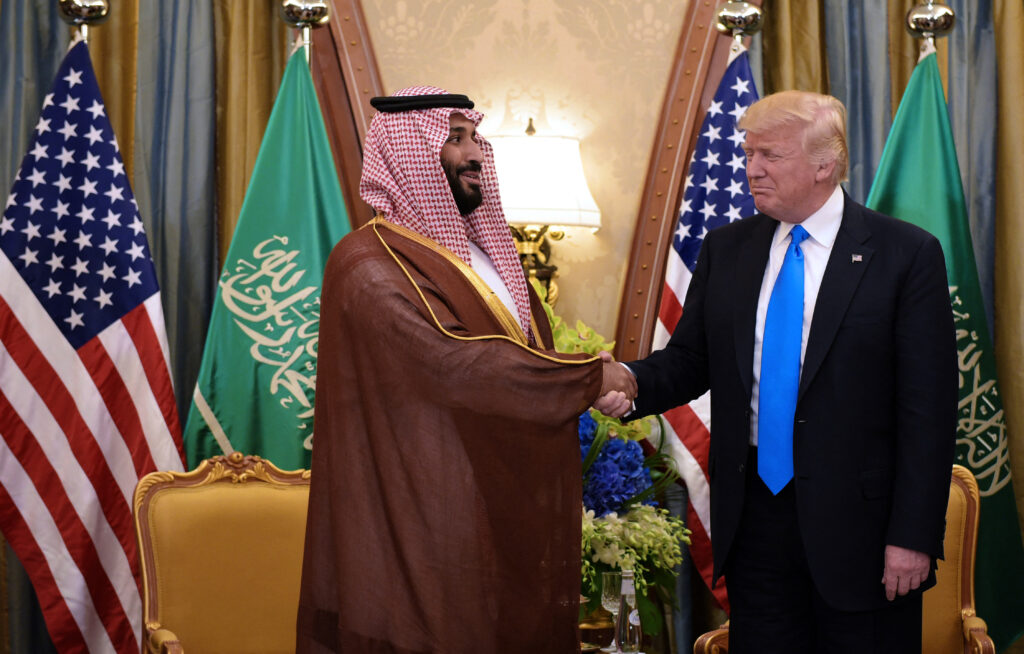
The fact that the GCC should be the destination for President Trump’s first substantive foreign visit in his second term (following his trip to the Vatican for Pope Francis’s funeral) is little surprise; after all, Trump broke with convention in his first term when he made his first foreign trip to Saudi Arabia in 2017. On that occasion, Trump continued on to Israel, whereas this time he will go on to Qatar and the UAE, which is a signal of how central the Gulf States loom in the administration’s attempt to secure inward investment and business ventures that can generate jobs and prosperity for Americans.
From the Gulf States’ perspective, officials may seek to leverage the administration’s desire for a positive trip to make the point that their economies would be damaged by any continuing tariff volatility or trade uncertainty, to say nothing of any escalation with Iran that threatens the de-risking strategies in the Gulf. Trade and commercial tie-ups may therefore form the focus of the trip, but the administration may well return to Washington with a clearer view of the importance of geopolitical stability for U.S. economic wellbeing.
Kristian Ulrichsen
Fellow for the Middle East at the Baker Institute, Rice University
The visit of President Donald Trump to the Middle East will mark his first trip abroad since his return to the White House (aside from attending the funeral of Pope Francis in Rome). His tour, which includes Saudi Arabia, Qatar, and the UAE, will emphasize the strong ties between the Gulf kingdoms and the Trump administration. However, since no significant diplomatic initiatives are anticipated, it may devolve into a simple business trip. US arms sales and Gulf investments in American industry are likely to be made, as the White House has already indicated that these deals are at the top of the agenda.
But beyond these major trade announcements, it will be worth checking any announcement regarding the Gaza war: Trump’s visit will coincide with an imminent Israeli operation intended as a military occupation of the territory. This could exacerbate the humanitarian catastrophe in the enclave without bringing Israeli hostages back. Perhaps the American President will use his time in Doha to urge his Qatari interlocutors to resume the Israel-Hamas negotiations, hoping to stop the war.
Meanwhile, the Yemen crisis will loom in the background of the visit. After weeks of an intense air campaign against the Houthis, the Trump administration signed a ceasefire with the insurgents in early May, who promised to stop attacks on ships crossing the Red Sea (though they exclude Israel from the agreement). The ceasefire may be a temporary lull to avoid a crisis while President Trump travels to the region. As it stands, it consolidates the Houthis’ grip on power inside Yemen. It also sends a surprising signal of the US distancing itself from Israel. Trump might not care much about the Yemen conundrum, but the crisis and its spillover into the Red Sea will surely resurface, and they will underscore the inconsistencies in US strategy in the area.
Jean-Loup Samaan
Senior Research Fellow, Middle East Institute-NUS
President Donald Trump’s visit to three Gulf Arab states (Saudi Arabia, the UAE, and Qatar) is marked by significant economic hype, not least because of his belief that these countries are capable of injecting optimism into the American economy, but also because of how Gulf leadership resonates with his own working style — personalist with considerable executive power. From the Gulf’s perspective, currying favour with Mr Trump is an uncomplicated task — already Qatar has already offered a super luxury Boeing jet quipped as “palace in the sky”. But across the region there is equally appreciation of the president’s ability to arm-twist parties — notably adversaries — into a deal, while there is also awareness of Trump’s “America First” policy. In other words, the Gulf is under no illusion that any deal involving security guarantees will require a trade-off — economic or otherwise.
Behind an understanding of Trump’s strongman personality lies the hope that he will make good on his promise to deliver peace in the Middle East, which in turn aids the Gulf’s economic agendas. But since returning to office, Trump has only had limited success in conflict theatres such as Gaza, and further afield, the Russia-Ukraine war. With the call for a summit between the US and the Gulf heads of state in Riyadh, discussions on regional security encompassing Iran’s nuclear programme, the day after in Gaza, Syria, and Yemen will likely surface. However, with varying interests and motivations across parties, bridging national positions will be a challenge.
Clemens Chay
Research Fellow, Middle East Institute-NUS
Image Caption: US President Donald Trump (R) and Saudi Deputy Crown Prince Mohammad bin Salman al-Saud take part in a bilateral meeting at a hotel in Riyadh on 20 May 2017. Photo: AFP