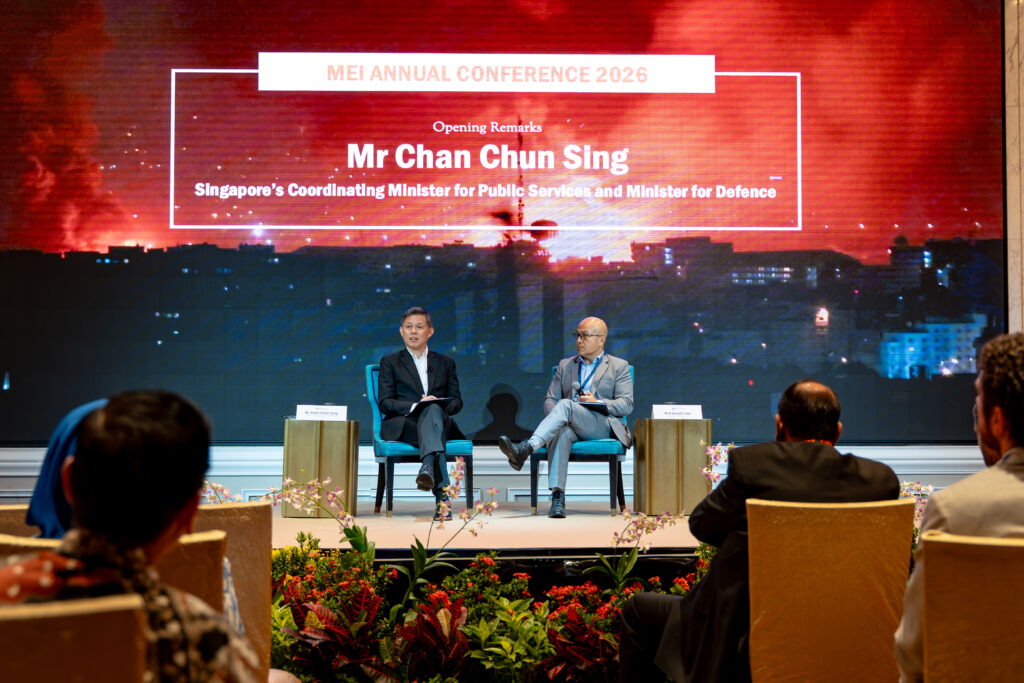
* The writer was a speaker at MEI’s Annual Conference this year – this article expands on his perspectives.
Syria’s new rulers have moved the country from near-total isolation to re-establishing regional relations and gaining international backing, but without a parallel course correction at home, these gains could quickly evaporate. Their zero-problems approach to foreign policy secured sanctions relief, and Gulf funding, and has helped manage difficult relations with Russia and Israel with some level of success. Yet, these external gains rest on fragile ground. Syria cannot succeed externally unless it succeeds internally, and the magnitude of the challenges it faces at home are enormous. While the end of the brutal Assad regime is a source of continued relief for many Syrians, many fear that the current leadership seeks to build a political system that will leave little space for them, and minority communities in particular feel threatened in a shaky security environment.
Damascus’ formula for dealing with domestic challenges, though still a work in progress, has relied too much on concentrating ever-greater power in a small number of hands, and on an internal security apparatus that has tended to aggravate the problems it is supposed to address — in several cases driving dangerous surges of violence. Incidents on the coast in March, and in the south in July, illustrate how, in a society deeply traumatised by 14 years of civil war, heavy-handed tactics breed instability. With some local communities still linked to foreign patrons, such breakdowns risk inviting renewed external meddling. Stalled integration talks with the Kurdish-led Syrian Democratic Forces (SDF), and the resilience of Isis in the north and east, add to the fragility of the transition. Successful resolution to these problems is within reach if Damascus extends the conciliatory approach that has succeeded so well in the foreign policy realm to the domestic front.
Diplomatic Reset Abroad
Since December, Damascus has achieved notable strides in securing external legitimacy among actors that are otherwise not always aligned, effectively ending its decades-long isolation. At the centre of these efforts is a “zero-problems” strategy focusing on de-escalation and pragmatic dealings that reaches out to former – and current – enemies, and seeks to avoid creating new ones. Within months of implementation, regional and international actors restored ties, Western powers began rolling back sanctions, and Gulf actors committed billions in investments for reconstruction. Following the easing of sanctions in January, Washington made a series of decisive and unexpected moves, waiving Caesar Act secondary sanctions for 180 days in May, revoking the comprehensive Syria sanctions programme in June, and, by July, even delisting Hei’at Tahrir al-Sham (HTS) – the former rebel group now heading the new government – as a Foreign Terrorist Organization, removing a major deterrent to foreign assistance. Damascus also reached out to accommodate difficult partners, such as Russia and Israel.
The new leadership clearly understood that accommodating Western capitals would be essential to achieve international legitimacy and unlock investment from its regional allies. To that end, it launched a diplomatic push in Washington and European capitals, offering assurances on priority issues such as countering Isis, dismantling chemical weapons infrastructure, banning Iran and its allies from using Syrian territory, and keeping foreign jihadist fighters under tight control. Meeting these conditions in the first half of 2025, alongside astute lobbying from Saudi Arabia and Turkey, paved the way for a rapid rollback of Western sanctions. In parallel, regional powers that had long supported the armed opposition to Bashar al-Assad, such as Turkey, Qatar, and Saudi Arabia, positioned themselves as primary partners in Syria’s economic recovery. Riyadh and Doha stepped in with emergency budget support and pledged open-ended reconstruction aid, while Damascus’ cracked down on the production and trade of Captagon, the Assad-era narcotics industry that had flooded Gulf markets, thereby showing it was serious about being a cooperative neighbour.
Damascus also made progress with difficult counterparts, such as Russia, previously one of the main backers and enablers of the Assad regime and its war crimes. Moscow’s veto power at the United Nations Security Council, Russian oil supplies, and the need for maintenance of Syria’s Kremlin-supplied military equipment all seem to have been part of this pragmatic calculation. As a result, Russian air and naval bases and forces remain in place, though now as guests under Syrian oversight, rather than the dominant powerbrokers they previously were. With Iran, which has far less to offer than Russia, relations cooled more sharply: The new authorities froze direct ties, restricted Iranian influence, and expelled allied militias, but they remain cautious to avoid open confrontation. Channels of communication reportedly remain open via Turkey and Qatar, reflecting Damascus’ aim of keeping Tehran at bay without turning it into an active enemy.
Even in the face of Israel’s destabilising posture, Damascus has maintained a de-escalatory course. In the aftermath of Assad’s fall, Israel moved quickly to degrade Syria’s remaining military assets, staged an incursion in the south, and warned against any redeployment of forces south of the capital — measures that seem to signal an intent to keep its neighbour weak. Since then, Israel has cultivated ties with factions in the Druze-majority Suweida province and carried out strikes on government buildings in Damascus, framing these moves as efforts to “defend the Druze”, in a nod to its own community. Despite this aggressive posture, which has encouraged secessionist tendencies among some local leaders, Damascus opted to avoid confrontation with Israel, and instead pursued US-mediated security talks, including publicly-announced direct meetings between Israeli and Syrian officials, a taboo for previous rulers.
Domestic Fault Lines
Where Syria’s foreign policy has prized de-escalation and pragmatic bargaining, its domestic counterpart has been on a rougher road. Contrary to the fears of many Syrians, the new authorities have so far refrained from imposing a maximalist Islamist agenda, and instead engaged in the rebuilding and rehabilitation of state institutions and a constitutional process. Yet many Syrians argue that the new order is far from inclusive. Instead, rebuilding political institutions has gone hand in hand with the progressive concentration of power in the hands of a narrow circle drawn from the former leadership of HTS, while other constituencies remain largely relegated to token, if any, roles. Many Syrians are increasingly expressing concern about a new authoritarian order in the making. In the security realm, efforts to manage surges of violence have gone awry, with government-aligned forces displaying problems with troop training, discipline, and command and control. This in turn has fed perceptions of a heavy-handed security sector, while aggravating local unrest and deepening sectarian divisions generated by the civil war, and the previous regime’s strategy of setting the different components of Syria’s multi-religious and multi-ethnic society against one another.
Initially, the new leadership said it intended to build a state that would act in the interest of all its citizens. It signalled that it would not seek indiscriminate reprisals against former regime personnel, and would pursue an integration deal with the Kurdish-led SDF, which controls around 25 per cent of Syria. But minority communities soon found themselves on the wrong end of exclusionary measures. This was most evident for the Alawite community, which Assad hailed from. Large-scale dismissals of public-sector employees — including some 500,000 from the former security apparatus, but also thousands of teachers and medical personnel —disproportionately affected them. While the authorities announced the reinstatement of most non-security public-sector employees as of 1 September, implementation has so far been inconsistent, and those from the security sector remain excluded. At the same time, the new security force deployed by Damascus often proved either unable or unwilling to shield minority communities from violent retribution meted out by rogue rebel fighters, or civilians who felt victimised by the former regime — and held the Alawite community in particular collectively responsible. Meanwhile, many of the armed factions that had been part of the victorious rebel coalition remain outside effective state control, even after formally becoming part of the new Syrian army in late January.
Subsequent crises exposed the severe cost that came with the interim government’s security approach. In March, a campaign to subdue pro-Assad insurgents in the coastal areas descended into a massacre, with government-aligned forces carrying out mass killings of Alawite civilians. In July, government intervention to quell local clashes between Druze factions and Bedouin tribal militias in southern Suweida province triggered a dramatic escalation. After delaying intervention, and allowing armed groups mobilised in support of the Bedouins to move through its checkpoints unimpeded, the government launched an operation to assert control over the semi-autonomous region. This was widely perceived by Druze locals as the government siding with the attacking Bedouin tribal militias. Reports of sectarian abuse against Druze civilians, involving some of the same government-aligned forces implicated in the coastal violence, convinced Druze leaders, including those who were initially seeking compromise with Damascus, that they faced an existential threat, prompting them to rally behind hardliners, and even seek Israeli protection.
Such episodes jeopardise the authorities’ wider project of consolidating authority and building national legitimacy, potentially roiling the ground even further. While relying on massive security responses that sometimes careen out of control may suppress unrest for a while, this can also backfire, breeding resentment, entrenching resistance, and making it even more difficult to heal the wounds of the civil war. Grievance empowers hard-line actors within affected communities, while Damascus’ limited willingness to offer meaningful accommodation to minority actors made vulnerable by the massive ongoing changes in Syria reinforces the perception that remaining armed is the only way to secure a stake in the new order. The consequences extend beyond the coast and the south: The July violence complicated the already slow-moving integration process with the SDF, entrenching its position, and reinforcing fears among the Kurdish leadership that Damascus will seek to impose control through force whenever the opportunity arises.
The potential for conflict with the SDF appears substantial. In the aftermath of the Suweida violence, skirmishes broke out along the 500 km-long line of contact, which runs mostly along the Euphrates River and divides their zones of control. The SDF’s long history of fighting Turkish-backed factions, which have now been absorbed into the Syrian army, has left many fighters and commanders on both sides with an urge for vengeance. Without credible progress on integration, the standoff between them seems liable to trigger recurrent confrontations that could spiral out of control.
Ankara, for its part, appears unlikely to reconcile itself with indefinite rule by the SDF, which it considers an affiliate of the PKK, over areas just beyond its border. Even President Ahmed al-Sharaa has hinted at the potential for violent confrontation, and evoked the scenario of a Turkish intervention. Thus, if the integration process was to hit a protracted delay, or fail altogether, this could open the door to renewed fighting, with both Damascus and Ankara having incentives to escalate. Meanwhile, developing Damascus-Washington relations and the Trump Administration’s intent to draw down and redeploy its forces could sideline US relations with the SDF. Washington appears less and less inclined to sympathise with the SDF’s misgivings regarding Damascus’ intentions, and more likely to press for quick integration. With most of Syria’s oil and gas, and much of its agricultural output, originating from SDF-held territory, and lucrative smuggling routes criss-crossing the area, there is also a significant resource dimension to the standoff that could fuel a drawn-out, low-level conflict.
Risks of Relapse into State Failure
While Damascus has made headway internationally, failing to address domestic issues risks squandering these gains. The external goodwill rests on fragile ground: If Syria descends into renewed insecurity, it will not become an attractive destination for needed investment. Western capitals which provided sanctions relief out of concern for stability and on the basis of early reassurances by the new leadership may eventually reconsider their backing for Syria’s new rulers if faced with repeated instances of sectarian violence and growing instability. Further domestic failures would not only risk renewed violence, but may also provide external actors such as Israel, Iran, Russia, and Turkey with openings to pursue their own agendas at the expense of Syria’s integrity and sovereignty. With Damascus’ limited military capacity, it would not be able to deter such advances. More broadly, unresolved domestic tensions could turn Syria back into the security threat and source of instability that regional and international actors had hoped to move beyond. External legitimacy may buy breathing space, but only internal legitimacy and stability can sustain it.
In a more fragmented environment, extremist groups stand to gain, and could emerge as spoilers of the new order. The relative security vacuum, particularly in the Syrian desert and peripheral areas, left by Assad’s fall — which Damascus has yet to fill in a sustainable fashion — has already allowed groups such as Isis and the Isis-aligned Saraya Ansar al-Sunna to reorganise. In December 2024, radical groups captured weapons and ammunition abandoned by retreating regime forces and allied militias, while the release of prisoners from Assad’s jails replenished Isis’ ranks. Since then, the group has intensified recruitment, including attempts to draw in jihadist elements from factions aligned with the new authorities, and has reportedly established sleeper cells in urban areas. Such dynamics create serious risks for the transition. Groups in the Isis mould thrive in polarised contexts, which they could take advantage of to stage attacks that erode public confidence in the new authorities. The June suicide bombing by Saraya Ansar al-Sunna in a Damascus church, which killed 30 worshippers, illustrates the capacity of radical Islamists to destabilise urban centres and inflame sectarian tensions.
A Way Forward
Assad’s fall has given Damascus a rare chance to reposition Syria after years of isolation, and to benefit from significant external support as influential outside actors — from regional states to Western capitals — have banked on the new leadership to establish stability. But without a corresponding internal strategy, this window could close quickly. To preserve recent gains, Damascus will need to pursue a strategy of de-escalation and inclusion and engage in structured dialogue with wary communities, rather than episodic outreach to cultivate loyalists. The government needs to prioritise protection, ensure that only disciplined forces are deployed to sensitive areas, and bring all armed factions under central control. While the last may be particularly difficult, it is crucial to establish a monopoly over armed force for the state-building project to succeed. Visible steps towards accountability for recent abuses, alongside incremental, but credible, progress on integration of the SDF, could help build trust at home while reinforcing the case for continued support abroad. For their part, external actors should use their engagement to nudge Damascus towards prioritising internal stability and encouraging steps that protect communities, improve security provision, and prioritise deconfliction measures that reduce the risk of local flare-ups spiralling into regional stand-offs.
About the Author
Dr Nanar Hawach is the Senior Analyst for Syria at the International Crisis Group, specialising in conflict and security dynamics, politics and governance. Based in Dubai, he conducts regular fieldwork in Syria, engaging with a wide range of stakeholders, including government and security officials, civil society, and non-state armed actors. His recent research centres on strategies to stabilise the country’s transition and addressing security challenges. He frequently informs and provides analysis on developments in Syria to diplomats, policymakers and international organisations. Dr Hawach holds a PhD in Political Science from Université Libre de Bruxelles. Prior to joining Crisis Group, he worked as a researcher at Uppsala University, and consultant for the UNDP and the World Bank.
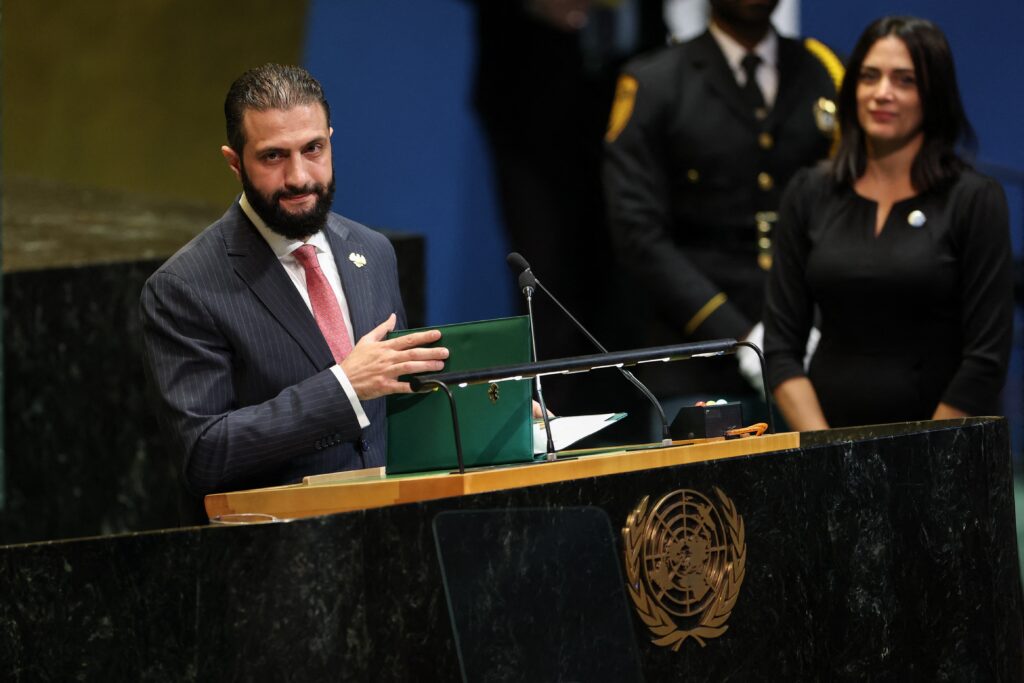
Image Caption: Syrian President Ahmed al-Sharaa concludes his remarks during the General Debate of the United Nations General Assembly at the UN headquarters in New York City on September 24, 2025. The new leaders of Syria have managed to end the country’s international isolation, but on the home front, their record is spottier. (Photo by ANGELA WEISS / AFP)