*The writer was a speaker at MEI’s Annual Conference this year – this article expands on his perspectives.
Introduction
Not all years in the Middle East are created equally. Despite the constant tumult and even more constant global attention, there are likely only a handful of years and events in the region’s modern history that can truly be called seismic, and which changed the geopolitical order: 2011 and the outbreak of the Arab Spring revolutions, 2003 and the United States’ invasion of Iraq, 1979 and both the Islamic Revolution and Israel-Egypt peace treaty, the 1967 Six-Day War, as well as 1948 and Israel’s creation in the crucible of that Arab-Israeli war.
To this historic list has to now be added 2023, and Hamas’s 7 October assault on southern Israel, dubbed by Yahya Sinwar and Mohammed Deif the “Al Aqsa Flood.” In the two years since that fateful morning, Israel, the entire Middle East, and (parts of) the world have been grappling with the consequences — après le deluge.
To say that the subsequent “post-7 October wars” — in Gaza, Lebanon, Syria, Iran, Yemen, and the West Bank — have re-ordered the Middle East’s balance of power would be an understatement. The examples are many.
Israeli ground forces currently hold territory and self-declared “buffer zones” inside Gaza, southern Lebanon, southwestern Syria, and the refugee camps of the northern West Bank. The Israeli air force has, just in recent weeks, struck Gaza City, Beirut, Damascus, Sanaa, and Tehran — and much else, on a near-daily basis and with near immunity.
Compare this to the eve of 7 October 2023, when the Iranian-led “axis of resistance” could rightfully boast of a mutual balance of deterrence vis-a-vis Israel.
The debate inside Israel the preceding summer was whether the military should take down Hezbollah tents set up across the Blue Line in Israeli-held territory. Hamas in Gaza was plied with Israeli work permits and Qatari cash payments in order to remain quiet and refrain from firing rockets. There were legitimate questions at the very top of the Israeli establishment over whether the country had the military ability — and political will — to strike Iran’s nuclear facilities.
Those questions now seem like a relic of a bygone era, especially after the 12-Day War between Israel and Iran this past June. The Iranian axis encircling Israel, built up over decades, has now been broken.
“It’s a new world,” one Israeli military official told me atop the Golan Heights this past spring, looking out at the expanse of territory seized by Israel after the fall of the Assad regime in Damascus late last year.
The questions for many now are: Why and how did this new world come into being, and how long can it last? The answers, I argue, need to be found in Israeli domestic politics and the country’s new military doctrine stemming from the trauma of 7 October. Therein also lie the future perils, for both Israel and the entire region.
Domestic Politics
The 7 October attack collapsed much of the Israeli public’s long-held beliefs: About the ability of the vaunted Israel Defense Forces (IDF) and intelligence services to keep them safe, about the intentions and capabilities of their enemies, and about Israel’s place in the wider Middle East.
The worst loss of Jewish life since the Holocaust is a trauma that, 22 months later, is still felt and re-lived — in public protests, in the media, in the remarks of senior politicians — on a daily basis. Adjusted for population size, it would have been akin to 30,000 Americans killed on 9/11, impacting most people in the country. When taking into account the savagery exhibited by Hamas fighters in the towns, villages, and music festivals of southern Israel, most Israelis agreed with the idea, put forward by a senior IDF official at the time, that this was a paradigm-altering “game-changer in society”.
And so it did. According to a snap poll taken in October 2023, over 92 per cent of Israeli Jews supported a ground offensive into Gaza to root out Hamas. 300,000 reservists immediately reported for duty, with all who were mobilised — and many who were not — reporting for duty: Some units had to turn away those who showed up as they were at full combat strength. The Israeli public was fully behind a punishing military response to the Hamas attack, just as a multi-front war erupted with Hezbollah in Lebanon and other smaller Iranian proxies, who began firing missiles and drones at the country.
The sense of unity and purpose, coupled with genuine existential fear in those early weeks of the war, led to the establishment of an expanded wartime government with the inclusion of a centrist party led by Benny Gantz. Yet, critically, Prime Minister Benjamin Netanyahu refused to remove his far-right allies, led by Bezalel Smotrich and Itamar Ben-Gvir, from his ruling coalition.
Mr Netanyahu’s political dependence on hardline ultranationalists had — and continues to have — an outsized influence on wartime strategy in Gaza, all for the worse.
Humanitarian aid to Gaza was heavily politicised, realistic post-war planning for the “Day After” was undermined due to the veto over any role for the Palestinian Authority, and the emphasis on the “voluntary emigration” of Palestinians from Gaza and the re-establishment of Jewish settlements called into question Israel’s ultimate aims. Worse, far-right ministers in Mr Netanyahu’s Cabinet have consistently threatened to topple the government if the premier deigned to end the war in return for the release of all Israeli hostages still in Hamas captivity.
“It’s a period of miracles,” a senior minister from Mr Smotrich’s party said last year, alluding to the possibility of not only resettling Gaza but continuing to expand settlements — and evict Palestinians — from the West Bank under cover of the larger war.
The singular promise of “total victory,” as Mr Netanyahu calls it, and the complete “destruction” of Hamas have prolonged the Gaza campaign far beyond what most Israeli security officials believe is both realistic and prudent.
As of this writing, there is a growing likelihood that Mr Netanyahu will choose to continue and escalate the war, no matter the growing cost to an exhausted IDF conscript and reserve force, Israel’s international standing, the local economy, and the fate of the remaining hostages and Palestinian civilians.
Absent a ceasefire deal that at least halts, if not ends, the Gaza campaign, the Israeli public could increasingly turn against the war via mass demonstrations, strike actions, and refusals to serve.
Unlike in the immediate aftermath of 7 October, a solid majority of Israelis — between 70 to 80 per cent, according to polls going back months — support a deal that returns all of the hostages in return for ending the conflict. There is also now a genuine domestic anti-war movement, still small, but increasingly visible, calling for a stop to the war on moral grounds due to the human suffering on the Palestinian side.
Ultimately, what could tip Mr Netanyahu’s hand is the threat by his other coalition partners — the ultra-Orthodox Jewish parties — to finally leave over the issue of forcibly conscripting religious seminary students into the military. Continuing the war as this entire demographic is still exempt from service, while reservists and soldiers have been fighting for nearly two years, could prove to be truly unsustainable politically.
If this comes to pass, the Premier may be forced into the one thing he has attempted to push off since 7 October at all costs: Elections, and a public reckoning for his role in the worst disaster to befall Israel in its nearly eight-decade history.
Military Doctrine
Israeli opposition leaders have been clear that they would have handled the Gaza campaign differently, certainly since spring 2024, and at least agreed to halt the war in return for the release of all the hostages. But even they would have endorsed the hyper-aggressive new Israeli military doctrine born out of the 7 October attack, and the broader “lessons learned” from how Hamas in Gaza had been (mis)handled for over a decade.
The official IDF inquiry, presented to journalists earlier this year, stated clearly that Israeli intelligence fundamentally misunderstood Hamas’ intentions, and was overconfident in its knowledge of the group and early warning abilities. The larger strategic misconception was, in the words of one senior military official, “you can’t let a terror army build at your door”.
“We thought for years that the ‘least bad’ solution was to let Hamas reign over Gaza. Now, we realise it was the worst solution,” he added.
The IDF, and with it the entire Israeli security and political establishment, has now course-corrected in the opposite direction. Instead of focusing on an enemy’s intentions and the logic of deterrence, Israel has shifted to a doctrine of aggressive pre-emption and prevention across the Middle East, which seeks to degrade actual capabilities and eliminate perceived threats.
No longer content with border walls and early warning systems, the IDF is seizing territory from its neighbours, building buffer zones, and regularly bombing targets regionwide.
It remains unclear how long Israel intends to hold these self-declared buffer zones inside Lebanon, Syria, and the West Bank refugee camps. Various diplomatic arrangements would, in theory, require the IDF to withdraw out of most of them — although this is not thought to be imminent, and could easily be delayed at least into next year. Gaza will likely be a different matter, no matter the future course of the war. At minimum, the Israeli government will demand to hold a significant buffer zone inside the Strip in perpetuity, to forestall the possibility of any mass cross-border incursion.
For both the Israeli public and military strategists, this “offensive defence,” as senior officials have called it, is an enticing approach when security is viewed as the paramount goal.
That Israel will no longer “let a terror army” sit on its borders is a given, no matter which political leadership is in power. And now that striking Iran has clearly been proven possible both militarily and politically — including “normalising” it in Israeli public opinion — the chances will only grow that, if required, Israel will strike again.
The bottom line is that what international and regional actors view as recklessness and impunity, Israelis view as sensible and legitimate, given the carnage of 7 October and the various fronts that erupted in its stead.
Yet the questions need to be asked: How sustainable is this approach, given that IDF ground forces are already overstretched? And is an exclusively military solution — as has been the case now for nearly two years — the best way to ensure Israel’s ultimate security?
Conclusion
Even Sinwar and Deif could not have possibly imagined all that they would have unleashed on the morning of 7 October, 2023.
The repercussions have been nothing short of cataclysmic for Gaza and its people, and will require decades to repair — if at all. Hezbollah is a shell of its former self, devoid of its longtime leader Hassan Nasrallah, much of its missile arsenal, and its southern Lebanese stronghold. In Syria, the new regime that toppled Assad will, at the very least, no longer allow its territory to be an Iranian playground. And in Tehran itself, the Islamic Republic has, for the first time since the 1980s, felt real existential dread after 12 days of Israeli and US strikes on its nuclear, missile, and air defense sites.
Israel’s geopolitical position in the Middle East has never been stronger, with some referring to it as the new “hegemon” and “bully” of the region. But all is not rosy — far from it. The ongoing war in Gaza has also unleashed a wave of global opprobrium and condemnation of Israel unlike any in its history, with the state’s very legitimacy called into question and its citizens, in some circles, turned into near pariahs.
The wars of the past two years have also shown Israel’s extreme dependence on the US — militarily and diplomatically — as its defender of last resort, far more than at any time since its founding. And the current Israeli government’s ideological fixation on territorial expansion in the Palestinian Territories also raises doubts about the prospects for further normalisation with the rest of the region, which had looked extremely close on the eve of Hamas’ attack.
Mr Netanyahu likes to say that Israel is “changing the face of the Middle East”. But 7 October also changed — indeed, is still changing — the face of Israel. And what it will end up looking like remains an open question.
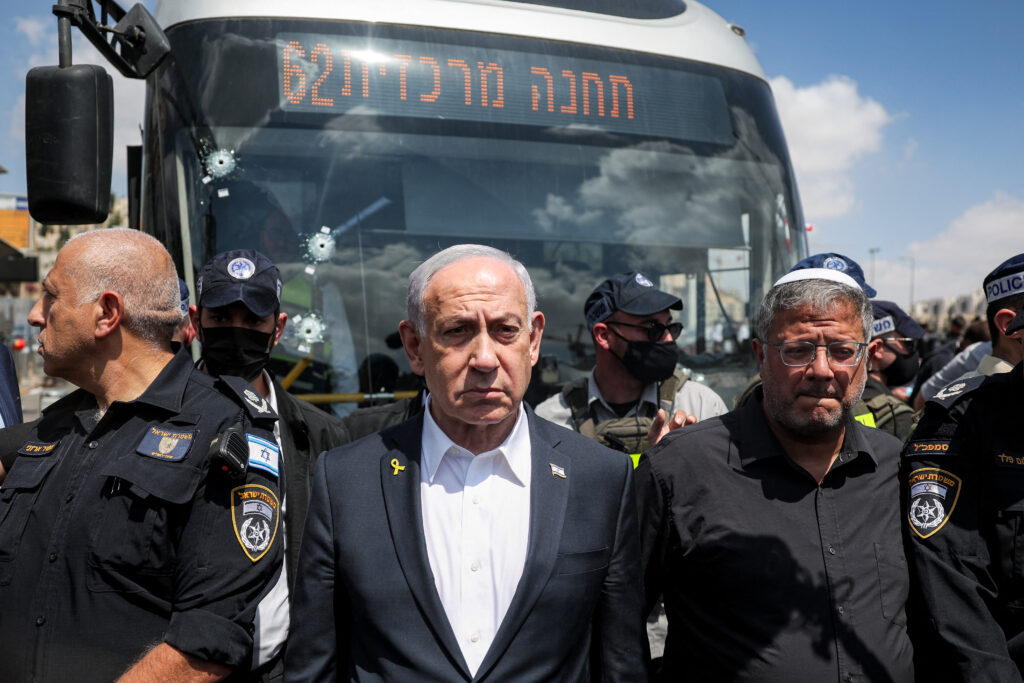
Image Caption: Israel’s Prime Minister Benjamin Netanyahu (C) and National Security Minister Itamar Ben-Gvir (R) visit the scene of a shooting at the Ramot road junction in Israeli-annexed east Jerusalem on 8 September 2025. Palestinian gunmen opened fire at a bus stop in Israeli-annexed east Jerusalem on 8 September, killing five people and wounding several others. Israeli emergency service Magen David Adom (MDA) said there were five victims dead in the shooting attack, updating an earlier toll of four. Police said the two gunmen were also killed. Photo: AFP
About the Author
Neri Zilber is a journalist and analyst covering Middle East politics. He is currently a correspondent for the Financial Times, and an adviser to the Israel Policy Forum, where he hosts the Israel Policy Pod.
His work has appeared in The New York Times, Washington Post, The Atlantic, Politico, Guardian, and Foreign Policy, among others. He was previously an adjunct fellow at the Washington Institute for Near East Policy, where he was the co-author of “State with No Army, Army with No State: Evolution of the Palestinian Authority Security Forces 1994-2018”.
He is the contributing author on Israel’s social protest demonstrations for “The Occupy Handbook”, a chronicle of the global “Occupy” movement, and, more recently, authored an essay about Tel Aviv for the “Jewish Priorities” anthology.
Mr Zilber holds a bachelor’s degree from the School of Foreign Service, Georgetown University, and a master’s degree from the Department of War Studies, King’s College London. He was raised and educated in Israel, Singapore, Spain, and the United States.